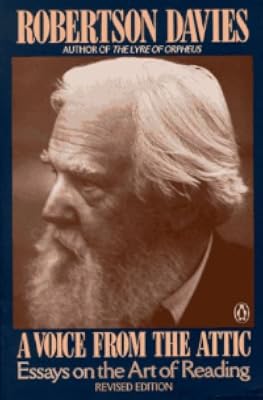
A Voice from the Attic: Essays on the Art of Reading
by Robertson Davies
On This Page
Description
A collection of essays "filled with pleasantly rambling opinions about everything from self-help books to erotica" from the celebrated Canadian author ( The Chronicle Journal ). An urbane, robust, and wonderfully opinionated voice from Canada, sometimes called "America's attic, " speaks here of the delights of reading, and of what mass education has done to readers today, to taste, to books, to culture. With his usual wit and breadth of vision, Robertson Davies ranges through the world of show more letters-books renowned and obscure, old and recent; English, Irish, Canadian, and American writers both forgotten and fondly remembered. "Sweet reason in the raiment of well-woven prose? Most assuredly. Good humor agraze over broad literary demesnes? No doubt of it. Forgotten popular favorites rescued and rehabilitated? Certainly. A parade of agreeable prejudices? He would not be a true Canadian if he did not have them. Lightheartedness where needed? Yes. Seriousness where it counts? Yes. Wit, satirical touches, firm indignations, sound sense, good taste, judiciousness, cosmopolitan breadth of view, urbanity, sanity, unexpected eccentricities, educated humanism? By all means. It is indeed by all these means and more that this book of essays and observations bestows its multiple benefactions, and anyone picking it up is bound north to pleasure and profit."- The New York Times show lessTags
Recommendations











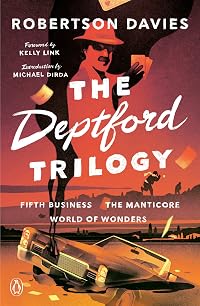





Member Recommendations

Member Reviews
Reading this book is to sit in a dusty, sunlit study with Robertson Davies while he reads books (many of them obscure or otherwise unexpected), smokes his pipe and occasionally gives a little chuckle. It's a literary treat - scholarly, very readable, and highly intelligent. Davies discusses literature of various types, encompassing a diversity of genres from self help books to Victorian theatre to pornography to 15th century joke books. But though this is a type of literary criticism, he is not setting out to be critical in the sense that your average literary critic might be. He never wants to be scathing (though he can achieve it sometimes) and is genuinely looking for the worth in everything he reads. The insights he brings out as a show more result are deeply thought out and fascinating.
On reading Davies one has the sense of being in the presence of a genuine scholar - someone very widely read, deeply thoughtful. Davies is a gentleman who uses his mind and his wit for something far more real than the sensation and ego so often found in so-called literary criticism these days. He also gives a sense, most unusual, of having nothing to prove. He has read a lot, thought a lot, and is sharing the fruits of it with the intelligent reader. And there’s the end of it. I found that particularly refreshing.
Davies reinvents an otherwise disused word, the clerisy. The clerisy are those who read for pleasure, but not for idleness; who read for pastime but not to kill time; who love books, but do not live by books. If you are of the clerisy, you will probably love A Voice from the Attic. show less
On reading Davies one has the sense of being in the presence of a genuine scholar - someone very widely read, deeply thoughtful. Davies is a gentleman who uses his mind and his wit for something far more real than the sensation and ego so often found in so-called literary criticism these days. He also gives a sense, most unusual, of having nothing to prove. He has read a lot, thought a lot, and is sharing the fruits of it with the intelligent reader. And there’s the end of it. I found that particularly refreshing.
Davies reinvents an otherwise disused word, the clerisy. The clerisy are those who read for pleasure, but not for idleness; who read for pastime but not to kill time; who love books, but do not live by books. If you are of the clerisy, you will probably love A Voice from the Attic. show less
A very amusing, and erudite, look at different aspects of literature high and low. Davies was a brilliant book expert and a discerning, kind critic.
The author discusses everything from earnest middlebrow novels to pornography. While Davies is very serious in his desire to get people reading, his touch is so light that the book is a lot of fun to read.
Designed in discrete sections, the book can be read from time to time or pored over from page one till the end.
Highly recommended for any book lover.
The author discusses everything from earnest middlebrow novels to pornography. While Davies is very serious in his desire to get people reading, his touch is so light that the book is a lot of fun to read.
Designed in discrete sections, the book can be read from time to time or pored over from page one till the end.
Highly recommended for any book lover.
I love it when in the first chapter of this book, Robertson Davies starts by reviewing self-help books. Before the first chapter, he had not given a complete hint about what type of literature he would be discussing. Just because of what I knew about him, I had assumed he would go straight to Dickens, or Jane Austen, or James Joyce, or some exalted string of authors. But no, he goes straight to self-help books. I guess I might have missed the clue that he was going to go to what sells the most in book stores. I think he had given some statistics. I imagine statistics that would have made him choose the way he did to be something like:
Percentage of books sold in bookstores that are really good classics like Dickens, Austen, Joyce and show more others: 4%.
Cookbooks: 30%.
Self-help books: 20%.
Trashy beach novels: 15% and ... you get the idea.
But the good thing is that he never eliminates any book from consideration without actually reading it and analyzing and finding out if there is something good or notable in it. Good job, Robertson.
I started reading his novels in about 1980 and worked backwards to beginning of his oeuvre. Next I began reading each new one that was released until his death a few years later. I have missed him.
This guy is really really smart. Please read this book if you get a chance. show less
Percentage of books sold in bookstores that are really good classics like Dickens, Austen, Joyce and show more others: 4%.
Cookbooks: 30%.
Self-help books: 20%.
Trashy beach novels: 15% and ... you get the idea.
But the good thing is that he never eliminates any book from consideration without actually reading it and analyzing and finding out if there is something good or notable in it. Good job, Robertson.
I started reading his novels in about 1980 and worked backwards to beginning of his oeuvre. Next I began reading each new one that was released until his death a few years later. I have missed him.
This guy is really really smart. Please read this book if you get a chance. show less
I've been reading RD for almost 40 yrs. now. Reading his essays has added greatly to my fund of knowlege. He introduced me to among others: JC Powys, Mervyn Peake, Gwyn Thomas, Cothburn O'neal, I simply cannot put a value on this. One of my treasured possessions is a letter from Davies. I owe him a debt, alas, i can never pay.
Ratings
Members
- Recently Added By
Published Reviews
ThingScore 75
" ... this book of essays and observations bestows its multiple benefactions, and anyone picking it up is bound north to pleasure and profit."
added by GYKM
Lists

New Canadian Library
191 works; 7 members
Author Information

89+ Works 24,731 Members
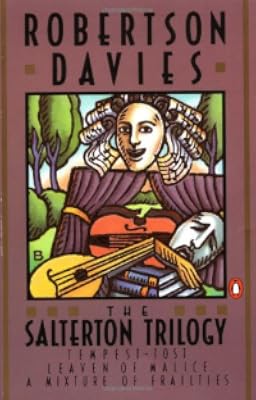
William Robertson Davies was born in Thamesville, Ontario in 1913. He taught English at the University of Toronto and was an actor, journalist, and newspaper editor before winning acclaim as a novelist with Tempest-Tost, the first of his Salterton trilogy. His most famous trilogy, The Deptford Trilogy--Fifth Business, The Manticore, and World of show more Wonders--develops the earlier Salterton novels. The locale is a fictitious Ontario city that prizes its English tradition, including the Anglican Church and the genealogy of the old families. Robertson's novels have been translated into approximately 20 languages. His masterful story-telling encompasses such issues as evil, love, fear, tradition, and magic as he brings his characters to life with wisdom and humor. Robertson Davies died in 1995. (Bowker Author Biography) Robertson Davies (1913-1995) had three successive careers during the time he became an internationally acclaimed author: first as an actor with the Old Vic Company in England; then as publisher of "The Peterborough Ontario Examiner"; & finally as professor & first master of Massey College at the University of Toronto. With twelve novels & several volumes of essays & plays to his credit, Davies was the first Canadian to be inducted to the American Academy & Institute of Arts & Letters. His last novel, "The Cunning Man" (Viking 1995), was a national bestseller. (Publisher Provided) show less
Series
Belongs to Publisher Series
New Canadian Library (83)
Common Knowledge
- Original title
- A Voice From the Attic
- Alternate titles
- The Personal Art
- Original publication date
- 1960
- First words
- This book was first published in 1960 and reprinted in 1971.
- Quotations
- The gifts demanded of a good reader are less those of the critic than of the actor. You must bestir yourself, and above all you must cultivate the inward ear.
It is a widespread belief that a truly critical mind exists in a constant state of high-toned irascibility.
The anti-intellectual pose is one of the unforeseen results of our great experiment in complete literacy.
For the present, that is sufficient about the “good laugh” [puns]. Only a curmudgeon is utterly indifferent to it; only those to whom laughter is the most serious thing in the world attach great value to it (as in the cas... (show all)e of the film called The Perfect Furlough, which advertised “287 certified laughs”). But has it anything to do with a sense of humor? It is possible to “get” all the jokes in a television program, or even to laugh the two hundred and eighty-seven laughs of the funny film, without ever initiating a joke or experiencing laughter which has not been provoked by something external to oneself. A sense of humor, surely, is something which permits its possessor to perceive jokes which are wholly or partly personal; a man who has this much admired sense ought occasionally to laugh—perhaps inwardly—when others are not laughing. ‘What is he otherwise but the creature of the jokesmith?
Classifications
- Genres
- Nonfiction, Literature Studies and Criticism, General Nonfiction
- DDC/MDS
- 028.1 — Computer science, information & general works Library & information sciences Reading and use of other information media Reviews of Books
- LCC
- PR9199.3 .D3 .V6 — Language and Literature English English Literature English literature: Provincial, local, etc.
- BISAC
Statistics
- Members
- 278
- Popularity
- 116,051
- Reviews
- 4
- Rating
- (3.79)
- Languages
- English
- Media
- Paper, Ebook
- ISBNs
- 6
- ASINs
- 10