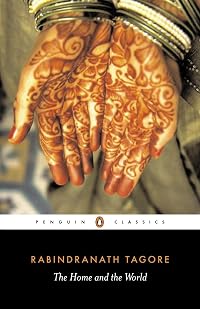
The Home and the World
by Rabindranath Tagore, Helene Meyer-Franck (Translator)
On This Page
Description
Set on a Bengali noble's estate in 1908, this is both a love story and a novel of political awakening. The central character, Bimala, is torn between the duties owed to her husband, Nikhil, and the demands made on her by the radical leader, Sandip. Her attempts to resolve the irreconciliable pressures of the home and world reflect the conflict in India itself, and the tragic outcome foreshadows the unrest that accompanied Partition in 1947.Tags
Recommendations

























Member Recommendations
CGlanovsky Both deal with the position of women in relation to the wider world.

Member Reviews
The Home and the World is a classic Indian novel that focuses on a trio of characters living in the time of the Indian independence movement. Rotating between each of their perspectives, the novel does an excellent job of portraying each of their unique viewpoints, and, particularly when it comes to Nikhil and Sandip, playing them off each other in a way that allows the reader to ponder on their own beliefs. By the end of the book, I had a deep understanding of each character's ethical standpoint and how they disagreed on what should be done for the sake of the country despite all being in favor of independence.
I especially appreciated that Bimala was given so much focus. This in itself tells the reader that women are full people whose show more viewpoints matter. I also liked the development of Bimala's sister-in-law throughout the course of the story. In fact, she was my favorite character. But I also found myself questioning certain aspects of Bimala's characterization as I read. Most disturbing to me personally is her persistent belief that a "woman's heart... must worship in order to love". Is she attributing to all women something that applies only to herself? Is this a form of internalized sexism that real women experience or have experienced in the past? Or is it the result of a male author justifying the treatment of women in his society by claiming it aligns with their nature?
Unfortunately, I'm far from an expert when it comes to this cultural context, so I spent much of the book considering rather than concluding. I'm sure Indian readers have a far different reading experience, including appreciating aspects that went right over my head. As a US reader of the translation, I can only advise doing research on the Swadeshi movement and Indian history in general (if you were never taught much on the subject) before reading and say that, as I read, I found myself comparing the philosophies of these characters with others I'm familiar with and thinking about independence movements in general. I do believe books like this can provide readers with a deeper insight into humanity as well as specific insights into the history and culture of a particular country. I think it's a shame that my library system doesn't have a copy of this book, as I think it's an indication that not many people here are reading it.
Beyond that, I would be remiss to neglect the beauty of the writing itself. Although I read the English translation and therefore can't speak to the original, I can say that I highlighted more passages in this book than in any other I've read this year. The thoughts being communicated are striking in themselves. Each character expresses themselves so passionately and with such insight that I was truly impressed. This book undeniably deserves to be a classic, and I would have loved studying it in a university-level literature course. It's not difficult to understand without one, but I can feel how much depth there is to be explored and imagine how rewarding it would be.
Overall, I'm very glad I chose to read this book, and I hope this review will convince other readers to try it as well. If you love classics, you won't be disappointed. show less
I especially appreciated that Bimala was given so much focus. This in itself tells the reader that women are full people whose show more viewpoints matter. I also liked the development of Bimala's sister-in-law throughout the course of the story. In fact, she was my favorite character. But I also found myself questioning certain aspects of Bimala's characterization as I read. Most disturbing to me personally is her persistent belief that a "woman's heart... must worship in order to love". Is she attributing to all women something that applies only to herself? Is this a form of internalized sexism that real women experience or have experienced in the past? Or is it the result of a male author justifying the treatment of women in his society by claiming it aligns with their nature?
Unfortunately, I'm far from an expert when it comes to this cultural context, so I spent much of the book considering rather than concluding. I'm sure Indian readers have a far different reading experience, including appreciating aspects that went right over my head. As a US reader of the translation, I can only advise doing research on the Swadeshi movement and Indian history in general (if you were never taught much on the subject) before reading and say that, as I read, I found myself comparing the philosophies of these characters with others I'm familiar with and thinking about independence movements in general. I do believe books like this can provide readers with a deeper insight into humanity as well as specific insights into the history and culture of a particular country. I think it's a shame that my library system doesn't have a copy of this book, as I think it's an indication that not many people here are reading it.
Beyond that, I would be remiss to neglect the beauty of the writing itself. Although I read the English translation and therefore can't speak to the original, I can say that I highlighted more passages in this book than in any other I've read this year. The thoughts being communicated are striking in themselves. Each character expresses themselves so passionately and with such insight that I was truly impressed. This book undeniably deserves to be a classic, and I would have loved studying it in a university-level literature course. It's not difficult to understand without one, but I can feel how much depth there is to be explored and imagine how rewarding it would be.
Overall, I'm very glad I chose to read this book, and I hope this review will convince other readers to try it as well. If you love classics, you won't be disappointed. show less
"This is exactly how such curious anomalies happen nowadays in our country. We must have our religion and also our nationalism... The result is that both of them suffer." So muses Sandip, one of the three main characters in this passionate revolutionary and personal drama of a novel.
The story is told on behalf of Nikhil, his wife of 9 years Bimala, and Sandip, a revolutionary staying at their mansion. The chapters on behalf of the three of them, telling the story from their own point of view, interchange throughout the book. The year is 1916, Bengal, India, during the developing Swadeshi (nationalist ) movement.
There is a sharp controversy between "used-to-be" friends, Nikhil and Sandip, as to which direction the country should go and show more by which means. Nikhil is a philosophical type and has strong moral values, while Sandip is a reckless revolutionary, with the "the-end-justifies-the-means" ideas. Bimala starts as an epitome of a devotional Hindu wife (constantly and sincerely "taking dust off her husband's feet", idolizing him..), but then evolving into a follower of Sandip who manipulates her in different ways, which she, thankfully, realizes by the end of the story.
In my understanding, Tagore was still struggling with searching for a solution to India's problems of that era. The novel is full of metaphoric speeches and pathos, while also poignantly describing the inner struggle of the main characters. It evokes turmoil and disquiet, not any distinct and rational answers. show less
The story is told on behalf of Nikhil, his wife of 9 years Bimala, and Sandip, a revolutionary staying at their mansion. The chapters on behalf of the three of them, telling the story from their own point of view, interchange throughout the book. The year is 1916, Bengal, India, during the developing Swadeshi (nationalist ) movement.
There is a sharp controversy between "used-to-be" friends, Nikhil and Sandip, as to which direction the country should go and show more by which means. Nikhil is a philosophical type and has strong moral values, while Sandip is a reckless revolutionary, with the "the-end-justifies-the-means" ideas. Bimala starts as an epitome of a devotional Hindu wife (constantly and sincerely "taking dust off her husband's feet", idolizing him..), but then evolving into a follower of Sandip who manipulates her in different ways, which she, thankfully, realizes by the end of the story.
In my understanding, Tagore was still struggling with searching for a solution to India's problems of that era. The novel is full of metaphoric speeches and pathos, while also poignantly describing the inner struggle of the main characters. It evokes turmoil and disquiet, not any distinct and rational answers. show less
 This review was written for LibraryThing Early Reviewers.
When Bimila is encouraged by her husband Nikhil to exercise more freedom than is usual for a woman of her status in Bengal in the first decade of the 20th century, she comes under the influence of Nikhil's friend Sandip, a charismatic radical nationalist.
Although I found it a bit heavy-going at times, especially in the more rhetorical passages, I kept reading, fascinated to see how events would play out.
Although I found it a bit heavy-going at times, especially in the more rhetorical passages, I kept reading, fascinated to see how events would play out.
Tagore’s story is set in Bengal at the early part of the 20th century when the Swadeshi (self-sufficiency) movement was taking root, which had as its aim that people would use only domestic goods. At the center of the novel is Bimala, a young woman who is happily married to an intelligent and enlightened landowner named Nikhil. When she’s exposed to a rousing revolutionary speech by Sandip, she’s not only drawn to the passion of his cause, but to Sandip himself, thus setting up a love triangle.
In cases of a people being oppressed, there is often a variety of viewpoints as to how to react, ranging from the gradual progressives to those who would use “any means necessary”. Tagore places the two men at opposite ends of this show more spectrum, and while both ironically want the same thing, an independent, strong India, Nikhil wants to follow the law and exercise restraint, believing that something far greater is lost if one steals or is unjust, while Sandip is not above lying, violence, and other treachery, believing himself to be serving a higher cause, and believing that all other strong nations have had leaders who have done similar in the past.
As to Swadeshi itself, Nikhil believes that the root cause to India’s dependence on foreign goods is its own demand, its own desire, which cannot forcibly changed, and any attempts to do so will not only be futile, but disproportionately harm the poor. Sandip believes that the root cause is essentially the supply itself, and that it must be suppressed with an iron hand.
The book’s main level is thus political, where Nikhil stands for conservatism, cool intellect, idealism, kindness, and holding steadfastly to one’s core principles. Sandip represents radical revolution, passion, the compromises one must make in the “real world”, including being cruel if necessary, and the ends justifying the means, because “this is war”, as he puts it. Bimala, who is torn between them, saying at one point that “this moment in our history seems to have dropped into our hand like a jewel from the crown of some drunken god”, represents Bengal itself.
While it’s easy to idealize Nikhil and demonize Sandip, and it’s clear that this is where Tagore’s sympathies lie, both men recognize their own weaknesses. Nikhil sees himself as a passionless, uninspiring lump of coal, and Sandip’s guilt gnaws away at him despite the vitriol of his words. Tagore also lets both men “present their argument” by assuming the point of view of each, as well as Bimala, in interleaving chapters throughout the book. To me, the characters are part of Tagore’s inner dialogue and conflict within himself, and I’m impressed by how in his work and in his life he tried to recognize all of these “voices”, and find a middle path. Nevertheless, he was criticized for being conservative in his viewpoint, and for flaws in the style of his prose on top of it.
I disagree with the former, but there is at least a little valid criticism with the latter: Tagore is essentially using the book as a vehicle for a debate, which can make it seem too plodding. On the other hand, as Anita Desai says in her excellent introduction, while it’s a “dramatic tale, yet not so particularly dramatic in the telling”, he writes as a Victorian, so this is a product of the time, and there are many touching, very human moments throughout the book.
And this is where the book works on the next level down: “at home”, the love triangle between the characters. Nikhil does not demand that Sandip leave his home, even though he knows something is going on, because he wants Bimala to choose freely. Nikhil is thus very forward thinking, adoring his wife but wanting her to be free … though if someone is so dispassionate it can come across as disinterest. Sandip here is raw emotion, and deludes Bimala along the way in his desire to just take her, and passionately. That has its appeal too, and she is torn.
Add in the minor characters, the chiding sister-in-law who has a long and close relationship with Nikhil (mirroring Tagore’s own beloved sister-in-law, who sadly committed suicide), as well as the young man who Sandip wants to use as a pawn and Bimala wants to keep pure, whatever her sins may be, and I found this to be a very appealing story. There was real tension in the tragedy that was unfolding for Bimala and for India after things been set in motion, and I think rather than being on the wrong side of history, Tagore correctly got his head around the issues with both perspectives, and foresaw the violence that was to come to India later in the century.
Quotes:
On desire, this is Sandip:
“When a man goes away from the market of real things with empty hands and empty stomach, merely filling his bag with big sounding words, I wonder why he ever came into this hard world at all. … What I desire, I desire positively, superlatively. I want to knead it with both my hands and both my feet; I want to smear it all over my body; I want to gorge myself with it to the full.”
And:
“Come, Sin, O beautiful Sin,
Let thy stinging red kisses pour down fiery red wine into our blood.
Sound the trumpet of imperious evil
And cross our forehead with the wreath of exulting lawlessness,
O Deity of Desecration,
Smear our breasts with the blackest mud of disrepute, unashamed.”
On being desired, Bimala:
“Sandip’s hungry eyes burnt like the lamps of worship before my shrine. All his gaze proclaimed that I was a wonder in beauty and power; and the loudness of his praise, spoken and unspoken, drowned all other voices in my world. Had the Creator created me afresh, I wondered? Did he wish to make up now for neglecting me so long? I who before was plain had become suddenly beautiful.”
“Nevertheless this flesh-and-blood lute of mine, fashioned with my feeling and fancy, found in him a master-player. What though I shrank from his touch, and even came to loathe the lute itself; its music was conjured up all the same.”
“The way of retreat is absolutely closed for both of us. We shall despoil each other: get to hate each other; but never more be free.”
“I can no longer enter my bedroom. The bedstead seems to thrust out a forbidding hand, the iron safe frowns at me. I want to get away from this continual insult to myself which is rankling within me. I want to keep running to Sandipto hear him sing my praises. There is just this one little altar of worship which has kept its head above the all-pervading depths of my dishonor, and so I want to cleave to it night and day; for on whichever side I step away from it, there is only emptiness.
Praise, praise, I want unceasing praise. I cannot live if my wine-cup be left empty for a single moment. So, as the very price of my life, I want Sandip of all the world, today.”
On love, Bimala:
“His love for me seemed to overflow my limits by its flood of wealth and service. But my necessity was more for giving than for receiving; for love is a vagabond, who can make his flowers bloom in the wayside dust, better than in the crystal jars kept in the drawing-room.”
And:
“My beloved, it was worthy of you that you never expected worship from me. But if you had accepted it, you would have done me a real service. You showed your love by decorating me, by educating me, by giving me what I asked for, and what I did not. I have seen what depth of love there was in your eyes when you gazed at me. I have known the secret sigh of pain you suppressed in your love for me. You loved my body as if it were a flower of paradise. You loved my whole nature as if it had been given you by some rare providence.”
On nationalism, Nikhil:
“’I am willing,’ he said, ‘to serve my country; but my worship I reserve for Right which is far greater than my country. To worship my country as a god is to bring a curse upon it.’”
And:
“…those who cannot love men just because they are men – who needs must shout and deify their country in order to keep up their excitement – these love excitement more than their country. … So long as we are impervious to truth and have to be moved by some hypnotic stimulus, we must know that we lack the capacity for self-government. Whatever may be our condition, we shall either need some imaginary ghost or some actual medicine-man to terrorize over us.”
On the old, Sandip:
“Chandranath Babu began to talk about Swadeshi. I thought I would let him go one with his monologues. There is nothing like letting an old man talk himself out. It makes him feel that he is winding up the world, forgetting all the while how far away the real world is from his wagging tongue.” show less
In cases of a people being oppressed, there is often a variety of viewpoints as to how to react, ranging from the gradual progressives to those who would use “any means necessary”. Tagore places the two men at opposite ends of this show more spectrum, and while both ironically want the same thing, an independent, strong India, Nikhil wants to follow the law and exercise restraint, believing that something far greater is lost if one steals or is unjust, while Sandip is not above lying, violence, and other treachery, believing himself to be serving a higher cause, and believing that all other strong nations have had leaders who have done similar in the past.
As to Swadeshi itself, Nikhil believes that the root cause to India’s dependence on foreign goods is its own demand, its own desire, which cannot forcibly changed, and any attempts to do so will not only be futile, but disproportionately harm the poor. Sandip believes that the root cause is essentially the supply itself, and that it must be suppressed with an iron hand.
The book’s main level is thus political, where Nikhil stands for conservatism, cool intellect, idealism, kindness, and holding steadfastly to one’s core principles. Sandip represents radical revolution, passion, the compromises one must make in the “real world”, including being cruel if necessary, and the ends justifying the means, because “this is war”, as he puts it. Bimala, who is torn between them, saying at one point that “this moment in our history seems to have dropped into our hand like a jewel from the crown of some drunken god”, represents Bengal itself.
While it’s easy to idealize Nikhil and demonize Sandip, and it’s clear that this is where Tagore’s sympathies lie, both men recognize their own weaknesses. Nikhil sees himself as a passionless, uninspiring lump of coal, and Sandip’s guilt gnaws away at him despite the vitriol of his words. Tagore also lets both men “present their argument” by assuming the point of view of each, as well as Bimala, in interleaving chapters throughout the book. To me, the characters are part of Tagore’s inner dialogue and conflict within himself, and I’m impressed by how in his work and in his life he tried to recognize all of these “voices”, and find a middle path. Nevertheless, he was criticized for being conservative in his viewpoint, and for flaws in the style of his prose on top of it.
I disagree with the former, but there is at least a little valid criticism with the latter: Tagore is essentially using the book as a vehicle for a debate, which can make it seem too plodding. On the other hand, as Anita Desai says in her excellent introduction, while it’s a “dramatic tale, yet not so particularly dramatic in the telling”, he writes as a Victorian, so this is a product of the time, and there are many touching, very human moments throughout the book.
And this is where the book works on the next level down: “at home”, the love triangle between the characters. Nikhil does not demand that Sandip leave his home, even though he knows something is going on, because he wants Bimala to choose freely. Nikhil is thus very forward thinking, adoring his wife but wanting her to be free … though if someone is so dispassionate it can come across as disinterest. Sandip here is raw emotion, and deludes Bimala along the way in his desire to just take her, and passionately. That has its appeal too, and she is torn.
Add in the minor characters, the chiding sister-in-law who has a long and close relationship with Nikhil (mirroring Tagore’s own beloved sister-in-law, who sadly committed suicide), as well as the young man who Sandip wants to use as a pawn and Bimala wants to keep pure, whatever her sins may be, and I found this to be a very appealing story. There was real tension in the tragedy that was unfolding for Bimala and for India after things been set in motion, and I think rather than being on the wrong side of history, Tagore correctly got his head around the issues with both perspectives, and foresaw the violence that was to come to India later in the century.
Quotes:
On desire, this is Sandip:
“When a man goes away from the market of real things with empty hands and empty stomach, merely filling his bag with big sounding words, I wonder why he ever came into this hard world at all. … What I desire, I desire positively, superlatively. I want to knead it with both my hands and both my feet; I want to smear it all over my body; I want to gorge myself with it to the full.”
And:
“Come, Sin, O beautiful Sin,
Let thy stinging red kisses pour down fiery red wine into our blood.
Sound the trumpet of imperious evil
And cross our forehead with the wreath of exulting lawlessness,
O Deity of Desecration,
Smear our breasts with the blackest mud of disrepute, unashamed.”
On being desired, Bimala:
“Sandip’s hungry eyes burnt like the lamps of worship before my shrine. All his gaze proclaimed that I was a wonder in beauty and power; and the loudness of his praise, spoken and unspoken, drowned all other voices in my world. Had the Creator created me afresh, I wondered? Did he wish to make up now for neglecting me so long? I who before was plain had become suddenly beautiful.”
“Nevertheless this flesh-and-blood lute of mine, fashioned with my feeling and fancy, found in him a master-player. What though I shrank from his touch, and even came to loathe the lute itself; its music was conjured up all the same.”
“The way of retreat is absolutely closed for both of us. We shall despoil each other: get to hate each other; but never more be free.”
“I can no longer enter my bedroom. The bedstead seems to thrust out a forbidding hand, the iron safe frowns at me. I want to get away from this continual insult to myself which is rankling within me. I want to keep running to Sandipto hear him sing my praises. There is just this one little altar of worship which has kept its head above the all-pervading depths of my dishonor, and so I want to cleave to it night and day; for on whichever side I step away from it, there is only emptiness.
Praise, praise, I want unceasing praise. I cannot live if my wine-cup be left empty for a single moment. So, as the very price of my life, I want Sandip of all the world, today.”
On love, Bimala:
“His love for me seemed to overflow my limits by its flood of wealth and service. But my necessity was more for giving than for receiving; for love is a vagabond, who can make his flowers bloom in the wayside dust, better than in the crystal jars kept in the drawing-room.”
And:
“My beloved, it was worthy of you that you never expected worship from me. But if you had accepted it, you would have done me a real service. You showed your love by decorating me, by educating me, by giving me what I asked for, and what I did not. I have seen what depth of love there was in your eyes when you gazed at me. I have known the secret sigh of pain you suppressed in your love for me. You loved my body as if it were a flower of paradise. You loved my whole nature as if it had been given you by some rare providence.”
On nationalism, Nikhil:
“’I am willing,’ he said, ‘to serve my country; but my worship I reserve for Right which is far greater than my country. To worship my country as a god is to bring a curse upon it.’”
And:
“…those who cannot love men just because they are men – who needs must shout and deify their country in order to keep up their excitement – these love excitement more than their country. … So long as we are impervious to truth and have to be moved by some hypnotic stimulus, we must know that we lack the capacity for self-government. Whatever may be our condition, we shall either need some imaginary ghost or some actual medicine-man to terrorize over us.”
On the old, Sandip:
“Chandranath Babu began to talk about Swadeshi. I thought I would let him go one with his monologues. There is nothing like letting an old man talk himself out. It makes him feel that he is winding up the world, forgetting all the while how far away the real world is from his wagging tongue.” show less
I enjoyed the ideas expressed in this book by Tagore. They are well ahead of their time. Refuting narrow minded nationalist agenda in favour of inclusive considerations of well-being of everyone must have appeared like extreme thinking at the start of the First World War. The West had got it wrong, here in India we have a chance of not making the same mistake. Did Gandhi hear that message? Was one great thinker able to influence another? How much of the peaceful resistance policy came out of Tagore’s ideas? I will need to read more about them and their discussions and arguments.
Despite the excellent ideas the novel fails to deliver as a work of literature. Characters as allegories do not take an author far. A certain level of human show more authenticity is absolutely essential in a novel. Unfortunately Sandip and Bimala appear as caricatures of human beings. One can almost see the changes necessary for the book to be able to matter more, to reach deeper. I wonder if Satyajit Ray was able to fix it? I am almost tempted to get hold of the movie right away! show less
Despite the excellent ideas the novel fails to deliver as a work of literature. Characters as allegories do not take an author far. A certain level of human show more authenticity is absolutely essential in a novel. Unfortunately Sandip and Bimala appear as caricatures of human beings. One can almost see the changes necessary for the book to be able to matter more, to reach deeper. I wonder if Satyajit Ray was able to fix it? I am almost tempted to get hold of the movie right away! show less
In early twentieth century India, a man and wife are more fully revealed to one another when they find themselves on opposite sides of a political divide. Where the husband Nikhil is intransigent towards the first burgeoning of India's independence movement, Bimala is swept up by the fine speeches of its lead proponent and aligns herself with the cause. It is not until words must translate into actions that her choice is truly put to the test. There is an excellent Wikipedia entry for this novel that is worth reading afterwards, uncovering its many themes and providing more historical context.
The novel's first half is thin on action, long on politically-laced dialogue and overloaded with metaphor. I like that sort of thing, so for me show more this was still was a great read when another reader might understandably find it dry. Tagore clearly had a lock on diametrically opposed perspectives, demonstrating a deep understanding of their relative positions and self-justifications. Marital strife isn't front and centre, but adds a secondary layer as events unfold.
Mint Editions has included simple explanations for a number of terms I would have otherwise required some help with, and not just definitions but also explanations as well for cultural practices which the author assumes his readers are familiar with. This made the reading much easier and more enjoyable for me. Some are marked as translator notes, and the credits identify the author's nephew Surendranath Tagore as translator to English from the original Bengali. show less
The novel's first half is thin on action, long on politically-laced dialogue and overloaded with metaphor. I like that sort of thing, so for me show more this was still was a great read when another reader might understandably find it dry. Tagore clearly had a lock on diametrically opposed perspectives, demonstrating a deep understanding of their relative positions and self-justifications. Marital strife isn't front and centre, but adds a secondary layer as events unfold.
Mint Editions has included simple explanations for a number of terms I would have otherwise required some help with, and not just definitions but also explanations as well for cultural practices which the author assumes his readers are familiar with. This made the reading much easier and more enjoyable for me. Some are marked as translator notes, and the credits identify the author's nephew Surendranath Tagore as translator to English from the original Bengali. show less
This review was written for LibraryThing Early Reviewers.My exposure to Tagore was previously limited to Satyajit Ray's films of this book and other Tagore works as well as his documentary on the author. Initially I was reminded of early Turgenev or other mid 19th century Russian novels where the characters work out their relationships through a filter of their prescriptions for their homeland's resurrection. It moves to an environment of very effective high sexual tension that I thought owed something to D.H. Lawrence. Later in the book what is described as an explicit Western novel figures in the plot and I thought it must be a Lawrence work. The two male protagonists indulge in a Nietzschean will to power struggle that resolves itself in an ending that one could describe as involving show more aspects from a thriller. The translation by Tagore's brother into a somewhat old fashioned English prose which is nevertheless natural and effective. Overall, a good introduction to an important author. show less
This review was written for LibraryThing Early Reviewers.Members
- Recently Added By
Lists

The Guardian's 1000 Novels Everyone Must Read
1,005 works; 550 members

Best of World Literature
432 works; 51 members

All Things India
95 works; 21 members

1910s
90 works; 16 members

Expand Your Reading Demographics!
47 works; 15 members

Reading Globally
136 works; 16 members

First published in 1916
68 works; 4 members

Canon de la narrativa universal del s. XX (cicutadry)
499 works; 3 members

In Our Time books
4,934 works; 2 members
Author Information

1,025+ Works 9,609 Members
Rabindranath Tagore was born on May 7, 1861 in Calcutta, India. He attended University College, at London for one year before being called back to India by his father in 1880. During the first 51 years of his life, he achieved some success in the Calcutta area of India with his many stories, songs, and plays. His short stories were published show more monthly in a friend's magazine and he played the lead role in a few of the public performances of his plays. While returning to England in 1912, he began translating his latest selections of poems, Gitanjali, into English. It was published in September 1912 in a limited edition by the India Society in London. In 1913, he received the Nobel Prize for literature. He was the first non-westerner to receive the honor. In 1915, he was knighted by King George V, but Tagore renounced his knighthood in 1919 following the Amritsar massacre of 400 Indian demonstrators by British troops. He primarily worked in Bengali, but after his success with Gitanjali, he translated many of his other works into English. He wrote over one thousand poems; eight volumes of short stories; almost two dozen plays and play-lets; eight novels; and many books and essays on philosophy, religion, education and social topics. He also composed more than two thousand songs, both the music and lyrics. Two of them became the national anthems of India and Bangladesh. He died on August 7, 1941 at the age of 80. (Bowker Author Biography) show less
Some Editions
Awards and Honors
Notable Lists
Series
Belongs to Publisher Series
Work Relationships
Is contained in
Has the adaptation
Has as a reference guide/companion
Common Knowledge
- Canonical title
- The Home and the World
- Original title
- ঘরে বাইরে; Ghôre Baire
- Original publication date
- 1915 [serial form]; 1916 [book form]; 1919 [Surendranath Tagore's translation into English]
- People/Characters
- Bimala; Sandip; Nikhil
- Important places
- India
- First words
- Preface
The Home and the World is a great modern novel that has waited a long time to come into its own.
Introduction
Georg Lukács condemned The Home and the World as 'a petit bourgeois yarn of the shoddiest kind' and said of Tagore that he was a 'wholly insignificant figure...whose creative powers do not e... (show all)ven stretch to a decent pamphlet.
Chapter One
Bimala's Story
Mother, today there comes back to mind the vermilion mark at the parting of your hair, the sari which you used to wear, with its wide red border, and those wonderful eyes of you... (show all)rs, full of depth and peace. - Last words
- (Click to show. Warning: May contain spoilers.)"He has a bullet through the heart. He is done for."
- Original language
- Bengali
Classifications
- Genres
- Fiction and Literature, General Fiction
- DDC/MDS
- 813 — Literature & rhetoric American literature in English American fiction in English
- LCC
- PK1723 .G5 .E5 — Language and Literature Indo-Iranian languages and literatures Indo-Iranian philology and literature Indo-Aryan languages Modern Indo-Aryan languages Particular languages and dialects Bengali
- BISAC
Statistics
- Members
- 767
- Popularity
- 36,608
- Reviews
- 15
- Rating
- (3.63)
- Languages
- 10 — English, Finnish, French, German, Italian, Polish, Portuguese, Russian, Spanish, Swedish
- Media
- Paper, Audiobook, Ebook
- ISBNs
- 93
- UPCs
- 2
- ASINs
- 23