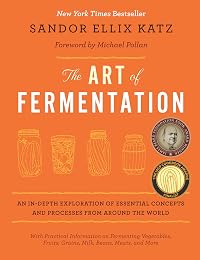
The Art of Fermentation: An In-Depth Exploration of Essential Concepts and Processes from around the World
by Sandor Ellix Katz
On This Page
Description
"'The Art of Fermentation' is the most comprehensive guide to do-it-yourself home fermentation ever published. Sandor Katz presents the concepts and processes behind fermentation in ways that are simple enough to guide a reader through their first experience making sauerkraut or yogurt, and in-depth enough to provide greater understanding and insight for experienced practitioners. While Katz expertly contextualizes fermentation in terms of biological and cultural evolution, health and show more nutrition, and even economics, this is primarily a compendium of practical information--how the processes work; parameters for safety; techniques for effective preservation; troubleshooting; and more. With full-color illustrations and extended resources, this book provides essential wisdom for cooks, homesteaders, farmers, gleaners, foragers, and food lovers of any kind who want to develop a deeper understanding and appreciation for arguably the oldest form of food preservation, and part of the roots of culture itself. Readers will find detailed information on fermenting vegetables; sugars into alcohol (meads, wines, and ciders); sour tonic beverages; milk; grains and starchy tubers; beers (and other grain-based alcoholic beverages); beans; seeds; nuts; fish; meat; and eggs, as well as growing mold cultures, using fermentation in agriculture, art, and energy production, and considerations for commercial enterprises. Sandor Katz has introduced what will undoubtedly remain a classic in food literature, and is the first--and only--of its kind"-- show lessTags
Recommendations




Member Recommendations

Member Reviews
4.5, but dinged for a ridiculous anti-science statement near the end.
This book is full to the brim of great information about fermentation - both theoretical and practical - and recipes. If you are at all interested in home cooking, indigenous or traditional cooking or even just the history and geography of food and cooking, you'll find this book interesting.
The hippiness of it might turn some off, but, while I found it a little distracting it didn't detract significantly from the book.
The statement that really irked me was near the end as was something to the effect that scientifically gained knowledge of the microscopic world had drained it of wonder. Variations of this have been flogged by many people. This is a demonstrably false show more and ridiculous statement - doubly since since the author draws on this same scientific knowledge throughout the book. Plenty of people find wonder in exactly these same scientific details about how life at all scales functions.
If knowledge robs something of its wonder, Mr. Katz, it does so for you and not in general. And that's an indication of your inability to choose to see the wonder from a different angle and in a different light, not the fault of science or scientists. show less
This book is full to the brim of great information about fermentation - both theoretical and practical - and recipes. If you are at all interested in home cooking, indigenous or traditional cooking or even just the history and geography of food and cooking, you'll find this book interesting.
The hippiness of it might turn some off, but, while I found it a little distracting it didn't detract significantly from the book.
The statement that really irked me was near the end as was something to the effect that scientifically gained knowledge of the microscopic world had drained it of wonder. Variations of this have been flogged by many people. This is a demonstrably false show more and ridiculous statement - doubly since since the author draws on this same scientific knowledge throughout the book. Plenty of people find wonder in exactly these same scientific details about how life at all scales functions.
If knowledge robs something of its wonder, Mr. Katz, it does so for you and not in general. And that's an indication of your inability to choose to see the wonder from a different angle and in a different light, not the fault of science or scientists. show less
I love Sandor Katz. Love. His writing is engaging, familiar, and yet pushes you ever so subtly towards new truths. This is not a cover-to-cover book; I'm jumping all over the place in it. But if you liked his first book, "Wild Fermentation," you'll love this one too.
An outstanding resource on all things fermentation. The author makes the microbiology available and accessible, but he also captures the enjoyment of process as well. In my experience, the guide is really meant to be used in the company of a community of fermenters, each with their own variations of recipes and starter cultures. This is good for those of you with local communities of like-minded experimenters. For the rest of us, there’s always the internet.
Fascinating look at a wide variety of fermentation, not just for eating and drinking but things like compost too. Sometimes felt that the research or information wasn't thorough enough, for example for ginger beer, Katz says you can use kombucha as a starter - however it is a different culture entirely to the ginger beer plant.
I enjoyed reading this book and am excited to try more ferments. Mi have fermented pickles and made yogurt for years but this book opens up the possibility for much more. A note, though. This is not a recipe book as such. It does have a few recipes but it is more what I would call a 'how-to' guide, explaining concepts, general instructions and some pitfalls.
This is a very comprehensive volume on the practices of fermentation. Covers the food preservation aspects, potential health benefits, yet provides detailed enough information to do it yourself, including cautions. Covers everything from how to process vegetables, fruits, grains, dairy products to meats and eggs. The author relates both the history and modern practices, based on a combination of his own experience and extensive research/collaboration with people from around the world. A true reference, but is easy to read.
This book covers all sorts of fermented foods (with a few related topics). It focuses more on the culture behind the fermentation, why it is healthy to eat, and how the fermentation process works, instead of fermentation recipes. It has certainly encouraged me to explore in the future making some kraut and pickles!
Members
- Recently Added By
Lists

Piglet Tournament of Cookbooks
160 works; 1 member
Author Information

16 Works 2,567 Members
All Editions
Some Editions
Awards and Honors
Common Knowledge
- Dedication
- FOR MY FATHER, JOE KATZ, whose favorite thing to talk about is the vegetables coming out of his garden and all the things he and my stepmother Pattie do with them; the acorn doesn't fall far from the tree. I dedicate this bo... (show all)ok to him and to the many other teachers mentors, and elders who have guided and inspired me throughout my life.
- First words
- [Foreword] "The Art of Fermentation" is an inspiring book, and I mean that literally.
[Introduction] Little could I have imagined, as a New York City kid who loved pickles, that those delicious, crunchy sour pickles would lead me on such an extraordinary journey of discovery and exploration.
Most of the information you will find in this book pertains to techniques for fermenting delicious, nutritious foods and beverages for human consumption.
[Epilogue] We must reclaim our food. - Last words
- (Click to show. Warning: May contain spoilers.)[FOREWORD] Welcome to the party.
(Click to show. Warning: May contain spoilers.)[INTRODUCTION] With that understanding, recipes are everywhere, and you can creatively explore.
(Click to show. Warning: May contain spoilers.)The artist explains that for her, "De/composition represents beginnings, change, contingencies of cause and effect, interconnectedness, possibility. . . . Perhaps decomposition is where my hope for the world lives."
(Click to show. Warning: May contain spoilers.)[Epilogue] By engaging life forces, we rediscover and reconnect with our context. - Original language
- English
Classifications
Statistics
- Members
- 1,006
- Popularity
- 26,057
- Reviews
- 13
- Rating
- (4.46)
- Languages
- English, German, Portuguese, Spanish
- Media
- Paper, Audiobook, Ebook
- ISBNs
- 11
- UPCs
- 1
- ASINs
- 3