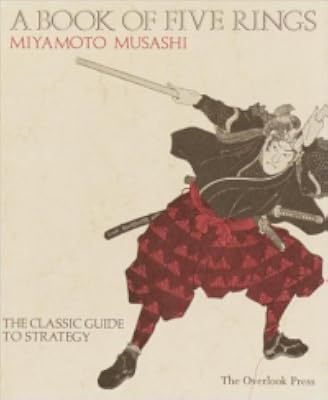
The Book of Five Rings
by Musashi Miyamoto
On This Page
Description
Setting down his thoughts on swordplay, on winning, and on spirituality, legendary swordsman Miyamoto Musashi intended this modest work as a guide for his immediate disciples and future generations of samurai. He had little idea he was penning a masterpiece that would be eagerly devoured by people in all walks of life centuries after his death.Along with The Art of War by Sun Tzu, The Book of Five Rings has long been regarded as an invaluable treatise on the strategy of winning. Musashi's show more timeless advice on defeating an adversary, throwing an opponent off-guard, creating confusion, and other techniques for overpowering an assailant was addressed to the readers of earlier times on the battlefield and now serves the modern reader in the battle of life. In this new rendering by the translator of Hagakure and The Unfettered Mind, William Scott Wilson adheres rigorously to the seventeenth-century Japanese text and clarifies points of ambiguity in earlier translations. In addition, he offers an extensive introduction and a translation of Musashi's rarely published The Way of Walking Alone. show lessTags
Recommendations




Member Recommendations

Member Reviews
I can't believe I never read this before now, but damn, HAVING read it now, I also appreciate it more.
Huh? Am I learning the way of the blade, wanting to defeat my foes from first principles and needing someone from many hundreds of years ago to tell me to EXPLORE THE PRACTICE DEEPLY? Yes? Practice it a LOT?
No. I'm not picking up a blade, and I'm not reading this from the PoV of some modern businessman wanting to get one-up on my competition, but I sure as hell got a LOT out of this.
You can say that it can be distilled down into a version of Buddhism, or you can say the essence is Fire, Wind, Water, and Stone, plus The Emptiness. But saying so doesn't explain a damn thing, nor does it teach anyone what is really beneath the words in show more this very clear text.
It does, however, lend itself WONDERFULLY to metaphor. Analogy.
I mean, of COURSE you're supposed to aim for the face. It always makes them flinch.
Of course you're supposed to dominate the battlefield with your own timing, never losing momentum, and always face your opponents with courage.
Pay attention to everything. Use everything.
But above all, heed the path of the Emptiness. Stop assuming shit! Learn your lessons well, always be honest with yourself, and never stop facing -- absolutely everything.
I think I'm going to buy this in a very nice edition and place it within my reach everywhere I go. It's that good. After all, minds ARE blades. show less
Huh? Am I learning the way of the blade, wanting to defeat my foes from first principles and needing someone from many hundreds of years ago to tell me to EXPLORE THE PRACTICE DEEPLY? Yes? Practice it a LOT?
No. I'm not picking up a blade, and I'm not reading this from the PoV of some modern businessman wanting to get one-up on my competition, but I sure as hell got a LOT out of this.
You can say that it can be distilled down into a version of Buddhism, or you can say the essence is Fire, Wind, Water, and Stone, plus The Emptiness. But saying so doesn't explain a damn thing, nor does it teach anyone what is really beneath the words in show more this very clear text.
It does, however, lend itself WONDERFULLY to metaphor. Analogy.
I mean, of COURSE you're supposed to aim for the face. It always makes them flinch.
Of course you're supposed to dominate the battlefield with your own timing, never losing momentum, and always face your opponents with courage.
Pay attention to everything. Use everything.
But above all, heed the path of the Emptiness. Stop assuming shit! Learn your lessons well, always be honest with yourself, and never stop facing -- absolutely everything.
I think I'm going to buy this in a very nice edition and place it within my reach everywhere I go. It's that good. After all, minds ARE blades. show less
Study, consider, train, examine, observe. The list goes on. This book is a practical guide to life, whether you are in the military or a business person or just an average joe looking to get a handle on life.
Musashi lays out in plain language an idea he calls 'The Way.' The purpose of this 'Way' is simple, to ignore all pomp, circumstance, distractions, grandiose displays of prowess and close with the enemy and kill them. Swiftly, without rancor, without a second thought.
"Do nothing which is of no use."
Whether this enemy is a real live one, a competitor, or an obstacle/struggle within your own life, the point is to take control through practice, hard work, perseverance, study, and master that which opposes you through any means show more necessary.
Those looking for free handouts need not apply; those looking for the Western romanticized (Therefore erroneous) view of Bushido need not apply. Musashi explicitly states that in a fight, there is no honor beyond victory. You do whatever you can to throw your opponent off balance, onto their weak hand, blind them, use every advantage you know to utterly remove them from the equation.
If you can accept this, you'll never fear a thousand fights. show less
Musashi lays out in plain language an idea he calls 'The Way.' The purpose of this 'Way' is simple, to ignore all pomp, circumstance, distractions, grandiose displays of prowess and close with the enemy and kill them. Swiftly, without rancor, without a second thought.
"Do nothing which is of no use."
Whether this enemy is a real live one, a competitor, or an obstacle/struggle within your own life, the point is to take control through practice, hard work, perseverance, study, and master that which opposes you through any means show more necessary.
Those looking for free handouts need not apply; those looking for the Western romanticized (Therefore erroneous) view of Bushido need not apply. Musashi explicitly states that in a fight, there is no honor beyond victory. You do whatever you can to throw your opponent off balance, onto their weak hand, blind them, use every advantage you know to utterly remove them from the equation.
If you can accept this, you'll never fear a thousand fights. show less
I found this vintage book (published May, 1982) in my Little Free Library and decided to read it because I've recently become interested in things Japanese. The book was written by a masterless samurai, Miyamoto Musashi, who lived in the late 1500's and early 1600's and practiced what he called heiho. It is said that he never lost a bout with 60 individual swordsmen before reaching the age of thirty. In this book, he wrote the principles of his heiho.
I liked this book for learning about this particular form of swordsmanship, but I never took it to be a book about "Japanese success in business" as was advertised at the top of this mass market paperback. It was weird, though, reading a book about mastering the skill to kill another show more individual. I'm not unhappy that the time of samurai is gone. show less
I liked this book for learning about this particular form of swordsmanship, but I never took it to be a book about "Japanese success in business" as was advertised at the top of this mass market paperback. It was weird, though, reading a book about mastering the skill to kill another show more individual. I'm not unhappy that the time of samurai is gone. show less
There are always going to be inevitable comparisons to Sun Tzu’s Art of War which are, perhaps, unfair. The Book of Five Rings, dealing with strategy and critical thinking, is a bit more purely focused on swordwork and martial art. As a result, it is perhaps less applicable to “other” areas of life like AoW is. Or maybe it is and I just haven’t devoted enough thought to it. Granted this is only the first time I’ve read it so I haven’t had as much of a chance to absorb what it has to say and let it percolate in the noggin. It still has a lot to teach about diligence bringing results, how “surface” understanding doesn’t even begin to scratch the surface, and so on. So, overall quite interesting; one of those that will show more yield even more with subsequent re-readings.
On a pettier note, I couldn’t say who published this edition because there is no information to that effect anywhere in the book. I suspect it is one of those micro-small, self-publishing type outfits. Just as well they didn’t put their name to it because the amount of copy errors and typographical no-nos I noticed was quite astounding considering the whole thing is less than 50 pages. That’s why I believe it was a self-published job, because quite frankly it shows. HIRE AN EDITOR. Musashi deserves better treatment than that. show less
On a pettier note, I couldn’t say who published this edition because there is no information to that effect anywhere in the book. I suspect it is one of those micro-small, self-publishing type outfits. Just as well they didn’t put their name to it because the amount of copy errors and typographical no-nos I noticed was quite astounding considering the whole thing is less than 50 pages. That’s why I believe it was a self-published job, because quite frankly it shows. HIRE AN EDITOR. Musashi deserves better treatment than that. show less
A beautiful edition, well-designed and with many wonderful plates. However the translation is less direct and more flowery than some, to the point of obscuring the points being made.
This isn't a work that benefits from a translation that over-explains in order to be "comprehensive," in fact the opposite is achieved. A simple example: "8. Pay attention even to trifles. 9. Do not do anything which is of no use." In the first edition I was aware of (T.: Thomas Cleary) these were translated as, "8. Be careful even in small matters. 9. Do not do anything useless." Still, with the wonderful artwork and original text, this is a nice edition to complete any "set of editions."
This isn't a work that benefits from a translation that over-explains in order to be "comprehensive," in fact the opposite is achieved. A simple example: "8. Pay attention even to trifles. 9. Do not do anything which is of no use." In the first edition I was aware of (T.: Thomas Cleary) these were translated as, "8. Be careful even in small matters. 9. Do not do anything useless." Still, with the wonderful artwork and original text, this is a nice edition to complete any "set of editions."
This is a classic work of Japanese philosophy in regards to battle. The tome is actually rather slim, less than 100 pages, which makes this a brief read. The version I read also had a brief bio of Musashi in it, which helped me to appreciate the text itself more. Musashi shares several very practical observations which can be used for not just battle, but other situations such as business or confrontations with people.
The version I read also had several of his paintings. I have to say that in my opinion, he was a much better fighter than he was an artist.
The version I read also had several of his paintings. I have to say that in my opinion, he was a much better fighter than he was an artist.
This book, written by a famous Japanese duelist, tells one of his relatives how to win with the sword. It is divided into five "Rings" based on five "Elements". He concentrates on Strategy and does not talk about the best guard to take or other technicalities. Many people find this book to be immoral as it espouses winning at all costs in a deadly pursuit. I regard it more as a-moral. Musashi simply never considers the question. He is simply putting down his concept of Strategy. Perhaps the moral onus is on the reader of the book?
Students of Zen would do well to read the book, particularly the final Ring - entitled The Void. Afterward the perceptive student would take up an individual sport - not necessarily fencing, tennis would do show more just as well - and give up trying to solve koans. After all, even the Masters say that the more you study Zen the further from enlightenment you get and there can be little doubt that Musashi was a master.
This translation from the original Japanese also contains an insightful introduction. show less
Students of Zen would do well to read the book, particularly the final Ring - entitled The Void. Afterward the perceptive student would take up an individual sport - not necessarily fencing, tennis would do show more just as well - and give up trying to solve koans. After all, even the Masters say that the more you study Zen the further from enlightenment you get and there can be little doubt that Musashi was a master.
This translation from the original Japanese also contains an insightful introduction. show less
Members
- Recently Added By
Published Reviews
Knjiga koja na engleskom nosi ispravan naziv „Knjiga pet sfera“, delo Mijamota Musašija posvećeno umeću ratovanja, predstavlja čisto pragmatični poduhvat. Musaši ismeva spoljašnji sjaj i komercijalizaciju borilačkih veština, usmeravajući pažnju na psihološki i fizički aspekt smrtonosnog napada i odlučne pobede kao suštine ratovanja.
Njegov naučno agresivan, u potpunosti show more nemilosrdan pristup vojnoj nauci, iako nije bio široko zastupljen među japanskim majstorima borilačkih veština, predstavlja jednu visoko koncentrovanu karakterizaciju određenog tipa ratnika samuraja. Iako se u vezi njegovih dramatičnih podviga razvio čitav korpus legendi, malo se toga pouzdano zna o životu Mijamota Musašija. Ono što je on izneo o sebi u svojoj „Knjizi pet prstenova“ je primarni izvor istorijskih činjenica. Prvi put je u borbi ubio čoveka sa trinaest godina, a poslednji put sa dvadeset i devet godina. U jednom trenutku svog života on je navodno prestao da koristi pravi mač, ali je nastavio da zadaje smrtonosne udarce protivnicima sve do kraja karijere mačevaoca. Poslednje tri decenije života Musaši je proveo usavršavajući i podučavajući svoju ratničku nauku. Priča se da se nikada nije češljao, da se nikada nije kupao, da se nije ženio, da nije stvorio dom i da nije podizao decu. Iako je poznavao društvene veštine svog vremena i uistinu ih je preporučivao svakome, Mijamoto Musaši je u suštini išao asketskim putem ratnika do kraja svog života.
Ovo izdanje sadrži u sebi još jednu proslavljenu knjigu, Knjigu porodičnih predanja o umeću ratovanja, Jagju Munenorija, čuvenog samuraja koji se u poznim godinama posvetio zen budizmu. Otuda ova knjiga predstavlja spoj zena i borilačkih veština. show less
Njegov naučno agresivan, u potpunosti show more nemilosrdan pristup vojnoj nauci, iako nije bio široko zastupljen među japanskim majstorima borilačkih veština, predstavlja jednu visoko koncentrovanu karakterizaciju određenog tipa ratnika samuraja. Iako se u vezi njegovih dramatičnih podviga razvio čitav korpus legendi, malo se toga pouzdano zna o životu Mijamota Musašija. Ono što je on izneo o sebi u svojoj „Knjizi pet prstenova“ je primarni izvor istorijskih činjenica. Prvi put je u borbi ubio čoveka sa trinaest godina, a poslednji put sa dvadeset i devet godina. U jednom trenutku svog života on je navodno prestao da koristi pravi mač, ali je nastavio da zadaje smrtonosne udarce protivnicima sve do kraja karijere mačevaoca. Poslednje tri decenije života Musaši je proveo usavršavajući i podučavajući svoju ratničku nauku. Priča se da se nikada nije češljao, da se nikada nije kupao, da se nije ženio, da nije stvorio dom i da nije podizao decu. Iako je poznavao društvene veštine svog vremena i uistinu ih je preporučivao svakome, Mijamoto Musaši je u suštini išao asketskim putem ratnika do kraja svog života.
Ovo izdanje sadrži u sebi još jednu proslavljenu knjigu, Knjigu porodičnih predanja o umeću ratovanja, Jagju Munenorija, čuvenog samuraja koji se u poznim godinama posvetio zen budizmu. Otuda ova knjiga predstavlja spoj zena i borilačkih veština. show less
added by Sensei-CRS
Knjiga koja na engleskom nosi ispravan naziv „Knjiga pet sfera“, delo Mijamota Musašija posvećeno umeću ratovanja, predstavlja čisto pragmatični poduhvat. Musaši ismeva spoljašnji sjaj i komercijalizaciju borilačkih veština, usmeravajući pažnju na psihološki i fizički aspekt smrtonosnog napada i odlučne pobede kao suštine ratovanja.
Njegov naučno agresivan, u potpunosti show more nemilosrdan pristup vojnoj nauci, iako nije bio široko zastupljen među japanskim majstorima borilačkih veština, predstavlja jednu visoko koncentrovanu karakterizaciju određenog tipa ratnika samuraja. Iako se u vezi njegovih dramatičnih podviga razvio čitav korpus legendi, malo se toga pouzdano zna o životu Mijamota Musašija. Ono što je on izneo o sebi u svojoj „Knjizi pet prstenova“ je primarni izvor istorijskih činjenica. Prvi put je u borbi ubio čoveka sa trinaest godina, a poslednji put sa dvadeset i devet godina. U jednom trenutku svog života on je navodno prestao da koristi pravi mač, ali je nastavio da zadaje smrtonosne udarce protivnicima sve do kraja karijere mačevaoca. Poslednje tri decenije života Musaši je proveo usavršavajući i podučavajući svoju ratničku nauku. Priča se da se nikada nije češljao, da se nikada nije kupao, da se nije ženio, da nije stvorio dom i da nije podizao decu. Iako je poznavao društvene veštine svog vremena i uistinu ih je preporučivao svakome, Mijamoto Musaši je u suštini išao asketskim putem ratnika do kraja svog života.
Ovo izdanje sadrži u sebi još jednu proslavljenu knjigu, Knjigu porodičnih predanja o umeću ratovanja, Jagju Munenorija, čuvenog samuraja koji se u poznim godinama posvetio zen budizmu. Otuda ova knjiga predstavlja spoj zena i borilačkih veština. show less
Njegov naučno agresivan, u potpunosti show more nemilosrdan pristup vojnoj nauci, iako nije bio široko zastupljen među japanskim majstorima borilačkih veština, predstavlja jednu visoko koncentrovanu karakterizaciju određenog tipa ratnika samuraja. Iako se u vezi njegovih dramatičnih podviga razvio čitav korpus legendi, malo se toga pouzdano zna o životu Mijamota Musašija. Ono što je on izneo o sebi u svojoj „Knjizi pet prstenova“ je primarni izvor istorijskih činjenica. Prvi put je u borbi ubio čoveka sa trinaest godina, a poslednji put sa dvadeset i devet godina. U jednom trenutku svog života on je navodno prestao da koristi pravi mač, ali je nastavio da zadaje smrtonosne udarce protivnicima sve do kraja karijere mačevaoca. Poslednje tri decenije života Musaši je proveo usavršavajući i podučavajući svoju ratničku nauku. Priča se da se nikada nije češljao, da se nikada nije kupao, da se nije ženio, da nije stvorio dom i da nije podizao decu. Iako je poznavao društvene veštine svog vremena i uistinu ih je preporučivao svakome, Mijamoto Musaši je u suštini išao asketskim putem ratnika do kraja svog života.
Ovo izdanje sadrži u sebi još jednu proslavljenu knjigu, Knjigu porodičnih predanja o umeću ratovanja, Jagju Munenorija, čuvenog samuraja koji se u poznim godinama posvetio zen budizmu. Otuda ova knjiga predstavlja spoj zena i borilačkih veština. show less
added by Sensei-CRS
Author Information

Some Editions
Awards and Honors
Awards
Series
Belongs to Publisher Series
Work Relationships
Common Knowledge
- Canonical title
- The Book of Five Rings
- Original title
- Go-rin no sho; Gorin-no-sho; Gorin no sho; 五輪の書
- Alternate titles
- The Book of Five Rings (Gorin No Sho): A Practical Guide to Strategy (Gorin No Sho) (Gorin No Sho | Gorin No Sho)
- Original publication date
- 1643; 1936 Kyōzaisha (J) (J)
- People/Characters
- Miyamoto Musashi; Shirō Tsujimura; William Scott Wilson; Shinmen Takezō; Miyamoto Bennosuke; Niten Dōraku
- Important places
- Japan
- Important events
- 17th century; Edo period or Tokugawa period
- First words
- (Translator's Introduction by Thomas Cleary): The Book of Five Rings and The Book of Family Traditions on the Art of War are two of the most important texts on conflict and strategy emerging from the Japanese w... (show all)arrior culture.
(Preface): The science of martial arts called the Individual School of Two Skies is something that I have spent many years refining.
Martial arts are the warrior's way of life.
(Translator's Introduction by Victor Harris): Miyamoto Musashi was born in 1584, in a Japan struggling to recover from more than four centuries of internal strife. - Quotations
- All things, at first try, are difficult to handle.
Broaden your knowledge. It is necessary to polish your own path. - Last words
- (Click to show. Warning: May contain spoilers.)Seriousness is not the ultimate realization; it is training in the first couple of steps.
- Disambiguation notice
- ISBN matches Das Buch der fünf Ringe: Mit einer Biografie.
Classifications
- Genres
- Philosophy, Sports and Leisure, Nonfiction, General Nonfiction, Business, History
- DDC/MDS
- 355.547 — Society, government, & culture Public administration & military science The Military - Land, Air & Sea / Warfare Military training Military Training and Martial Arts
- LCC
- U101 .M5913 — Military Science Military science (General)
- BISAC
Statistics
- Members
- 4,338
- Popularity
- 3,484
- Reviews
- 50
- Rating
- (3.76)
- Languages
- 20 — Czech, Danish, Dutch, English, Finnish, French, German, Greek, Hungarian, Indonesian, Italian, Japanese, Polish, Romanian, Russian, Serbian, Spanish, Swedish, Turkish, Portuguese (Portugal)
- Media
- Paper, Audiobook, Ebook
- ISBNs
- 277
- UPCs
- 1
- ASINs
- 72