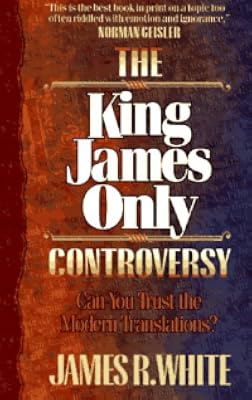
The King James Only Controversy: Can You Trust the Modern Translations?
by James R. White
On This Page
Description
"A thoroughly researched discussion of the development of Bible translations ancient and modern, including key differences between versions such as the New International, New American Standard Bible, and the Authorized Version of 1611"--Provided by publisher.Tags
Recommendations








Member Reviews
James R. White states his purpose as “a corrective to the ongoing (if dwindling) KJVO movement” and “an introduction to the history and background of the biblical text” (p. 19).
In Chapter One, James White defines King James Only. White’s “Groups” or categories of KJVO is found on pages 23-28.
• Group #1: “I Like the KJV Best”
• Group #2: “The Textual Argument”
• Group #3: “Received Text Only”
• Group #4: “The Inspired KJV Group”
• Group #5: “The KJV as New Revelation”
These categories serve more for polemic purposes than educational ones. They cause readers to understand the KJV controversy incorrectly. Groups 1-3 have compelling legitimate reasons to complain of being called KJV Only. Groups 4-5 show more fail to include some who are legitimately KJV Only (that is, those who reject the ideas of re-inspiration and new revelation, but nevertheless believe the King James Bible is the only translation that should be used by English-speaking Christians.). “Group # 2” perhaps best illustrates the weirdness of White’s categories. In it, he dumps Majority Text advocates (pp. 24-25) who have compiled Greek texts in distinction to the Textus Receptus, and have made translations in distinction to the King James Version! He admits they are not KJV Only, but still places them within the “range of beliefs within the broad category of KJV Only” (p. 23). Ridiculous.
Not recommended for beginners. White intends this work as an introduction to and explanation of the “King James Only Movement.” At some point, those who are studying the “versions” issue should read this book. However, it will confuse the beginners, and set them up to wrongly understand what does and does not constitute “King James Onlyism”. Problems need to be addressed in the generally accepted categorizations that White has foisted on his readership. show less
In Chapter One, James White defines King James Only. White’s “Groups” or categories of KJVO is found on pages 23-28.
• Group #1: “I Like the KJV Best”
• Group #2: “The Textual Argument”
• Group #3: “Received Text Only”
• Group #4: “The Inspired KJV Group”
• Group #5: “The KJV as New Revelation”
These categories serve more for polemic purposes than educational ones. They cause readers to understand the KJV controversy incorrectly. Groups 1-3 have compelling legitimate reasons to complain of being called KJV Only. Groups 4-5 show more fail to include some who are legitimately KJV Only (that is, those who reject the ideas of re-inspiration and new revelation, but nevertheless believe the King James Bible is the only translation that should be used by English-speaking Christians.). “Group # 2” perhaps best illustrates the weirdness of White’s categories. In it, he dumps Majority Text advocates (pp. 24-25) who have compiled Greek texts in distinction to the Textus Receptus, and have made translations in distinction to the King James Version! He admits they are not KJV Only, but still places them within the “range of beliefs within the broad category of KJV Only” (p. 23). Ridiculous.
Not recommended for beginners. White intends this work as an introduction to and explanation of the “King James Only Movement.” At some point, those who are studying the “versions” issue should read this book. However, it will confuse the beginners, and set them up to wrongly understand what does and does not constitute “King James Onlyism”. Problems need to be addressed in the generally accepted categorizations that White has foisted on his readership. show less
“Why is the KJV Bible the only Bible you can trust?” “The KJV 1611, that’s the book for me. The very words of God.” Statements such as these are far too common in the odd cornucopia that is American Christianity. Certain Christians have combined an ignorance of bibliology with an ardent desire to defend the Bible and have spawned a group of followers so virulent and so committed that they have infected churches all around the world with their insidious misunderstanding of the very Scriptures themselves. Enter James White’s clear and compelling book, The King James Only Controversy. White takes the Onlyists head on and refutes their divisive theories systematically. His convincing work is thoughtful and careful in dealing show more with an issue that rarely receives scholarly attention because the conclusions drawn by the proponents of KJV Onlyism are so absurd. Not only is the position itself radically indefensible, the adherents are largely very closed to debate, and often secluded among their followers. Combine this herd mentality with a simultaneous desire to spread their strange doctrines, and the need for a defense is clear. White guides his readers through a veritable minefield of errors and oddities, stopping along the way to debunk the folly of KJV Onlyism by examining the aberration historically, theologically and exegetically. In addition to his apologia, White provides an invaluable lesson to his audience; upon finishing his work they now understand where and how their precious Bible came into being.
Perhaps the most insightful section of White’s book is his explanation of the history of the text of Scripture. Many KJV Onlyists present a very vocal revision of the TR, so White spends two chapters the history lesson which draws an amazing parallel between modern day KJV Onlyists delusions of the A.V. 1611 and their historical counterparts. Upon each translation of the Bible, the “traditional” text found many defenders, who raised the same questions that KJV Onlyists raise today. As White explains the historical cycles related to Jerome’s translation and then Erasmus’ translation, the reader is shown the same basic pattern. Traditionalists question the new translation as undermining the word of God, centuries pass, and the new translation becomes the traditional translation, and as language in which the Bible is read changes and the Bible is brought to new areas and peoples, it must again be translated. The same weary cycle begins again, except now the traditionalists have adopted the text that was once considered modern. Whites wise historical warning should serve well to guard against future cries of “ESV Onlyism” and the like.
Theologically, White pokes numerous holes in the KJV Only movement as well as helpfully critiquing the theological accusations of those who would attack the “modern versions.” As White uncovers the misquotations and considers them in their original context the reader is shown that the NASB is not attempting to undermine the incarnation or the sonship of Christ, rather it is the KJV Only camp that misunderstands the theology as well as the text. KJV Onlyists cry of “manifold serious theological perversions” are shown to be nothing of the sort as White displays how the incarnation is clear in the text of scripture and has not been edited or deleted from the modern translations. White’s opponents take no prisoners though, one popular KJV Only cartoonist (I am not making this up) writes on his web site, “You must decide whether or not you believe God has kept this promise: Did He preserve His Word throughout the generations? Or did He not? That decision will lead you to one of two Bible texts.” This is followed by a cartoon illustrated discussion of the perversions of the Alexandrian school and the purity of the TR. As this strange and often sordid diatribe against the so-called enemies of God’s word continues, the reader is shown that the Bible they hold in their hands cannot be trusted unless it was published by a group of Anglicans in 1611. Their case is pressed forward by their continual use of the word “scholar” as a synonym for “enemy of the preservation of God’s Words.” White decimates this argument with the help of Athanasius and a true scholars grasp of historical theology. White concludes that the modern translations are theologically vindicated, regardless of the name-calling.
Not only does White tackle the historical background that has been skewed in this debate and the various theological accusations leveled wrongly against the modern translations, but White superbly exegetes the problem passages raised by KJV Onlyists. Employing the original languages and assembling many helpful charts, White quotes extensively from his opponents taking their accusations on one by one. They claim that the NASB text is ambiguous on the deity of Christ, so White handles Philippians 2 in careful detail. They claim that the prophesies of the messiah and the virgin birth have been undermined by the modern versions, White takes them to the Hebrew employing exegetical acumen as he demonstrates the strength of the word of God, not relying on one particular English translation.
One would think that this brand of cultish Christianity would have died out with the dunderheads that began it, but the KJV Onlyists are alive and well. Many church members have been exposed to this sort of doctrine and many could be led astray because of the lack of understanding on the transmission, translation, and source of the Scriptures. Even if James Whites book transformed every KJV Onlyist into a repentant carrier of the MacArthur Study Bible (in its new NASB edition, of course), The King James Only Controversy would still be a useful tool for the student of the Bible. White insists on clarity, and as he explains a basic grid of translation and preservation the reader is given an indispensable guide to bibliology. His work would continue to be valuable as an introductory work to recommend to anyone who desires to understand the history of the Bible. show less
Perhaps the most insightful section of White’s book is his explanation of the history of the text of Scripture. Many KJV Onlyists present a very vocal revision of the TR, so White spends two chapters the history lesson which draws an amazing parallel between modern day KJV Onlyists delusions of the A.V. 1611 and their historical counterparts. Upon each translation of the Bible, the “traditional” text found many defenders, who raised the same questions that KJV Onlyists raise today. As White explains the historical cycles related to Jerome’s translation and then Erasmus’ translation, the reader is shown the same basic pattern. Traditionalists question the new translation as undermining the word of God, centuries pass, and the new translation becomes the traditional translation, and as language in which the Bible is read changes and the Bible is brought to new areas and peoples, it must again be translated. The same weary cycle begins again, except now the traditionalists have adopted the text that was once considered modern. Whites wise historical warning should serve well to guard against future cries of “ESV Onlyism” and the like.
Theologically, White pokes numerous holes in the KJV Only movement as well as helpfully critiquing the theological accusations of those who would attack the “modern versions.” As White uncovers the misquotations and considers them in their original context the reader is shown that the NASB is not attempting to undermine the incarnation or the sonship of Christ, rather it is the KJV Only camp that misunderstands the theology as well as the text. KJV Onlyists cry of “manifold serious theological perversions” are shown to be nothing of the sort as White displays how the incarnation is clear in the text of scripture and has not been edited or deleted from the modern translations. White’s opponents take no prisoners though, one popular KJV Only cartoonist (I am not making this up) writes on his web site, “You must decide whether or not you believe God has kept this promise: Did He preserve His Word throughout the generations? Or did He not? That decision will lead you to one of two Bible texts.” This is followed by a cartoon illustrated discussion of the perversions of the Alexandrian school and the purity of the TR. As this strange and often sordid diatribe against the so-called enemies of God’s word continues, the reader is shown that the Bible they hold in their hands cannot be trusted unless it was published by a group of Anglicans in 1611. Their case is pressed forward by their continual use of the word “scholar” as a synonym for “enemy of the preservation of God’s Words.” White decimates this argument with the help of Athanasius and a true scholars grasp of historical theology. White concludes that the modern translations are theologically vindicated, regardless of the name-calling.
Not only does White tackle the historical background that has been skewed in this debate and the various theological accusations leveled wrongly against the modern translations, but White superbly exegetes the problem passages raised by KJV Onlyists. Employing the original languages and assembling many helpful charts, White quotes extensively from his opponents taking their accusations on one by one. They claim that the NASB text is ambiguous on the deity of Christ, so White handles Philippians 2 in careful detail. They claim that the prophesies of the messiah and the virgin birth have been undermined by the modern versions, White takes them to the Hebrew employing exegetical acumen as he demonstrates the strength of the word of God, not relying on one particular English translation.
One would think that this brand of cultish Christianity would have died out with the dunderheads that began it, but the KJV Onlyists are alive and well. Many church members have been exposed to this sort of doctrine and many could be led astray because of the lack of understanding on the transmission, translation, and source of the Scriptures. Even if James Whites book transformed every KJV Onlyist into a repentant carrier of the MacArthur Study Bible (in its new NASB edition, of course), The King James Only Controversy would still be a useful tool for the student of the Bible. White insists on clarity, and as he explains a basic grid of translation and preservation the reader is given an indispensable guide to bibliology. His work would continue to be valuable as an introductory work to recommend to anyone who desires to understand the history of the Bible. show less
This book, along with D. A. Carson's on the same topic, are two essentials on the subject of King James Onlyism that I highly recommend. James White goes into much more detail refuting the KJV-Only arguments than Carson, but the information contained in both books effectively addresses just about all the points KJV-Only proponents (especially the more ludicrous arguments from those on the extreme end of KJV-Onlyism like Peter Ruckman, Sam Gipp, Gail Riplinger, et. al). It is a shame that "jensen75" grossly mischaracterizes James White's stance on the King James Bible for he has never shown nor has "contempt of the KJV/AV." Quite the contrary; White recognizes the King James Bible as a legitimate translation. He just does not accept the show more erroneous belief that the King James Bible (AV1611) is the ONLY legitimate translation. This tends to infuriate the more extreme proponents of King James Version Onlyism. However, James White has even addressed this on his website. In short, The King James Only Controversy contains accurate and thorough examinationsand refutations of KJV-Only beliefs and should be a valued addition to any Christian's library, especially those confronted by proponents of the King James Only position. show less
In this work, James White seeks to counter some of the claims of the more Cultic KJV-only folk, which is why White distinguishes the types of KJV-only proponents in the beginning of the book. White gives a good overview on textual criticism that is accessible to the lay person but also is deep enough to take down popular level KJV-only arguments (there aren’t any scholarly arguments for KJV-onlyism, at least not the type he’s trying to debunk.) Oftentimes, TR-onlyist scholars take personal issues with some of White’s arguments in favor of the Nestle-Åland text, but that’s another issue.The focus of the book is that Cultic KJV-onlyism, an ideological disease that has the symptoms of
You must hear/read from the KJV to be saved. show more
The KJV is the only Bible for the English speaking people
The KJV is 100 percent perfect and where it differs from the original languages the KJV is correct.
The KJV was re-inspired in 1611, making it better than the Hebrew and Greek we have today (though they would say the KJV is on par with the actual original autographs that the biblical writers wrote themselves.)
The King James is a beautiful translation and you can use it to the exclusion of all others, but don’t make it a salvation issue with your fellow Christians. show less
You must hear/read from the KJV to be saved. show more
The KJV is the only Bible for the English speaking people
The KJV is 100 percent perfect and where it differs from the original languages the KJV is correct.
The KJV was re-inspired in 1611, making it better than the Hebrew and Greek we have today (though they would say the KJV is on par with the actual original autographs that the biblical writers wrote themselves.)
The King James is a beautiful translation and you can use it to the exclusion of all others, but don’t make it a salvation issue with your fellow Christians. show less
For some time already I've been fascinated and interested in the study of the New Testament language and the study of manuscripts. It just seems to interesting to me, to know how God has worked in history to preserve His Words for us.
I should admit that I'm blessed that living in Holland I have not encountered KJV Onlyist, man...I just can't understand the logic. People can truly be very obedient slaves to their traditions...
The first work on Textual Criticism I read was Timothy Paul Jones's Misquoting Truth, it was a short read and I liked it. I've been following Dr James White's ministry for some time now and I have watched many of his debates /discussions on Textual Criticism. I must say that this inspired me to get back to learning show more Greek.
James was very respectful, although the KJV Onlyists are/were anything but respectful to the other side. He dealt with the issues honestly and documented his assertions and the reasons why he or the scholars think so regarding a specific passage.
I look forward by the grace of God to continue my learning of Greek and deepen my study in Textual Criticism and Koine Greek. show less
I should admit that I'm blessed that living in Holland I have not encountered KJV Onlyist, man...I just can't understand the logic. People can truly be very obedient slaves to their traditions...
The first work on Textual Criticism I read was Timothy Paul Jones's Misquoting Truth, it was a short read and I liked it. I've been following Dr James White's ministry for some time now and I have watched many of his debates /discussions on Textual Criticism. I must say that this inspired me to get back to learning show more Greek.
James was very respectful, although the KJV Onlyists are/were anything but respectful to the other side. He dealt with the issues honestly and documented his assertions and the reasons why he or the scholars think so regarding a specific passage.
I look forward by the grace of God to continue my learning of Greek and deepen my study in Textual Criticism and Koine Greek. show less
The King James Only Controversy: Can You Trust Modern Translations?, by James R. White, is well written and easy to follow. White clearly disagrees with the traditional KJV-Only position, but he is also quick to emphasize that those who believe the position are still his brothers and sisters in Christ. White tries to minimize his bias, and does a reasonably good job of it. He gives credit where credit is due, and points out inconsistencies, regardless of which side of the debate the argument is promoting.
The first part of the book (the largest part) doesn't need much technical knowledge to understand. The second part of the Book uses some Hebrew and Greek words while discussing Textual Criticism. Have some knowledge in one or more of show more these areas would be beneficial. show less
The first part of the book (the largest part) doesn't need much technical knowledge to understand. The second part of the Book uses some Hebrew and Greek words while discussing Textual Criticism. Have some knowledge in one or more of show more these areas would be beneficial. show less
Did you ever see those alternate readings in the margin of your Bible and wonder what that was about? Or see the double brackets around the ending of Mark and see that this ending isn't in the best manuscripts? Or perhaps you've heard the criticism from Muslims or skeptics that we don't have the original text of the New Testament, and what we have varies widely from manuscript to manuscript?
James White tackles the wide and important topic of textual criticism in this work. While the main point of the book is to refute the claims of the King James Onlyist movement -- which claims (or at least the most vocal part of the movement claims) that the King James Bible is the only true version and is perhaps inspired -- White starts from the show more beginning and gives an understandable explanation of the field of study and why the skeptic claim that there are perhaps hundreds of thousands textual variants in the Bible is misleading.
White also makes a strong case that the NIV, NKJV, and NASB (it was written before the ESV was finished) are trustworthy.
This book gives you a really good basic understanding of textual criticism in order to not only refute the claims of the KJV-onlyists, but also to understand why your Bible has marginal notes on certain verses and why we can trust that our Bible is the same Bible written by the Apostles. show less
James White tackles the wide and important topic of textual criticism in this work. While the main point of the book is to refute the claims of the King James Onlyist movement -- which claims (or at least the most vocal part of the movement claims) that the King James Bible is the only true version and is perhaps inspired -- White starts from the show more beginning and gives an understandable explanation of the field of study and why the skeptic claim that there are perhaps hundreds of thousands textual variants in the Bible is misleading.
White also makes a strong case that the NIV, NKJV, and NASB (it was written before the ESV was finished) are trustworthy.
This book gives you a really good basic understanding of textual criticism in order to not only refute the claims of the KJV-onlyists, but also to understand why your Bible has marginal notes on certain verses and why we can trust that our Bible is the same Bible written by the Apostles. show less
Members
- Recently Added By
Author Information

44+ Works 6,115 Members
James R. White is the author of several acclaimed books; including The God Who Justifies and The Forgotten Trinity. The director of Alpha and Omega Ministries, he is an accomplished debater of Muslim apologists and an elder of the Phoenix Reformed Baptist Church. Tie arid his family live in Phoenix, Arizona.
Common Knowledge
- Canonical title
- The King James Only Controversy: Can You Trust the Modern Translations?
Classifications
Statistics
- Members
- 1,307
- Popularity
- 18,593
- Reviews
- 12
- Rating
- (4.19)
- Languages
- English, German
- Media
- Paper
- ISBNs
- 2
- ASINs
- 3