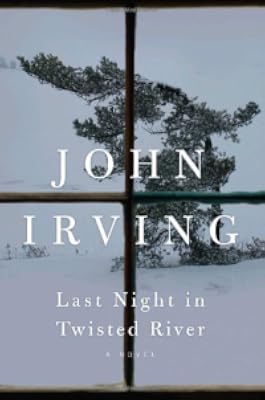
Last Night in Twisted River
by John Irving
On This Page
Description
In 1954, in the cookhouse of a logging and sawmill settlement in northern New Hampshire, an anxious twelve-year-old boy mistakes the local constable's girlfriend for a bear. Both the twelve-year-old and his father become fugitives, forced to run from Coos County-to Boston, to southern Vermont, to Toronto-pursued by the implacable constable. Their lone protector is a fiercely libertarian logger, once a river driver, who befriends them. A tale that spans five decades.Tags
Recommendations





Member Recommendations

eleanor_eader Explores an American's changing relationship with his own country.
Member Reviews
This was my first John Irving novel and the word "operatic" comes to mind. Even though this novel is long, the plot is tight and interesting. I never thought I'd read a novel which has a tight plot, but still manages to ramble on and on as well as keep my interest - but there you have it.
The premise of the novel seems, at least to me, is the making of a writer. Daniel Baciagalupo and his father flee a 1950's New Hampshire logging town after Daniel accidentally killed his father's lover. On the run the Baciagalupo rediscover their Boston roots and spend a large part of the novel dodging a vengeful and crazy New Hampshire sheriff.
After attending some very exclusive schools, Daniel becomes a successful writer, has a son and keeps in touch show more with Ketchum, an extinct species of Americans who embodies New Hampshire's motto of "Live Free or Die". Ketchum manages to rant against everyone and anyone, the hippies, Catholics, conservatives and liberals; ironically the embodiment of extreme libertarian hates all other extremes - yet, in my opinion, his character is the glue that holds the story together.
The story moves back and forth in time, despite Irving's weird sex scenes, violent actions and some funny (and not so funny) deaths, the plot revolves around Daniel becoming a writer and gives Mr. Irving the opportunity to take out his ire on "dimwitted" book reviewers and sensationalistic media, which I thought was hilarious given the context.
This is one of those books that I, personally, really like. The book is polished (but not overdone), the characters are very engaging and each one, even the minor ones, has their own history full of prose as well as many insights into parenthood and the joys and pains that come with it. show less
The premise of the novel seems, at least to me, is the making of a writer. Daniel Baciagalupo and his father flee a 1950's New Hampshire logging town after Daniel accidentally killed his father's lover. On the run the Baciagalupo rediscover their Boston roots and spend a large part of the novel dodging a vengeful and crazy New Hampshire sheriff.
After attending some very exclusive schools, Daniel becomes a successful writer, has a son and keeps in touch show more with Ketchum, an extinct species of Americans who embodies New Hampshire's motto of "Live Free or Die". Ketchum manages to rant against everyone and anyone, the hippies, Catholics, conservatives and liberals; ironically the embodiment of extreme libertarian hates all other extremes - yet, in my opinion, his character is the glue that holds the story together.
The story moves back and forth in time, despite Irving's weird sex scenes, violent actions and some funny (and not so funny) deaths, the plot revolves around Daniel becoming a writer and gives Mr. Irving the opportunity to take out his ire on "dimwitted" book reviewers and sensationalistic media, which I thought was hilarious given the context.
This is one of those books that I, personally, really like. The book is polished (but not overdone), the characters are very engaging and each one, even the minor ones, has their own history full of prose as well as many insights into parenthood and the joys and pains that come with it. show less
Last week at book group in discussing books we’d lately been reading, I brought out my copy of John Irving’s latest, Last Night in Twisted River, and passed it around. Upon reading the back cover of the book, one of the gals (my sixth grade son’s current teacher) excited exclaimed that she grew up in Coos County, where much of the action in Last Night originates. That seemed oddly coincidental, and piqued everyone’s interest in the book; but I warned the interested readers of this group that if they really want to appreciate it, they must first read all of John Irving’s previous books. They laughed. I assured them I was totally serious.
I have read all of John Irving’s books, mostly in order: as a teen he was the first show more “literary” writer I ever read. By the time A Prayer for Owen Meany was published, I was invested enough in Irving’s writing that I bought it immediately in hardback. It may very well be the first hardcover new release book I ever bought. It continues to be my favorite book of all time. Irving taught me how to look not only at fiction in a way that none of my English classes ever taught, but also to look at myself and other people through different eyes: the eyes of a writer. Irving’s characters have always been seemingly quirky and strange, but really, they are Everyman. Irving gets inside the human psyche, mixing pathos and humor with humanity’s forever-misguided attempts to find connection. It is this unique, but often hopeful blend, that makes me love his stories.
John Irving does not disappoint in his latest novel, Last Night in Twisted River.
One of the elements that makes Last Night in Twisted River so engaging is the self-referential nature of the book. Though the book isn’t “biographical”, one of the characters becomes a famous author. Irving plays with his own authorial history to convincingly flesh-out this character. Readers unfamiliar with Irving will miss a great deal of playfulness and delight in what is often a pathos-filled story.
Last Night spans a fifty year period of time; three generations pass through the story. It reads at times more like stream-of-consciousness note-taking than a novel. It is meandering and there are often large gaps in time and character development. However, this is a highly structured and intentional novel. Every chapter feels a bit like a visit from an old friend, which is what his wonderfully drawn characters become. Much happens in the years between visits; there is a lot to catch up on both on a micro and macro level. From a lesser author, this might not have worked. The book might have been disjointed, but a master like Irving pulls the reader in and doesn’t let go. This is purely “relational” story; a kind of conversation.
While there are shocking moments, Irving doesn’t play them with shock value (though he could). He simply says what needs to be said and lets the reader’s imagination sort through the rest. The resulting tension is often insistent and unarticulated. You know that something is going to happen, or perhaps has already happened, always attendant is a sense of foreboding. Irving plays with what may well be some of the deepest fears of mankind – the loss of a loved-one, how people can run away from devastating loss for only so long. Loss is out there; it will happen; it is the “when” and the “how” we don’t know and that haunts us most. And it is this strange tension that Irving plays up and with.
Last Night in Twisted River is not a book that should be (maybe it can’t be) read quickly. I’ll admit: it took me several weeks to read it. Several times I put it down to read something else. I’m glad I did. Irving’s story isn’t “fast food” to be wolfed down untasted; it is fine cuisine and should be as carefully enjoyed. This is a book that should be savored; it should be allowed to marinate and the flavors to blend.
Especially for those who have read John Irving’s other work, this book is a treat. My bets on a major literary award for this one. show less
I have read all of John Irving’s books, mostly in order: as a teen he was the first show more “literary” writer I ever read. By the time A Prayer for Owen Meany was published, I was invested enough in Irving’s writing that I bought it immediately in hardback. It may very well be the first hardcover new release book I ever bought. It continues to be my favorite book of all time. Irving taught me how to look not only at fiction in a way that none of my English classes ever taught, but also to look at myself and other people through different eyes: the eyes of a writer. Irving’s characters have always been seemingly quirky and strange, but really, they are Everyman. Irving gets inside the human psyche, mixing pathos and humor with humanity’s forever-misguided attempts to find connection. It is this unique, but often hopeful blend, that makes me love his stories.
John Irving does not disappoint in his latest novel, Last Night in Twisted River.
One of the elements that makes Last Night in Twisted River so engaging is the self-referential nature of the book. Though the book isn’t “biographical”, one of the characters becomes a famous author. Irving plays with his own authorial history to convincingly flesh-out this character. Readers unfamiliar with Irving will miss a great deal of playfulness and delight in what is often a pathos-filled story.
Last Night spans a fifty year period of time; three generations pass through the story. It reads at times more like stream-of-consciousness note-taking than a novel. It is meandering and there are often large gaps in time and character development. However, this is a highly structured and intentional novel. Every chapter feels a bit like a visit from an old friend, which is what his wonderfully drawn characters become. Much happens in the years between visits; there is a lot to catch up on both on a micro and macro level. From a lesser author, this might not have worked. The book might have been disjointed, but a master like Irving pulls the reader in and doesn’t let go. This is purely “relational” story; a kind of conversation.
While there are shocking moments, Irving doesn’t play them with shock value (though he could). He simply says what needs to be said and lets the reader’s imagination sort through the rest. The resulting tension is often insistent and unarticulated. You know that something is going to happen, or perhaps has already happened, always attendant is a sense of foreboding. Irving plays with what may well be some of the deepest fears of mankind – the loss of a loved-one, how people can run away from devastating loss for only so long. Loss is out there; it will happen; it is the “when” and the “how” we don’t know and that haunts us most. And it is this strange tension that Irving plays up and with.
Last Night in Twisted River is not a book that should be (maybe it can’t be) read quickly. I’ll admit: it took me several weeks to read it. Several times I put it down to read something else. I’m glad I did. Irving’s story isn’t “fast food” to be wolfed down untasted; it is fine cuisine and should be as carefully enjoyed. This is a book that should be savored; it should be allowed to marinate and the flavors to blend.
Especially for those who have read John Irving’s other work, this book is a treat. My bets on a major literary award for this one. show less
 This review was written for LibraryThing Early Reviewers.
This book is going on my all-time-faves list. Not only is Irving's language exquisite and his characters well-developed, the settings and plot vibrate with humanity and life. There are many little touches for the Irving fan, and the passages about Danny Baciagalupo's writing process will delight any lover of language and the creative process. A must-read; it is quintessential Irving (and you have been warned).
There were rumblings that Last Night in Twisted River was a return to form, so, hesitatingly, I cracked open his latest novel, and began to read a corker of an opening sentence; "The young Canadian, who could not have been more than fifteen, had hesitated too long." And what I found as I continued on through the pages was almost a primer (intentionally so) for everything I loved about Irving's earlier novels - it has (among other Irving obsessions) bears, farting dogs, unlikely coincidences, sex, sudden violence, accidental deaths, and gloriously rich characters.
But it was also uneven, occasionally sloppy, and sometimes unbearably twee. But it is a John Irving novel through and through, and in the end, that is quite a good thing indeed.
show more target="_top">Read the rest of the review here. show less
But it was also uneven, occasionally sloppy, and sometimes unbearably twee. But it is a John Irving novel through and through, and in the end, that is quite a good thing indeed.
show more target="_top">Read the rest of the review here. show less
I adored Garp, liked Hotel New Hampshire, but John Irving has clearly jumped the shark with this one. The classic mash-up of Irving elements are present (bears, wrestling etc), but in an almost perfunctory capacity that adds little or nothing to the story. The book rambles on and on, with pages and pages of excessive detail (especially on forestry and Italian cuisine) that is too ostentatiously supposed to demonstrate how much research the author has done, but which makes it only more aggravating when there are glaring errors (just to quote one: "dormi pur" does not mean "sleep clean", as any Italian could have told the author). My main beef was with the characters: the three generations of male protagonists are insufficiently sketched show more out, and with all the flashbacks their characters fuse together. As for the female characters, I'm wondering if there were any. I was reminded of the Sixtine Chapel ceiling, where Michelangelo (who wasn't too familiar with or interested in female anatomy) depicted all the women with the musculature of builders. Likewise, the female characters in this book are huge, bulking figures that tower over the men like primitive goddesses, but have no distinct personalities - let alone a female one; most of them look and act like transvestite body-builders. There was a great 250-page book hiding in the current 550 pages; and possibly an even greater one if Mr Irving will one day address his demons which for now are still hiding behind these disconcerting she-male giants. show less
I know that various book reviews have discussed this book as "quintessential Irving" for the many aspects of the book that are revisitations of earlier themes. Even Irving has acknowledged this in interviews. From an interview with Goodreads he stated:
"For a serious novelist, there are recurring obsessions; repetition is the natural concomitant of having something worthwhile to say, and repeatedly needing to say it. Bears, wrestling, New England boarding schools, violent accidents—these are the mere landscape details in much of my fiction. But loss, and the fear of losing someone dear to you—these are obsessions. Anxiety, grief, the passage of time, the perils facing children (and other loved ones)—these are huge, and lingering, show more obsessions, and they are oft-repeated in my novels."
Okay, I see what you're trying to do. But I'm also not entirely buying it. You can return to familiar themes and "landscape details" without necessarily being so nakedly repetitious.
This is a point that I'm sure can be discussed at great length and I'm sure that others may see Irving's repetition differently (perhaps as a honing of his familiar themes instead of a mere revisitation), so I'll leave it be and move on to some of the other thoughts I had while reading.
It's a long book, and it jumps about somewhat haphazardly -- rambling and meandering. So perhaps I'll perform similarly in my review.
- The first thing I thought was that Irving was trying to pull what John Grisham did with A Painted House: switching from familiar, tried-and-true themes to a more iconic, Great American Novel-type story: the extended discussion of logging practices and cooking specifics, the varied cultural differences, the slice-of-Americana feel. But then he quickly changes gears back to the same old shtick he's always done. I think I just wanted to see something new from him, not just Same Old Irving or Regular American Author.
- Ketchum was a great character, though I don't feel like he really grows and develops much throughout. Even after half a century of aging he only gets a little bit of gray in his beard, and I think that little bit of gray represents how little he's changed and grown. But otherwise I really enjoyed him.
- I don't think Irving handled the flow of the story well at all. Of course there's nothing new or wrong with jumping around a bit in time. It's helpful to have a flashback to provide additional context or slipping in a little foreshadowing, but Irving is all over the place. He'll jump ahead 20 years, then flash back to get you up to speed, then show some "current" time, then flash back, then jump ahead another 20 years, then flash back. Then after another jump of several years in an entirely new section he'll flash back even earlier, to before previous flashbacks, then move ahead some and then jump back again. Confused by trying to read this? Yeah, try to keep up with 500+ pages of it. There were times that he'd be discussing certain characters as young children and then discussing their later sexual experiences without adequate transition and it could be a bit jarring. I think my biggest beef with his tendency to jump around revolved around one particular scene. About midway through the story, two women enter a restaurant. The reader knows that something big is going to happen as a result of what's been read so far. But it probably takes Irving nearly 100 pages or more to get to the action that you know is going to occur. Why? Because he jumps all over the place. Flashbacks, foreshadowing, present, foreshadowing, present, flashback, flashback-in-a-flashback. By the time the action finally comes to that scene, I didn't even care anymore because he'd drawn out the suspense far too long for it to feel urgent and important anymore. I was just ready for it to be over. He ruins a LOT of scenes that would otherwise have been great by his clumsy handling of timing. There were several major events that I should've cared about more but I was too busy getting distracted by the thought of "Oh just get ON with it."
- I often doubt Irving's sincerity in this book, and so I doubt the story. Fiction or not, when the author himself seems insincere then his story comes across as phony. You become ever more aware that you're reading a book and not having an experience. Thus even the well-constructed scenes and characters get a little lost as I was constantly reminded that they're fictional by virtue of his insincerity. I knew I wasn't crazy in thinking this once I read Irving's promotional interviews for this book. He clearly has less of a story to tell than he does a score to settle with journalists/interviewers, as well as any readers who dare to be curious about autobiographical aspects of the novel. (That's a funny point in itself which I'll get to next.) Overall, the insincerity prevents an otherwise potentially warm story from drawing the reader in. Instead it comes across like a less real warmth. Like a space heater, perhaps.
- The book lampoons people who look for autobiographical aspects in fiction. Extensively. Irving basically confirms this in interviews about the book. He obviously has little patience for people who like looking for the "real" in fiction. But at the same time, all his writing draws extensively -- and very repetitively -- on his personal experiences. Most consistently: his neverending obsession with younger men and older women having sex, as well as general sexual deviance/oddities. Then there's also sport, specifically running and wrestling. There's New England. Feelings of loss and constant exposure to death. My point is that people are going to care about the autobiographical if you rely so heavily on the autobiographical. Don't ask your readers not to care so much about autobiography while not taking your own advice. (This is a very big reason why the story feels so insincere -- because you can't be sincere if you're also being a hypocrite, in a sense.)
- I'm typically not a big fan of metafiction. I find stories within stories to be a bit tedious and rarely managed well -- especially when heavily self-referential. But Irving surprised me with how neatly the meta aspect of the story wrapped up. It was a lovely little circle that made most of the tedium of the practice worth it. But again with the repetition: he already did this so much in The World According to Garp and other stories that it took me a while to care that he was doing it a little better and different this time.
- My biggest overall thought throughout: this story could've used a tougher editor. I think Irving's reached that point of success as an author that he has the power to scoff at suggested changes and get away with it, assuming he had a true editor at all. (Anyone remember Anne Rice's meltdown when she got criticized for not having a firm editor?) Not that I'm a good writer or editor myself, but I really feel like this story could have been more than just "good" -- it could've been downright magnificent if Irving had put his trust in someone with a more aggressive red pen.
- Random thing: I think Irving had learned the word "insouciant" and really loved it just before he began writing this novel. Because I swear he uses it in every chapter, if not every other page. Let's be honest here -- any of the synonyms for "insouciant" would have worked better than that word.
I wrote down lots of other thoughts while reading this, but I figure that I've probably already bored anyone who might be reading this to sleep. (If not to death!) So I'll just stop here. Overall I did actually enjoy it, though I still maintain that I probably would've enjoyed it more had a less forgiving editor taken it to task. show less
"For a serious novelist, there are recurring obsessions; repetition is the natural concomitant of having something worthwhile to say, and repeatedly needing to say it. Bears, wrestling, New England boarding schools, violent accidents—these are the mere landscape details in much of my fiction. But loss, and the fear of losing someone dear to you—these are obsessions. Anxiety, grief, the passage of time, the perils facing children (and other loved ones)—these are huge, and lingering, show more obsessions, and they are oft-repeated in my novels."
Okay, I see what you're trying to do. But I'm also not entirely buying it. You can return to familiar themes and "landscape details" without necessarily being so nakedly repetitious.
This is a point that I'm sure can be discussed at great length and I'm sure that others may see Irving's repetition differently (perhaps as a honing of his familiar themes instead of a mere revisitation), so I'll leave it be and move on to some of the other thoughts I had while reading.
It's a long book, and it jumps about somewhat haphazardly -- rambling and meandering. So perhaps I'll perform similarly in my review.
- The first thing I thought was that Irving was trying to pull what John Grisham did with A Painted House: switching from familiar, tried-and-true themes to a more iconic, Great American Novel-type story: the extended discussion of logging practices and cooking specifics, the varied cultural differences, the slice-of-Americana feel. But then he quickly changes gears back to the same old shtick he's always done. I think I just wanted to see something new from him, not just Same Old Irving or Regular American Author.
- Ketchum was a great character, though I don't feel like he really grows and develops much throughout. Even after half a century of aging he only gets a little bit of gray in his beard, and I think that little bit of gray represents how little he's changed and grown. But otherwise I really enjoyed him.
- I don't think Irving handled the flow of the story well at all. Of course there's nothing new or wrong with jumping around a bit in time. It's helpful to have a flashback to provide additional context or slipping in a little foreshadowing, but Irving is all over the place. He'll jump ahead 20 years, then flash back to get you up to speed, then show some "current" time, then flash back, then jump ahead another 20 years, then flash back. Then after another jump of several years in an entirely new section he'll flash back even earlier, to before previous flashbacks, then move ahead some and then jump back again. Confused by trying to read this? Yeah, try to keep up with 500+ pages of it. There were times that he'd be discussing certain characters as young children and then discussing their later sexual experiences without adequate transition and it could be a bit jarring. I think my biggest beef with his tendency to jump around revolved around one particular scene. About midway through the story, two women enter a restaurant. The reader knows that something big is going to happen as a result of what's been read so far. But it probably takes Irving nearly 100 pages or more to get to the action that you know is going to occur. Why? Because he jumps all over the place. Flashbacks, foreshadowing, present, foreshadowing, present, flashback, flashback-in-a-flashback. By the time the action finally comes to that scene, I didn't even care anymore because he'd drawn out the suspense far too long for it to feel urgent and important anymore. I was just ready for it to be over. He ruins a LOT of scenes that would otherwise have been great by his clumsy handling of timing. There were several major events that I should've cared about more but I was too busy getting distracted by the thought of "Oh just get ON with it."
- I often doubt Irving's sincerity in this book, and so I doubt the story. Fiction or not, when the author himself seems insincere then his story comes across as phony. You become ever more aware that you're reading a book and not having an experience. Thus even the well-constructed scenes and characters get a little lost as I was constantly reminded that they're fictional by virtue of his insincerity. I knew I wasn't crazy in thinking this once I read Irving's promotional interviews for this book. He clearly has less of a story to tell than he does a score to settle with journalists/interviewers, as well as any readers who dare to be curious about autobiographical aspects of the novel. (That's a funny point in itself which I'll get to next.) Overall, the insincerity prevents an otherwise potentially warm story from drawing the reader in. Instead it comes across like a less real warmth. Like a space heater, perhaps.
- The book lampoons people who look for autobiographical aspects in fiction. Extensively. Irving basically confirms this in interviews about the book. He obviously has little patience for people who like looking for the "real" in fiction. But at the same time, all his writing draws extensively -- and very repetitively -- on his personal experiences. Most consistently: his neverending obsession with younger men and older women having sex, as well as general sexual deviance/oddities. Then there's also sport, specifically running and wrestling. There's New England. Feelings of loss and constant exposure to death. My point is that people are going to care about the autobiographical if you rely so heavily on the autobiographical. Don't ask your readers not to care so much about autobiography while not taking your own advice. (This is a very big reason why the story feels so insincere -- because you can't be sincere if you're also being a hypocrite, in a sense.)
- I'm typically not a big fan of metafiction. I find stories within stories to be a bit tedious and rarely managed well -- especially when heavily self-referential. But Irving surprised me with how neatly the meta aspect of the story wrapped up. It was a lovely little circle that made most of the tedium of the practice worth it. But again with the repetition: he already did this so much in The World According to Garp and other stories that it took me a while to care that he was doing it a little better and different this time.
- My biggest overall thought throughout: this story could've used a tougher editor. I think Irving's reached that point of success as an author that he has the power to scoff at suggested changes and get away with it, assuming he had a true editor at all. (Anyone remember Anne Rice's meltdown when she got criticized for not having a firm editor?) Not that I'm a good writer or editor myself, but I really feel like this story could have been more than just "good" -- it could've been downright magnificent if Irving had put his trust in someone with a more aggressive red pen.
- Random thing: I think Irving had learned the word "insouciant" and really loved it just before he began writing this novel. Because I swear he uses it in every chapter, if not every other page. Let's be honest here -- any of the synonyms for "insouciant" would have worked better than that word.
I wrote down lots of other thoughts while reading this, but I figure that I've probably already bored anyone who might be reading this to sleep. (If not to death!) So I'll just stop here. Overall I did actually enjoy it, though I still maintain that I probably would've enjoyed it more had a less forgiving editor taken it to task. show less
This review was written for LibraryThing Early Reviewers.Bears make it into the story naturally, but the book drags on and on. It's also a novel about a novelist writing a novel and reflecting on how auto-biographical bits are transformed to appear in novels. Of course there are parallels between the protagonist and Irving's life -- all this self-reference is too clever by half.
Members
- Recently Added By
Published Reviews
ThingScore 75
The coy hints of connections between the author and the narrator have been forced onto a plot that can’t accommodate them, and the fact that Danny is a famous novelist too often seems a mere contrivance, giving Irving a convenient opportunity to include rambling background information and to air his own ideas about writing. In his bid to make something “serious,” Irving has risked show more distracting readers from what otherwise could be a moving, cohesive story. show less
added by Shortride
I thought I was heading for another “The Cider House Rules,” my personal favorite of his novels. But the full reading experience ended up being more like “A Widow for One Year,” where one outstanding section has to carry the weight of the whole book. And at 554 pages, that’s a lot to carry.
added by Shortride
Irving playfully invents a story that’s as much about the pleasures of reading one of his novels as it is anything else, until it poignantly turns into a paean for a dying art and a plea for the idea of the story. This could all seem self-indulgent. Instead, it’s Irving’s best since the ’80s.
added by Shortride
Lists

Books Read in 2022
5,226 works; 115 members

Llibres que he llegit el 2010
35 works; 1 member

Books Read in 2021
5,361 works; 113 members

Lucy's Long List
69 works; 1 member
Author Information

61+ Works 96,585 Members
John Irving published his first novel at the age of twenty-six. He has received awards from the Rockefeller Foundation, the National Endowment for the Arts, and the Guggenheim Foundation; he has won an O. Henry Award, a National Book Award, and an Academy Award. (Publisher Provided) John Irving was born John Wallace Blunt, Jr. on March 2, 1942 in show more Exeter, New Hampshire. His named was changed to John Winslow Irving when his stepfather adopted him at the age of six. He was a dyslexic child and it took him five years to get through Exeter Academy, which is where his adoptive father taught Russian history. He received a B.A. (cum laude) from the University of New Hampshire in 1965 and an M.F.A. from the Iowa Writers' Workshop, in 1967, where he studied with Kurt Vonnegut Jr. His first novel was Setting Free the Bears (1969) but it wasn't until The World According to Garp was published in 1978, that he became a literary star. The novel spent six months on the bestseller list and won the American Book Award in 1980. It was also made into a movie in 1982 starring Robin Williams and costarring Glenn Close and John Lithgow. In 1981, he received an O. Henry Award for the short story Interior Space. Some of his other novels were also made into movies including The Hotel New Hampshire starring Jodie Foster and Rob Lowe; A Prayer for Owen Meany, which was titled Simon Birch starring Jim Carrey; and The Cider House Rules starring Michael Caine. He won the Oscar for Best Adapted Screenplay for The Cider House Rules in 2000. Irving also wrote two memoirs; one detailing his wrestling adventures entitled The Imaginary Girlfriend, and another concerning his novels made into Hollywood films entitled My Movie Business: A Memoir. (Bowker Author Biography) show less
Some Editions
Awards and Honors
Series
Belongs to Publisher Series
Common Knowledge
- Canonical title
- Last Night in Twisted River
- Original title
- Last Night in Twisted River
- Original publication date
- 2009-10-27
- People/Characters
- Angel Pope; Ketchum; Dominic Baciagalupo (aka Tony Angel aka Gambo aka Cookie); Daniel Baciagalupo (aka Danny Angel); Injun Jane; Constable Carl (aka the cowboy)
- Important places
- Coos County, New Hampshire, USA; Boston, Massachusetts, USA; Windham County, Vermont, USA; Iowa City, Iowa, USA; Toronto, Ontario, Canada; Canada (show all 12); USA; Iowa, USA; Massachusetts, USA; New Hampshire, USA; Ontario, Canada; Vermont, USA
- Important events
- Vietnam War; September 11 Attacks
- Epigraph
- "I had a job in the great north woods/ Working as a cook for a spell/ But I never did like it all that much/ And one day the ax just fell" -Bob Dylan, "Tangled Up in Blue
- Dedication
- "For Everett-my pioneer, my hero"
- First words
- "The young Canadian, who could not have been more than fifteen, had hesitated too long."
- Quotations
- Constipated Christ!
Don't get your balls crossed. - Last words
- (Click to show. Warning: May contain spoilers.)"He felt that the great adventure of his life was just beginning-as his father must have felt, in the throes and dire circumstances of his last night in Twisted River."
- Blurbers
- Jan Morris; Robertson Davies
Classifications
Statistics
- Members
- 3,425
- Popularity
- 4,905
- Reviews
- 142
- Rating
- (3.78)
- Languages
- 15 — Catalan, Czech, Danish, Dutch, English, Finnish, French, German, Italian, Lithuanian, Norwegian (Bokmål), Polish, Portuguese, Spanish, Swedish
- Media
- Paper, Audiobook, Ebook
- ISBNs
- 64
- ASINs
- 23
