On This Page
Description
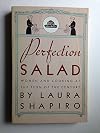
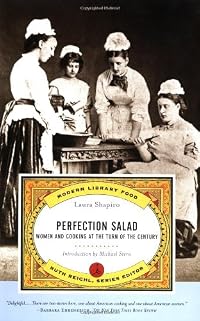
This social history of the culinary habits of turn-of-the-century women depicts their passion and idealism, as well as their frequently bizarre and misguided ideas.Tags
Recommendations














Member Reviews
This was a great read on so many levels. Laura Shapiro writes with an easy and often humorous style. If you are interested in the science behind cooking; the chemical process of cooking food or the biological process of digestion; how arithmetic factors into cooking. How about the study of bacteria, whether it be from the germy dishcloth or the garbage can? Domestic "scientists" were determined to improve diets through science and chemistry.
Cooking because the great equalizer at the turn of the century. the interest in learning to cook was as such that in shops cooking was done in the open so that customers could witness both ingredients and preparation (the birth of the cooking show?).
From a feminist angle, it was great to read about show more so many women "firsts." For example, Ellen Richards as the first woman admitted to the Massachusetts Institute of Technology. Even though she was considered a "special student" she broke the male-only barrier in 1870.
My favorite invention from this time period was the "Aladdin Oven" - a portable stove the size of a dinner pail that would cook a meal all day long. The first slow cooker! show less
Cooking because the great equalizer at the turn of the century. the interest in learning to cook was as such that in shops cooking was done in the open so that customers could witness both ingredients and preparation (the birth of the cooking show?).
From a feminist angle, it was great to read about show more so many women "firsts." For example, Ellen Richards as the first woman admitted to the Massachusetts Institute of Technology. Even though she was considered a "special student" she broke the male-only barrier in 1870.
My favorite invention from this time period was the "Aladdin Oven" - a portable stove the size of a dinner pail that would cook a meal all day long. The first slow cooker! show less
Meandering tale of the home-ec movement in the late 1800s-early 1900s. There's some pretty great source material here, including many back issues of publications like Ladies' Home Journal. Only the first chapter, on domestic sentimental literature, seems prone to the correlation-is-causation problem of cultural criticism. The rest of the book is solidly researched and cleverly written. Instead of glossing over what seems impossible to research (e.g. what were people actually eating, and not writing about), Shapiro uses what she's got, such as letters to the editors of magazines requesting recipes. She also leads you to some insights (What to do with increasing female enrollment in colleges? Shunt them off to food science classes) show more without hitting you over the head with them. show less
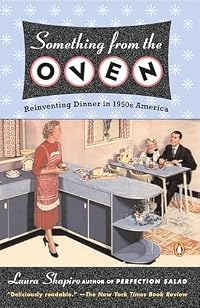
I'd already read Shapiro's follow-up to this, Something From the Oven, and that was a hoot. This one was much drier. In part, probably, because it wasn't covering as goofy an era. I did bog down in boredom a few times.
There weren't as many specifics on the food as I would have liked. You heard over and over again what the home economists were assigning people to eat, but not much about what the public was actually eating and even less about the reasoning behind those healthy selections. It was particularly frustrating to hit the bit near the end that described the big fad to sweeten up all the food (marshmallows in everything) but not why it happened and who was behind it.
The social analysis was still interesting, however. Especially show more the overall thesis that home economists had pretty low opinions of both food and women, and ended up doing neither any favors.
One factoid that stood out due to current events was the belief that it was the responsibility of the homemaker to have a chemistry set at home, and know how to use it, in order to check purchased foods for dangerous additives like, say, melamine. show less
There weren't as many specifics on the food as I would have liked. You heard over and over again what the home economists were assigning people to eat, but not much about what the public was actually eating and even less about the reasoning behind those healthy selections. It was particularly frustrating to hit the bit near the end that described the big fad to sweeten up all the food (marshmallows in everything) but not why it happened and who was behind it.
The social analysis was still interesting, however. Especially show more the overall thesis that home economists had pretty low opinions of both food and women, and ended up doing neither any favors.
One factoid that stood out due to current events was the belief that it was the responsibility of the homemaker to have a chemistry set at home, and know how to use it, in order to check purchased foods for dangerous additives like, say, melamine. show less
A social history of changing attitudes towards cooking and other aspects of homemaking, specifically the emergence of domestic science aka home economics towards the end of the 19th century. The re-imagining and re-purposing of housework (women’s work) as a matter of scientific logic and precision (men’s work) had some interesting social and culinary consequences (some of which Shapiro covers in another excellent book, Something From The Oven).
The title comes from a recipe for chopped vegetables in aspic. At the time, stretching the definition of salad to its absolute limit seems to have been en vogue.
The title comes from a recipe for chopped vegetables in aspic. At the time, stretching the definition of salad to its absolute limit seems to have been en vogue.
This book is basically the history of Home Economics that were taught to the poor in the late 19th and early 20th century. Women in Boston in the late 19th century started a group called the Women's Education Association and later another was the Boston Kitchen.
Women's Education Association of Boston "believed that educated women were the natural leaders of a domestic revolution that was only waiting to be ignited."
Women of these organizations worked to improve the appearance, nutritional value and cost efficiency of the food that was being prepared by the lower classes. Notice that taste did not enter into their equation. If it was nutritious and could be made for pennies a day/person, they didn't care what it taste like. However, back show more in that time , recipes didn't have any consistency until Fannie Farmer came along and standardized measurements. Yes, there really was a Fannie Farmer and when she published recipes they became standards for the new housewives and cooks in the nation. Her books showed basic procedures of how to boil, bake, stew, fry, and debone so that new cooks would be proficient and if when times were tough, domestic help was unattainable.
One of the interesting items was a suggestion that menus be developed according to the workload of the day. Monday - the normal laundry day of the time - was strenuous so potato salad was recommended so that leftovers could then produce mashed potatoes. Tuesday - ironing day - nothing that would give off a scent should be cooked so that the smell of the cooking food wouldn't cling the freshly pressed clothes.
Anything that was served with lettuce was considered a salad - Perfection Salad itself was a mixture of cabbage, celery, and red peppers, chopped finely and bound together by a plain gelatin. Gelatin (KNOX in particular) became very popular at this time. This salad did not last the test of time unlike the Waldorf salad that was developed at the same period. Salads were reserved for the upper class because it was believed that it was Brain food because it required less digestion.
Some fun facts that were noted in the book
It was an interesting book, not sure whether I would recommend it or not because the writing style was a bit dry. show less
Women's Education Association of Boston "believed that educated women were the natural leaders of a domestic revolution that was only waiting to be ignited."
Women of these organizations worked to improve the appearance, nutritional value and cost efficiency of the food that was being prepared by the lower classes. Notice that taste did not enter into their equation. If it was nutritious and could be made for pennies a day/person, they didn't care what it taste like. However, back show more in that time , recipes didn't have any consistency until Fannie Farmer came along and standardized measurements. Yes, there really was a Fannie Farmer and when she published recipes they became standards for the new housewives and cooks in the nation. Her books showed basic procedures of how to boil, bake, stew, fry, and debone so that new cooks would be proficient and if when times were tough, domestic help was unattainable.
One of the interesting items was a suggestion that menus be developed according to the workload of the day. Monday - the normal laundry day of the time - was strenuous so potato salad was recommended so that leftovers could then produce mashed potatoes. Tuesday - ironing day - nothing that would give off a scent should be cooked so that the smell of the cooking food wouldn't cling the freshly pressed clothes.
Anything that was served with lettuce was considered a salad - Perfection Salad itself was a mixture of cabbage, celery, and red peppers, chopped finely and bound together by a plain gelatin. Gelatin (KNOX in particular) became very popular at this time. This salad did not last the test of time unlike the Waldorf salad that was developed at the same period. Salads were reserved for the upper class because it was believed that it was Brain food because it required less digestion.
Some fun facts that were noted in the book
1) daily guidelines were for men 90 gr of protein and 4500 calories per day (reduced slightly if not working at physically demanding labor) where women were 1200 calories (obviously they didn't think that housework in those days was physically demanding). 2) Food at the hospitals, almshouses, and prisons was not supposed to be palatable to prevent the people desiring to return for the food. 3) Ladies Home Journal and Good Housekeeping were part of the Home Economics movement of the time. (I didn't know that.)
It was an interesting book, not sure whether I would recommend it or not because the writing style was a bit dry. show less
I thought this would be better. I loved Ruth Reichl's introduction. I was all set for a fabulous, interesting book. Instead, I found it rather dry. I did learn some things and there were some good parts but all-in-all, the introduction was the best part of this book.
Members
- Recently Added By
Author Information

11+ Works 1,319 Members
Laura Shapiro was an award-winning writer at Newsweek for more than fifteen years. The author of Perfection Salad, she has written for many publications, including The New York Times, Rolling Stone, Granta, and Gourmet. She lives in New York City
Some Editions
Series

Belongs to Publisher Series
Common Knowledge
- Canonical title
- Perfection Salad: Women and Cooking at the Turn of the Century
- Original publication date
- 1986
- People/Characters
- Mary Hinman Abel; Edward Atkinson; W. O. Atwater; Anna Barrows; Isabel Bevier; Helen Campbell (show all 14); Juliet Corson; Fannie Merritt Farmer; Mary J. Lincoln; Maria Parloa; Elizabeth Stuart Phelps; Ellen Richards; Sarah Tyson Rorer; Catharine Maria Sedgwick
- Publisher's editor
- Strachen, Pat
Classifications
Statistics
- Members
- 347
- Popularity
- 90,658
- Reviews
- 7
- Rating
- (3.51)
- Languages
- English
- Media
- Paper
- ISBNs
- 5
- ASINs
- 5