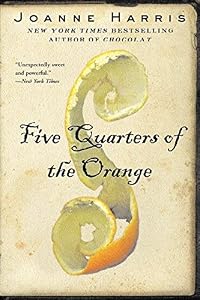
Five Quarters of the Orange
by Joanne Harris
On This Page
Description
When Framboise Simon returns to a small village on the banks of the Loire, the locals do not recognize her as the daughter of the infamous woman they hold responsible for a tragedy during the German occupation years ago. But the past and present are inextricably entwined, particularly in a scrapbook of recipes and memories that Framboise has inherited from her mother. And soon Framboise will realize that the journal also contains the key to the tragedy that indelibly marked that summer of show more her ninth year. . . . show lessTags
Recommendations





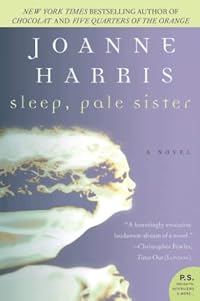




Member Recommendations

Member Reviews
Reading Five Quarters of the Orange felt like stepping into another time. I really liked the way Joanne Harris captured the atmosphere of wartime rural France through the eyes of the children. Framboise, especially, stood out to me — she’s spunky, strong, and independent, even as a child caught in difficult times, and she is the narrator of this story. But she had a dark side with the way she fought against her mother. That bothered me a bit with the intensity but it made her a strong person. I admired how she carried that strength into adulthood, even when haunted by memories of the past, even though she had to assume a new identity to return to the village of her childhood late in life.
I was less thrilled with the modern part of show more the story where sibling frictions were rather annoying. All over a "secret" cookbook and recipes that Framboise's mother had made into a diary, which required careful translation to discover the reality of the childhood times and the person behind the mother's mask.
The German soldier storyline was fascinating too, but it got sort of dropped for a time after being an important part of the story, before coming back. Harris gave him a kind of complexity that made the story feel more real, and sympathetic, not just a simple “good vs. bad” setup.
And the final ending was sweet and satisfying. Seeing Framboise reconnect with Paul, her childhood friend, felt like a gentle full circle, a quiet kind of healing after so much pain. The mix of wartime shadows and a sort of personal redemption is what made the book linger with me after finishing it.
I can see myself rereading this again one day, if only there weren't so many other great books calling. show less
I was less thrilled with the modern part of show more the story where sibling frictions were rather annoying. All over a "secret" cookbook and recipes that Framboise's mother had made into a diary, which required careful translation to discover the reality of the childhood times and the person behind the mother's mask.
The German soldier storyline was fascinating too, but it got sort of dropped for a time after being an important part of the story, before coming back. Harris gave him a kind of complexity that made the story feel more real, and sympathetic, not just a simple “good vs. bad” setup.
And the final ending was sweet and satisfying. Seeing Framboise reconnect with Paul, her childhood friend, felt like a gentle full circle, a quiet kind of healing after so much pain. The mix of wartime shadows and a sort of personal redemption is what made the book linger with me after finishing it.
I can see myself rereading this again one day, if only there weren't so many other great books calling. show less
Five Quarters of the Orange is set in a chocolate-box France—all placid countryside and slow-moving Loire and small villages where the peasants gather each morning in the local creperie for their café au lait—and is full of so many descriptions of luscious meals that my mouth watered throughout. Despite the tactility and the sensuality of the writing, though, this is quite a dark book, which deals with the occupation of France during the Second World War, collaboration and its aftermath. It's a quick and engrossing read, though I was never quite convinced by Harris' characters—Framboise, the main character, is supposedly nine years old when the central events of the novel occur, but her thoughts, her dialogue and her behaviour show more were far, far too mature for a nine year old in the 1940s. Had Harris made her 12 or 13, I think, it would have resolved quite a few of my difficulties with the book. I think the way she drew things out also made for a novel which was curiously—dispassionate? that might be the word I'm looking for—in spite of the fact that so many of the characters were marked out by their bitterness and their anger. show less
There is something a little unbalanced about this book -- and one gets that feeling from the start. In fact, the title itself suggests a certain asymmetrical allure which is disconcerting: five quarters of the orange suggests a lopsided business, perhaps; but nonetheless a surfeit of something. The "too many" quarters-of-the-orange makes me uneasy and leaves me wondering how it will all fit back together again, once sliced. In the end, the title presages its own problematic ending.
I loved Framboise the moment I met her because contrary to the lushness that her name suggests, she is quite a tough little nut to crack. She is strong and wilful, disconcertingly honest and brave as a Spaniard. Despite that she is the youngest, her siblings show more pale in comparison to her; and indeed, they are written in as "extras" -- vapid little ghosts without much to them.
Framboise's dark strength is counter-balanced by her mother's ephemeral nature. For the most part, the mother suffers in a tormented hell in the curtained darkness of her room. Her migraine headaches, brought on by the scent of oranges, keeps her absent from her own life and leaves her open to the doom that the children's mischief will eventually bring upon her.
In a strange contradiction of her own nature, the mother is also a superb cook: the delicious meals she prepares would make a voluptuary blush -- an irony, and an enigma. How does one gather such fruits, (quite literally) when the rest of Europe is starving? This rang something of a false note -- but perhaps the juxtaposition suggests that out of rotten fruit can spring the most wondrous delicacies? Still ...
Some of the writing falls into cliché, at times, and I found some of the scenes to be improbable. The evening at La Mauvaise Reputation, for instance, reads like the author may have had a bit of an eye on a movie-script for Hollywood, as rife as it is with patter.
I did expect a somewhat more complex ending, especially given the originality and strength of the majority of the book. I asked myself ... can it really be that simple? ... Can it really be that banal? And then I started to wonder if the beauty wasn't in the simplicity after all.
Whatever some of its minor problems may be, every inch of this book rings with life. The sights and scents and sounds of war-torn France grip every corner of every page and I found myself turning the pages with the same relish as indulging in an epicure's meal. I think I gained 5 lbs by reading this book, so hungry was I for the menu before me.
After all is said and done: I was sorely disappointed when I reached the final paragraph, because I knew there wouldn't be more. show less
I loved Framboise the moment I met her because contrary to the lushness that her name suggests, she is quite a tough little nut to crack. She is strong and wilful, disconcertingly honest and brave as a Spaniard. Despite that she is the youngest, her siblings show more pale in comparison to her; and indeed, they are written in as "extras" -- vapid little ghosts without much to them.
Framboise's dark strength is counter-balanced by her mother's ephemeral nature. For the most part, the mother suffers in a tormented hell in the curtained darkness of her room. Her migraine headaches, brought on by the scent of oranges, keeps her absent from her own life and leaves her open to the doom that the children's mischief will eventually bring upon her.
In a strange contradiction of her own nature, the mother is also a superb cook: the delicious meals she prepares would make a voluptuary blush -- an irony, and an enigma. How does one gather such fruits, (quite literally) when the rest of Europe is starving? This rang something of a false note -- but perhaps the juxtaposition suggests that out of rotten fruit can spring the most wondrous delicacies? Still ...
Some of the writing falls into cliché, at times, and I found some of the scenes to be improbable. The evening at La Mauvaise Reputation, for instance, reads like the author may have had a bit of an eye on a movie-script for Hollywood, as rife as it is with patter.
I did expect a somewhat more complex ending, especially given the originality and strength of the majority of the book. I asked myself ... can it really be that simple? ... Can it really be that banal? And then I started to wonder if the beauty wasn't in the simplicity after all.
Whatever some of its minor problems may be, every inch of this book rings with life. The sights and scents and sounds of war-torn France grip every corner of every page and I found myself turning the pages with the same relish as indulging in an epicure's meal. I think I gained 5 lbs by reading this book, so hungry was I for the menu before me.
After all is said and done: I was sorely disappointed when I reached the final paragraph, because I knew there wouldn't be more. show less
I found this book to be a very engrossing read. Set in a small French town, the protagonist, Framboise Simon refects on her past life as a nine year old farm girl(during World War II) and her present life as a sixty five extremely bitter woman.
I was fascinating with the character development in this story, Framboise (Boise) was an extremely cruel child and hateful older woman. Although the character never had any redeeming qualities, I wanted to know her story. I wanted to know about each family member's secrets, what happened with the German soldier, and most importantly, what happened the summer of Boise's ninth year.
Add the many food references to this wonderful book and it makes for an excellent read.
I was fascinating with the character development in this story, Framboise (Boise) was an extremely cruel child and hateful older woman. Although the character never had any redeeming qualities, I wanted to know her story. I wanted to know about each family member's secrets, what happened with the German soldier, and most importantly, what happened the summer of Boise's ninth year.
Add the many food references to this wonderful book and it makes for an excellent read.
A little village on the Loire is the setting of the story. A war widow tends to her farm and her three children, while writing recipes and the details of a troubled life.
I loved the atmospheric setting, the complex relations between the villagers and the invading Germans. The blurring of the lines of propriety and morality during times of war, and the mixed loyalties. On another level, though, the secret and the buildup to it became too predictable towards the end. So the novel did not have the interesting plots of her previous work. But for a short book it is worth the time, if only for the description of food.
I loved the atmospheric setting, the complex relations between the villagers and the invading Germans. The blurring of the lines of propriety and morality during times of war, and the mixed loyalties. On another level, though, the secret and the buildup to it became too predictable towards the end. So the novel did not have the interesting plots of her previous work. But for a short book it is worth the time, if only for the description of food.
I enjoyed this story about life in occupied rural France during World War II. The writing is excellent...giving hints of deeper truths that are revealed at the end; and evoking the atmosphere of the setting so well. The characters are complex and nuanced. This is a story about how difficult it is to know the truth, about relationships, and about the consequences of war beyond the battlefields.
A look back at an anything but innocent childhood along the Loire in WWII. Framboise is the youngest of three children of a war widow and is involved with her older siblings in interactions with a young German soldier who charms and manipulates everyone securing information used not for the military but for personal gain. Combined with their unstable mother ruthlessly manipulated by Framboise the situation becomes entirely unstable. In the retrospective it is her nephew's journalist wife who wants to write a book about what happened whereas Framboise wants to maintain the secrets she has kept for over half a century. I felt the ending was the weakest part of story and didn't do it any favors.
Members
- Recently Added By
Lists

Favourite Women's Prize for Fiction, Orange & Bailey's Prize contenders
132 works; 52 members

Books That Made Me Cry
199 works; 105 members

Books about World War II
241 works; 22 members

Best family sagas
244 works; 33 members

Stories set in Western Europe
36 works; 1 member

Food Fiction
24 works; 7 members

A Smorgasbord of Culinary Fiction
221 works; 94 members

Top Five Books of 2025
950 works; 302 members
Talk Discussions
Past Discussions
Five Quarters of the Orange by Joanne Harris in Orange January/July (October 2011)
Author Information

61+ Works 32,102 Members
Joanne Harris was born in Barnsley, Yorkshire, England on July 3, 1964. She studied Modern and Mediaeval Languages at St Catharine's College, Cambridge. While working as a teacher for fifteen years, she published three novels: The Evil Seed (1989), Sleep, Pale Sister (1993) and Chocolat (1999), which was made into a film starring Juliette Binoche show more and Johnny Depp. Her other works include Blackberry Wine, Five Quarters of the Orange, Coastliners, Holy Fools, The Lollipop Shoes and Runemarks. She also co-wrote two cookbooks with cookery writer Fran Warde: The French Kitchen and The French Market. (Bowker Author Biography) show less
Some Editions
Awards and Honors
Awards
Distinctions
Notable Lists
Series
Belongs to Publisher Series
Gallimard, Folio (4005)
Work Relationships
Common Knowledge
- Canonical title
- Five Quarters of the Orange
- Original title
- Five quarters of the orange
- Original publication date
- 2001
- People/Characters
- Framboise Simon; Tomas Liebniz,; Mirabelle Dartigen
- Important places
- Loire Valley, France; France
- Important events
- World War II, German Occupation of France (1940 | 1944); World War II (1939 | 1945)
- Dedication
- To my granfather, Georges Payen, who was there.
- First words
- When my mother died, she left the farm to my brother, Cassis, the fortune in the wine cellar to my sister, Reine-Claude, and to me the youngest, her album, and a two-liter jar containing a single black Perigord truffle, large... (show all) as a tennis ball, suspended in sunflower oil, that, when uncorked, still releases the rich dank perfume of the forest floor.
- Last words
- (Click to show. Warning: May contain spoilers.)We toasted our homecomings with sweet black coffee and croissants and green-tomato jam made to my mother's recipe.
Classifications
Statistics
- Members
- 4,190
- Popularity
- 3,619
- Reviews
- 89
- Rating
- (3.75)
- Languages
- 28 — Bulgarian, Catalan, Czech, Danish, Dutch, English, Finnish, French, German, Greek, Hebrew, Hungarian, Italian, Japanese, Korean, Lithuanian, Norwegian, Polish, Russian, Serbian, Croatian, Slovenian, Spanish, Swedish, Turkish, Ukrainian, Portuguese (Portugal), Chinese, traditional
- Media
- Paper, Audiobook, Ebook
- ISBNs
- 68
- ASINs
- 23