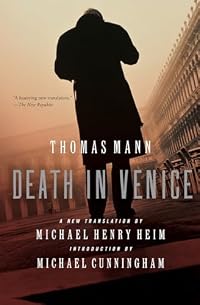
Death in Venice
by Thomas Mann 
On This Page
Description
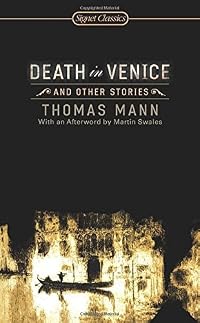
The world-famous masterpiece by Nobel laureate Thomas Mann-here in a new translation by Michael Henry Heim Published on the eve of World War I, a decade after Buddenbrooks had established Thomas Mann as a literary celebrity, Death in Venice tells the story of Gustave von Aschenbach, a successful but aging writer who follows his wanderlust to Venice in search of spiritual fulfillment that instead leads to his erotic doom. In the decaying city, besieged by an unnamed epidemic, he becomes show more obsessed with an exquisite Polish boy, Tadzio. “It is a story of the voluptuousness of doom,” Mann wrote. “But the problem I had especially in mind was that of the artist's dignity.”. show lessTags
Recommendations




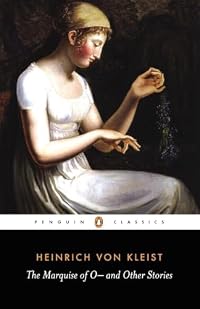
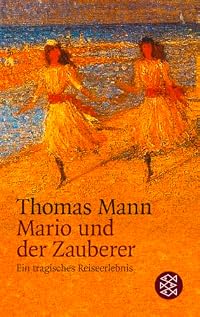















Member Recommendations


by spiphany

JuliaMaria Königsallee, ein biografischer Roman über Karl Heuser und Thomas Mann. Karl Heuser soll Vorbild für die Josephsfigur gewesen sein, gleichzeitig aber auch eine der großen Lieben Thomas Manns. Wie in der autobiografischen Erzählung von Thomas Mann "Tod in Venedig" geht es um die homoerotische Beziehung zwischen einem älteren Mann und einem schönen Knaben.
Member Reviews
"...where the hideous death lurked in secret—at such times the atrocious seemed to him rich in possibilities, and laws of morality had dropped away."
The novel astonished me. It wasn't what I expected. It is quite brilliant, a masterpiece.
Unlike others, I didn't find this novel explicitly about pedophilia--unlike Lolita, which distinctly and undeniably is. I know that won't sit well with everyone. I can understand that. When I watched the 1971 film of the novel, that pedophilia lust was a major aspect and exacerbated by the shameful exploitation and lack of protection for "the most beautiful boy in the world," the real youth, Björn Andrésen. But the novel is about so much more than that. It is about lust, but also lust for life, for show more youth, for beauty, for being loved in spite of outward appearances (ironic, I know) by a misguided man who never so much as even speaks a word to the boy.
The man is Gustav von Aschenbach, age 50, who, up to this point, has over-intellectualized his whole life, putting Art with a capitol A as the most desirable and potent of all things. He has never been a physically robust or a remarkably attractive person and does not seem to, thus far, possess any passion, except in theory. He has a grown daughter and had a wife who has since died. He describes their marriage as having been happy, although that seems faint praise since he doesn't even call her by name. From an early age, he has given his truest devotions to his work. That is what has provided his life, if not passion, its meaning, satisfaction, staid acclimation, respectability, honors, and financial reward. His work has been accomplished with deliberate study and steadfastness. His whole identity is Artist. A tightly controlled one.
When he decides to go for a vacation to Venice ("Not far, not all the way to the tigers"), it is the first sign Aschenbach is not quite as satisfied as he once was. He is repulsed by ugliness, and especially the ugliness of, we slowly learn, of aging. And he is aging.
The brilliance of Mann is how deftly he takes readers down the emotionally stifled deterioration of Aschenbach, through so many successively progressive stages, until ultimately to his complete humiliated, unraveled, unfettered indulgence of his long ignored emotions.
Upon seeing a remarkably beautiful 14 year old boy at his Venice hotel (we can agree that we too can be momentarily smitten by a remarkable beauty, at any age; we too have eyes)--begins in earnest his slow but pointed rejection of his own aging and transforms the rejection into an absurd hope, then obsession, and then a truly wicked disregard for danger. All for the sake of a ridiculous projected fantasy of a reciprocal budding love with this boy. An elixir.
It's not an easy novel to experience, but it's not exactly about outright sexual deviance either. It is full moral abandonment of self-regard due to fear of aging and death.
It's a story of such pathos, repugnance, and, under Mann's genius, deep sadness, even pity. Aschenbach began a needlessly tragic journey with a mere natural, but much belated observation about his own capacity for lust that he has dismissed since his youth for the sake of his plans for success. When his intellectualizing about Eros and Socrates and whatever Classicism he has hitherto relied on for balance and harmony, when those begin to ring more and more hollow, he progressively becomes consumed by "the tigers" he once avoided, to self obliteration.
And it started with a small belated recognition of delight in feelings,
"Past emotions, precious early afflictions and yearnings which had been stifled by his rigorous programme of living, were now returning in such strange new forms. With an embarrassed, astonished smile, he recognized them..." show less
The novel astonished me. It wasn't what I expected. It is quite brilliant, a masterpiece.
Unlike others, I didn't find this novel explicitly about pedophilia--unlike Lolita, which distinctly and undeniably is. I know that won't sit well with everyone. I can understand that. When I watched the 1971 film of the novel, that pedophilia lust was a major aspect and exacerbated by the shameful exploitation and lack of protection for "the most beautiful boy in the world," the real youth, Björn Andrésen. But the novel is about so much more than that. It is about lust, but also lust for life, for show more youth, for beauty, for being loved in spite of outward appearances (ironic, I know) by a misguided man who never so much as even speaks a word to the boy.
The man is Gustav von Aschenbach, age 50, who, up to this point, has over-intellectualized his whole life, putting Art with a capitol A as the most desirable and potent of all things. He has never been a physically robust or a remarkably attractive person and does not seem to, thus far, possess any passion, except in theory. He has a grown daughter and had a wife who has since died. He describes their marriage as having been happy, although that seems faint praise since he doesn't even call her by name. From an early age, he has given his truest devotions to his work. That is what has provided his life, if not passion, its meaning, satisfaction, staid acclimation, respectability, honors, and financial reward. His work has been accomplished with deliberate study and steadfastness. His whole identity is Artist. A tightly controlled one.
When he decides to go for a vacation to Venice ("Not far, not all the way to the tigers"), it is the first sign Aschenbach is not quite as satisfied as he once was. He is repulsed by ugliness, and especially the ugliness of, we slowly learn, of aging. And he is aging.
The brilliance of Mann is how deftly he takes readers down the emotionally stifled deterioration of Aschenbach, through so many successively progressive stages, until ultimately to his complete humiliated, unraveled, unfettered indulgence of his long ignored emotions.
Upon seeing a remarkably beautiful 14 year old boy at his Venice hotel (we can agree that we too can be momentarily smitten by a remarkable beauty, at any age; we too have eyes)--begins in earnest his slow but pointed rejection of his own aging and transforms the rejection into an absurd hope, then obsession, and then a truly wicked disregard for danger. All for the sake of a ridiculous projected fantasy of a reciprocal budding love with this boy. An elixir.
It's not an easy novel to experience, but it's not exactly about outright sexual deviance either. It is full moral abandonment of self-regard due to fear of aging and death.
It's a story of such pathos, repugnance, and, under Mann's genius, deep sadness, even pity. Aschenbach began a needlessly tragic journey with a mere natural, but much belated observation about his own capacity for lust that he has dismissed since his youth for the sake of his plans for success. When his intellectualizing about Eros and Socrates and whatever Classicism he has hitherto relied on for balance and harmony, when those begin to ring more and more hollow, he progressively becomes consumed by "the tigers" he once avoided, to self obliteration.
And it started with a small belated recognition of delight in feelings,
"Past emotions, precious early afflictions and yearnings which had been stifled by his rigorous programme of living, were now returning in such strange new forms. With an embarrassed, astonished smile, he recognized them..." show less
Creepy and disturbing like a fever dream, as infection encroaches on the city and corruption on the protagonist's soul with the same icky stench.
Also, weird book to read during a pandemic! deeply upsetting and grimly funny at the same time? All this stuff about how the authorities are trying to hush up the situation so as not to spook the tourists, and the numbers of sick and dead are printed in the newspapers every morning, but the numbers shift around and are unreliable, and some people are saying the problem is being overblown, and the government is trying to put public health measures in place, but no one is sure if they are effective, and the people are uncooperative because they are worried about their businesses suffering...
show more target="_top">https://donut-donut.dreamwidth.org/828141.html show less
Also, weird book to read during a pandemic! deeply upsetting and grimly funny at the same time? All this stuff about how the authorities are trying to hush up the situation so as not to spook the tourists, and the numbers of sick and dead are printed in the newspapers every morning, but the numbers shift around and are unreliable, and some people are saying the problem is being overblown, and the government is trying to put public health measures in place, but no one is sure if they are effective, and the people are uncooperative because they are worried about their businesses suffering...
show more target="_top">https://donut-donut.dreamwidth.org/828141.html show less
It can be a joy to be wrong sometimes. Going into this collection I didn't have much to go on regarding Thomas Mann. I'd heard some biographical details and titles of works, but nothing more. I'd heard his name mentioned in the same breaths and sentences as Kafka, Goethe, Hesse, in German literature particularly, and in the same vein along some of the writers of the highest echelons of the world generally, but I, for lack of a better term, never got around to him. I expected him to be the runt of the German litter, the one who came late to the party and only made it in by the skin of his teeth. I was wrong beyond words.
But one early evening segueing languidly into night in Jerusalem, I popped into a used bookshop (which, wonderfully, show more Jerusalem has plenty of) and picked up a few tomes for my soon to be coming move back to America. I was in an odd state of mind as I was tremendously relieved to be traveling back to the country of my upbringing with all that that entailed...but I was also more than a bit sad, troubled even, that I hadn't succeeded in Israel. Not getting into the army, not learning Hebrew quickly enough to get a job to improve it further and also being unable to attain the Masters degree I had to set out to obtain...I was tired, so tired, in so many ways.
On that night though, I picked up (if I recall correctly) Peer Gynt, a copy of A History of Ancient Philosophy, and this Thomas Mann collection.
A lot happened between my buying the collection and my actually reading it. For one thing, I left Israel and spent an eventful and infinitely memorable six days in Estonia. After that I made my way back home to California. It was there I started thumbing through Death in Venice.
It was a slow process. I thought after reading Saul Bellow I'd be ready for languid prose that took it's time and suffused the pages as well as nearly overwhelmed the reader with no acquiescence to ease or convenience. But Bellow would be the speaker at the dinner party, the man surrounded by onlookers throwing out as many cultured references and allusions as he can muster in an attempt to do through force what a writer like Mann, the one sitting around a fire place with a sparse but intimate number of friends can do easily, casually, with no less effort, but with infinitely more grace, calculation, and, dare I say, skill.
Death in Venice is haunting to me because it acts, completely knowingly, as a collapsing bridge between two exclusive worlds beyond joining, that are also inexorably linked. The ancient world of the classics, of Greek, of Latin, of Gods and and passion and feeling more fluid, more primal than what we have now. And the second world, our ostensible world, a world trying harder and harder to divest itself of its more flexible, even more sylvan past, and maintain everything through repetitious, near dogmatic assertions of reason, logic, philosophy, science, all of it meant to make explicable, make real, make palatable our reality. But Mann in this story, depicts a man torn in half who vacillates between straddling the line and, finally, inevitably, letting it cut him in two, destroying him utterly. It's a fecund and feverish story that's relentless in its artistry. Objectionable due to the content? Of a grown man fallen in hopeless love and lust for a boy? Oh, most definitely. But that's the point. It's from this vantage point Mann shows us two worlds colliding, and all the passionate and destructive fallout that ensues. It's a lush and even deadly story.
Now, as for the rest of the collection. What can I possibly say? They are all excellent. And considering this is a short story collection that's doubly impressive. I don't think I've ever given a perfect score to any collection like this before, not even Joyce's Dubliners. Tonio Kruger is as beautiful an authorial and even artistic manifesto as one is likely to find (hand in hand with Portrait of the Artist), Man and his Dog is a humble and warm slice of life, Tristan is a maddening look at human frailty and the power coupled with futility of the written word, Blood of the Walsungs is a masterwork of decadence and narcissism and an incredible depiction of an empty and superficial generation descending into apathy and slow irrelevant death. Mario and the Magician is a deft satire about the rise of character based cults in German leadership and chilling given its context. Disorder and Early Sorrow feels like a blueprint for later works, a slow and drawn out exhalation that still holds true and still shows the keenness of Mann's vision. And finally Felix Krull, while funny, is also unexpectedly tragic, so much so that I believe the last few lines of it, of a son paying tribute to a dead father through the gift of his tears, will stay with me for quite some time, if not for the rest of my time I read and think.
It's a powerful collection, at times, many times, even sublime. Please devote yourself to it when you get a chance, make the time for it even. It's worth far and beyond the time and energy needed to read it and will pay you back emotionally, even spiritually, in dividends, as an affirmation or possibly a reaffirmation of the awesome and necessary power of true words written by a divinely skilled hand. And now, as per a friend's advice, I must start the Magic Mountain, possibly even putting my life on hold until it's finished and appreciated fully. show less
But one early evening segueing languidly into night in Jerusalem, I popped into a used bookshop (which, wonderfully, show more Jerusalem has plenty of) and picked up a few tomes for my soon to be coming move back to America. I was in an odd state of mind as I was tremendously relieved to be traveling back to the country of my upbringing with all that that entailed...but I was also more than a bit sad, troubled even, that I hadn't succeeded in Israel. Not getting into the army, not learning Hebrew quickly enough to get a job to improve it further and also being unable to attain the Masters degree I had to set out to obtain...I was tired, so tired, in so many ways.
On that night though, I picked up (if I recall correctly) Peer Gynt, a copy of A History of Ancient Philosophy, and this Thomas Mann collection.
A lot happened between my buying the collection and my actually reading it. For one thing, I left Israel and spent an eventful and infinitely memorable six days in Estonia. After that I made my way back home to California. It was there I started thumbing through Death in Venice.
It was a slow process. I thought after reading Saul Bellow I'd be ready for languid prose that took it's time and suffused the pages as well as nearly overwhelmed the reader with no acquiescence to ease or convenience. But Bellow would be the speaker at the dinner party, the man surrounded by onlookers throwing out as many cultured references and allusions as he can muster in an attempt to do through force what a writer like Mann, the one sitting around a fire place with a sparse but intimate number of friends can do easily, casually, with no less effort, but with infinitely more grace, calculation, and, dare I say, skill.
Death in Venice is haunting to me because it acts, completely knowingly, as a collapsing bridge between two exclusive worlds beyond joining, that are also inexorably linked. The ancient world of the classics, of Greek, of Latin, of Gods and and passion and feeling more fluid, more primal than what we have now. And the second world, our ostensible world, a world trying harder and harder to divest itself of its more flexible, even more sylvan past, and maintain everything through repetitious, near dogmatic assertions of reason, logic, philosophy, science, all of it meant to make explicable, make real, make palatable our reality. But Mann in this story, depicts a man torn in half who vacillates between straddling the line and, finally, inevitably, letting it cut him in two, destroying him utterly. It's a fecund and feverish story that's relentless in its artistry. Objectionable due to the content? Of a grown man fallen in hopeless love and lust for a boy? Oh, most definitely. But that's the point. It's from this vantage point Mann shows us two worlds colliding, and all the passionate and destructive fallout that ensues. It's a lush and even deadly story.
Now, as for the rest of the collection. What can I possibly say? They are all excellent. And considering this is a short story collection that's doubly impressive. I don't think I've ever given a perfect score to any collection like this before, not even Joyce's Dubliners. Tonio Kruger is as beautiful an authorial and even artistic manifesto as one is likely to find (hand in hand with Portrait of the Artist), Man and his Dog is a humble and warm slice of life, Tristan is a maddening look at human frailty and the power coupled with futility of the written word, Blood of the Walsungs is a masterwork of decadence and narcissism and an incredible depiction of an empty and superficial generation descending into apathy and slow irrelevant death. Mario and the Magician is a deft satire about the rise of character based cults in German leadership and chilling given its context. Disorder and Early Sorrow feels like a blueprint for later works, a slow and drawn out exhalation that still holds true and still shows the keenness of Mann's vision. And finally Felix Krull, while funny, is also unexpectedly tragic, so much so that I believe the last few lines of it, of a son paying tribute to a dead father through the gift of his tears, will stay with me for quite some time, if not for the rest of my time I read and think.
It's a powerful collection, at times, many times, even sublime. Please devote yourself to it when you get a chance, make the time for it even. It's worth far and beyond the time and energy needed to read it and will pay you back emotionally, even spiritually, in dividends, as an affirmation or possibly a reaffirmation of the awesome and necessary power of true words written by a divinely skilled hand. And now, as per a friend's advice, I must start the Magic Mountain, possibly even putting my life on hold until it's finished and appreciated fully. show less
Death in Venice is a novella written by German author, Thomas Mann. It was first published in 1912. It is a story about a writer who is suffering from writer’s block. He visits Venice and finds himself liberated, uplifted and then obsessed by the sight of a beautiful boy. Though he never actually speaks to the boy, or has any contact whatsoever, the writer feels a great passion. This obsession that he feels distracts him from the fact that rumors have begun to circulate about a disease that is spreading through the city.
Although a slim volume, Death in Venice is far from light reading. Strangely decadent and uncomfortable yet beautifully written the author uses the contrast between the young boy and the elderly author to symbolize the show more variation between youth and old age, as well as external and internal beauty and, of course, life and death. This symbolic story definitely held my attention but I felt myself more drawn to his writing style than to the story itself. show less
Although a slim volume, Death in Venice is far from light reading. Strangely decadent and uncomfortable yet beautifully written the author uses the contrast between the young boy and the elderly author to symbolize the show more variation between youth and old age, as well as external and internal beauty and, of course, life and death. This symbolic story definitely held my attention but I felt myself more drawn to his writing style than to the story itself. show less
Right after I revisited Death in Venice, in whose cult I counted myself as a teen, I perused this history of interpretation: Thomas Mann's Death in Venice: A Novella and its Critics. I’ve come to the conclusion that this story which rests on atmophere and symbolism is an ‘As You Like It’ affair: interpretations range wildly, and Mann did not in fact give certain information as to his intentions. Besides, with a plot like this, how was he to speak out, post-publication, without positions of defence and postures in response to criticism?
Death in Venice keeps its mystery, or rather, its individuality, as if written for you to make of it ‘What You Will’ (another Shakespeare title. It’s apt somehow).
I know that, devoted as I am show more to this little book at story-level, I can happily live with Death in Venice for the rest of my life, read the English translations, and each time see a different meaning in its swirl of dream and intellectualisation around Beauty, Truth and Art. At the moment I might say it’s like that line of Keats: ‘Beauty is truth, truth beauty,—that is all/ Ye know on earth, and all ye need to know.’ Which in turn has been to me a statement more to ponder than to understand. Death in Venice can be seen as a radical challenge to that line, a cruel refutation, a glorious endorsement. I just don’t know. Did Mann? show less
Death in Venice keeps its mystery, or rather, its individuality, as if written for you to make of it ‘What You Will’ (another Shakespeare title. It’s apt somehow).
I know that, devoted as I am show more to this little book at story-level, I can happily live with Death in Venice for the rest of my life, read the English translations, and each time see a different meaning in its swirl of dream and intellectualisation around Beauty, Truth and Art. At the moment I might say it’s like that line of Keats: ‘Beauty is truth, truth beauty,—that is all/ Ye know on earth, and all ye need to know.’ Which in turn has been to me a statement more to ponder than to understand. Death in Venice can be seen as a radical challenge to that line, a cruel refutation, a glorious endorsement. I just don’t know. Did Mann? show less
This is my first experience of Thomas Mann and I am staggered by how much he can pack into a book that I would term more a novella than a novel. First off, nobody would accuse Mann of not being intellectual enough. I stopped several times to ponder the classical allusions that were scattered throughout the story, some of them obvious references and some of them so subtle that they might easily escape your notice. None of them irrelevant, however; all contributing something to the meaning and understanding of the story and most foreshadowing the outcome.
The strange conveyance, handed down without any change from days of yore, and so peculiarly black--the only other thing that black is a coffin--recalls hushed criminal adventures in the show more night, accompanied only by the quiet splashing of water; even more, it recalls death itself, the bier and the dismal funeral and the final taciturn passage. And have you observed that the seat in such a boat, that armchair painted black like a coffin and upholstered in a dull black, is the softest, most luxurious and enervating seat in the world?
What a visceral writer he is! Once he engaged me, he kept me to the end, which was one of the finest endings I could imagine. I would caution other readers that the start of this is extremely laborious and slow. It provides information that is essential to understanding this man and his ramblings, but I had to push through the first two chapters. Once Aschenbach makes the decision to go to Venice, the writing begins to flow.
There is a predatory element to this novel that makes the reader cringe. Unlike the perversion in Lolita, this perversion is kept in the right perspective for me; the child is innocent and there is no pretense that there is anything pure or acceptable about the thoughts of this old man.
There are numerous themes running through this novel. The irony of a man who criticizes others for faults he so obviously shares; the contrast between youth and old age, innocence and corruption; the presence of death in the midst of life; and the corrosive nature of self-importance. It is a novel that begs to be dissected with a scalpel. Can’t say I “enjoyed” it, but I do think it is an important piece of literature that conjure up Poe’s Mask of the Red Death and Wilde’s Portrait of Dorian Grey for me. show less
The strange conveyance, handed down without any change from days of yore, and so peculiarly black--the only other thing that black is a coffin--recalls hushed criminal adventures in the show more night, accompanied only by the quiet splashing of water; even more, it recalls death itself, the bier and the dismal funeral and the final taciturn passage. And have you observed that the seat in such a boat, that armchair painted black like a coffin and upholstered in a dull black, is the softest, most luxurious and enervating seat in the world?
What a visceral writer he is! Once he engaged me, he kept me to the end, which was one of the finest endings I could imagine. I would caution other readers that the start of this is extremely laborious and slow. It provides information that is essential to understanding this man and his ramblings, but I had to push through the first two chapters. Once Aschenbach makes the decision to go to Venice, the writing begins to flow.
There is a predatory element to this novel that makes the reader cringe. Unlike the perversion in Lolita, this perversion is kept in the right perspective for me; the child is innocent and there is no pretense that there is anything pure or acceptable about the thoughts of this old man.
There are numerous themes running through this novel. The irony of a man who criticizes others for faults he so obviously shares; the contrast between youth and old age, innocence and corruption; the presence of death in the midst of life; and the corrosive nature of self-importance. It is a novel that begs to be dissected with a scalpel. Can’t say I “enjoyed” it, but I do think it is an important piece of literature that conjure up Poe’s Mask of the Red Death and Wilde’s Portrait of Dorian Grey for me. show less
For all the potential intrigue of this novel, I found it slightly underwhelming. The protagonist - an author past his prime - indulges his own whims and obsessions even with the claim at the outset of the story of being an industrious artisan of extreme discipline. I’m not sure if the theory of the mid-life crisis was an identified theme pre-WWI, but Thomas Mann has clearly tapped into the essence of the middle-aged man who reaches his peak achievement in life (in Gusdtav’s case, he has gained literary fame and has built a stable life for himself) and then throws everything away for want of knowing what to do with himself. Going on a summer jaunt to Venice is not really our traveller’s crime here, but I can’t see his obsession show more with the Polish boy, Tadzio, as anything other than a kind of sick mania. Gustav is a widower, so his emotional latching on to the sickly youth is clearly at odds with his “normative” lifestyle and his stalking behaviour is an engagement that flirts very directly with danger. At the climax of the novel, which I view as his discovery of the truth about the cholera epidemic, does nothing to halt his rash behaviour. It is only with his death - once again staring out at the boy who has come to rule his life - that the reader is brought to any sort of ending, even though it does not seem to fit the building of the narrative. Is Mann a critic of Gustav? Or does he prefer the romanticism of dying with one’s life’s goals unattained, but steeped in passion? It is an odd ending to a strange story, and seems to bring the reader back to the centre of the narrative, as we are kept perpetually waiting for Tadzio’s true reaction to his stalker’s affections. show less
Members
- Recently Added By
Published Reviews
ThingScore 50
This man in the gate of the cemetery is almost the Motiv of the story. By him, Aschenbach is infected with a desire to travel. He examines himself minutely, in a way almost painful in its frankness, and one sees the whole soul of this author of fifty-three. And it seems, the artist has absorbed the man, and yet the man is there, like an exhausted organism on which a parasite has fed itself show more strong. Then begins a kind of Holbein Totentanz. The story is quite natural in appearance, and yet there is the gruesome sense of symbolism throughout...
It is as an artist rather than as a story-teller that Germany worships Thomas Mann. And yet it seems to me, this craving for form is the outcome, not of artistic conscience, but of a certain attitude to life... Thomas Mann seems to me the last sick sufferer from the complaint of Flaubert. The latter stood away from life as from a leprosy. show less
It is as an artist rather than as a story-teller that Germany worships Thomas Mann. And yet it seems to me, this craving for form is the outcome, not of artistic conscience, but of a certain attitude to life... Thomas Mann seems to me the last sick sufferer from the complaint of Flaubert. The latter stood away from life as from a leprosy. show less
added by SnootyBaronet
Lists

The Guardian's 1000 Novels Everyone Must Read
1,005 works; 549 members

1001 Books You Must Read Before You Die
1,448 works; 1,131 members

Read the book and saw the movie
1,170 works; 195 members

German Literature
518 works; 55 members
20th Century Literature
1,161 works; 54 members

1910s
90 works; 16 members

Best Psychological Fiction
81 works; 16 members

Books Set in Italy
167 works; 19 members

Favourite Books
1,817 works; 309 members

Favorite Literary Love Stories
182 works; 100 members
Canon de la narrativa universal del siglo XX
254 works; 6 members

Pre-1969 LGBTQ Literature
182 works; 66 members

Best Books About Plagues and Epidemics
99 works; 15 members

Short and Sweet
243 works; 23 members
LibraryThingers' 1001 Books You Must Read Before You Die
442 works; 30 members

1,001 BYMRBYD Concensus
723 works; 27 members

100 Most Recommended Works
100 works; 11 members

Modernism
140 works; 8 members

Daria Morgendorffer's Bookshelf
70 works; 5 members

A Novel Cure
742 works; 23 members

College Reads (Lit Edition)
75 works; 5 members

Nobel Price Winners
222 works; 20 members
Lithub: 50 Great Classic Novels Under 200 pages
50 works; 10 members
Out of Copyright
244 works; 14 members

Books Read in 2023
5,547 works; 145 members

tell me where it hurts
36 works; 7 members
Elegant Prose
80 works; 4 members
Five star books
1,755 works; 107 members

Books Read in 2016
4,666 works; 197 members

End of Your Life Book Club
134 works; 4 members

Authors from Germany
4 works; 1 member

Books About Older People
50 works; 11 members

Europe
205 works; 6 members

Venice
9 works; 2 members

Good LGBT fiction for LGBT folk and friends
537 works; 54 members

Books Read in 2009
464 works; 11 members

Stories set in Venice The City Of Canals
14 works; 2 members

Short Stories, Tales and Novellas
31 works; 1 member
.
396 works; 1 member

Liste Otto
107 works; 1 member

DigitalDreamDoor top 300
300 works; 4 members
Recommended Reading : 600 Classics Reviewed, Editors of Salem Press, 2015
634 works; 6 members

Writers In Public Domain 2026
90 works; 1 member

Novels with a city or town in the title
61 works; 1 member
Canon de la narrativa universal del s. XX (cicutadry)
499 works; 3 members

Books Read in 2018
4,360 works; 110 members
Great Short Books: A Year of Reading-Briefly
59 works; 4 members

AP Lit
363 works; 6 members

Greatest Books, allegedly
484 works; 9 members

Biggest Disappointments
606 works; 164 members

books read in 2019
50 works; 1 member

Viral Outbreaks and Pandemics
82 works; 8 members
Bibliografia essenziale
86 works; 2 members

Global Reads: Books Set in Western Europe
186 works; 10 members

Meditations on Death
18 works; 3 members

bound
100 works; 1 member
Talk Discussions
Past Discussions
Mann: Death in Venice in Author Theme Reads (May 2014)
Author Information

946+ Works 51,369 Members
Thomas Mann was born into a well-to-do upper class family in Lubeck, Germany. His mother was a talented musician and his father a successful merchant. From this background, Mann derived one of his dominant themes, the clash of views between the artist and the merchant. Mann's novel, Buddenbrooks (1901), traces the declining fortunes of a merchant show more family much like his own as it gradually loses interest in business but gains an increasing artistic awareness. Mann was only 26 years old when this novel made him one of Germany's leading writers. Mann went on to write The Magic Mountain (1924), in which he studies the isolated world of the tuberculosis sanitarium. The novel was based on his wife's confinement in such an institution. Doctor Faustus (1947), his masterpiece, describes the life of a composer who sells his soul to the devil as a price for musical genius. Mann is also well known for Death in Venice (1912) and Mario the Magician (1930), both of which portray the tensions and disturbances in the lives of artists. His last unfinished work is The Confessions of Felix Krull, Confidence Man (1954), a brilliantly ironic story about a nineteenth-century swindler. An avowed anti-Nazi, Mann left Germany and lived in the United States during World War II. He returned to Switzerland after the war and became a celebrated literary figure in both East and West Germany. In 1929 he was awarded the Nobel Prize for literature. (Bowker Author Biography) show less
Thomas Mann has a Legacy Library. Legacy libraries are the personal libraries of famous readers, entered by LibraryThing members from the Legacy Libraries group.
Some Editions
Awards and Honors
Awards
Notable Lists
Torchlight List (#128)
Series
Belongs to Publisher Series
Biblioteca Folha (18)
Columna Jove (28)
Colecção Mil Folhas (27)
Salamanderpockets (36)
A tot vent (121)
Stichting De Roos (107)
Fischer Taschenbuch (11266)
Work Relationships
Is contained in
Death in Venice ; Tristan ; Tonio Kroger ; Doctor Faustus ; Mario and the magician ; A man and his dog ; The black swan ; Confessions of Felix Krull, confidence man by Thomas Mann
The Great Books Foundation, Set Three, Volume Two: Mann, Death in Venice; Aeschylus, Oresteia. by The Great Books Foundation
Die großen Hörspiele: Buddenbrooks / Der Zauberberg / Der Tod in Venedig [ungekürzte Lesung] by Thomas Mann
Great Modern Writers: Three Lives, the Metamorphosis and Other Stories, a Room With a View, Death in Venice, a Portrait by Dover Publications Inc
Has the adaptation
Inspired
Has as a reference guide/companion
Has as a study
Has as a commentary on the text
Has as a student's study guide
Has as a teacher's guide
Common Knowledge
- Canonical title*
- Der Tod in Venedig
- Original title
- Der Tod in Venedig
- Original publication date
- 1912
- People/Characters
- Gustav von Aschenbach; Tadzio
- Important places
- Grand Hotel des Bains, Venice, Veneto, Italy; Venice, Veneto, Italy; Veneto, Italy; Italy
- Important events
- Cholera Epidemic
- Related movies
- Morte a Venezia (1971 | IMDb); Death in Venice (1981 | IMDb)
- First words
- On a spring afternoon in 19--, a year that for months flowered threateningly over our continent, Gustav Aschenbach--or von Aschenbach, as he had been known officially since his fiftieth birthday--set off alone from his dwelli... (show all)ng in Prinzregentenstrasse in Munich on a rather long walk. [Norton Critical Edition]
Von Aschenbach, nombre oficial de Gustavo Aschenbach a partir de la celebración de su cincuentenario, salió de su casa de la calle del Príncipe Regente, en Munich, para dar un largo paseo solitario, una tarde de primavera ... (show all)del año 19... - Quotations*
- Denn Haltung im Schicksal, Anmut in der Qual bedeutet nicht nur ein Dulden; sie ist eine aktive Leistung, ein positiver Triumph […]
Auch persönlich genommen ist ja die Kunst ein erhöhtes Leben. Sie beglückt tiefer, sie verzehrt rascher. Sie gräbt in das Antlitz ihres Dieners die Spuren imaginärer und geistiger Abenteuer, und sie erzeugt, selbst bei k... (show all)lösterlicher Stille des äußeren Daseins, auf die Dauer eine Verwöhntheit, Überfeinerung, Müdigkeit und Neugier der Nerven, wie ein Leben voll ausschweifender Leidenschaften und Genüsse sie kaum hervorzubringen vermag. - Last words
- (Click to show. Warning: May contain spoilers.)And later that same day the world was respectfully shocked to receive the news of his death.
(Click to show. Warning: May contain spoilers.)And later that same day a respectfully shaken world received the news of his death. [Norton Critical Edition]
(Click to show. Warning: May contain spoilers.)Le llevaron a su habitación, y aquel mismo día, el mundo, respetuosamente estremecido, recibió la noticia de su muerte. - Original language
- German
*Some information comes from Common Knowledge in other languages. Click "Edit" for more information.
Classifications
- Genres
- Fiction and Literature, General Fiction, LGBTQ+
- DDC/MDS
- 833.912 — Literature & rhetoric German & related literatures German fiction 1900- 1900-1990 1900-1945
- LCC
- PT2625 .A44 .T62 — Language and Literature German, Dutch and Scandinavian literatures German literature Individual authors or works 1860/70-1960
- BISAC
Statistics
- Members
- 5,993
- Popularity
- 2,121
- Reviews
- 119
- Rating
- (3.72)
- Languages
- 30 — Catalan, Chinese, Czech, Danish, Dutch, English, Estonian, Finnish, French, German, Galician, Greek, Hungarian, Icelandic, Italian, Japanese, Lithuanian, Norwegian (Bokmål), Norwegian, Farsi/Persian, Polish, Romanian, Russian, Serbian, Slovak, Slovenian, Spanish, Swedish, Turkish, Portuguese (Portugal)
- Media
- Paper, Audiobook, Ebook
- ISBNs
- 241
- UPCs
- 4
- ASINs
- 120