
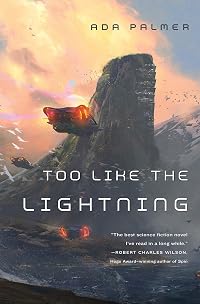
On This Page
Description
Mycroft Canner is a convict. For his crimes he is required, as is the custom of the 25th century, to wander the world being as useful as he can to all he meets. Carlyle Foster is a sensayer-a spiritual counselor in a world that has outlawed the public practice of religion, but which also knows that the inner lives of humans cannot be wished away. The world into which Mycroft and Carlyle have been born is as strange to our 21st-century eyes as ours would be to a native of the 1500s. It is a show more hard-won utopia built on technologically-generated abundance, and also on complex and mandatory systems of labeling all public writing and speech. What seem to us normal gender distinctions are now distinctly taboo in most social situations. And most of the world's population is affiliated with globe-girdling clans of the like-minded, whose endless economic and cultural competition is carefully managed by central planners of inestimable subtlety. To us it seems like a mad combination of heaven and hell. To them, it seems like normal life. And in this world, Mycroft and Carlyle have stumbled on the wild card that may destabilize the system: the boy Bridger, who can effortlessly make his wishes come true. Who can, it would seem, bring inanimate objects to life. show lessTags
Recommendations





Member Recommendations

Member Reviews
Ambitious, provocative, challenging science fiction political thriller, complete with unreliable narrator who favours 18th century styles and philosophical digressions and a weird habit of going out of his way to justify misgendering other characters in a society where gendered langage is almost taboo. Mycroft Canner is a servitor, a criminal on lifelong parole as a sort of public slave. For such a lowly person he moves in circles with the most powerful people on the planet who treat him with trust and familiarity. He also spends time at the household of the family unit that controls and oversees the vital global transport network, the speeding flying cars that have made nation states redundant. It's a household full of secrets, but the show more the most terrible secret is the little boy who can perform miracles, and his potential impact in a society that has banished all religion and religious talk, instead providing sensayers to give sessions of spiritual and philosophical therapy.
You couldn't call it a perfect utopia, but it's got a lot going for it, and is worth protecting when a theft and a break-in threaten to be the pebbles that start a catastrophic avalanche
It took me longer than I liked to get into this, the archaic language and Mycroft's sometimes dense narration proving tough for my lazy brain, but when I did finally break through, a revelation here, a twist there, I couldn't put it down. Next volume, please. show less
You couldn't call it a perfect utopia, but it's got a lot going for it, and is worth protecting when a theft and a break-in threaten to be the pebbles that start a catastrophic avalanche
It took me longer than I liked to get into this, the archaic language and Mycroft's sometimes dense narration proving tough for my lazy brain, but when I did finally break through, a revelation here, a twist there, I couldn't put it down. Next volume, please. show less
I have been staring at the blank white box on the screen because I don't quite know how to review this book. It was less a reading experience and more an ensorcellment. This inventive, disturbing novel set in an ambiguous utopia is so very, very well-crafted, offering the dual pleasures of enjoying an ambitious science fiction story and enjoying the narrator tell that story.
Mycroft Canner is a convicted criminal in a world that has done away with incarceration (and organized religion, and nation-states). Also, there's possibly magic? And political conspiracies are afoot? Palmer drops us in this inventive and immersive future, but she tells it slant. We soon realize that Mycroft is not just an unreliable narrator with a mysterious past, show more he is totally bonkers. As a reader I was increasingly unsettled by the layers of creepy, gossamer subtext (its webs surely spider-infested) yet totally charmed by Canner's manic, sententious prose, complete with back-and-forth arguments with the imagined reader and supercharged similes that would be at home in a SF retelling of Paradise Lost.
I also feel that for a trippy, literary SF novel, Too Like the Lightning delivers good storytelling. Every scene advances the story, and there's a convoluted mystery story that's resolved with some surprising but fairly satisfying reveals. I found it to be a page-turner, although tastes may vary.
Most of all, I think this novel is brave, and charts a way forward for writing socially-conscious fiction that isn't overly earnest or stylistically conservative. Mycroft Canner is an uncomfortable mind to inhabit, and plenty in this book tends toward the lurid and salacious - but this book doesn't feel like a prurient read; we never get the sense that Palmer is leering at her own characters or glorying in her book's most shocking moments. She writes too well for that, skillfully juxtaposing utopia and horror, dark and light. She's getting something right in a genre that plenty of authors before her have failed at, becoming too enamored with their own monsters.
My favorite book so far this year - highly recommended. show less
Mycroft Canner is a convicted criminal in a world that has done away with incarceration (and organized religion, and nation-states). Also, there's possibly magic? And political conspiracies are afoot? Palmer drops us in this inventive and immersive future, but she tells it slant. We soon realize that Mycroft is not just an unreliable narrator with a mysterious past, show more he is totally bonkers. As a reader I was increasingly unsettled by the layers of creepy, gossamer subtext (its webs surely spider-infested) yet totally charmed by Canner's manic, sententious prose, complete with back-and-forth arguments with the imagined reader and supercharged similes that would be at home in a SF retelling of Paradise Lost.
I also feel that for a trippy, literary SF novel, Too Like the Lightning delivers good storytelling. Every scene advances the story, and there's a convoluted mystery story that's resolved with some surprising but fairly satisfying reveals. I found it to be a page-turner, although tastes may vary.
Most of all, I think this novel is brave, and charts a way forward for writing socially-conscious fiction that isn't overly earnest or stylistically conservative. Mycroft Canner is an uncomfortable mind to inhabit, and plenty in this book tends toward the lurid and salacious - but this book doesn't feel like a prurient read; we never get the sense that Palmer is leering at her own characters or glorying in her book's most shocking moments. She writes too well for that, skillfully juxtaposing utopia and horror, dark and light. She's getting something right in a genre that plenty of authors before her have failed at, becoming too enamored with their own monsters.
My favorite book so far this year - highly recommended. show less
In the future, mankind has avoided self-destruction by a hair's breadth. Organized religions have been outlawed. Ultrafast transportation has rendered geographical nations irrelevant. Society has been rebuilt according to the ideals of 18th century Enlightenment philosophy. The world's most notorious criminal—serving a sentence in service to any who command—and a sensayer (a spiritual therapist and guide) discover a child who can perform miracles, with the power to irrevocably change the nature of reality itself. And a brazen theft threatens to expose secrets that could topple the world's greatest powers.
Too Like the Lightning by Ada Palmer is a near perfect blend of science fiction and philosophy.
As SF, it's one of the most show more original novels I've read: visionary, compelling, utterly unique. As a work of philosophical storytelling, it's intelligent, rigorous, challenging. Indeed, in her "Afterword" Ms. Palmer states her desire was to offer an answer to the great thinkers of the 18th century Enlightenment: Diderot, Voltaire, Rousseau, de Sade.
One of the most impressive things about Too Like the Lightning is how well Ms. Palmer summarizes the philosophies of the Enlightenment for the lay reader. You don't need to have read any philosophy to understand the world of the story or follow what happens. Equally impressive is how appropriately she integrates philosophical discussions into the narration and dialog. For a book so weighty with ideas, the plot remains briskly paced and exciting.
But it's the world Ms. Palmer creates in these pages which astounds me. It's vivid, immersive, complex, fascinating, exceptionally detailed, and unlike anything I've encountered—equally dependent on technology and philosophical ideas. Too Like the Lightning belongs on every list of greatest world-building in SF.
This world is populated by a sprawling cast of compelling characters in complex political relationships, machinating amongst each other, vying for power, loving and fighting one another. The essential stuff of human drama and comedy.
The biggest challenge is keeping all the characters straight: there are a lot of them and many of them are referred to by multiple names. The convoluted naming conventions work well to flesh out the society and culture of the world of the story, but it can get a bit confusing if you're not paying attention. Also, the way Ms. Palmer plays with gender pronouns is both delightful and occasionally frustrating—intentionally so, for good reason and to good effect. Like the names, it renders the world of the story in vivid detail.
The most immediate thing you notice when you start reading Too Like the Lightning is how it's written in the style of 18th century philosophical treatises, with florid prose, complex sentences, asides and appeals to the reader, and a first-person narrator who explains why he's telling the story this way. It's an appropriate and effective voice for the story, breathing life into the philosophical underpinnings of this society, personalizing them.
Some people have said they find the writing style imposing. I had little problem with it—Ms. Palmer gives you space at the beginning to get used to it and it has a compelling flow that sweeps you along.
One detail which I particularly like: Ms. Palmer wrote this novel for English-speaking readers—therefore, almost all of the dialog is written in English (there are a few passages written in Latin with English translations provided). However, several different characters speak different languages and there are situations where this is important in terms of who can and can't understand what's being said. She employs a simple technique of using different punctuation marks to bracket dialog to designate lines spoken in different languages, even though it's all written in English. It's visual and effective.
With its ornate writing style, its complex society and many characters, and its weighty philosophical ideas, this book is intended to be a challenge for the reader. Don't take it on if you're looking for something easy. You better be willing to put in the work to read it—and that work is amply rewarded.
Too Like the Lightning is visionary and astonishing. There's so much it does exceptionally well. It's a stunning accomplishment and far more than we have a right to expect from a debut novel.
But I still walked away from it convinced that it should have been better.
(Does this abrupt change in tone surprise you, dear reader? For there are deep flaws even in the heart of such majestic pinnacles of artistic achievement.)
Take the 18th century writing style: The narrator goes to great effort at the beginning of the novel to explain why this story must be told in this style, and his reasoning is entirely sound. It's an effective and appropriate device. But it also never quite stops feeling like a gimmick.
The world of this novel is rich, complex and immersive, an astonishing achievement. But it also feels ever-so-slightly too contrived, artificially constrained in service to the author's clever idea.
That's the essential flaw in this book:
It's a very clever idea that never lets you forget how very clever it is.
It's all a bit too self-conscious, it never lets go as fully as you want it to. Every time I expect a plot twist, I get a plot twist. Every time I expect a shocking revelation, I get one. As shocking as some of these plot twists and revelations are, as original and unexpected as this book is as a whole, it never feels quite as surprising as it should be.
I'm reminded of what the wise man once said:
All fiction is a thought experiment exploring the nature of reality. The art of fiction is to convince the reader there are real tigers lurking in the bushes.
As a thought experiment, Too Like the Lightning is a tremendous accomplishment: intelligent, insightful, creative, clever, unique. It offers up a feast of ideas.
As a work of storytelling, it falls ever-so-slightly short. As exceptional as its tigers are, it doesn't quite fully convince me they're real.
It feels wrong of me to have these criticisms of a book so visionary, so innovative. I want to be clear: I love this novel. But I don't love it as unreservedly as I want to. The criticisms I offer are my attempts to understand why not.
Make no mistake: Too Like the Lightning achieves greatness. It just tries a bit too hard to get there. show less
Too Like the Lightning by Ada Palmer is a near perfect blend of science fiction and philosophy.
As SF, it's one of the most show more original novels I've read: visionary, compelling, utterly unique. As a work of philosophical storytelling, it's intelligent, rigorous, challenging. Indeed, in her "Afterword" Ms. Palmer states her desire was to offer an answer to the great thinkers of the 18th century Enlightenment: Diderot, Voltaire, Rousseau, de Sade.
One of the most impressive things about Too Like the Lightning is how well Ms. Palmer summarizes the philosophies of the Enlightenment for the lay reader. You don't need to have read any philosophy to understand the world of the story or follow what happens. Equally impressive is how appropriately she integrates philosophical discussions into the narration and dialog. For a book so weighty with ideas, the plot remains briskly paced and exciting.
But it's the world Ms. Palmer creates in these pages which astounds me. It's vivid, immersive, complex, fascinating, exceptionally detailed, and unlike anything I've encountered—equally dependent on technology and philosophical ideas. Too Like the Lightning belongs on every list of greatest world-building in SF.
This world is populated by a sprawling cast of compelling characters in complex political relationships, machinating amongst each other, vying for power, loving and fighting one another. The essential stuff of human drama and comedy.
The biggest challenge is keeping all the characters straight: there are a lot of them and many of them are referred to by multiple names. The convoluted naming conventions work well to flesh out the society and culture of the world of the story, but it can get a bit confusing if you're not paying attention. Also, the way Ms. Palmer plays with gender pronouns is both delightful and occasionally frustrating—intentionally so, for good reason and to good effect. Like the names, it renders the world of the story in vivid detail.
The most immediate thing you notice when you start reading Too Like the Lightning is how it's written in the style of 18th century philosophical treatises, with florid prose, complex sentences, asides and appeals to the reader, and a first-person narrator who explains why he's telling the story this way. It's an appropriate and effective voice for the story, breathing life into the philosophical underpinnings of this society, personalizing them.
Some people have said they find the writing style imposing. I had little problem with it—Ms. Palmer gives you space at the beginning to get used to it and it has a compelling flow that sweeps you along.
One detail which I particularly like: Ms. Palmer wrote this novel for English-speaking readers—therefore, almost all of the dialog is written in English (there are a few passages written in Latin with English translations provided). However, several different characters speak different languages and there are situations where this is important in terms of who can and can't understand what's being said. She employs a simple technique of using different punctuation marks to bracket dialog to designate lines spoken in different languages, even though it's all written in English. It's visual and effective.
With its ornate writing style, its complex society and many characters, and its weighty philosophical ideas, this book is intended to be a challenge for the reader. Don't take it on if you're looking for something easy. You better be willing to put in the work to read it—and that work is amply rewarded.
Too Like the Lightning is visionary and astonishing. There's so much it does exceptionally well. It's a stunning accomplishment and far more than we have a right to expect from a debut novel.
But I still walked away from it convinced that it should have been better.
(Does this abrupt change in tone surprise you, dear reader? For there are deep flaws even in the heart of such majestic pinnacles of artistic achievement.)
Take the 18th century writing style: The narrator goes to great effort at the beginning of the novel to explain why this story must be told in this style, and his reasoning is entirely sound. It's an effective and appropriate device. But it also never quite stops feeling like a gimmick.
The world of this novel is rich, complex and immersive, an astonishing achievement. But it also feels ever-so-slightly too contrived, artificially constrained in service to the author's clever idea.
That's the essential flaw in this book:
It's a very clever idea that never lets you forget how very clever it is.
It's all a bit too self-conscious, it never lets go as fully as you want it to. Every time I expect a plot twist, I get a plot twist. Every time I expect a shocking revelation, I get one. As shocking as some of these plot twists and revelations are, as original and unexpected as this book is as a whole, it never feels quite as surprising as it should be.
I'm reminded of what the wise man once said:
"You can spend your life examining the nature of reality in all its depth and detail, and then one day a tiger jumps out of the bushes and bites your face off."
All fiction is a thought experiment exploring the nature of reality. The art of fiction is to convince the reader there are real tigers lurking in the bushes.
As a thought experiment, Too Like the Lightning is a tremendous accomplishment: intelligent, insightful, creative, clever, unique. It offers up a feast of ideas.
As a work of storytelling, it falls ever-so-slightly short. As exceptional as its tigers are, it doesn't quite fully convince me they're real.
It feels wrong of me to have these criticisms of a book so visionary, so innovative. I want to be clear: I love this novel. But I don't love it as unreservedly as I want to. The criticisms I offer are my attempts to understand why not.
Make no mistake: Too Like the Lightning achieves greatness. It just tries a bit too hard to get there. show less
Update 1/5/17:
Re-read complete! And one thing I can definitely say without hesitation? : Definitely better the second time around.
It's still mightily dense with ideas and worldbuilding and truly fascinating characters that always manage to surprise, surprise again, tease me to death with hints and portents, and then managing to slam me up against the wall in a very civilized fashion before disemboweling me. It's just that kind of novel.
I'm loving the Marquis De Sade commentary as much this time as before, the extra commentaries on how to rule effectively, right down to the philosophical underpinnings of morals and Apollo's aphorisms, and yet this novel still manages to be both firmly 18th century and 25th century to the hilt. :)
What show more was slow in the beginning becomes absolutely necessary for the later blowout special effects of Ada Palmer's writing later in the novel. I firmly believe that now. It was just a glimmer before, but now on the second read, I'm a firm believer that this novel is just about perfect as it is.
I'm going to be recommending it for this year's Hugo nominations. It's wilding entertaining and strange and very intelligent, and beyond that, it shakes me nearly to the core.
I will also admit that it isn't an easy novel to read or enjoy superficially. It requires plenty of effort at all times and it's even more rewarding if you get all the classical and rather specialized Enlightenment references, but if you're on the same page, it's well beyond most novels out there. I'm talking about intellectual scope and the sheer depth and breadth of worldbuilding and ideas.
But I would be extremely remiss not to mention that Mycroft has got to be one of the most fascinating characters that I've ever read. And most surprising.
This mild-mannered squib did WHAT???? Oh my lordy... :) And the reasons for it? Oh my god... :)
I'm quickly wanting to ramp this one up to one of my all time favorite novels. Fantastic!
And now that I've got the sequel in my hands, I'm gonna enjoy the living hell out of a crumbling social system. :) Seven Surrenders, indeed. :) Seven-Ten list, anyone? lol And just who are they surrendering to? :)
Update 1/4/17:
This deserves a nice long re-read in preparation for the SEQUEL. :) Of which I just got and will be reviewing soon after. :) :) :)
Original Review:
Beautiful, Beautiful, Beautiful, Beautiful.
First impressions are very deceiving, with this one, and assumptions can get you into a huge mess of problems, but fortunately for us, this writer has some serious chops, can lead us into a world that never quite changes, from the first page to the last, but instead invites and sometimes pushes us over the edge and CHANGES US.
What is this world, where are we headed? Is this truly a futuristic high-tech utopia that stylizes itself off the Enlightenment period including Voltaire, Sade, and Rousseau? Ha! You'd like to think so as you begin your read.
Is the tale revolving around a handful of seemingly mild mysteries, that while interesting in themselves, seem more like a vehicle for unfolding one of the most gorgeous societal world-building tableaus I've ever had the privilege to read? Ha! ... Again, I was fooled, lulled into complacency even as I was overwhelmed with sheer walls of world-data, only to be saved, regularly, by the sure hand of a truly wonderful and insightful narrator who would steer us through the dense currents and land us safely upon solid ground. Could I have wished for a more perfect or more gentlemanly Victorian Guide in a strange land? Nope!
And then there were the conversations. This novel has a lot to say about gender roles, and it is tackled delightfully, maybe even better than [b:Ancillary Justice|17333324|Ancillary Justice (Imperial Radch, #1)|Ann Leckie|https://images.gr-assets.com/books/1397215917s/17333324.jpg|24064628] for sheer oddity. Social and societal quirks surrounding religion, was a big part of the novel, too, but it was the Conversation that made this novel become something Really Special.
And I really mean the Conversation; the ongoing discussion within whole fields of study and art and literature, or in this case, philosophy and science fiction. Ada Palmer deserves to be right up there with some of the best I've read, having so much to say about the Enlightenment period, made into a deep part of the story, aspects of the world-building, discussions both light and powerful between characters and even within our narrator's mind.
Some of the most awesome aspects of this novel are direct-line continuations of philosophy made into Art.
But do not let that dissuade you from this Oh So Excellent and Fascinating read, for even as I was fooled in the beginning, and as new and otherwise unforgivable glossed facts are slowly revealed to us, we are caught in a web much more complicated, dangerous, harrowing, bloody, and frankly more awe-inducing than I would have guessed in the first 150 pages.
It's a book worth reading several times over if only to pick up on all the clues that I had registered in passing, but not understood until much later.
And I will, because here's the real beauty... it's only part one of a two book cycle that belongs to one another. You know the symptoms. This is a fantastic larger tale that, by requirements out of the author's control, needed to be split unnaturally into two. It's only something truly miraculous and fantastic that the author still managed to make this single book feel complete and satisfying, even as it points to the second half of it's soul.
I feel truly blessed to be reading this. Ada Palmer has just earned herself a lifelong fanboy after a single wonderful read. This is what true Idea SF is all about, and it deserves to be up there with the very best. Remember [b:Anathem|2845024|Anathem|Neal Stephenson|https://images.gr-assets.com/books/1442903535s/2845024.jpg|6163095]? Sit yourself down for some real brilliance and some truly great set-sets.
I'm sure I won't be the only one who thinks the premise of the political setup is one I'd love to have now, even with its mature problems. I think this novel is going to be prompting an absolute TON of discussion among its soon-to-be legion fans. :) If there's any justice in the world, mind you. :) show less
Re-read complete! And one thing I can definitely say without hesitation? : Definitely better the second time around.
It's still mightily dense with ideas and worldbuilding and truly fascinating characters that always manage to surprise, surprise again, tease me to death with hints and portents, and then managing to slam me up against the wall in a very civilized fashion before disemboweling me. It's just that kind of novel.
I'm loving the Marquis De Sade commentary as much this time as before, the extra commentaries on how to rule effectively, right down to the philosophical underpinnings of morals and Apollo's aphorisms, and yet this novel still manages to be both firmly 18th century and 25th century to the hilt. :)
What show more was slow in the beginning becomes absolutely necessary for the later blowout special effects of Ada Palmer's writing later in the novel. I firmly believe that now. It was just a glimmer before, but now on the second read, I'm a firm believer that this novel is just about perfect as it is.
I'm going to be recommending it for this year's Hugo nominations. It's wilding entertaining and strange and very intelligent, and beyond that, it shakes me nearly to the core.
I will also admit that it isn't an easy novel to read or enjoy superficially. It requires plenty of effort at all times and it's even more rewarding if you get all the classical and rather specialized Enlightenment references, but if you're on the same page, it's well beyond most novels out there. I'm talking about intellectual scope and the sheer depth and breadth of worldbuilding and ideas.
But I would be extremely remiss not to mention that Mycroft has got to be one of the most fascinating characters that I've ever read. And most surprising.
This mild-mannered squib did WHAT???? Oh my lordy... :) And the reasons for it? Oh my god... :)
I'm quickly wanting to ramp this one up to one of my all time favorite novels. Fantastic!
And now that I've got the sequel in my hands, I'm gonna enjoy the living hell out of a crumbling social system. :) Seven Surrenders, indeed. :) Seven-Ten list, anyone? lol And just who are they surrendering to? :)
Update 1/4/17:
This deserves a nice long re-read in preparation for the SEQUEL. :) Of which I just got and will be reviewing soon after. :) :) :)
Original Review:
Beautiful, Beautiful, Beautiful, Beautiful.
First impressions are very deceiving, with this one, and assumptions can get you into a huge mess of problems, but fortunately for us, this writer has some serious chops, can lead us into a world that never quite changes, from the first page to the last, but instead invites and sometimes pushes us over the edge and CHANGES US.
What is this world, where are we headed? Is this truly a futuristic high-tech utopia that stylizes itself off the Enlightenment period including Voltaire, Sade, and Rousseau? Ha! You'd like to think so as you begin your read.
Is the tale revolving around a handful of seemingly mild mysteries, that while interesting in themselves, seem more like a vehicle for unfolding one of the most gorgeous societal world-building tableaus I've ever had the privilege to read? Ha! ... Again, I was fooled, lulled into complacency even as I was overwhelmed with sheer walls of world-data, only to be saved, regularly, by the sure hand of a truly wonderful and insightful narrator who would steer us through the dense currents and land us safely upon solid ground. Could I have wished for a more perfect or more gentlemanly Victorian Guide in a strange land? Nope!
And then there were the conversations. This novel has a lot to say about gender roles, and it is tackled delightfully, maybe even better than [b:Ancillary Justice|17333324|Ancillary Justice (Imperial Radch, #1)|Ann Leckie|https://images.gr-assets.com/books/1397215917s/17333324.jpg|24064628] for sheer oddity. Social and societal quirks surrounding religion, was a big part of the novel, too, but it was the Conversation that made this novel become something Really Special.
And I really mean the Conversation; the ongoing discussion within whole fields of study and art and literature, or in this case, philosophy and science fiction. Ada Palmer deserves to be right up there with some of the best I've read, having so much to say about the Enlightenment period, made into a deep part of the story, aspects of the world-building, discussions both light and powerful between characters and even within our narrator's mind.
Some of the most awesome aspects of this novel are direct-line continuations of philosophy made into Art.
But do not let that dissuade you from this Oh So Excellent and Fascinating read, for even as I was fooled in the beginning, and as new and otherwise unforgivable glossed facts are slowly revealed to us, we are caught in a web much more complicated, dangerous, harrowing, bloody, and frankly more awe-inducing than I would have guessed in the first 150 pages.
It's a book worth reading several times over if only to pick up on all the clues that I had registered in passing, but not understood until much later.
And I will, because here's the real beauty... it's only part one of a two book cycle that belongs to one another. You know the symptoms. This is a fantastic larger tale that, by requirements out of the author's control, needed to be split unnaturally into two. It's only something truly miraculous and fantastic that the author still managed to make this single book feel complete and satisfying, even as it points to the second half of it's soul.
I feel truly blessed to be reading this. Ada Palmer has just earned herself a lifelong fanboy after a single wonderful read. This is what true Idea SF is all about, and it deserves to be up there with the very best. Remember [b:Anathem|2845024|Anathem|Neal Stephenson|https://images.gr-assets.com/books/1442903535s/2845024.jpg|6163095]? Sit yourself down for some real brilliance and some truly great set-sets.
I'm sure I won't be the only one who thinks the premise of the political setup is one I'd love to have now, even with its mature problems. I think this novel is going to be prompting an absolute TON of discussion among its soon-to-be legion fans. :) If there's any justice in the world, mind you. :) show less
Ada Palmer throws readers right into the deep end with Too Like the Lightning, the first book in the Terra Ignota series. This is a complex, immersive, fleshed-out and idea-filled work of science fiction. Set in the 25th century, it is a world unrecognizable in its political, economic and social makeup.
Travel anywhere in the world is measured in minutes. This has led to a breakdown in traditional governments and let people all across the world associate based on common interests rather than geography. Religion is outlawed but may be discussed privately with sensayers, who tend to a person’s spiritual well-being. Gender distinctions are mostly taboo. A handful of corporation-like clans mixed with philosophers and remnants of nation show more states guide world affairs.
Mycroft Canner is a convict. His sentence is to be useful. To other people and to all of society. That he is a criminal is never hidden, but the nature of his crimes are not revealed to the reader until deep into the novel. Committing crimes is infinitely more difficult, but not impossible. Carlyle Foster is a sensayer who lands in the middle of Mycroft’s life and a secret he is concealing: Bridger. Bridger is a boy who can make wishes reality. That ability could threaten the entire interconnected world.
Too Like the Lightning is an ambitious and challenging book. There are almost too many ideas expressed to discuss or even fully absorb. It is a mystery as well as a political treatise. It is a distant future with a reverence for the 18th century, particularly Voltaire. The narrator breaks the fourth wall and at times speaks directly to the reader. Palmer does a magnificent job of placing you in this fully realized world and letting you pick up the rules as you go. The pace at which significant pieces of information are revealed are timed for maximum effect. She keeps you unsure of who to trust and how far to trust them. You are likewise puzzled about the many plots and subplots at work, but always given enough information to keep frustration from setting in.
I suspect this book reveals more every time you read it. The characters are people you would want to spend time with and be alternately charmed by and terrified of.
If anyone was still afraid that science fiction was out of ideas after Ann Leckie’s wonderful Ancillary series, Ada Palmer will put any remaining fears to rest. This is an exciting and important work.
One word of caution. The book ends abruptly as it is the first of two parts. The second part is slated to come out before the end of the year so it is not a long wait. Not only should you read this book, you should make all your friends read it because you are going to want to talk about it. A lot. Highly recommended!
I listened to the audio version of this book narrated by Jefferson Mays who did an outstanding job with it. The narration places you directly in the world and the melodic voices of the characters keeps you glued to the story. This is a story, particularly in audio form, that both demands and rewards close attention.
I was fortunate to receive an advance copy of this book. show less
Travel anywhere in the world is measured in minutes. This has led to a breakdown in traditional governments and let people all across the world associate based on common interests rather than geography. Religion is outlawed but may be discussed privately with sensayers, who tend to a person’s spiritual well-being. Gender distinctions are mostly taboo. A handful of corporation-like clans mixed with philosophers and remnants of nation show more states guide world affairs.
Mycroft Canner is a convict. His sentence is to be useful. To other people and to all of society. That he is a criminal is never hidden, but the nature of his crimes are not revealed to the reader until deep into the novel. Committing crimes is infinitely more difficult, but not impossible. Carlyle Foster is a sensayer who lands in the middle of Mycroft’s life and a secret he is concealing: Bridger. Bridger is a boy who can make wishes reality. That ability could threaten the entire interconnected world.
Too Like the Lightning is an ambitious and challenging book. There are almost too many ideas expressed to discuss or even fully absorb. It is a mystery as well as a political treatise. It is a distant future with a reverence for the 18th century, particularly Voltaire. The narrator breaks the fourth wall and at times speaks directly to the reader. Palmer does a magnificent job of placing you in this fully realized world and letting you pick up the rules as you go. The pace at which significant pieces of information are revealed are timed for maximum effect. She keeps you unsure of who to trust and how far to trust them. You are likewise puzzled about the many plots and subplots at work, but always given enough information to keep frustration from setting in.
I suspect this book reveals more every time you read it. The characters are people you would want to spend time with and be alternately charmed by and terrified of.
If anyone was still afraid that science fiction was out of ideas after Ann Leckie’s wonderful Ancillary series, Ada Palmer will put any remaining fears to rest. This is an exciting and important work.
One word of caution. The book ends abruptly as it is the first of two parts. The second part is slated to come out before the end of the year so it is not a long wait. Not only should you read this book, you should make all your friends read it because you are going to want to talk about it. A lot. Highly recommended!
I listened to the audio version of this book narrated by Jefferson Mays who did an outstanding job with it. The narration places you directly in the world and the melodic voices of the characters keeps you glued to the story. This is a story, particularly in audio form, that both demands and rewards close attention.
I was fortunate to receive an advance copy of this book. show less
To begin at the end: this book is far from a standalone novel, and I would only recommend it to those with a reasonable expectation of continuing to the later numbers of the Terra Ignota tetralogy. It opens a variety of plots and questions, but it supplies very little closure. Mostly, this volume accomplishes the presentation of a future world society and the definition of key characters within it.
The setting is a 25th century that I found a little improbably optimistic in terms of the perpetuation of our contemporary civilization, although there are increasingly explicit references to upheavals that have happened in the interim. The questionably reliable narrator is a sort of public slave ("servicer") with intimate connections to the show more global elite, and his conscious efforts to supply historical perspective mostly reference the 18th-century Enlightenment. It has really been a joy for me to read sf that is in overt conversation with Voltaire and de Sade!
Ada Palmer's future world supposes a formidable transportation network that makes the whole planet local. Ethnic phenotypes and nationalities have become merely ornamental, while public expressions of human gender are socially discouraged. Religion has been actively suppressed by universal legislation, with individual spiritual needs ministered to by non-prostelytizing "sensayer" professionals. The largest polities are a handful of Hives which adults join voluntarily.
The Hive with the greatest population is that of the Masonic Empire, distinguished by--among other features--its official and social use of Latin. This detail reminded me at once of the Martian language in the Church of All Worlds in Stranger in a Strange Land. The connection is more than incidental. Like Heinlein's touchstone work, Too Like the Lightning also concerns itself with sex and religion, and suspends much of its plot from the advent of a child with miraculous powers. In fact, there is an explicit allusion to Valentine Michael Smith (267).
The style here is however more Wolfe than Heinlein, where the fictional narrator's exposition assumes a hypothetical audience whose needs are different than those of the actual 21st-century reader. Palmer cleverly highlights this fact with a device that has apparently irritated some reviewers: The reader is conscripted to protest elements of the narrator's presentation, and given the actual verbiage of doing so, with these interjections distinguished by italic type and archaic diction.
The book is an ambitious and intricate start to a work I will certainly continue reading. show less
The setting is a 25th century that I found a little improbably optimistic in terms of the perpetuation of our contemporary civilization, although there are increasingly explicit references to upheavals that have happened in the interim. The questionably reliable narrator is a sort of public slave ("servicer") with intimate connections to the show more global elite, and his conscious efforts to supply historical perspective mostly reference the 18th-century Enlightenment. It has really been a joy for me to read sf that is in overt conversation with Voltaire and de Sade!
Ada Palmer's future world supposes a formidable transportation network that makes the whole planet local. Ethnic phenotypes and nationalities have become merely ornamental, while public expressions of human gender are socially discouraged. Religion has been actively suppressed by universal legislation, with individual spiritual needs ministered to by non-prostelytizing "sensayer" professionals. The largest polities are a handful of Hives which adults join voluntarily.
The Hive with the greatest population is that of the Masonic Empire, distinguished by--among other features--its official and social use of Latin. This detail reminded me at once of the Martian language in the Church of All Worlds in Stranger in a Strange Land. The connection is more than incidental. Like Heinlein's touchstone work, Too Like the Lightning also concerns itself with sex and religion, and suspends much of its plot from the advent of a child with miraculous powers. In fact, there is an explicit allusion to Valentine Michael Smith (267).
The style here is however more Wolfe than Heinlein, where the fictional narrator's exposition assumes a hypothetical audience whose needs are different than those of the actual 21st-century reader. Palmer cleverly highlights this fact with a device that has apparently irritated some reviewers: The reader is conscripted to protest elements of the narrator's presentation, and given the actual verbiage of doing so, with these interjections distinguished by italic type and archaic diction.
The book is an ambitious and intricate start to a work I will certainly continue reading. show less
For me, this was a five star books, plain and simple, but I *completely* understand why it would be a 0-, 1-, 2-star book for others.
It's pretentious at times. It wants you to have classical knowledge of ancient Rome and 18th century France. It plays on that knowledge, and knowledge of literature in 18th century France explicitly. At least it explains lots of the in-jokes, so it's not terribly arrogant in choosing its readership, but the pretentiousness is there. The storytelling is great, full with an apologising, opinionated actor-narrator, with intermezzi by other characters.
That said, I loved it. I loved the world, the 24th century world that consits of lots and lots of non-nation based groups (and some nation based ones), and seven show more major orientations everybody chooses (or becomes a blacklaw, which is fine, too): The Masons who have resurrected ancient Rome, the Humanists who have a flexible democracy, the Mitsubishi super clan who are focussed on land ownership, the Brillists who go ahead and analyse anyone and everyone, the Cousins who are something like the priests of a world that prohibits organised religion, the Europeans, based around a borderless idea of old nations, and the Utopians who are everywhere, especially in space, on the moon, and terraforming Mars.
We get a complete, complex world, with penal systems, laws, cultures, capital punishments, regular people, and … special people of all kinds. Emperors, kings, convicts, gods, …Wow.
And then it just ends in the middle of it all. *sigh* show less
It's pretentious at times. It wants you to have classical knowledge of ancient Rome and 18th century France. It plays on that knowledge, and knowledge of literature in 18th century France explicitly. At least it explains lots of the in-jokes, so it's not terribly arrogant in choosing its readership, but the pretentiousness is there. The storytelling is great, full with an apologising, opinionated actor-narrator, with intermezzi by other characters.
That said, I loved it. I loved the world, the 24th century world that consits of lots and lots of non-nation based groups (and some nation based ones), and seven show more major orientations everybody chooses (or becomes a blacklaw, which is fine, too): The Masons who have resurrected ancient Rome, the Humanists who have a flexible democracy, the Mitsubishi super clan who are focussed on land ownership, the Brillists who go ahead and analyse anyone and everyone, the Cousins who are something like the priests of a world that prohibits organised religion, the Europeans, based around a borderless idea of old nations, and the Utopians who are everywhere, especially in space, on the moon, and terraforming Mars.
We get a complete, complex world, with penal systems, laws, cultures, capital punishments, regular people, and … special people of all kinds. Emperors, kings, convicts, gods, …Wow.
And then it just ends in the middle of it all. *sigh* show less
Members
- Recently Added By
Lists

Favorite Science Fiction by Women Authors
737 works; 196 members

Best Science Fiction Novels
816 works; 430 members

2017 Hugo Eligible Novels
145 works; 14 members

Recommend the 20 best books you've read in the last five years
2,168 works; 606 members

Dystopian and Apocalyptic Literature
350 works; 74 members

Science Fiction by female authors
43 works; 4 members

Otherland Book Club
36 works; 2 members

Top Five Books of 2016
795 works; 229 members

2016 Science Fiction and Fantasy Books I'm Looking Forward To.
54 works; 6 members

Female Author
1,235 works; 65 members
LGBTQ+ Speculative Fiction
820 works; 50 members

Speculative Fiction to Read
706 works; 32 members

Books Read in 2019
4,052 works; 108 members
Books Read in 2018
4,360 works; 110 members

Books Read in 2021
5,361 works; 113 members

Overdue Podcast
805 works; 9 members

Books Read in 2017
4,249 works; 129 members
Book Worlds We'd Like To Visit
322 works; 158 members

Top Five Books of 2025
954 works; 303 members
Favorite Science Fiction
454 works; 217 members
Author Information

11+ Works 4,248 Members
Some Editions
Awards and Honors
Awards
Distinctions
Notable Lists
Series

Work Relationships
Common Knowledge
- Canonical title
- Too Like the Lightning
- Original title
- Too Like the Lightning
- Original publication date
- 2016-05-10
- People/Characters
- Mycroft Canner; Carlyle Foster; Bridger; Thisbe Saneer; J.E.D.D. Mason; Martin Guildbreaker (show all 7); Dominic Seneschal
- Epigraph
- Ah, my poor Jacques! You are a philosopher. But don't worry: I'll protect you.
—Diderot, Jacques the Fatalist and His Master - Dedication
- This book is dedicated to the first human who thought to hollow out a log to make a boat, and his or her successors.
- First words
- You will criticize me, reader, for writing in a style six hundred years removed from the events I describe, but you came to me for explanation of those days of transformation which left your world the world it is, and since i... (show all)t was the philosophy of the Eighteenth Century, heavy with optimism and ambition, whose abrupt revival birthed the recent revolution, so it is only in the language of the Enlightenment, rich with opinion and sentiment, that those days can be described.
- Last words
- (Click to show. Warning: May contain spoilers.)"No, not ten billion people. Seven. Seven is enough."
- Publisher's editor
- Nielsen Hayden, Patrick
- Blurbers
- Walton, Jo; Wilson, Robert Charles; Smith, Sherwood; Brust, Steven; Wilde, Fran
- Original language
- English
Classifications
Statistics
- Members
- 2,215
- Popularity
- 9,091
- Reviews
- 107
- Rating
- (3.73)
- Languages
- 5 — English, French, German, Polish, Turkish
- Media
- Paper, Audiobook, Ebook
- ISBNs
- 20
- ASINs
- 7