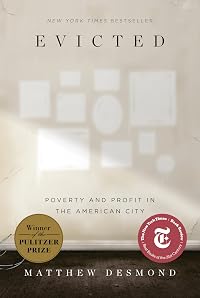
Evicted: Poverty and Profit in the American City
by Matthew Desmond
On This Page
Description
"[The author] takes us into the poorest neighborhoods of Milwaukee to tell the story of eight families on the edge. Arleen is a single mother trying to raise her two sons on the 20 dollars a month she has left after paying for their rundown apartment. Scott is a gentle nurse consumed by a heroin addiction. Lamar, a man with no legs and a neighborhood full of boys to look after, tries to work his way out of debt. Vanetta participates in a botched stickup after her hours are cut. All are show more spending almost everything they have on rent, and all have fallen behind. The fates of these families are in the hands of two landlords: Sherrena Tarver, a former schoolteacher turned inner-city entrepreneur, and Tobin Charney, who runs one of the worst trailer parks in Milwaukee. They loathe some of their tenants and are fond of others, but as Sherrena puts it, "Love don't pay the bills." She moves to evict Arleen and her boys a few days before Christmas. Even in the most desolate areas of American cities, evictions used to be rare. But today, most poor renting families are spending more than half of their income on housing, and eviction has become ordinary, especially for single mothers. In vivid, intimate prose, Desmond provides a ground-level view of one of the most urgent issues facing America today. As we see families forced into shelters, squalid apartments, or more dangerous neighborhoods, we bear witness to the human cost of America's vast inequality-- and to people's determination and intelligence in the face of hardship. Based on years of embedded fieldwork and painstakingly gathered data, this masterful book transforms our understanding of extreme poverty and economic exploitation while providing fresh ideas for solving a devastating, uniquely American problem. Its unforgettable scenes of hope and loss remind us of the centrality of home, without which nothing else is possible"--Amazon.com. show lessTags
Recommendations





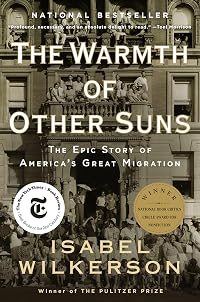

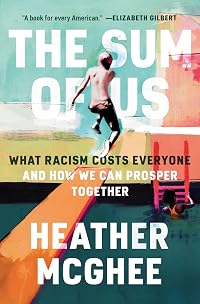
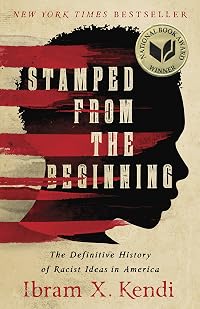
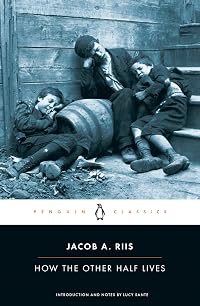
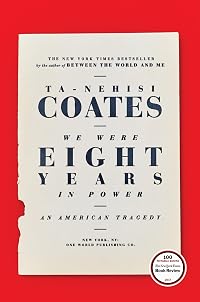
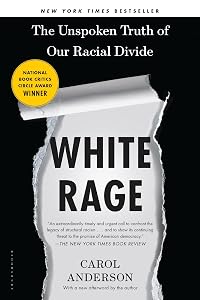
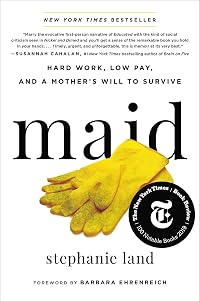
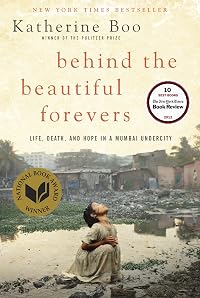







Member Recommendations

Member Reviews
This was so well written and handles a tough subject skillfully. It follows a small number of families through their experiences with housing and homelessness, and brings much needed light to what is a far too common experience. It deals with a few landlords but only a couple in detail. In addition to the book dealing with how things are unequal on so many levels, the author theorizes in the epilogue regarding potential fixes. Such fixes though are nigh on impossible when housing has become a commodity and wealth vehicle for so many. This book was at times heart-wrenching, at others it was infuriating (landlords taking advantage), but ultimately hopeful. The families will remain with me for quite some time. There are extensive notes show more that I haven’t looked at much, mostly because I fear it would add a mass amount of books to my wishlist if I did. I have another book by this author, titled “Poverty, by America”. I’ll be dipping into that soon. show less
Evicted is a powerful account of people living in poverty trying to find and keep a roof over their heads in Milwaukee, Wisconsin. Told through the eyes of the author who followed the renters (and a landlord), it demonstrates the many paths to housing instability as well the inequalities and injustices to trying to keep a place to live.
The story follows several renters and their quest to find suitable housing, stay in it and in some cases, follows them through evictions. I say the story, because the book flows like one despite it being non-fiction. Desmond describes these people in detail, from their pasts to how they are struggling today. It feels like the reader gets to know them Some stories are particularly harrowing – people show more forced out into the street at the whim of their landlord for little to no reason as snow falls and their belongings are left on the footpath. All are sad and some are anger inducing, such as the family living in a barely habitable house unable to seek repairs for fear of repercussion. Desmond also follows a landlord around with her many properties and complaints of tenants not paying or wrecking their home. The renters aren’t always angels – there’s drug use, crime, lies and withholding money - but the landlords in this city are out to make a profit, human cost or not. (Also – going overseas and not having any options for your tenants to raise issues? Not cool.) It’s discomforting to see the issues in the private rental market and how it has fractured America into people who can and can’t afford the basic needs for survival. Desmond offers some potential solutions on how to provide stable housing without increasing government housing or disrupting the private rental market significantly. Not being American, I’m not sure if any have been implemented but if I had to take a wild guess, then I think not.
The story is extensively researched and it didn’t become clear to me until the ending just how involved Desmond got in experiencing the lives of multiple people. He is very careful about noting what he did and didn’t witness, but it does not distract from the overall narrative. The book is also strongly emotive – it’s not the type of book that offers a happily ever after. People experience setback after setback, sometimes their own fault and sometimes definitely not. It’s an engaging read that I hope will motivate change and for countries that aren’t America, to look at how not to get into this situation or make it worse.
http://samstillreading.wordpress.com show less
The story follows several renters and their quest to find suitable housing, stay in it and in some cases, follows them through evictions. I say the story, because the book flows like one despite it being non-fiction. Desmond describes these people in detail, from their pasts to how they are struggling today. It feels like the reader gets to know them Some stories are particularly harrowing – people show more forced out into the street at the whim of their landlord for little to no reason as snow falls and their belongings are left on the footpath. All are sad and some are anger inducing, such as the family living in a barely habitable house unable to seek repairs for fear of repercussion. Desmond also follows a landlord around with her many properties and complaints of tenants not paying or wrecking their home. The renters aren’t always angels – there’s drug use, crime, lies and withholding money - but the landlords in this city are out to make a profit, human cost or not. (Also – going overseas and not having any options for your tenants to raise issues? Not cool.) It’s discomforting to see the issues in the private rental market and how it has fractured America into people who can and can’t afford the basic needs for survival. Desmond offers some potential solutions on how to provide stable housing without increasing government housing or disrupting the private rental market significantly. Not being American, I’m not sure if any have been implemented but if I had to take a wild guess, then I think not.
The story is extensively researched and it didn’t become clear to me until the ending just how involved Desmond got in experiencing the lives of multiple people. He is very careful about noting what he did and didn’t witness, but it does not distract from the overall narrative. The book is also strongly emotive – it’s not the type of book that offers a happily ever after. People experience setback after setback, sometimes their own fault and sometimes definitely not. It’s an engaging read that I hope will motivate change and for countries that aren’t America, to look at how not to get into this situation or make it worse.
http://samstillreading.wordpress.com show less
Shortly before Christmas I found this book used and decided to read it during my holiday travels. I'd heard of it, seen it in year-end lists one year before (it got a Pulitzer, too), but I didn't know much about it. With the author's credentials as a professor of social sciences at Harvard, I figured it was a scholarly look at the dynamic of the poor being evicted from their homes. While that is pretty much the case, it is not presented in an academic way. Desmond lived in a trailer park and other parts of North Milwaukee and followed a number of tenants and landlords in the predominantly poor area.
He presents their stories in third person, as straight narratives of what they said and did. He intertwines the various characters and their show more stories in three sections: rent, out, after. Across the 24 chapters (8 per section), we become familiar with the characters -- real people, not fictional, although their names were changed for privacy -- to such a degree that it's difficult to simply dismiss their problems as situational, caused by being poor. Their problems -- paying too much for rent, facing involuntary evictions, having a hard time rebounding into new housing -- are in Desmond's words, "shameful and unnecessary." If I found myself in a similar situation, I now realize how hard it would be to crawl myself out from it; rent would still be high and without public assistance most of my money would go to rent, leading inevitably to the inability to pay under difficult circumstances, followed most likely by eviction. The book elicits empathy.
Something needs to be done, and Desmond's book is valuable in creating a strong case for some structural change, be it in housing policy, legal assistance for poor renters, or some other means of providing decent homes for those unable to afford market-rate housing.
Evicted is not just the stories of poor renters and their landlords. Desmond does inject more academic prose, occasionally within some of the 24 chapters but primarily in the epilogue and an "about the project" chapter. The latter is necessary for the many readers, like myself, who must wonder how Desmond followed the individuals and families, how they trusted him, and how he didn't affect their lives to a degree that negatively impacted the ethnographic study. There's also information on the surveys and other research he pulled off after his year and a half of living in inner-city Milwaukee; I'm amazed he distilled his observations and research into only 400 pages. If he uses other parts of the study for another related book or not, I'm curious to see what Desmond does next. show less
He presents their stories in third person, as straight narratives of what they said and did. He intertwines the various characters and their show more stories in three sections: rent, out, after. Across the 24 chapters (8 per section), we become familiar with the characters -- real people, not fictional, although their names were changed for privacy -- to such a degree that it's difficult to simply dismiss their problems as situational, caused by being poor. Their problems -- paying too much for rent, facing involuntary evictions, having a hard time rebounding into new housing -- are in Desmond's words, "shameful and unnecessary." If I found myself in a similar situation, I now realize how hard it would be to crawl myself out from it; rent would still be high and without public assistance most of my money would go to rent, leading inevitably to the inability to pay under difficult circumstances, followed most likely by eviction. The book elicits empathy.
Something needs to be done, and Desmond's book is valuable in creating a strong case for some structural change, be it in housing policy, legal assistance for poor renters, or some other means of providing decent homes for those unable to afford market-rate housing.
Evicted is not just the stories of poor renters and their landlords. Desmond does inject more academic prose, occasionally within some of the 24 chapters but primarily in the epilogue and an "about the project" chapter. The latter is necessary for the many readers, like myself, who must wonder how Desmond followed the individuals and families, how they trusted him, and how he didn't affect their lives to a degree that negatively impacted the ethnographic study. There's also information on the surveys and other research he pulled off after his year and a half of living in inner-city Milwaukee; I'm amazed he distilled his observations and research into only 400 pages. If he uses other parts of the study for another related book or not, I'm curious to see what Desmond does next. show less
Evicted is the most important book I have read so far on the subject of poverty. Years of research and analysis of data have convinced Matthew Desmond that lack of stable and affordable housing is a root cause of so much misery in the US. Parents, particularly single moms, spend so much of their money, time and energy trying to maintain housing that by necessity they neglect such essentials as feeding their children, supporting them in school, and maintaining good health, not to mention simply taking care of themselves so they are there to take care of their children. We all know the routine, "put your oxygen mask on first before helping anyone else with theirs." People at the lowest end of the economic scale haven't a chance at show more following this dictum.
After immersing myself in the lives of the people living through the experience of being evicted, in some cases, multiple times, I was in despair of a solution but Desmond lays it out simply and clearly; expand the existing housing voucher program to all low income families and provide the program with adequate funding. At the present time, he says that it would require an additional $22.5 billion to cover all renting families below 30 percent of their area's median income. That sounds like a lot of money until he contrasts it with the $171 billion spent on homeowner tax benefits.These figures do not account for the potential savings from the prevention of homelessness, reduction of health-care costs, and curbing other costly consequences of the affordable housing crisis. This is a must read for all thinking persons. show less
After immersing myself in the lives of the people living through the experience of being evicted, in some cases, multiple times, I was in despair of a solution but Desmond lays it out simply and clearly; expand the existing housing voucher program to all low income families and provide the program with adequate funding. At the present time, he says that it would require an additional $22.5 billion to cover all renting families below 30 percent of their area's median income. That sounds like a lot of money until he contrasts it with the $171 billion spent on homeowner tax benefits.These figures do not account for the potential savings from the prevention of homelessness, reduction of health-care costs, and curbing other costly consequences of the affordable housing crisis. This is a must read for all thinking persons. show less
 This review was written for LibraryThing Early Reviewers.
Written in the style of Oscar Lewis's classic, LA VIDA, which covered the lives of poor families in a very poor neighborhood of San Juan, Puerto Rico, EVICTED examines several families and individuals living in Milwaukee, Wisconsin circa 2008-2009 whose lives are greatly affected by the decisions of their landlords. Author Desmond, we learn at the end of the book, moved into what was considered the worst trailer park in Milwaukee in order to write his book from experience. In the park, he met a variety of families facing different challenges - mental and physical health issues, substance abuse, lack of empowerment - and the overriding theme of poverty. Through them, he met others renting from different landlords in private buildings show more across the city, but primarily in the poorest neighborhood and the one with the most crime. He studied the decisions made by landlords and by tenants to offer up a considered book on what is wrong with housing in America.
We all know there are good landlords and bad landlords, but it is the bad ones who play a major role in Desmond's research. Although every state may have different laws to protect tenants, the state of Wisconsin and the city of Milwaukee did not - at the time of Desmond's writing - seem to have any serious, working tenants' organization. One can only hope that in the interim, one has been started . Perhaps new state rules have been passed. Any step to improve housing and prevent needless evictions would be welcome. For the robber barons of Milwaukee's slum kingdom, tenants seemed to be pawns on a chess board, something to be taken up, put down, moved, and controlled. In the trailer park, tenants were "given" a dilapidated trailer and told they were responsible for any repairs. The landlord collected rent only for the land on which the trailer sat. To a poor person, being given housing and only having to pay "land rent" must have sounded like a bargain created in heaven. But when tenants moved in they found collapsing floors, leaking showers, malfunctioning heating units, and broken windows. On their minimum wage jobs or their SSI checks, tenants couldn't afford to fix up, let alone maintain their trailers, creating not only dangerous living conditions but also the chance that their shelter might be condemned.
Tenants living in regular apartments and renting from unscrupulous landlords found themselves in another strange world, one where landlords refused to fix anything based on an idea that the tenant would only break it again. Or landlords would suggest that tenants make repairs or improvements (such as painting) and then tell them they did a poor job and refuse to pay. It appears some landlords rented to anyone with the money for the first month's rent, not caring that the rent might total 50% or more of the person's meager income. The landlords didn't care as they knew their way around the eviction court and how to make "quick" evictions happen. A person or family might only be in their apartment for a month or two when an eviction notice appeared, along with their landlord showing the next unfortunate tenant the premises and often renting it to them right in front of the original tenants!
No American should have to live in substandard or dangerous living conditions. In subsidized housing, there are inspectors and maintenance crews who, at least sometimes do their jobs. But when tenants rent from private landlords, they are often at their mercy, a situation EVICTED shows quite clearly. Also, no one in the US should have to pay over 50% of their income for housing. Imagine a disability check of $700 a month. If $350 goes to rent, how does an individual live on $350 a month when they have to pay for utilities, transportation, groceries, clothing, toiletries and all the other necessities of life? Desmond advocates for the voucher system (such as Section 8) but also points out its liabilities: landlords in some states can refuse to deal with the program, landlords complain of the endless inspections, and sometimes tenants cannot come up with the required one-third of their income as rent payment, leaving them vulnerable to eviction.
There is a good deal to ponder in Desmond's book. It should be required reading for all Americans as there are so many in the US who have no idea of how the other half lives (something pointed out in another century by photojournalist, Jacob Riis in his famous book.) How do we house our poor? How do we empower them? How do we protect them from the unscrupulous? The responsibility cannot be left to families, neighbors, and churches. The government already plays a large part, but it could play a larger one. One definite takeaway from EVICTED is that the US government cannot possibly scale back or downsize its housing programs. It has every responsibility to expand them. show less
We all know there are good landlords and bad landlords, but it is the bad ones who play a major role in Desmond's research. Although every state may have different laws to protect tenants, the state of Wisconsin and the city of Milwaukee did not - at the time of Desmond's writing - seem to have any serious, working tenants' organization. One can only hope that in the interim, one has been started . Perhaps new state rules have been passed. Any step to improve housing and prevent needless evictions would be welcome. For the robber barons of Milwaukee's slum kingdom, tenants seemed to be pawns on a chess board, something to be taken up, put down, moved, and controlled. In the trailer park, tenants were "given" a dilapidated trailer and told they were responsible for any repairs. The landlord collected rent only for the land on which the trailer sat. To a poor person, being given housing and only having to pay "land rent" must have sounded like a bargain created in heaven. But when tenants moved in they found collapsing floors, leaking showers, malfunctioning heating units, and broken windows. On their minimum wage jobs or their SSI checks, tenants couldn't afford to fix up, let alone maintain their trailers, creating not only dangerous living conditions but also the chance that their shelter might be condemned.
Tenants living in regular apartments and renting from unscrupulous landlords found themselves in another strange world, one where landlords refused to fix anything based on an idea that the tenant would only break it again. Or landlords would suggest that tenants make repairs or improvements (such as painting) and then tell them they did a poor job and refuse to pay. It appears some landlords rented to anyone with the money for the first month's rent, not caring that the rent might total 50% or more of the person's meager income. The landlords didn't care as they knew their way around the eviction court and how to make "quick" evictions happen. A person or family might only be in their apartment for a month or two when an eviction notice appeared, along with their landlord showing the next unfortunate tenant the premises and often renting it to them right in front of the original tenants!
No American should have to live in substandard or dangerous living conditions. In subsidized housing, there are inspectors and maintenance crews who, at least sometimes do their jobs. But when tenants rent from private landlords, they are often at their mercy, a situation EVICTED shows quite clearly. Also, no one in the US should have to pay over 50% of their income for housing. Imagine a disability check of $700 a month. If $350 goes to rent, how does an individual live on $350 a month when they have to pay for utilities, transportation, groceries, clothing, toiletries and all the other necessities of life? Desmond advocates for the voucher system (such as Section 8) but also points out its liabilities: landlords in some states can refuse to deal with the program, landlords complain of the endless inspections, and sometimes tenants cannot come up with the required one-third of their income as rent payment, leaving them vulnerable to eviction.
There is a good deal to ponder in Desmond's book. It should be required reading for all Americans as there are so many in the US who have no idea of how the other half lives (something pointed out in another century by photojournalist, Jacob Riis in his famous book.) How do we house our poor? How do we empower them? How do we protect them from the unscrupulous? The responsibility cannot be left to families, neighbors, and churches. The government already plays a large part, but it could play a larger one. One definite takeaway from EVICTED is that the US government cannot possibly scale back or downsize its housing programs. It has every responsibility to expand them. show less
This review was written for LibraryThing Early Reviewers.I am blown away.
I might not have read this book, but it was an assignment for school, and I'm very glad it was. It's an eye-opening study that everyone should read.
The book follows the lives of people in eight families in Milwaukee who were facing eviction. I didn't realize until I read the last section of the book, "About this Project," that the author lived among the families he wrote about, immersing himself in their lives as much as he could.
The writing until the end was observational and informative. It wasn't until the epilogue that the author's passion about this problem fully came out.
As I was reading this, I kept asking, "What can I do? What can I do?" And the beauty of this book is that he doesn't just talk about the problem-he talks about solutions, has worked toward solutions. At the very end of the book, he lists the website www.justshelter.org as a resource for people who want to help.
An astounding amount of time, thought and effort went into this book. It deserves to be read. show less
I might not have read this book, but it was an assignment for school, and I'm very glad it was. It's an eye-opening study that everyone should read.
The book follows the lives of people in eight families in Milwaukee who were facing eviction. I didn't realize until I read the last section of the book, "About this Project," that the author lived among the families he wrote about, immersing himself in their lives as much as he could.
The writing until the end was observational and informative. It wasn't until the epilogue that the author's passion about this problem fully came out.
Whatever our way out of this mess, one thing is certain. This degree of inequality, this withdrawal of opportunity, this cold denial of basicshow more
needs, this endorsement of pointless suffering- by no American value is this situation justified. No moral code or ethical principle, no piece of scripture or holy teaching, can be summoned to defend what we have allowed our country to become.
As I was reading this, I kept asking, "What can I do? What can I do?" And the beauty of this book is that he doesn't just talk about the problem-he talks about solutions, has worked toward solutions. At the very end of the book, he lists the website www.justshelter.org as a resource for people who want to help.
An astounding amount of time, thought and effort went into this book. It deserves to be read. show less
An astonishingly good book that examines the lives of poor residents of Milwaukee and the struggles they have with affordable, stable housing. (Landlords and their employees are also profiled.) It turns out housing has become much more unaffordable in recent years and losing your place of residence has all kinds of consequences. The author's research (both qualitative - the narratives that form most of the book) and quantitative is a model of ethical engagement with social problems. He doesn't leave us simply feeling despair, though - he has suggestions that could go a long way toward solving this solvable problem.
Members
- Recently Added By
Published Reviews
A shattering account of life on the American fringe, Matthew Desmond’s Evicted shows the reality of a housing crisis that few among the political or media elite ever think much about, let alone address. It takes us to the center of what would be seen as an emergency of significant proportions if the poor had any legitimate political agency in American life. ... The son of a working-class show more preacher, Desmond is an associate professor of social sciences at Harvard, and he did much of his research as he completed a Ph.D. at the University of Wisconsin. Evicted recalls Studs Terkel’s searching representations of ordinary people in their jobs in his 1974 book, Working, and more recently, George Packer’s account of the disintegration of the social contract in The Unwinding in 2013. show less
added by Lemeritus
It has been a long time since a book has struck me like Desmond’s “Evicted,” not since Drew Gilpin Faust’s “This Republic of Suffering,” which showed how Americans dealt with their Civil War dead. I suspect the resonance is not coincidental. Desmond, a sociologist at Harvard University, writes about another kind of mass death: The demise of opportunity and of hope that occurs when show more individuals are forced to leave their homes. ... “Evicted” does not traffic in tired arguments about racial pathologies or family breakdown. Rather, Desmond identifies perverse market structures, destructive government policies and the cascade of misfortunes that comes with losing your home. ... “Evicted” is an extraordinary feat of reporting and ethnography. Desmond has made it impossible to ever again consider poverty in America without tackling the central role of housing — and without grappling with “Evicted.” show less
added by Lemeritus
“Evicted” is a regal hybrid of ethnography and policy reporting. It follows the lives of eight families in Milwaukee, some black and some white, all several leagues below the poverty line. Mr. Desmond, a sociologist and a co-director of the Justice and Poverty Project at Harvard, lived among them in 2008 and 2009. ... The result is an exhaustively researched, vividly realized and, above show more all, unignorable book — after “Evicted,” it will no longer be possible to have a serious discussion about poverty without having a serious discussion about housing. ... “If incarceration had come to define the lives of men from impoverished black neighborhoods,” Mr. Desmond writes, “eviction was shaping the lives of women. Poor black men were locked up. Poor black women were locked out.” show less
added by Lemeritus
Lists

Top Five Books of 2017
757 works; 231 members
Top Five Books of 2018
802 works; 264 members

Top Five Books of 2020
982 works; 350 members

Top Five Books of 2016
795 works; 229 members

Books recommended by Barack Obama
295 works; 28 members

Phi Beta Kappa reading list
260 works; 8 members

True Color
16 works; 1 member

2017 Notable Books for Adults
26 works; 5 members

Penguin Random House
458 works; 4 members

Allie's List of Books I Want To Read
93 works; 1 member

GAL Book Club
75 works; 3 members

NYT 100 best books of 21st C
100 works; 31 members

NYT Readers best of 21st C
100 works; 8 members
Barack Obama's Favorite Books of 2017
12 works; 1 member

The War on Cars podcast
108 works; 1 member

.
184 works; 1 member
Talk Discussions
Past Discussions
Group Read: Evicted by Matthew Desmond in 75 Books Challenge for 2017 (January 2017)
Author Information

8+ Works 6,124 Members
Matthew Desmond received a bachelor's degree from Arizona State University and a Ph.D. in sociology from the University of Wisconsin at Madison in 2010. He is a professor of social sciences at Harvard University. His books include On the Fireline: Living and Dying with Wildland Firefighters, Race in America written with Mustafa Emirbayer, The show more Racial Order written with Mustafa Emirbayer, and Evicted: Poverty and Profit in the American City, which won the Pulitzer Prize for general nonfiction in 2017. (Bowker Author Biography) show less
Some Editions
Awards and Honors
Awards
Distinctions
The Guardian Book of the Day (2016-04-07)
The Guardian Book of the Day (2016-03-07)
Work Relationships
Common Knowledge
- Canonical title*
- Sfrattati. Miseria e profitti nelle città americane
- Original publication date
- 2016-03-01
- People/Characters
- Arleen Belle; Sherrena Tarver; Quentin Tarver; Patrice Hinkston; Doreen Hinkston; Natasha Hinkston (show all 18); Larraine Jenkins; Lamar Richards; Tobin Charney; Vanetta Evans; Lenny Lawson; Pam Reinke; Scott Bunker; Susie Dunn (Office Susie); Crystal Mayberry; Kamala; Devon; Robert Beaker
- Important places
- Milwaukee, Wisconsin, USA
- Epigraph
- I wish the rent
was heaven sent.
Langston Hughes, "Little Lyric (Of Great Importance)" - Dedication
- For Michelle, who's been down the line
- First words
- Jori and his cousin were cutting up, tossing snowballs at passing cars.
- Quotations
- If incarceration had come to define the lives of men from impoverished black neighborhoods, eviction was shaping the lives of women. Poor black men were locked up. Poor black women were locked out.
No one thought the poor more undeserving than the poor themselves.
A community that saw so clearly its own pain had a difficult time also sensing its potential.
What the chief failed to realize, or failed to reveal, was that his department's own rules presented battered women with the devil's bargain: keep quiet and face abuse or call the police and face eviction. - Last words
- (Click to show. Warning: May contain spoilers.)No moral code or ethical principle, no piece of scripture or holy teaching, can be summoned to defend what we have allowed our country to become.
(Click to show. Warning: May contain spoilers.)I have been blessed by countless acts of generosity from the people I met in Milwaukee. Each one reminds me how gracefully they refuse to be reduced to their hardships. Poverty has not prevailed against their deep humanity. - Publisher's editor
- Cook, Amanda
- Blurbers
- Skloot, Rebecca; Hobbs, Jeff; LeBlanc, Adrian Nicole; Ward, Jesmyn; Wilson, William Julius; Putnam, Robert D. (show all 11); Patchett, Ann; Ehrenreich, Barbara; Dyer, Geoff; Leovy, Jill; Kristof, Nicholas
- Original language
- English US
- Canonical DDC/MDS
- 339.460973
- Canonical LCC
- HD7287.96.U6
*Some information comes from Common Knowledge in other languages. Click "Edit" for more information.
Classifications
- Genres
- Sociology, General Nonfiction, Economics, Nonfiction
- DDC/MDS
- 339.460973 — Society, government, & culture Economics Macroeconomics and related topics Factors Impacting GDP Poverty
- LCC
- HD7287.96 .U6 — Social sciences Industries. Land use. Labor Industries. Land use. Labor Labor. Work. Working class
- BISAC
Statistics
- Members
- 4,354
- Popularity
- 3,450
- Reviews
- 228
- Rating
- (4.45)
- Languages
- 6 — English, French, German, Italian, Polish, Spanish
- Media
- Paper, Audiobook, Ebook
- ISBNs
- 22
- ASINs
- 9
