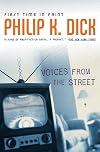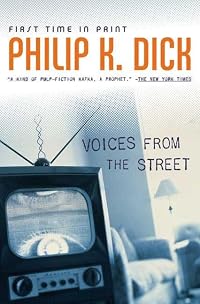
Voices from the Street
by Philip K. Dick
On This Page
Description
In 1950s Oakland, California, Stuart Hadley, a young radio electronics salesman, puts his perfect life at risk as his growing anger, anxiety, and fear results in a quest to fill the void with drinking, sex, and religious fanaticism.Tags
Recommendations


















Member Reviews
Most [[Philip K. Dick]] readers expect a psychedelic, Escher-like exploration of the future - [Voices from the Street] couldn't be more mundane in setting, a television repair store in the suburbs, yet also more like his other-world work. Like other great science fiction and horror writers, PKD often camouflages his descent into the human heart in neon glare and techno-noir, but he's ultimately examining the human condition - you just have to listen more carefully. In this book, he shakes off all those conventions and stares directly into the abyss, following a man in despair with the state of his marriage, his job, himself. He's fed up with the political state of the world, but also the politics of his workplace and his friendships. show more When he finally breaks, he finds redemption in a simple, blue-collar job fixing things that need fixing, living in a small town with his family. it's a deep social commentary, and deep commentary on socialism and the redemptive power of work.
Highly recommended.
5 bones!!!!! show less
Highly recommended.
5 bones!!!!! show less
This is one of Philip K. Dick's earlier stories that was unpublished until a few years ago. I found this in one of those giant book-overstock stores that's open for a while until they run out of inventory or money to rent the storefront. Fitting, considering certain elements of this story.
Except for the fact that the story is set in 1952, the characters and the plot of this book could just as well be found today. In fact, there were moments where conversations between characters seemed like something one might overhear on the streets right this very moment. It's fascinating how little has changed since the 50s in regards to religion, politics, and especially the mixture of the two.
The story itself is the descent of a young man, typical show more of the age, or any age, into animalistic fury. He's a dreamer, stuck in a salesman job he hates, looking for meaning in his life while feeling stuck by the trappings of society. He starts to look for another way, tries out the big new religion sweeping through town, tries to drown himself in drink, even tries to become the most perfect everyday citizen; but it all leads him deeper and deeper into the hole of unfulfillment he digs for himself. Things get dark, incredibly, wickedly dark.
That's the genius of Dick's writing. He creates this vividly descriptive world and pulls you in, then takes you into the darkest workings of the human mind. He would later use science fiction to explore these emotions, playing with allegory and metaphor, but early on he wrote bleak, starkly contrasting reality, and it's terrifying. show less
Except for the fact that the story is set in 1952, the characters and the plot of this book could just as well be found today. In fact, there were moments where conversations between characters seemed like something one might overhear on the streets right this very moment. It's fascinating how little has changed since the 50s in regards to religion, politics, and especially the mixture of the two.
The story itself is the descent of a young man, typical show more of the age, or any age, into animalistic fury. He's a dreamer, stuck in a salesman job he hates, looking for meaning in his life while feeling stuck by the trappings of society. He starts to look for another way, tries out the big new religion sweeping through town, tries to drown himself in drink, even tries to become the most perfect everyday citizen; but it all leads him deeper and deeper into the hole of unfulfillment he digs for himself. Things get dark, incredibly, wickedly dark.
That's the genius of Dick's writing. He creates this vividly descriptive world and pulls you in, then takes you into the darkest workings of the human mind. He would later use science fiction to explore these emotions, playing with allegory and metaphor, but early on he wrote bleak, starkly contrasting reality, and it's terrifying. show less
It's June 5, 1952...early on, in that "Happy Days" decade of Joe and Marilyn and Elvis,...but Stuart Hadley, the protagonist of Voices in the Street, is not happy in the least. Though, by all rights, he should be. He's 4-F (safe from the draft and the Korean War). He's young, blond and handsome. His wife adores him. He has a healthy baby son. And his boss sees something of promise in him; Stuart's been promoted to manager of a TV/Radio sales and repair shop. BUT, inexplicably, Stuart Hadley is miserable! He's sensitive enough to feel that there's more to life than commercial success, - something ineffable but what, but What? Neither religion or alcohol or sex work as escapes or solutions. California, for him, is bleak as a cage.
Voices show more in the Street is Phillip K Dick's second novel, and last to be published, in 2007, fifty five years after it was written. Dick earned his place in a pantheon of Sci-Fi writers, over his long career. But this novel is more akin in style and subject matter to something by Theodore Dreiser. An unstinting look, in precise, naturalistic, and photographic prose, at way fate and society can crush the naive and their dreams. But style aside, "Voices" fits in with Dick's canon, whether chronologically viewed as a finial or a cornerstone. The grand themes of his Sci-Fi work concern the individual psyche, lost and searching for reality and identity, in a morphing world, controlled by hostile corporate and governmental forces. Stuart Hadley is that individual, on that same harrowing quest, and facing the same dominant forces, albeit in the mundane, bland world of 1950's Oakland. And for that reason, the novel still resonates - loudly - in this Age of "Businessantium" where many have no alternatives to McJobs, shopping mall serfdom, and a life in thrall to intertwined nexi of corporate and governmental powers. show less
Voices show more in the Street is Phillip K Dick's second novel, and last to be published, in 2007, fifty five years after it was written. Dick earned his place in a pantheon of Sci-Fi writers, over his long career. But this novel is more akin in style and subject matter to something by Theodore Dreiser. An unstinting look, in precise, naturalistic, and photographic prose, at way fate and society can crush the naive and their dreams. But style aside, "Voices" fits in with Dick's canon, whether chronologically viewed as a finial or a cornerstone. The grand themes of his Sci-Fi work concern the individual psyche, lost and searching for reality and identity, in a morphing world, controlled by hostile corporate and governmental forces. Stuart Hadley is that individual, on that same harrowing quest, and facing the same dominant forces, albeit in the mundane, bland world of 1950's Oakland. And for that reason, the novel still resonates - loudly - in this Age of "Businessantium" where many have no alternatives to McJobs, shopping mall serfdom, and a life in thrall to intertwined nexi of corporate and governmental powers. show less
The situation of the main character should be recognizable to many in our service-based economy. He is a salesman in a small TV shop in southern California in the early 1950s. Like so many of our minimum wage, or slightly higher paid, store employees today, he is barely scrapping by. His wife is pregnant, he has no car, and he feels he has lost his opportunity to make something of himself. His father is a doctor. He is a talented artist. The war everyone worries about is in Korea. A nuclear holocaust seems inevitable. A religious sect offers some answers. Adultery looms.His frustration and rage vent in an almost acceptable manner for the time; he often leaves home, goes to bars, and comes back drunk with the occasional fight or trip to show more the drunk tank thrown in. His boss and coworkers deride him yet care about him. He's smart, good looking, and teems with ideas for success. He just never quite gets his act together. I was fascinated by the social similarities and differences with today. Life was less impersonal then. He gets an opportunity for greater pay and responsibility. Will he succeed or succumb to his faults?The author paints many vivid scenes which stay in my mind. Here he is on an equal footing with his later works. I feel there needed to be more connection and flow between them though. Some were powerful, some were awkward, and some were just good stories. They lack of flow was most noticeable at the ending where, after a digression or two, the plot slammed to a halt leaving me wondering what had just happened. The author is dead so I can't ask him. Given the erratic life of the protagonist maybe an unexpected ending is appropriate. show less
The situation of the main character should be recognizable to many in our service-based economy. He is a salesman in a small TV shop in southern California in the early 1950s. Like so many of our minimum wage, or slightly higher paid, store employees today, he is barely scrapping by. His wife is pregnant, he has no car, and he feels he has lost his opportunity to make something of himself. His father is a doctor. He is a talented artist. The war everyone worries about is in Korea. A nuclear holocaust seems inevitable. A religious sect offers some answers. Adultery looms.His frustration and rage vent in an almost acceptable manner for the time; he often leaves home, goes to bars, and comes back drunk with the occasional fight or trip to show more the drunk tank thrown in. His boss and coworkers deride him yet care about him. He's smart, good looking, and teems with ideas for success. He just never quite gets his act together. I was fascinated by the social similarities and differences with today. Life was less impersonal then. He gets an opportunity for greater pay and responsibility. Will he succeed or succumb to his faults?The author paints many vivid scenes which stay in my mind. Here he is on an equal footing with his later works. I feel there needed to be more connection and flow between them though. Some were powerful, some were awkward, and some were just good stories. They lack of flow was most noticeable at the ending where, after a digression or two, the plot slammed to a halt leaving me wondering what had just happened. The author is dead so I can't ask him. Given the erratic life of the protagonist maybe an unexpected ending is appropriate. show less
I've been a fan of Philip K. Dick's writing for quite a while, having purchased and hungrily read every novel on which he was the single author, most of his short stories, and a fair bit of his nonfiction writing. If you aren't familiar, it's very hard to pick even a small handful for the novice, but I would recommend in particular:
* "Now Wait for Last Year" (my favorite)
* "Flow My Tears, the Policeman Said"
* "The Man in the High Tower"
* "A Scanner Darkly"
To return to the point: as a long-time fan of PKD, it was a pleasure to discover (while following up on a friend's recommendation of the PKD biography "I am Alive and You Are Dead", review to come shortly) that not one, but two of the author's mainstream novels are now being show more printed widely for the first time, and over twenty years after the author's death. "Voices from the Street" is in fact the last of his unpublished novels to go to press, adding to my excitement in devouring the work.
Like his other mainstream novels, "Voices" is a work steeped in the culture of 1950s California. The salesman and their world, the attitudes of the characters toward race issues, even the details regarding music sales are familiar from PKD's mainstream works like "Mary and the Giant" and (my favorite) "In Mliton Lumky Territory". As always in both his mainstream and Science Fiction novels, the relationships between women and men are complex and often strained, as in "Mary", "Milton Lumky", and "Confessions of a Crap Artist".
"Voices" is an earlier effort along the same rough lines as his later mainstream work, and it shows a little. I was reminded of my experience in reading Henry Miller's "Moloch" a few years ago, which was a similar mining of an author's early work, with similar rough edges. A friend of mine who is also reading the book pointed out that the characters' voices are a bit too obviously mouthpieces for the author and not characters in their own right. I would reluctantly agree, although I tend to enjoy Dick's descriptive detail and narrative rather and not be bothered by his characterizations.
I won't go into the details of the story much further, as I'm increasingly wary of spoiling anything for future readers. I will say, however, that like so many of PKD's works, whether or not the end resolution is positive depends largely on the reader's perspective. For those of you that make it through the book, I offer this: the main character reminds me of Grady at the end of Michael Chabon's excellent "Wonder Boys". For anyone who's read both, I hope the comparison makes sense, if not, that's what the comments section of this blog is for.
Although I am far from an unbiased consumer of PKD's work, I enjoyed "Voices" very much, even though it was emotionally exhausting to read in comparison with his Science Fiction novels. If you have read and enjoyed "Milton Lumky" or other mainstream PKD novels, I highly recommend it. If you're unsure, you could do a lot worse than picking up one of the many new editions of his work that are now being reprinted. show less
* "Now Wait for Last Year" (my favorite)
* "Flow My Tears, the Policeman Said"
* "The Man in the High Tower"
* "A Scanner Darkly"
To return to the point: as a long-time fan of PKD, it was a pleasure to discover (while following up on a friend's recommendation of the PKD biography "I am Alive and You Are Dead", review to come shortly) that not one, but two of the author's mainstream novels are now being show more printed widely for the first time, and over twenty years after the author's death. "Voices from the Street" is in fact the last of his unpublished novels to go to press, adding to my excitement in devouring the work.
Like his other mainstream novels, "Voices" is a work steeped in the culture of 1950s California. The salesman and their world, the attitudes of the characters toward race issues, even the details regarding music sales are familiar from PKD's mainstream works like "Mary and the Giant" and (my favorite) "In Mliton Lumky Territory". As always in both his mainstream and Science Fiction novels, the relationships between women and men are complex and often strained, as in "Mary", "Milton Lumky", and "Confessions of a Crap Artist".
"Voices" is an earlier effort along the same rough lines as his later mainstream work, and it shows a little. I was reminded of my experience in reading Henry Miller's "Moloch" a few years ago, which was a similar mining of an author's early work, with similar rough edges. A friend of mine who is also reading the book pointed out that the characters' voices are a bit too obviously mouthpieces for the author and not characters in their own right. I would reluctantly agree, although I tend to enjoy Dick's descriptive detail and narrative rather and not be bothered by his characterizations.
I won't go into the details of the story much further, as I'm increasingly wary of spoiling anything for future readers. I will say, however, that like so many of PKD's works, whether or not the end resolution is positive depends largely on the reader's perspective. For those of you that make it through the book, I offer this: the main character reminds me of Grady at the end of Michael Chabon's excellent "Wonder Boys". For anyone who's read both, I hope the comparison makes sense, if not, that's what the comments section of this blog is for.
Although I am far from an unbiased consumer of PKD's work, I enjoyed "Voices" very much, even though it was emotionally exhausting to read in comparison with his Science Fiction novels. If you have read and enjoyed "Milton Lumky" or other mainstream PKD novels, I highly recommend it. If you're unsure, you could do a lot worse than picking up one of the many new editions of his work that are now being reprinted. show less
This is a UFD. Let me explain.
Almost before he could read, Lloyd Spiegel wanted to play blues. As a precocious youngster he went on tour of the US. Bo Diddley came to see him and then went backstage and asked Spiegel what he wanted to be. Lloyd beamed up at him. ‘Don’t you get it, Mr Diddley? I’m a blues man.’ Whereupon Bo Diddley looked down at him and said ‘Son – you’ll be a blues man when I say you’re a blues man’.
Late in life Dick opined that he hadn’t been told early and often enough when his work was no good. I guess it’s too late, but if you are listening from whatever bizarre possie you might have elsewhere now: this book here? Voices from the Street? Absolutely bar none the worst written thing I’ve ever show more seen in print.
Rest here:
https://alittleteaalittlechat.wordpress.com/2015/03/13/voices-from-the-street-by...
To make it clear, I have not forgotten to add stars. show less
Almost before he could read, Lloyd Spiegel wanted to play blues. As a precocious youngster he went on tour of the US. Bo Diddley came to see him and then went backstage and asked Spiegel what he wanted to be. Lloyd beamed up at him. ‘Don’t you get it, Mr Diddley? I’m a blues man.’ Whereupon Bo Diddley looked down at him and said ‘Son – you’ll be a blues man when I say you’re a blues man’.
Late in life Dick opined that he hadn’t been told early and often enough when his work was no good. I guess it’s too late, but if you are listening from whatever bizarre possie you might have elsewhere now: this book here? Voices from the Street? Absolutely bar none the worst written thing I’ve ever show more seen in print.
Rest here:
https://alittleteaalittlechat.wordpress.com/2015/03/13/voices-from-the-street-by...
To make it clear, I have not forgotten to add stars. show less
Members
- Recently Added By
Published Reviews
ThingScore 75
Voices is the work of an apprentice novelist who was already a journeyman short-story writer. Undoubtedly, it has flaws, but readers familiar with PKD will be fascinated to observe the young writer working out—alongside some technical issues—many of the themes he would return to obsessively throughout his extensive oeuvre.
added by paradoxosalpha
Author Information

667+ Works 146,384 Members
Phillip Kindred Dick was an American science fiction writer best known for his psychological portrayals of characters trapped in illusory environments. Born in Chicago, Illinois, on December 16, 1928, Dick worked in radio and studied briefly at the University of California at Berkeley before embarking on his writing career. His first novel, Solar show more Lottery, was published in 1955. In 1963, Dick won the Hugo Award for his novel, The Man in the High Castle. He also wrote a series of futuristic tales about artificial creatures on the loose; notable of these was Do Androids Dream of Electric Sheep?, which was later adapted into film as Blade Runner. Dick also published several collections of short stories. He died of a stroke in Santa Ana, California, in 1982. (Bowker Author Biography) show less
Series
Belongs to Publisher Series
PKD composition order (1952)
ハヤカワ文庫 SF (2283)
Common Knowledge
- Canonical title
- Voices from the Street
- Original title
- Voices from the Street
- Original publication date
- 1952/1953 (manuscript) (manuscript); 2007-01-23
- People/Characters
- Stuart Hadley
- Epigraph
- They find it harder to locate their
external enemies than to grapple with
their internal conditions. Their
seemingly impersonal defect has spun
a personally tragic plot and they are
betrayed by what is false w... (show all)ithin them.
- C. Wright Mills - Dedication
- To S. M.
- First words
- Thursday morning, June 5, 1952, came bright and hot.
- Last words
- (Click to show. Warning: May contain spoilers.)"A whole lot of things," he said, preoccupied, absorbed, reciting something learned, repeating something cut into the deepest matrix of his mind."A whole bunch of things to get done."
- Blurbers
- Lethem, Jonathan; Williams, Paul
- Original language
- English
Classifications
Statistics
- Members
- 499
- Popularity
- 60,117
- Reviews
- 11
- Rating
- (3.23)
- Languages
- 6 — English, French, German, Italian, Japanese, Polish
- Media
- Paper, Audiobook, Ebook
- ISBNs
- 17
- ASINs
- 4