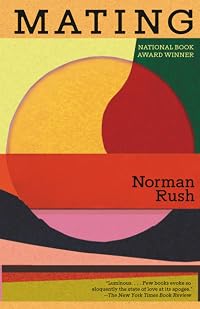
Mating
by Norman Rush
On This Page
Description
Set in the African republic of Botswana--the locale of his acclaimed short story collection, Whites--Norman Rush's novel simultaneously explores the highest of intellectual high grounds and the most tortuous ravines of the erotic and tackles the geopolitics of poverty and the mystery of what men and women really want.Tags
Recommendations








Member Reviews
“I wore myself out collecting enough wood for a ring fire, got us all set up inside it, went into my tent, and closed my eyes, and immediately there were lions in the neighborhood. There may have been only one. I heard a roar like no other sound on earth. I felt it in my atoms. This is my reward for taking precautions, was my first thought. I made myself emerge. I peered around. My [donkeys] were standing pressed together and shaking pathetically. I looked for glints from lion eyes out in the dark but saw nothing. In the morning I found it hard to eat. There was terror in me. I could die in this place, it was clear.”
The unnamed protagonist of Mating is an American thirty-something nutritional anthropologist living in Botswana in the show more 1980s. She has just determined that her doctoral thesis is going nowhere. She meets Nelson Denoon, the founder of Tsau, a secretive utopian community run by African women in a remote area of Botswana. Denoon intrigues her, and she wants to get to know him intimately, so she treks solo across the Kalahari Desert to reach Tsau, where she hopes to be welcomed.
“[H]e went into a sort of aria asking how Tsau could fail to be terrific, since it was the pyramidon at the top of all his prior failures, so called. He gave the entire sequence of truths learned, project to project, such as controlling the scale, working in the vernacular, cutting expatriate staff to near zero, locating yourself remotely enough to avoid premature disruption, balancing collective and individual incentives, basing your political economy on women instead of men…”
This novel is one of the most unusual I have read. It is a novel of ideas and philosophy. It explores intimacy, love, history, politics, economics, feminism, and justice. It is a little drawn out in the beginning, recounting several of the protagonist’s relationships in Gabarone, but once she starts her trek across the Kalahari, it is entirely engrossing. She is searching for the “ideal” romantic relationship. The narrative is filled with intellectual sparring and literary references. Topics include commune life, capitalism, socialism, Marxism, apartheid, and the geopolitics of southern Africa. As an added bonus, it is guaranteed to expand the reader’s vocabulary, even if it is already vast.
There is an intriguing psychological component, where questions arise as to the reason Nelson wants to remain in Tsau. This part gets into philosophy, such as that of the Tao Te Ching, and transformations caused by near-death experiences. Is the change real or fabricated?
This book takes time to read, not only due to its length, but also due to the need to absorb, or possibly look up, some of the regional references that will likely not be in many readers’ immediate scope of knowledge. A helpful glossary is included for the Afrikaans and Setswana terms, as well as descriptions of (real) local organizations. Rush has a dense writing style that respects a reader’s intelligence. I found it masterfully written and intellectually stimulating. show less
The unnamed protagonist of Mating is an American thirty-something nutritional anthropologist living in Botswana in the show more 1980s. She has just determined that her doctoral thesis is going nowhere. She meets Nelson Denoon, the founder of Tsau, a secretive utopian community run by African women in a remote area of Botswana. Denoon intrigues her, and she wants to get to know him intimately, so she treks solo across the Kalahari Desert to reach Tsau, where she hopes to be welcomed.
“[H]e went into a sort of aria asking how Tsau could fail to be terrific, since it was the pyramidon at the top of all his prior failures, so called. He gave the entire sequence of truths learned, project to project, such as controlling the scale, working in the vernacular, cutting expatriate staff to near zero, locating yourself remotely enough to avoid premature disruption, balancing collective and individual incentives, basing your political economy on women instead of men…”
This novel is one of the most unusual I have read. It is a novel of ideas and philosophy. It explores intimacy, love, history, politics, economics, feminism, and justice. It is a little drawn out in the beginning, recounting several of the protagonist’s relationships in Gabarone, but once she starts her trek across the Kalahari, it is entirely engrossing. She is searching for the “ideal” romantic relationship. The narrative is filled with intellectual sparring and literary references. Topics include commune life, capitalism, socialism, Marxism, apartheid, and the geopolitics of southern Africa. As an added bonus, it is guaranteed to expand the reader’s vocabulary, even if it is already vast.
There is an intriguing psychological component, where questions arise as to the reason Nelson wants to remain in Tsau. This part gets into philosophy, such as that of the Tao Te Ching, and transformations caused by near-death experiences. Is the change real or fabricated?
This book takes time to read, not only due to its length, but also due to the need to absorb, or possibly look up, some of the regional references that will likely not be in many readers’ immediate scope of knowledge. A helpful glossary is included for the Afrikaans and Setswana terms, as well as descriptions of (real) local organizations. Rush has a dense writing style that respects a reader’s intelligence. I found it masterfully written and intellectually stimulating. show less
“I wore myself out collecting enough wood for a ring fire, got us all set up inside it, went into my tent, and closed my eyes, and immediately there were lions in the neighborhood. There may have been only one. I heard a roar like no other sound on earth. I felt it in my atoms. This is my reward for taking precautions, was my first thought. I made myself emerge. I peered around. My [donkeys] were standing pressed together and shaking pathetically. I looked for glints from lion eyes out in the dark but saw nothing. In the morning I found it hard to eat. There was terror in me. I could die in this place, it was clear.”
The unnamed protagonist of Mating is an American thirty-something nutritional anthropologist living in Botswana in the show more 1980s. She has just determined that her doctoral thesis is going nowhere. She meets Nelson Denoon, the founder of Tsau, a secretive utopian community run by African women in a remote area of Botswana. Denoon intrigues her, and she wants to get to know him intimately, so she treks solo across the Kalahari Desert to reach Tsau, where she hopes to be welcomed.
“[H]e went into a sort of aria asking how Tsau could fail to be terrific, since it was the pyramidon at the top of all his prior failures, so called. He gave the entire sequence of truths learned, project to project, such as controlling the scale, working in the vernacular, cutting expatriate staff to near zero, locating yourself remotely enough to avoid premature disruption, balancing collective and individual incentives, basing your political economy on women instead of men…”
This novel is one of the most unusual I have read. It is a novel of ideas and philosophy. It explores intimacy, love, history, politics, economics, feminism, and justice. It is a little drawn out in the beginning, recounting several of the protagonist’s relationships in Gabarone, but once she starts her trek across the Kalahari, it is entirely engrossing. She is searching for the “ideal” romantic relationship. The narrative is filled with intellectual sparring and literary references. Topics include commune life, capitalism, socialism, Marxism, apartheid, and the geopolitics of southern Africa. As an added bonus, it is guaranteed to expand the reader’s vocabulary, even if it is already vast.
There is an intriguing psychological component, where questions arise as to the reason Nelson wants to remain in Tsau. This part gets into philosophy, such as that of the Tao Te Ching, and transformations caused by near-death experiences. Is the change real or fabricated?
This book takes time to read, not only due to its length, but also due to the need to absorb, or possibly look up, some of the regional references that will likely not be in many readers’ immediate scope of knowledge. A helpful glossary is included for the Afrikaans and Setswana terms, as well as descriptions of (real) local organizations. Rush has a dense writing style that respects a reader’s intelligence. I found it masterfully written and intellectually stimulating.
4.5 show less
The unnamed protagonist of Mating is an American thirty-something nutritional anthropologist living in Botswana in the show more 1980s. She has just determined that her doctoral thesis is going nowhere. She meets Nelson Denoon, the founder of Tsau, a secretive utopian community run by African women in a remote area of Botswana. Denoon intrigues her, and she wants to get to know him intimately, so she treks solo across the Kalahari Desert to reach Tsau, where she hopes to be welcomed.
“[H]e went into a sort of aria asking how Tsau could fail to be terrific, since it was the pyramidon at the top of all his prior failures, so called. He gave the entire sequence of truths learned, project to project, such as controlling the scale, working in the vernacular, cutting expatriate staff to near zero, locating yourself remotely enough to avoid premature disruption, balancing collective and individual incentives, basing your political economy on women instead of men…”
This novel is one of the most unusual I have read. It is a novel of ideas and philosophy. It explores intimacy, love, history, politics, economics, feminism, and justice. It is a little drawn out in the beginning, recounting several of the protagonist’s relationships in Gabarone, but once she starts her trek across the Kalahari, it is entirely engrossing. She is searching for the “ideal” romantic relationship. The narrative is filled with intellectual sparring and literary references. Topics include commune life, capitalism, socialism, Marxism, apartheid, and the geopolitics of southern Africa. As an added bonus, it is guaranteed to expand the reader’s vocabulary, even if it is already vast.
There is an intriguing psychological component, where questions arise as to the reason Nelson wants to remain in Tsau. This part gets into philosophy, such as that of the Tao Te Ching, and transformations caused by near-death experiences. Is the change real or fabricated?
This book takes time to read, not only due to its length, but also due to the need to absorb, or possibly look up, some of the regional references that will likely not be in many readers’ immediate scope of knowledge. A helpful glossary is included for the Afrikaans and Setswana terms, as well as descriptions of (real) local organizations. Rush has a dense writing style that respects a reader’s intelligence. I found it masterfully written and intellectually stimulating.
4.5 show less
Everything that I think this book sets out to do, it does, I think, incredibly well. With all the issues it topicalizes, explores and maintains incessantly it could be very dull indeed; I'd have expected the level of excitement a body of footnotes to the extended history of 20th century's social thought and gender issues would elicit. Here, however, each sentence carries a carefully crafted, cutting-edge syntactic strategy, gripping and leading your thought and emotion. The text is never boring, it is never even unadventurous, always insightful and yet can never be fully grasped.
Much has been made of the fact that the female narrator's voice actually belongs to a middle-aged novelist, and this is highly subversive in itself, because if show more it bothers you, you are thinking in wrong categories. Incidentally and absolutely unsurprisingly, to my knowledge no one has been able to put a finger on anything that betrays the author's true gender (notwithstanding the discussion on "working the tits down to nubs").
In her honesty the narrator reaches the darkest depths of psyche, disarming and menacing in their naked charm. Stylistically very distinctive and certainly far from both, by force of her inquiry and insight -- in my own literary "idioverse" as she'd put it -- she balances between Conrad and Frisch. In a consistent body of prose it is shown with piercing persuasiveness that intellectual scrutiny and even intervention into the ways of the soul cannot destroy, does not have to diminish in any way the metaphysical, the mystical component of human life. Nor does it take anything away from the sublime quality of the text.
And that returns me to my initial growing surprise, part of which was the impression that Rush could actually create a genious, a giant of thought, who would then only be incorporated in his novel as a character. This might seem like a waste (and is, of course, sleight of hand), but a taste of Rush's oeuvre convinces me that the stakes are high enough.
And yes, it is a novel about love, as visceral and as transcendent as can be. No inquiry, no insight explains that away. show less
Much has been made of the fact that the female narrator's voice actually belongs to a middle-aged novelist, and this is highly subversive in itself, because if show more it bothers you, you are thinking in wrong categories. Incidentally and absolutely unsurprisingly, to my knowledge no one has been able to put a finger on anything that betrays the author's true gender (notwithstanding the discussion on "working the tits down to nubs").
In her honesty the narrator reaches the darkest depths of psyche, disarming and menacing in their naked charm. Stylistically very distinctive and certainly far from both, by force of her inquiry and insight -- in my own literary "idioverse" as she'd put it -- she balances between Conrad and Frisch. In a consistent body of prose it is shown with piercing persuasiveness that intellectual scrutiny and even intervention into the ways of the soul cannot destroy, does not have to diminish in any way the metaphysical, the mystical component of human life. Nor does it take anything away from the sublime quality of the text.
And that returns me to my initial growing surprise, part of which was the impression that Rush could actually create a genious, a giant of thought, who would then only be incorporated in his novel as a character. This might seem like a waste (and is, of course, sleight of hand), but a taste of Rush's oeuvre convinces me that the stakes are high enough.
And yes, it is a novel about love, as visceral and as transcendent as can be. No inquiry, no insight explains that away. show less
Not for everybody, but a brilliant book. Somewhat esoteric and just too much use of made-up words, foreign words, and the arcane; if words like imbricated, ratissage, malentendus, jejune, ressentiment, proleptic, and purlieus, to name a few, roll off your tongue, then go ahead and roll your eyes. I, however, spent a good amount of time using Nook's dictionary feature. In spite of this I LOVED it. Anyway, set in Botswana, just prior to the end of Apartheid in South Africa, the main character and narrator is, of course, a white American woman in the middle of multiple variations of "finding herself."
This is a book I read over a period of nine years. I read it so slowly because I wanted it to never end and because even a few pages can give the reader so much to work with. The narrator is a bit unusual, in the sense that she is a highly analytical woman who observes her own love affair in an almost clinical fashion. However the tone does not detract from the power of the story and the affair, although one based on intellectual attraction, is not a dispassionate one. Additionally, the description of Africa from the viewpoint of an outsider is a tricky proposition and so is a female protagonist from a male writer; I think Rush avoids condescension here. I love this book. It is one of the most intelligent, erudite and thought-provoking show more I have ever read. It is probably flawless. show less
This is not a book for the impatient. Dense, demanding and highbrow, Norman Rush's National Book Award-winning novel about an obsessive academic chasing idealized love in the Botswana bush of the early 1980s is both adorable and infuriating in its impenetrable cleverness.
It took me over a month to read this book, which follows a thesis-stymied anthropologist from Stanford as she chases down political-activist-cum-revolution-figure Nelson Denoon, finding him and wooing him in his isolated feminist village experiment in the central Kalahari. This is Tsau, Denoon's somewhat implausible ideological refuge for maligned and mistreated women. Tsau is run as a regime that flips the typical Botswanan patriarchy—rendered both as a chauvinistic show more travesty and as a timeless, quaint culture that the Benighted White West was poisoning—on its head, granting landowning privileges and political clout exclusively to women.
Tsau's veneer of utopia wears a bit thin as our protagonist—she remains, obnoxiously, unnamed—engages in pseudo-intellectual love games with her quarry (Denoon) and becomes wrapped up in Tsau's intrigues.
The thoroughness with which Rush renders his heroine is impressive, perhaps the most thorough inner monologue I have ever seen a novelist give a first-person character of the opposite gender. From dysmenorrhea to maternal yearnings, Rush runs his protagonist through all of the necessary feminine paces. I looked for obvious absurdities in motives but couldn't exactly find any.
To you, the reader, Norman Rush says: 'You'd better work as hard as I did.' (Of course, Rush would not use quotation marks or even paragraph breaks to denote dialog; that's your job, as reader, to decipher). Mating demands familiarity with all of the major liberal arts fields, from western philosophy to political theory. The vocabulary is borderline cruel, forcing me to keep a dictionary handy. Echt, adumbrate, lares, bouleversement, noetic, crescive, elenchus, divagate, apercus, anschluss, sessile—on nearly every page of the 500-page intellectual trial was a word I'd never even seen before. What was he thinking? Does he hate us? Maybe not, but you'd better be up to date on your categories of socialism and your grasp of Middlemarch and Latin phraseology.
The real tragedy here is that there is extraordinary writing skill and some distinctly compelling plot that gets lost in the screaming academic fury of the book. Rush's understanding of 1980s South African politics and culture is admirable—he spent time there, and not just a dabble of time—and his sentences are often stunning. But the book is so cerebral as to chase away or otherwise flout most of its would-be readers. show less
It took me over a month to read this book, which follows a thesis-stymied anthropologist from Stanford as she chases down political-activist-cum-revolution-figure Nelson Denoon, finding him and wooing him in his isolated feminist village experiment in the central Kalahari. This is Tsau, Denoon's somewhat implausible ideological refuge for maligned and mistreated women. Tsau is run as a regime that flips the typical Botswanan patriarchy—rendered both as a chauvinistic show more travesty and as a timeless, quaint culture that the Benighted White West was poisoning—on its head, granting landowning privileges and political clout exclusively to women.
Tsau's veneer of utopia wears a bit thin as our protagonist—she remains, obnoxiously, unnamed—engages in pseudo-intellectual love games with her quarry (Denoon) and becomes wrapped up in Tsau's intrigues.
The thoroughness with which Rush renders his heroine is impressive, perhaps the most thorough inner monologue I have ever seen a novelist give a first-person character of the opposite gender. From dysmenorrhea to maternal yearnings, Rush runs his protagonist through all of the necessary feminine paces. I looked for obvious absurdities in motives but couldn't exactly find any.
To you, the reader, Norman Rush says: 'You'd better work as hard as I did.' (Of course, Rush would not use quotation marks or even paragraph breaks to denote dialog; that's your job, as reader, to decipher). Mating demands familiarity with all of the major liberal arts fields, from western philosophy to political theory. The vocabulary is borderline cruel, forcing me to keep a dictionary handy. Echt, adumbrate, lares, bouleversement, noetic, crescive, elenchus, divagate, apercus, anschluss, sessile—on nearly every page of the 500-page intellectual trial was a word I'd never even seen before. What was he thinking? Does he hate us? Maybe not, but you'd better be up to date on your categories of socialism and your grasp of Middlemarch and Latin phraseology.
The real tragedy here is that there is extraordinary writing skill and some distinctly compelling plot that gets lost in the screaming academic fury of the book. Rush's understanding of 1980s South African politics and culture is admirable—he spent time there, and not just a dabble of time—and his sentences are often stunning. But the book is so cerebral as to chase away or otherwise flout most of its would-be readers. show less
This is one of my favorite books. I have read it three times. The protagonist seems so real to me that I feel as if I am inhabiting her skin, in spite of the fact that we have dissimilar personalities -- our weaknesses and strengths are not at all the same.
The protagonist's dogged perseverance leads her to take on huge, dangerous challenges. She can be secretive with others, but she is always honest to herself.
Most of the story takes place in an African community based on matriarchy and many ingenious traditions and inventions for the ordinary actions of living. The inventor of this community is a famous, strong, intensely intellectual white man, motivated by a genuine need to create a living example of his talents -- to create a show more living example of his anthropological beliefs about people. However, at the end, his need to let his experiment evolve naturally makes him accept his downfall as community leader. show less
The protagonist's dogged perseverance leads her to take on huge, dangerous challenges. She can be secretive with others, but she is always honest to herself.
Most of the story takes place in an African community based on matriarchy and many ingenious traditions and inventions for the ordinary actions of living. The inventor of this community is a famous, strong, intensely intellectual white man, motivated by a genuine need to create a living example of his talents -- to create a show more living example of his anthropological beliefs about people. However, at the end, his need to let his experiment evolve naturally makes him accept his downfall as community leader. show less
Members
- Recently Added By
Published Reviews
ThingScore 100
It is in the disintegration of idealism that Rush shows his greatest hand. Denoon’s is an island of ideals, political, romantic and personal, and reality is in the tides that run ashore. Idealism has limitations, in literature and in life. Erosion is bound to happen sooner or later.
added by Shortride
Lists

Best Campus Novels
99 works; 18 members

Books Read in 2014
2,343 works; 89 members

TML 200 Best Books 1950-1999
202 works; 10 members

A Novel Cure
742 works; 23 members

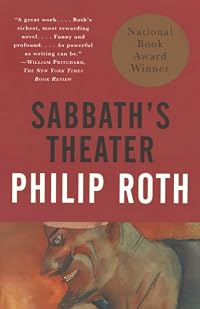
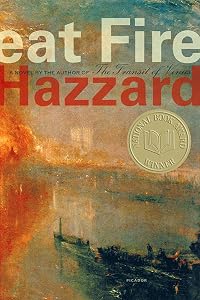
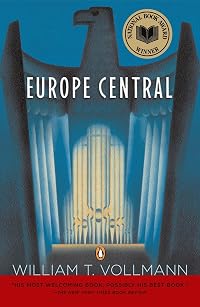
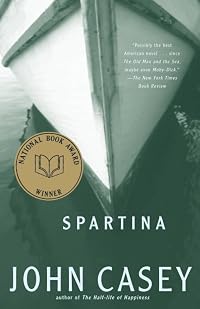
National Book Award - Fiction
78 works; 10 members

The Atlantic's The Great American Novel
136 works; 12 members

Leseliste
2 works; 1 member

2024-2025 Ezra Klein Guest Recommendations
213 works; 6 members

The Modern Library (The Two Hundred Best Novels....
202 works; 1 member
Author Information

6+ Works 2,463 Members
Awards and Honors
Awards
Distinctions
Work Relationships
Is contained in
Common Knowledge
- Canonical title
- Mating
- Original publication date
- 1991
- People/Characters
- Nelson Denoon; Unnamed female narrator
- Important places
- Botswana
- Dedication
- Everything I write is for Elsa, but especially this book, since in it her heart, sensibility, and intellect are so signally—if perforce esoterically—celebrated and exploited. My debt to her, in art and in life, grows howe... (show all)ver much I put against it. I also dedicate Mating to my beloved son and daughter-in-law, Jason and Monica, and to my mother, and to the memory of my father, and to my lost child, Liza.
- First words
- In Africa, you want more, I think.
Classifications
Statistics
- Members
- 1,456
- Popularity
- 16,100
- Reviews
- 20
- Rating
- (3.85)
- Languages
- 5 — English, French, Italian, Norwegian (Bokmål), Portuguese
- Media
- Paper, Audiobook, Ebook
- ISBNs
- 16
- ASINs
- 7