The Changes: A Trilogy
by Peter Dickinson
The Changes Trilogy (Collections and Selections — Omnibus 1-3)
On This Page
Description
In this breathtaking collection of three dystopian novels, award-winning author Peter Dickinson imagines a world where man has rejected technologySomething has gone very wrong in England. In a tunnel beneath Wales one man opens a crack in a mysterious stone wall, and all over the island of Britain people react with horror to perfectly normal machines. Abandoning their cars on the roads and destroying their own factories, many flee the cities for the countryside, where they return to farming show more and an old-fashioned life.
When families are split apart and grown-ups forget how they used to live, young people face unexpected challenges. Nicola Gore survives on her own for nineteen days before she's taken in by a Sikh family that still remembers how to farm and forge steel by hand. Margaret and Jonathan brave the cold and risk terrible punishment in order to save a man's life and lift the fog of fear and hate that's smothering their village. And Geoffrey and his little sister, Sally, escape to France only to be sent back to England on a vital mission: to make their way north to Wales, alone, and find the thing under the stones that shattered civilization—the source of the Changes.
Prolific author Peter Dickinson was known for "keeping up a page-turning pace" (The Guardian), and these adventure-packed novels are some of his most important contributions to science fiction.
This ebook features an illustrated personal history of Peter Dickinson including rare images from the author's collection.
. show less
Tags
Recommendations

















Member Recommendations

by Aquila
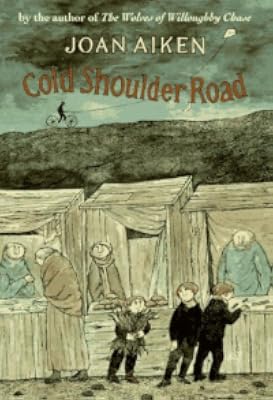
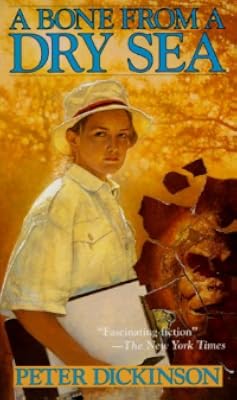
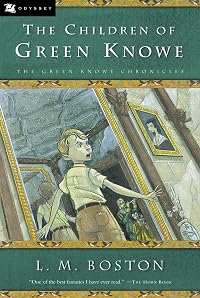
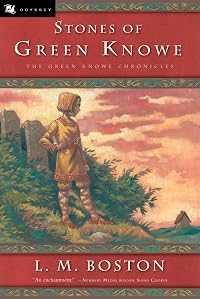
ed.pendragon Another fantasy involving an alternate Britain where the author's love of mechanical transport features strongly, also told in separate but related episodes.
Member Reviews
Had to order it from out-of-system ILL, but it was worth it. Best for ages 11 up, despite brevity of each third, because of provocative, subtle and sophisticated complexities... no simple good vs. evil, for example. I'm not really sure what to say. Exciting page-turning adventure, sure... but so much more. Would be wonderful to read at a young age, read again as a teen, and again as an adult, as one's perspective will change, one's sympathies will lie with the children at one read, with the families at another, with the leaders & the system and the history at another.
.......
To choose two of the most simple ideas, I quote:
"Most people prefer to have their thinking done for them. Democracy is not a natural growth, it is a weary show more responsibility."
"But we've got to be lucky, Sal, so there's no point in thinking about it." "You're all like that. Boys and men, I mean. If there's no use in thinking about something, you don't."
.......
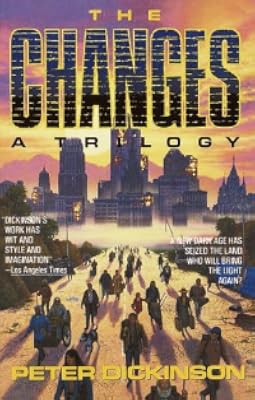
I do wish I could see the other covers irl - the trilogy cover is a basic post-apocalyptic trope, and is not wrong, but inadequate as to content and tone of the gestalt.
The first story, Devil's Children, does stand alone if that's all you can get; in fact, read any that you can get, if you can't get the trilogy. The series page reveals that they were published out of order of story chronology, but they are best read in order of DC, H, W. That way you'll get the full impact of both the science fiction and fantasy elements.
Makes me want to reread Dickinson's [b:The Kin|289577|The Kin|Peter Dickinson|https://images.gr-assets.com/books/1309203726s/289577.jpg|280952], which is (iirc) even richer and even more creative and thought-provoking. ... Though I could be wrong, because I can't stop thinking about this and do not want to pick up another book just yet....
And, in fact, I was going to give it four stars, but the more I think the more I can't resist going all the way with it. I do believe almost every one of you would enjoy & appreciate this. show less
.......
To choose two of the most simple ideas, I quote:
"Most people prefer to have their thinking done for them. Democracy is not a natural growth, it is a weary show more responsibility."
"But we've got to be lucky, Sal, so there's no point in thinking about it." "You're all like that. Boys and men, I mean. If there's no use in thinking about something, you don't."
.......
I do wish I could see the other covers irl - the trilogy cover is a basic post-apocalyptic trope, and is not wrong, but inadequate as to content and tone of the gestalt.
The first story, Devil's Children, does stand alone if that's all you can get; in fact, read any that you can get, if you can't get the trilogy. The series page reveals that they were published out of order of story chronology, but they are best read in order of DC, H, W. That way you'll get the full impact of both the science fiction and fantasy elements.
Makes me want to reread Dickinson's [b:The Kin|289577|The Kin|Peter Dickinson|https://images.gr-assets.com/books/1309203726s/289577.jpg|280952], which is (iirc) even richer and even more creative and thought-provoking. ... Though I could be wrong, because I can't stop thinking about this and do not want to pick up another book just yet....
And, in fact, I was going to give it four stars, but the more I think the more I can't resist going all the way with it. I do believe almost every one of you would enjoy & appreciate this. show less
The release of this trilogy as an omnibus inspired me to re-read these books, which I loved as a child. The collection reverses the original order of the books (which I think was a mistake - more details to follow) and adds in brief 'segues' between each book.
The omnibus also includes a 'biography' of Peter Dickinson (presumably an autobiography). It's brief, but longer than your usual 'About the Author' and includes a collection of family photos from his childhood up to the present day, which is rather interesting.
***THE DEVIL'S CHILDREN
The Apocalypse! Now! With More Tolerance-For-Sikhs!
I remember liking this whole trilogy when I was a kid, but I also recall that this one wasn't my favorite. I was surprised how little of the book felt show more familiar to me upon re-reading.
We're dropped into a post-apocalyptic scene. A young British girl is alone in a mostly-abandoned London struck by plague - and odder phenomena. All Britons, it seems, have been struck by some syndrome that makes them fly into a violent rage at the sight, sound, or presence of machinery or technology. This syndrome also makes them unable to think about certain topics.
In desperation, the girl attaches herself to an extended Sikh immigrant family that happens to be passing by in search of a more amenable place to live.
Together, they set themselves up on an abandoned farm - but more conflict is yet to come, due to the local village's xenophobia, which has been enhanced by this mysterious syndrome.
The main raison-d'etre of the book really does seem to be tolerance-for-Sikhs. They're set up to be the misunderstood heroes, and described lovingly (if somewhat exotically). The book is dedicated to a person whom I assume might've been a Sikh friend of the author. (And you know, maybe it worked on a subconscious level. I DO have a higher opinion of Sikhs than members of many other religions...)
However, the apocalypse here is both enigmatic and inconsistent. Why on earth would these 'changes' affect only native Britons, not immigrants? Why would affected people be able to think about medieval knights, but not WWII? Why are blacksmith's forges OK, but not even the most basic firearm? Why are some people apparently still able to tolerate thinking about leaving the country in modern ships, if buses are intolerable? There are possible explanations, but none are given, or even theorized about.
After one surprisingly-violent showdown, the book ends rather abruptly. In today's market, it would've been expected to be at least twice as long. Overall, by today's standards, this isn't a bad book... but it's not without its flaws.
***HEARTSEASE
The Apocalypse! Now! With English Children on Ponies!
Five years after the Changes affected England, the new way of life seems almost normal to children who were very young when the shift occurred. Margaret rarely thinks about how things used to be, and she shares the antipathy to and suspicion of technology and machines that has come over Britain, although she doesn't feel it as strongly as some do.
When a foreign 'witch' (actually an American intelligence agent) that her village stoned turns out to be still alive, Margaret and her brother Jonathan decide to rescue him in secret. Otto is in bad shape and partially paralyzed, but with the help of the woman who's been working for the family as a servant, Lucy, and her mentally-disabled brother Tim, a conspiracy to save Otto and get him back to his people unfolds.
In many ways, the way the story progresses, with a focus on young people independently using their ingenuity to solve problems, especially problems involving ponies and boats (the rescue plan involves a getaway in a vintage tugboat), the book reads a bit like a darker, post-apocalyptic 'Swallows and Amazons.'
The authorial standpoint on the events depicted in the book is... odd. I can't quite put my finger on it. On the one hand, this new England, yanked back into a pre-Industrial era, is horrific. It is one where strangers are stoned to death without question; where children fear, with justification, that their own families will kill them if they are caught breaking the rules, where people truly believe they're doing something charitable by keeping a mentally-disabled person in a shed like an animal.
Our main characters clearly see all these things as wrong - but they're awfully, and inexplicably, willing to forgive people their faults and try to see the best in them. Even the nasty village 'witch-hunter' who causes people's deaths and psychologically terrorizes their beloved aunt, is portrayed sort of like a cranky but lovable neighbor.
At the same time, while the faults of this society are noted, but to a degree, minimized, we have the portrayal of Jonathan, who's mechanically inclined and is attracted, rather than repulsed by technology (It seems the Changes just haven't affected him for some unknown reason). While Jonathan is bright, ingenious and has a moral compass, at the same time he's portrayed as being quite uncaring and callous toward living things, especially animals.
It's an interesting dichotomy that's set up, but I don't think the book uses or explores it as well as it could have. An opportunity to give the reader an outside viewpoint is missed, by giving the American Otto very little dialogue. And I felt like the ending was rather a cop-out (and for that matter, nearly the same cop-out that Dickinson uses in 'The Devil's Children.')
At the end, Margaret, who was always extremely reluctant to escape to America with Otto and the rest of them, decides, in a dramatic scene, to return to her home with her pony - even though she feared being killed for what she had done. Conveniently, she finds, once she arrives home, that with the death of the witch-hunter, everyone is much more mild and willing to forgive - it was just 'something [the witch-hunter] brought out in us.' This completely avoids having to deal with the anticipated consequences of Margaret's choice.
It's just like at the end of The Devil's Children, after the strict and power-hungry leader of the village is killed and the village is re-taken from a gang of thugs, suddenly all the formerly xenophobic villagers find themselves more willing to accept their neighbors.
Now, this is clearly intentional. Dickinson seems to be saying that without a misled and violent leader swaying people's minds, cooler heads might prevail. However, I'm still not sure that the events as shown in these books fully bolster that statement. I felt the books are too quick to shift the culpability for truly horrific actions onto others. The book uses the Changes (a possibly magical and inexplicable outside influence) as a device to say that people may not be fully responsible for their own actions - and to me, that puts the whole narrative on a weird and shifting footing.
I'm not saying this is necessarily a bad thing - there's a lot of food for thought here, and it's very refreshing to see complex issues without easy answers in a book intended for young people. Too many books published today lack anything of the sort. However, I still feel that the book could have done a bit more with these issues.
A re-read - I read and enjoyed this book more than once as a child, but long enough ago that I remembered few of the details.
****THE WEATHERMONGER
The Apocalyse! Now! With.... well, telling really would be a spoiler.
Let's just say that this book establishes that this trilogy belongs firmly in the genre of books that are about The Matter of Britain.
The book begins dramatically, as the curtain rises on two young people forced out into the water to drown as witches. The boy, Jeff, is suffering amnesia due to a recent knock on the head, but the girl, Sally, informs him that she's his sister and that he has the ability to control the weather.
He summons a fog, and the two manage to make their way to a boat that Jeff has kept in running order (part of the reason for the witchcraft charge - weather magic is accepted, but anything reeking of technology is suspect), and they escape across the Channel to France.
However, as soon as the two arrive in the French immigration office, they're (bafflingly quickly) sent back to England to spy on the situation and try to find out where the Changes which have caused so much upheaval are emanating from.
The plan is to grab a 1909 Rolls Royce Silver Ghost from a private collection (since simpler technology might be less troublesome) and make their way to Wales, where there have been rumors of a mysterious wood that's sprung up overnight, inhabited by a Necromancer.
A Quest is underway...
OK, this one in the trilogy is maintaining its remembered 4-star status. I really enjoyed it.
(Although, I didn't recall how much focus, for a good part of the book, is placed on the car... probably because when I read it I was young enough that I had no idea what the car looked like, so it didn't create a visual memory.
)
There is a LOT of love for this car in the book. (Though a lot of hate comes its way.)
Having now finished my re-read of the 'trilogy' I can say unequivocally that re-arranging the order in the omnibus from publication order to chronological order was a mistake. This one should be read first, and the other two should be regarded as ancillary works, only to be read afterward. It just makes more sense in the original publication order, and eliminates some of the issues I had with the other two books.
(Some of the issues - not all of them. There are still inconsistencies. For example, why, in this book, are animals as well as humans driven into a rage by technology, when in the other books animals seem to behave as usual?) Why are some people affected and not others? We still don't know.
The book is also not without its flaws. For example, Geoffrey's amnesia is nothing more than a plot device which gives Sally an excuse to explain the situation to her brother, and thus, the reader. Other than this, it's not really dealt with at all, and Jeff having lost 5 years of his life barely seems to upset him or his sister. This seems like a bit of authorial laziness. I also felt like the weather-magic aspect of the book was hyped-up enough that it's a bit of a let-down when it doesn't end up figuring more prominently in the plot.
I very much enjoyed the final reveal and denouement, however. From a dramatic perspective, it worked really well, even if the post-hoc scientific theorizing about explanations of great mysteries was a bit out-of-date (no one, at this point seriously thinks that there are large areas of the brain lying unused).
The final paragraphs of the book, as well as a few earlier lines, nicely encapsulate Dickinson's rather conflicted attitude toward the events of this book (and the other two).
BIG HUGE SPOILER DO NOT READ UNLESS YOU'VE READ THE BOOK OR DO NOT INTEND TO.The revelation in this book is that the Changes have been brought about by a pharmacist (chemist) discovering Merlin sleeping in his tomb, and using 'unnatural means' (injections) to try and rouse him from slumber. Half-conscious, Merlin's power has tried to bring the world around him back to that which he knew. (The Dark Ages.) In Merlin's opinion, "machines were just toys for clever apes, and not proper for man - they prevent him from finding his own nature." Regarding the chaos he had thrown England into and the deaths he'd caused "it was just unlucky for some of them, but they didn't matter much." (A Great Power is not concerned with petty morality?) Nevertheless, it is considered by both Merlin (and, we believe, the author) that it is correct and proper that Merlin is allowed to go back to his repose, and that civilization resumes its course. However, the book ends on a nostalgic note, when Jeff realizes that with Merlin back under the hill, magic is gone, and: "Nothing that he could do would alter the steady march of weeping clouds, or call down perfect summers, or summon snow for Christmas. Not ever again.
And the English air would soon be reeking with petrol fumes."
Recommended. And remember, read this one first!
Many thanks to NetGalley and Open Road Media for encouraging me to re-read these books. As always, my opinions are solely my own. show less
The omnibus also includes a 'biography' of Peter Dickinson (presumably an autobiography). It's brief, but longer than your usual 'About the Author' and includes a collection of family photos from his childhood up to the present day, which is rather interesting.
***THE DEVIL'S CHILDREN
The Apocalypse! Now! With More Tolerance-For-Sikhs!
I remember liking this whole trilogy when I was a kid, but I also recall that this one wasn't my favorite. I was surprised how little of the book felt show more familiar to me upon re-reading.
We're dropped into a post-apocalyptic scene. A young British girl is alone in a mostly-abandoned London struck by plague - and odder phenomena. All Britons, it seems, have been struck by some syndrome that makes them fly into a violent rage at the sight, sound, or presence of machinery or technology. This syndrome also makes them unable to think about certain topics.
In desperation, the girl attaches herself to an extended Sikh immigrant family that happens to be passing by in search of a more amenable place to live.
Together, they set themselves up on an abandoned farm - but more conflict is yet to come, due to the local village's xenophobia, which has been enhanced by this mysterious syndrome.
The main raison-d'etre of the book really does seem to be tolerance-for-Sikhs. They're set up to be the misunderstood heroes, and described lovingly (if somewhat exotically). The book is dedicated to a person whom I assume might've been a Sikh friend of the author. (And you know, maybe it worked on a subconscious level. I DO have a higher opinion of Sikhs than members of many other religions...)
However, the apocalypse here is both enigmatic and inconsistent. Why on earth would these 'changes' affect only native Britons, not immigrants? Why would affected people be able to think about medieval knights, but not WWII? Why are blacksmith's forges OK, but not even the most basic firearm? Why are some people apparently still able to tolerate thinking about leaving the country in modern ships, if buses are intolerable? There are possible explanations, but none are given, or even theorized about.
After one surprisingly-violent showdown, the book ends rather abruptly. In today's market, it would've been expected to be at least twice as long. Overall, by today's standards, this isn't a bad book... but it's not without its flaws.
***HEARTSEASE
The Apocalypse! Now! With English Children on Ponies!
Five years after the Changes affected England, the new way of life seems almost normal to children who were very young when the shift occurred. Margaret rarely thinks about how things used to be, and she shares the antipathy to and suspicion of technology and machines that has come over Britain, although she doesn't feel it as strongly as some do.
When a foreign 'witch' (actually an American intelligence agent) that her village stoned turns out to be still alive, Margaret and her brother Jonathan decide to rescue him in secret. Otto is in bad shape and partially paralyzed, but with the help of the woman who's been working for the family as a servant, Lucy, and her mentally-disabled brother Tim, a conspiracy to save Otto and get him back to his people unfolds.
In many ways, the way the story progresses, with a focus on young people independently using their ingenuity to solve problems, especially problems involving ponies and boats (the rescue plan involves a getaway in a vintage tugboat), the book reads a bit like a darker, post-apocalyptic 'Swallows and Amazons.'
The authorial standpoint on the events depicted in the book is... odd. I can't quite put my finger on it. On the one hand, this new England, yanked back into a pre-Industrial era, is horrific. It is one where strangers are stoned to death without question; where children fear, with justification, that their own families will kill them if they are caught breaking the rules, where people truly believe they're doing something charitable by keeping a mentally-disabled person in a shed like an animal.
Our main characters clearly see all these things as wrong - but they're awfully, and inexplicably, willing to forgive people their faults and try to see the best in them. Even the nasty village 'witch-hunter' who causes people's deaths and psychologically terrorizes their beloved aunt, is portrayed sort of like a cranky but lovable neighbor.
At the same time, while the faults of this society are noted, but to a degree, minimized, we have the portrayal of Jonathan, who's mechanically inclined and is attracted, rather than repulsed by technology (It seems the Changes just haven't affected him for some unknown reason). While Jonathan is bright, ingenious and has a moral compass, at the same time he's portrayed as being quite uncaring and callous toward living things, especially animals.
It's an interesting dichotomy that's set up, but I don't think the book uses or explores it as well as it could have. An opportunity to give the reader an outside viewpoint is missed, by giving the American Otto very little dialogue. And I felt like the ending was rather a cop-out (and for that matter, nearly the same cop-out that Dickinson uses in 'The Devil's Children.')
It's just like at the end of The Devil's Children, after the strict and power-hungry leader of the village is killed and the village is re-taken from a gang of thugs, suddenly all the formerly xenophobic villagers find themselves more willing to accept their neighbors.
Now, this is clearly intentional. Dickinson seems to be saying that without a misled and violent leader swaying people's minds, cooler heads might prevail. However, I'm still not sure that the events as shown in these books fully bolster that statement. I felt the books are too quick to shift the culpability for truly horrific actions onto others. The book uses the Changes (a possibly magical and inexplicable outside influence) as a device to say that people may not be fully responsible for their own actions - and to me, that puts the whole narrative on a weird and shifting footing.
I'm not saying this is necessarily a bad thing - there's a lot of food for thought here, and it's very refreshing to see complex issues without easy answers in a book intended for young people. Too many books published today lack anything of the sort. However, I still feel that the book could have done a bit more with these issues.
A re-read - I read and enjoyed this book more than once as a child, but long enough ago that I remembered few of the details.
****THE WEATHERMONGER
The Apocalyse! Now! With.... well, telling really would be a spoiler.
Let's just say that this book establishes that this trilogy belongs firmly in the genre of books that are about The Matter of Britain.
The book begins dramatically, as the curtain rises on two young people forced out into the water to drown as witches. The boy, Jeff, is suffering amnesia due to a recent knock on the head, but the girl, Sally, informs him that she's his sister and that he has the ability to control the weather.
He summons a fog, and the two manage to make their way to a boat that Jeff has kept in running order (part of the reason for the witchcraft charge - weather magic is accepted, but anything reeking of technology is suspect), and they escape across the Channel to France.
However, as soon as the two arrive in the French immigration office, they're (bafflingly quickly) sent back to England to spy on the situation and try to find out where the Changes which have caused so much upheaval are emanating from.
The plan is to grab a 1909 Rolls Royce Silver Ghost from a private collection (since simpler technology might be less troublesome) and make their way to Wales, where there have been rumors of a mysterious wood that's sprung up overnight, inhabited by a Necromancer.
A Quest is underway...
OK, this one in the trilogy is maintaining its remembered 4-star status. I really enjoyed it.
(Although, I didn't recall how much focus, for a good part of the book, is placed on the car... probably because when I read it I was young enough that I had no idea what the car looked like, so it didn't create a visual memory.
)
There is a LOT of love for this car in the book. (Though a lot of hate comes its way.)
Having now finished my re-read of the 'trilogy' I can say unequivocally that re-arranging the order in the omnibus from publication order to chronological order was a mistake. This one should be read first, and the other two should be regarded as ancillary works, only to be read afterward. It just makes more sense in the original publication order, and eliminates some of the issues I had with the other two books.
(Some of the issues - not all of them. There are still inconsistencies. For example, why, in this book, are animals as well as humans driven into a rage by technology, when in the other books animals seem to behave as usual?) Why are some people affected and not others? We still don't know.
The book is also not without its flaws. For example, Geoffrey's amnesia is nothing more than a plot device which gives Sally an excuse to explain the situation to her brother, and thus, the reader. Other than this, it's not really dealt with at all, and Jeff having lost 5 years of his life barely seems to upset him or his sister. This seems like a bit of authorial laziness. I also felt like the weather-magic aspect of the book was hyped-up enough that it's a bit of a let-down when it doesn't end up figuring more prominently in the plot.
I very much enjoyed the final reveal and denouement, however. From a dramatic perspective, it worked really well, even if the post-hoc scientific theorizing about explanations of great mysteries was a bit out-of-date (no one, at this point seriously thinks that there are large areas of the brain lying unused).
The final paragraphs of the book, as well as a few earlier lines, nicely encapsulate Dickinson's rather conflicted attitude toward the events of this book (and the other two).
BIG HUGE SPOILER DO NOT READ UNLESS YOU'VE READ THE BOOK OR DO NOT INTEND TO.
And the English air would soon be reeking with petrol fumes."
Recommended. And remember, read this one first!
Many thanks to NetGalley and Open Road Media for encouraging me to re-read these books. As always, my opinions are solely my own. show less
I've been wanting to read this series for a while, so I finally got it and started. The opening book is The Devil's Children.
It feels like The Devil's Children drops the reader in the middle of the story. We know "The Changes" happened, that modern technology was abandoned, and that people left the cities for the country. Since cars and trucks and such were abandoned, that means we follow the main character, Nicky, and her travels.
What I found the most interesting were her interactions with a clan of Sikhs, who are not affected by The Changes. She is used as a canary in a coal mine; their interactions with her let them know if they are about to upset other English people. This is really useful as the family settles down and starts show more farming and metalworking next to a village that is going down the feudal path.
At the end of the book, there are still a lot of questions to be answered. Why were only England and the English there currently affected by The Changes? What caused the Changes in the first place? And of course, what happens next? I'll keep reading.
Recommended as the start of the series. I think it could be used as a jumping-off point for a discussion on how the lack of technology would affect each of us.
The middle book of the trilogy is Heartsease. It is about five years after "The Changes." We find that some people have proven that absolute power corrupts absolutely. Other English children aren't as strongly affected by the technology avoidance. And, sadly, sheltering someone who is mentally-challenged is seen as absurd charity, even when he is kept in the barn. The kindness and heroism of the children are what kept me reading.
The Weathermonger is a great book. Finally, we get some answers as to why The Changes happened. But to get that answer requires a quest with the mount of a Silver Ghost Rolls-Royce. And there is even a meeting with a trickster.
Any more would be telling, and this book is worth reading. show less
It feels like The Devil's Children drops the reader in the middle of the story. We know "The Changes" happened, that modern technology was abandoned, and that people left the cities for the country. Since cars and trucks and such were abandoned, that means we follow the main character, Nicky, and her travels.
What I found the most interesting were her interactions with a clan of Sikhs, who are not affected by The Changes. She is used as a canary in a coal mine; their interactions with her let them know if they are about to upset other English people. This is really useful as the family settles down and starts show more farming and metalworking next to a village that is going down the feudal path.
At the end of the book, there are still a lot of questions to be answered. Why were only England and the English there currently affected by The Changes? What caused the Changes in the first place? And of course, what happens next? I'll keep reading.
Recommended as the start of the series. I think it could be used as a jumping-off point for a discussion on how the lack of technology would affect each of us.
The middle book of the trilogy is Heartsease. It is about five years after "The Changes." We find that some people have proven that absolute power corrupts absolutely. Other English children aren't as strongly affected by the technology avoidance. And, sadly, sheltering someone who is mentally-challenged is seen as absurd charity, even when he is kept in the barn. The kindness and heroism of the children are what kept me reading.
The Weathermonger is a great book. Finally, we get some answers as to why The Changes happened. But to get that answer requires a quest with the mount of a Silver Ghost Rolls-Royce. And there is even a meeting with a trickster.
Any more would be telling, and this book is worth reading. show less
not sci-fi, more like anti-sci-fi sci- fi? wait.. sci-fantasy? kinda, but still standard sci-fi, but with every day objects?
i really do not know what category this would fall into. it is definitely a young adult trilogy. it was also very good.
Peter Dickinson’s ‘The Changes’ trilogy follows the the experiences of three groups in the UK over a period of about a decade. This is basically a post apocalyptic tale with out the apocalypse.
one afternoon everybody just goes a little bit crazy and it sticks. They fear all things technological. Engines drive them mad and they fly into a fury of destruction. electricity is like witch craft, guns are completely out of the question. even simple machines like a bicycle could cause a mob scene.
in show more a matter of minutes, even seeing a unmoving vehicle or a telephone sitting idle makes people uncomfortable to the point of walking away.Only people in the UK are affected, the rest of the world fears the spread of their irrational fears.
unlike other turn society on it’s ear novels, these were a bit different because technology still works. people just refuse to use it, effectively placing themselves in a neo-dark age.
Written in the late 1960’s / early 70’s, The Changes trilogy covers three short books (about 200 pgs each).
* Book one is ‘The Devils Children’ followed by
* The Heartease
* The Weathermonger
interestingly, they were published backwards. The Weathermonger was the first published in 1968. it is by far the most Fantasy of the trilogy, it deals with a boy who can concentrate and call storms, fog, end rain, etc. He and his sister are seemingly immune to the effects of ‘the changes’ and are on a tech filled journey to wales, rumored to be where this ailment began. this is the conclusion to the series.
Heartease and the Devils Children were published in the two following years.
As standalone novels, i think that these would be enjoyable, but i believe they are best presented in the trilogy omnibus format. There are some simple introductions included which i am assuming wdid not exist for the standalones. as an example, in the preface, we are translucently introduced to a man ho is excavating in a pit, when he locates a stone slab covering a tomb. when he moves the slab, a bright green light shines out of his pit and the UK changes. you then start immediately into the story of a girl stuck at home awaiting her family. it has been 28 days since the change. these interludes are informative and the individual books would be difficult to link together with out these.
i think one of the huge benefits to this series is its flexibility to fit into modern eras. computers are not mentioned because they were not common household items. there are no lame fall back plots pertaining to cell phone use.. the internet does not exist. the tales do not come across as anything but antiquated.
i highly suggest this for any your adult reader as well as any adult sci-fantasy fan who wants some light but enjoyable reading.
apparently, there is also a 70’s british mini-series i may have to hunt down :)
about the author
Dickinson has written over 50 books and is a very humorous writer from what i can see. i would drink a beer with him.
folks who enjoyed the 1980’s movie “Flight of the Dragons” should note that it was based on one of his books.
on his Random house author page he is described as “Peter Dickinson is a tall, elderly, bony, beaky, wrinkled sort of fellow, with a lot of untidy grey hair and a weird hooting voice—in fact he looks and sounds a bit like Gandalf’s crazy twin, but he’s only rather absent-minded, probably because he’s thinking about something else. Day-dreaming, mostly. [...:]“ show less
i really do not know what category this would fall into. it is definitely a young adult trilogy. it was also very good.
Peter Dickinson’s ‘The Changes’ trilogy follows the the experiences of three groups in the UK over a period of about a decade. This is basically a post apocalyptic tale with out the apocalypse.
one afternoon everybody just goes a little bit crazy and it sticks. They fear all things technological. Engines drive them mad and they fly into a fury of destruction. electricity is like witch craft, guns are completely out of the question. even simple machines like a bicycle could cause a mob scene.
in show more a matter of minutes, even seeing a unmoving vehicle or a telephone sitting idle makes people uncomfortable to the point of walking away.Only people in the UK are affected, the rest of the world fears the spread of their irrational fears.
unlike other turn society on it’s ear novels, these were a bit different because technology still works. people just refuse to use it, effectively placing themselves in a neo-dark age.
Written in the late 1960’s / early 70’s, The Changes trilogy covers three short books (about 200 pgs each).
* Book one is ‘The Devils Children’ followed by
* The Heartease
* The Weathermonger
interestingly, they were published backwards. The Weathermonger was the first published in 1968. it is by far the most Fantasy of the trilogy, it deals with a boy who can concentrate and call storms, fog, end rain, etc. He and his sister are seemingly immune to the effects of ‘the changes’ and are on a tech filled journey to wales, rumored to be where this ailment began. this is the conclusion to the series.
Heartease and the Devils Children were published in the two following years.
As standalone novels, i think that these would be enjoyable, but i believe they are best presented in the trilogy omnibus format. There are some simple introductions included which i am assuming wdid not exist for the standalones. as an example, in the preface, we are translucently introduced to a man ho is excavating in a pit, when he locates a stone slab covering a tomb. when he moves the slab, a bright green light shines out of his pit and the UK changes. you then start immediately into the story of a girl stuck at home awaiting her family. it has been 28 days since the change. these interludes are informative and the individual books would be difficult to link together with out these.
i think one of the huge benefits to this series is its flexibility to fit into modern eras. computers are not mentioned because they were not common household items. there are no lame fall back plots pertaining to cell phone use.. the internet does not exist. the tales do not come across as anything but antiquated.
i highly suggest this for any your adult reader as well as any adult sci-fantasy fan who wants some light but enjoyable reading.
apparently, there is also a 70’s british mini-series i may have to hunt down :)
about the author
Dickinson has written over 50 books and is a very humorous writer from what i can see. i would drink a beer with him.
folks who enjoyed the 1980’s movie “Flight of the Dragons” should note that it was based on one of his books.
on his Random house author page he is described as “Peter Dickinson is a tall, elderly, bony, beaky, wrinkled sort of fellow, with a lot of untidy grey hair and a weird hooting voice—in fact he looks and sounds a bit like Gandalf’s crazy twin, but he’s only rather absent-minded, probably because he’s thinking about something else. Day-dreaming, mostly. [...:]“ show less
this is a well written tale that drags you into to make you part of the action. I can still see and not quite understand the lothing that people suddenly have towards things mechanical. This is a world that was me and then how it could be and i followed it down and felt it real.
Ratings
Members
- Recently Added By
Lists

It's the end of the world as we know it!
90 works; 23 members
Author Information

109+ Works 10,500 Members
Peter Dickinson was born in Livingstone, Northern Rhodesia, now Zambia on December 16, 1927. He served in the British Army before receiving a B.A. in English literature from King's College, Cambridge in 1951. He was an assistant editor and reviewer for Punch Magazine for seventeen years. His first book, The Weathermonger, was published in 1968. He show more has written over 50 books for adults and young adults. His works for adults include Death of a Unicorn, Skeleton-in-Waiting, Perfect Gallows, The Yellow Room Conspiracy, and Some Deaths Before Dying. His works for young adults include The Iron Lion, The Ropemaker, Angel Isle, and In the Palace of the Khans. He has won several awards including the Boston Globe Horn Book Award in 1989 for Eva, the Carnegie Medal in 1979 for Tulku and in 1980 for City of Gold, the Whitbread Children's Prize for Tulku, and the Crime Writer's Golden Dagger for Skin Deep in 1968 and A Pride of Heroes in 1969. In 2009, he was awarded the OBE for services to literature. He died after a brief illness on December 16, 2015 at the age of 88. (Bowker Author Biography) show less
Series

Work Relationships
Contains
Has the adaptation
Classifications
Statistics
- Members
- 164
- Popularity
- 200,421
- Reviews
- 5
- Rating
- (3.98)
- Languages
- English
- Media
- Paper, Ebook
- ISBNs
- 6
- ASINs
- 2