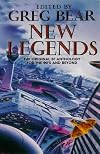
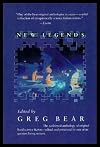
New Legends
by Greg Bear (Editor), Martin H. Greenberg (Editor)
On This Page
Description
Presenting many of the field's greatest names - such as Ursula K. le Guin, Poul Anderson, Gregory Benford and Robert Sheckley - this anthology also includes contributions from new science fiction writers such as Mary Rosenblum, Greg Egan and Paul J. McAuley.Tags
Recommendations



















Member Reviews
This is an original anthology dating from 1995; the editors, Greg Bear and Martin Greenberg, sought to bring together stories that would have relevance to the coming world of the 21st Century. In this, they broadly succeeded, even though some of the themes might have seemed remote or even of negligible relevance back in 1995.
Mary Rosemblum's Elegy concerns stem cell research, Sterling Blake's A Desperate Calculus looks at the machinery and statistics of pandemics. Ursula le Guin contributed Coming of age in Karhide, set in the world of her novel The Left Hand of Darkness, which has acquired relevance through our current concerns over matters of gender identity.
Greg Benford submits two pieces: High Abyss, and Old Legends, his show more recollections of working in a high-pressure scientific establishment working on advanced weaponry, the Lawrence Livermore Laboratory, and includes a personal portrait of Edward Teller, father of the hydrogen bomb. Such an establishment is depicted in Carter Scholz's Radiance; the politics, both internal and external, in such an establishment seems well-drawn.
Greg Abraham's Gnota concerns UN peacekeepers and transgenic transplant technology, though there was a practical difficulty for me. The protagonist, victim of a terrorist bombing attack, has an artificial pump implanted to keep him alive until a tailored transgenic heart can be grown for him; Abraham seems unable to decide on how big this medical device is - at one point, it is the size of a hand and a centimetre thick, yet at other times it is bigger than his backpack. I realise it might be depicted as feeling that big, but consistency would help. And as I know someone who spent three years or so with a left ventricular assist device awaiting a donor heart for transplant, Abraham has overlooked the practical difficulties (such as always looking for a power socket to recharge from) his protagonist would have in traipsing across Europe. And as soon as he gave his donor piglet a name - the 'Gnota' of the title - I knew we were in for trouble...
Rorvik's War by Geoffrey Landis looks initially like template military sf, but I saw the twist in the tale a few pages out from its revelation. It has relevance in our days of remote warfare and simulations. Perhaps my stand-out story was Robert Silverberg's The Red Blaze in the Morning, which involves an archaeologist working in southern Turkey who receives an offer he is reluctant to accept.
Other contributions come from Paul McAulay (Recording Angel), Sonia Orin Lyris (When Strangers Meet), Robert Sheckley (The Day the Aliens came) and Greg Egan (Wang's Carpets).
There are a few stories that didn't work for me: James Stevens-Ace's Scenes from a future marriage, about licenced reproduction in a media-driven North America (although the media landscape was very recognisable to my modern eyes, something about the experience of the couple seeking to reproduce in that future didn't gel). George Alec Effinger contributed One, where a couple head out in a faster-than-light spaceship to look for life and seed the systems they find with jump gates, but there is an accident and one of the couple dies, leaving the other, who has already displayed signs of stress, to carry on alone, always hoping that the next system he visits will finally have life. This didn't work for me on a couple of levels: even before the accident, they had discussed the possibility of turning back to Earth if the stress was becoming an impediment to successfully completing the mission. So why didn't they? And why didn't the lone survivor do so when they were left isolated?
And there was a Poul Anderson story, Scarecrow, which started out with an Expanse-style vibe but was marred by archaic language (referring to "yonder planet" may have been acceptable in the 1940s and 50s when Anderson was at the height of his career, but not in 1995) and excessive religiosity.
Nonetheless, this was a highly enjoyable anthology and most of the stories in it have not aged at all badly. This is worth looking out for in the second-hand market. show less
Mary Rosemblum's Elegy concerns stem cell research, Sterling Blake's A Desperate Calculus looks at the machinery and statistics of pandemics. Ursula le Guin contributed Coming of age in Karhide, set in the world of her novel The Left Hand of Darkness, which has acquired relevance through our current concerns over matters of gender identity.
Greg Benford submits two pieces: High Abyss, and Old Legends, his show more recollections of working in a high-pressure scientific establishment working on advanced weaponry, the Lawrence Livermore Laboratory, and includes a personal portrait of Edward Teller, father of the hydrogen bomb. Such an establishment is depicted in Carter Scholz's Radiance; the politics, both internal and external, in such an establishment seems well-drawn.
Greg Abraham's Gnota concerns UN peacekeepers and transgenic transplant technology, though there was a practical difficulty for me. The protagonist, victim of a terrorist bombing attack, has an artificial pump implanted to keep him alive until a tailored transgenic heart can be grown for him; Abraham seems unable to decide on how big this medical device is - at one point, it is the size of a hand and a centimetre thick, yet at other times it is bigger than his backpack. I realise it might be depicted as feeling that big, but consistency would help. And as I know someone who spent three years or so with a left ventricular assist device awaiting a donor heart for transplant, Abraham has overlooked the practical difficulties (such as always looking for a power socket to recharge from) his protagonist would have in traipsing across Europe. And as soon as he gave his donor piglet a name - the 'Gnota' of the title - I knew we were in for trouble...
Rorvik's War by Geoffrey Landis looks initially like template military sf, but I saw the twist in the tale a few pages out from its revelation. It has relevance in our days of remote warfare and simulations. Perhaps my stand-out story was Robert Silverberg's The Red Blaze in the Morning, which involves an archaeologist working in southern Turkey who receives an offer he is reluctant to accept.
Other contributions come from Paul McAulay (Recording Angel), Sonia Orin Lyris (When Strangers Meet), Robert Sheckley (The Day the Aliens came) and Greg Egan (Wang's Carpets).
There are a few stories that didn't work for me: James Stevens-Ace's Scenes from a future marriage, about licenced reproduction in a media-driven North America (although the media landscape was very recognisable to my modern eyes, something about the experience of the couple seeking to reproduce in that future didn't gel). George Alec Effinger contributed One, where a couple head out in a faster-than-light spaceship to look for life and seed the systems they find with jump gates, but there is an accident and one of the couple dies, leaving the other, who has already displayed signs of stress, to carry on alone, always hoping that the next system he visits will finally have life. This didn't work for me on a couple of levels: even before the accident, they had discussed the possibility of turning back to Earth if the stress was becoming an impediment to successfully completing the mission. So why didn't they? And why didn't the lone survivor do so when they were left isolated?
And there was a Poul Anderson story, Scarecrow, which started out with an Expanse-style vibe but was marred by archaic language (referring to "yonder planet" may have been acceptable in the 1940s and 50s when Anderson was at the height of his career, but not in 1995) and excessive religiosity.
Nonetheless, this was a highly enjoyable anthology and most of the stories in it have not aged at all badly. This is worth looking out for in the second-hand market. show less
While a few stories were interesting, most were not.
I picked it up because it contained one by Ursula LeGuin, but even that isn't enough to make me keep the book tho it was an interesting perspective on sexual identity, using a society where one's sex can shift each fertile season--and there is no continuous sexual drive.
Mary Rosenbaum's "Elegy" in which a woman scientist who continues her mother's cancelled research (& only we know what this will lead to). Greg Abraham's "Gnota" has a great quote "we're as fragile as our past, wherever we go. And as beautiful." in his tale of how a soldier in a UN-type "peacekeeping force" comes to terms with the citizen bombing which killed his friend & injured him. This was followed by Geoffre show more Landis' thought-provking "Rorvik's War".
The editor intended this collection to "show that the science fictionn neighborhood can still grow mental athletes stronger and more agile than ever before,...leave the impression that these stories might actually happen". I think he failed in that, tho he did include a few that "shout the desperate warnings" which are necessary for our society's development. show less
I picked it up because it contained one by Ursula LeGuin, but even that isn't enough to make me keep the book tho it was an interesting perspective on sexual identity, using a society where one's sex can shift each fertile season--and there is no continuous sexual drive.
Mary Rosenbaum's "Elegy" in which a woman scientist who continues her mother's cancelled research (& only we know what this will lead to). Greg Abraham's "Gnota" has a great quote "we're as fragile as our past, wherever we go. And as beautiful." in his tale of how a soldier in a UN-type "peacekeeping force" comes to terms with the citizen bombing which killed his friend & injured him. This was followed by Geoffre show more Landis' thought-provking "Rorvik's War".
The editor intended this collection to "show that the science fictionn neighborhood can still grow mental athletes stronger and more agile than ever before,...leave the impression that these stories might actually happen". I think he failed in that, tho he did include a few that "shout the desperate warnings" which are necessary for our society's development. show less
Ratings
Members
- Recently Added By
Author Information

Greg Bear was born in San Diego, California, on August 20, 1951. He received a Bachelor of Arts degree from San Diego State University in 1973. At age 14, he began submitting pieces to magazines and at 15 he sold his first story to Robert Lowndes' Famous Science Fiction. It would be five years before he sold another piece, but by 23 he was selling show more stories regularly. He has written more than 30 science fiction and fantasy books and has won numerous awards for his work. In 1984, Hardfought and Blood Music won the Nebula Awards for best novella and novelette; Blood Music went on to win the Hugo Award. The novel version of that story, also called Blood Music, won the Prix Apollo in France. In 1987, Tangents won the Hugo and Nebula awards for best short story. He also won a Nebula in 1994 for Moving Mars and in 2001 for Darwin's Radio. Both Dinosaur Summer and Darwin's Radio have been awarded the Endeavour for best novel published by a Northwest science fiction author. He is also an illustrator and his work has appeared in Galaxy, Fantasy and Science Fiction, and Vertex, and in both hardcover and paperback books. He was a founding member of ASFA, the Association of Science Fiction Artists. His works include City at the End of Time, Hull Zero Three, The Mongoliad, Mariposa, Halo: Cryptum, Halo: Primordium and Halo: Silentium. (Bowker Author Biography) show less

Martin Harry Greenberg (March 1, 1941 - June 25, 2011) was an American academic and speculative fiction anthologist. In all, he compiled 1,298 anthologies. He founded Tekno Books, a packager of more than 2000 published books; he was also a co-founder of the Sci-Fi Channel. Some of his anthologies included: Past Imperfect (2001), Once Upon a Galaxy show more (2002) and Sirius: The Dog Star (2004). (Bowker Author Biography) show less
All Editions
Some Editions
Work Relationships
Contains
Common Knowledge
- Canonical title
- New Legends
- Alternate titles
- New Legends: The Original SF Anthology of the 90s and Beyond
- Original publication date
- 1995-08
- Original language
- English
- Disambiguation notice
- First hardback edition of this title lacks subtitle found on later paperback versions.
Classifications
- Genres
- Fiction and Literature, Science Fiction
- DDC/MDS
- 813.0876208 — Literature & rhetoric American literature in English American fiction in English By type Genre fiction Adventure fiction Speculative fiction Science fiction Collections and anthologies Anthologies
- LCC
- PS648 .S3 .N45 — Language and Literature American literature American literature Collections of American literature Prose (General)
- BISAC
Statistics
- Members
- 186
- Popularity
- 175,616
- Reviews
- 2
- Rating
- (3.45)
- Languages
- English, Polish
- Media
- Paper
- ISBNs
- 6
- ASINs
- 3