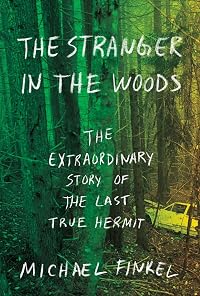
The Stranger in the Woods: The Extraordinary Story of the Last True Hermit
by Michael Finkel
On This Page
Description
"For readers of Jon Krakauer and The Lost City of Z, a remarkable tale of survival and solitude--the true story of a man who lived alone in a tent in the Maine woods, never talking to another person and surviving by stealing supplies from nearby cabins for twenty-seven years. In 1986, twenty-year-old Christopher Knight left his home in Massachusetts, drove to Maine, and disappeared into the woods. He would not have a conversation with another human being until nearly three decades later when show more he was arrested for stealing food. Living in a tent even in winter, he had survived by his wits and courage, developing ingenious ways to store food and water, to avoid freezing to death. He broke into nearby cottages for food, clothes, reading material, and other provisions, taking only what he needed, but terrifying a community never able to solve the mysterious burglaries. Based on extensive interviews with Knight himself, this is a vividly detailed account of the why and how of his secluded life--as well as the challenges he has faced returning to the world. A riveting story of survival that asks fundamental questions about solitude, community, and what makes a good life, and a deeply moving portrait of a man who was determined to live his own way, and succeeded"--Publisher description. show lessTags
Recommendations

























Member Recommendations

Donut Dolly: An American Red Cross Girl's War in Vietnam (North Texas Military Biography and Memoir Series) by Joann Puffer Kotcher
fulner A Public Radio recommend biography that gave away much of the story

Member Reviews
Synopsis
In 1986, twenty year-old Christopher Thomas Knight walked into the woods in Maine, abandoning his car, his job, his family, and his life. For the next twenty-seven years, until he was caught, Knight lived in the harsh woods of Maine, surviving by stealing food and other necessaries from the inhabitants of the cabins and camps around North Pond, Maine. During that entire twenty-seven years, the only contact he had with another human occurred during one chance encounter with hikers, limited to the word “hi” and a wave. After he was caught, Knight ultimately plead guilty to a handful of the estimated one thousand burglaries he committed over that quarter century and was forced to live again in society. The Stranger in the Woods show more is the story of Knight’s survival—both in the woods and once forced out—as well as the story of how Finkel came to meet Knight and come to terms with how he chose to live.
White Privilege
This is most decidedly not what I was supposed to take from this book, but I spent large portions of this book with the phrase “White Privilege” going off like an alarm in the back of my head. The Stranger in the Woods is the story of how a man committed something around one thousand burglaries, including multiple burglaries of a camp for children with disabilities, in order to live alone without human contact. No matter his reason, no matter how sympathetic a character he appears, Christopher Knight is a man who burglarized and terrorized a community for twenty-seven years. Sure, some residents found it mostly harmless to lose the occasional book, pack of chicken, and roll of toilet paper. But others, understandably, felt violated. It wasn’t the value of what was taken, but the idea that someone had been in your house, going through your things. (As someone whose home was burglarized five years ago, I can attest—this is definitely a thing.) Despite all of this, Finkel paints him sympathetically—explains his reasons for why he committed “break-ins” (not “burglaries”), emphasizes how he suffered during his self-imposed exile. I cannot imagine anyone writing or agreeing to publish a book with so sympathetic an eye towards a black man who committed a thousand burglaries. And so there we have it. While The Stranger in the Woods is fascinating and well-written, it’s also unsettling in a way Finkel almost certainly never intended it to be. (Of course, I should probably acknowledge here that Finkel is himself an able-bodied, cis-white male.)
Structure
If The Stranger in the Woods were simply a straight-forward factual rendition of how Knight came to move into, survive, and then be caught in the Maine woods, the book would (frankly) be boring and incredibly short. Outside of explaining how he managed to survive through impossible winters, there’s not a lot to say about the twenty years Knight spent in the forest.
Finkel fleshes out what could otherwise be a boring tenth grade biography essay with his own story of Knight agreed to meet him alone of all the journalists clamoring for interviews as well as his own journeys hiking into Knight’s camp. This choice adds more a human-interest angle. The reader is expected to (and I did) identify more with Finkel, so by inserting himself into the story, there’s an easier and quicker connection. We also learn more about Knight in his interacting with/against Finkel than we would with Finkel merely reciting facts. Our meeting Knight this way is far more effective and a credit to Finkel for showing the reader, rather than just telling.
The other major element of the book is Finkel’s lengthy asides into the history of hermits, the value and meaning of solitude, Asperger’s disorder/Autism spectrum disorders (a tentative diagnosis given to Knight after his capture), suffering, cognition, time, and death. Finkel boils down theories and philosophies to present relatively neat packages against which Knight is presented. As you can likely imagine, he fits neatly almost nowhere, which is, likely, the larger point. These sections are where the real value of the book was for me. I enjoyed the theories, the quotes, and their application to the person of Knight.
Exploitation / Permission
Even if I found him a less sympathetic character than I was intended to, Knight is still a human being entitled to own his own story. Finkel quite literally inserted himself into Knight’s story and has made money selling books about Knight’s story. I had concerns throughout the book that The Stranger in the Woods was exploitative of Knight. Towards almost the very end of his narrative, Finkel relates a series of conversations he had with Knight that had him worried Knight was about to end his life rather than continue to live in the society in which he did not fit. As part of this exchange, he notes that Knight conveyed to him that “after [Knight’s] gone…I can tell his story anyway I want.” Knight calls Finkel his “Boswell” (his biographer). So it would seem Knight gave Finkel permission…except Knight isn’t gone. So did he or did he not have permission to publish this information?
On the one hand, Knight gave him as close to explicit permission as you can get. On the other, it was conditional and has brought more scrutiny to Knight than would have if there were no book published—I had certainly never heard of the North Pond hermit and likely wouldn’t have if The Stranger in the Woods hadn’t been published and then reviewed in Time magazine (which is where I heard of it and decided to add it to my TBR list). One of the things that is very clear in Finkel’s book is that Knight loathed attention. That being caught and subject to the mini-media frenzy was the last thing he wanted. Had he been able to live as he wanted, he would have eventually died in the woods and remained unfound, unsung, unmourned. By publishing this book before Knights death, did Finkel violate one of Knight’s conditions for permission? It’s unlikely we’ll know since Knight himself is perhaps the last person on earth who would ever issue a public statement or talk to a reporter about he feels about this potential violation. Ultimately, it isn’t clear if The Stranger in the Woods is a celebration of Knight or the most glaring of the violations of Knight’s privacy after he was caught.
Recommendation
For all of the hesitancy I have after reading this book—particularly around privilege and permission—I still can’t help feeling like I want to recommend it. It was well-written. The pace and philosophical asides (which, admittedly, only skim the surface of the deeper themes) were well-done. It is a compelling, relatively quick read. If you aren’t troubled by the privilege and permission issues that lurk under the surface, it is a book that many would find highly enjoyable and intriguing. (So I guess sorry/not-sorry for introducing those issues to you that may now hamper your reading of the book). Knight’s way of life is challenging to contemplate and there is always value in reading about someone whose life is so different from yours that you cannot fathom living as they did. (I joke that I could do without people, but at the end of the day, I could never actually live as a hermit. At least, not without my dog to talk to.) So I leave it to you—if you can look past the two major issues above, it’s a book I recommend. If reading books where people use but never acknowledge privilege, it’s not going to be for you.
Notes
Published: March 7, 2017 by Knopf (@aaknopf)
Author: Michael Finkel
Date read: December 17, 2017
Rating: 3 ¾ stars
More reviews: http://lisaanreads.com show less
In 1986, twenty year-old Christopher Thomas Knight walked into the woods in Maine, abandoning his car, his job, his family, and his life. For the next twenty-seven years, until he was caught, Knight lived in the harsh woods of Maine, surviving by stealing food and other necessaries from the inhabitants of the cabins and camps around North Pond, Maine. During that entire twenty-seven years, the only contact he had with another human occurred during one chance encounter with hikers, limited to the word “hi” and a wave. After he was caught, Knight ultimately plead guilty to a handful of the estimated one thousand burglaries he committed over that quarter century and was forced to live again in society. The Stranger in the Woods show more is the story of Knight’s survival—both in the woods and once forced out—as well as the story of how Finkel came to meet Knight and come to terms with how he chose to live.
White Privilege
This is most decidedly not what I was supposed to take from this book, but I spent large portions of this book with the phrase “White Privilege” going off like an alarm in the back of my head. The Stranger in the Woods is the story of how a man committed something around one thousand burglaries, including multiple burglaries of a camp for children with disabilities, in order to live alone without human contact. No matter his reason, no matter how sympathetic a character he appears, Christopher Knight is a man who burglarized and terrorized a community for twenty-seven years. Sure, some residents found it mostly harmless to lose the occasional book, pack of chicken, and roll of toilet paper. But others, understandably, felt violated. It wasn’t the value of what was taken, but the idea that someone had been in your house, going through your things. (As someone whose home was burglarized five years ago, I can attest—this is definitely a thing.) Despite all of this, Finkel paints him sympathetically—explains his reasons for why he committed “break-ins” (not “burglaries”), emphasizes how he suffered during his self-imposed exile. I cannot imagine anyone writing or agreeing to publish a book with so sympathetic an eye towards a black man who committed a thousand burglaries. And so there we have it. While The Stranger in the Woods is fascinating and well-written, it’s also unsettling in a way Finkel almost certainly never intended it to be. (Of course, I should probably acknowledge here that Finkel is himself an able-bodied, cis-white male.)
Structure
If The Stranger in the Woods were simply a straight-forward factual rendition of how Knight came to move into, survive, and then be caught in the Maine woods, the book would (frankly) be boring and incredibly short. Outside of explaining how he managed to survive through impossible winters, there’s not a lot to say about the twenty years Knight spent in the forest.
Finkel fleshes out what could otherwise be a boring tenth grade biography essay with his own story of Knight agreed to meet him alone of all the journalists clamoring for interviews as well as his own journeys hiking into Knight’s camp. This choice adds more a human-interest angle. The reader is expected to (and I did) identify more with Finkel, so by inserting himself into the story, there’s an easier and quicker connection. We also learn more about Knight in his interacting with/against Finkel than we would with Finkel merely reciting facts. Our meeting Knight this way is far more effective and a credit to Finkel for showing the reader, rather than just telling.
The other major element of the book is Finkel’s lengthy asides into the history of hermits, the value and meaning of solitude, Asperger’s disorder/Autism spectrum disorders (a tentative diagnosis given to Knight after his capture), suffering, cognition, time, and death. Finkel boils down theories and philosophies to present relatively neat packages against which Knight is presented. As you can likely imagine, he fits neatly almost nowhere, which is, likely, the larger point. These sections are where the real value of the book was for me. I enjoyed the theories, the quotes, and their application to the person of Knight.
Exploitation / Permission
Even if I found him a less sympathetic character than I was intended to, Knight is still a human being entitled to own his own story. Finkel quite literally inserted himself into Knight’s story and has made money selling books about Knight’s story. I had concerns throughout the book that The Stranger in the Woods was exploitative of Knight. Towards almost the very end of his narrative, Finkel relates a series of conversations he had with Knight that had him worried Knight was about to end his life rather than continue to live in the society in which he did not fit. As part of this exchange, he notes that Knight conveyed to him that “after [Knight’s] gone…I can tell his story anyway I want.” Knight calls Finkel his “Boswell” (his biographer). So it would seem Knight gave Finkel permission…except Knight isn’t gone. So did he or did he not have permission to publish this information?
On the one hand, Knight gave him as close to explicit permission as you can get. On the other, it was conditional and has brought more scrutiny to Knight than would have if there were no book published—I had certainly never heard of the North Pond hermit and likely wouldn’t have if The Stranger in the Woods hadn’t been published and then reviewed in Time magazine (which is where I heard of it and decided to add it to my TBR list). One of the things that is very clear in Finkel’s book is that Knight loathed attention. That being caught and subject to the mini-media frenzy was the last thing he wanted. Had he been able to live as he wanted, he would have eventually died in the woods and remained unfound, unsung, unmourned. By publishing this book before Knights death, did Finkel violate one of Knight’s conditions for permission? It’s unlikely we’ll know since Knight himself is perhaps the last person on earth who would ever issue a public statement or talk to a reporter about he feels about this potential violation. Ultimately, it isn’t clear if The Stranger in the Woods is a celebration of Knight or the most glaring of the violations of Knight’s privacy after he was caught.
Recommendation
For all of the hesitancy I have after reading this book—particularly around privilege and permission—I still can’t help feeling like I want to recommend it. It was well-written. The pace and philosophical asides (which, admittedly, only skim the surface of the deeper themes) were well-done. It is a compelling, relatively quick read. If you aren’t troubled by the privilege and permission issues that lurk under the surface, it is a book that many would find highly enjoyable and intriguing. (So I guess sorry/not-sorry for introducing those issues to you that may now hamper your reading of the book). Knight’s way of life is challenging to contemplate and there is always value in reading about someone whose life is so different from yours that you cannot fathom living as they did. (I joke that I could do without people, but at the end of the day, I could never actually live as a hermit. At least, not without my dog to talk to.) So I leave it to you—if you can look past the two major issues above, it’s a book I recommend. If reading books where people use but never acknowledge privilege, it’s not going to be for you.
Notes
Published: March 7, 2017 by Knopf (@aaknopf)
Author: Michael Finkel
Date read: December 17, 2017
Rating: 3 ¾ stars
More reviews: http://lisaanreads.com show less
I can’t say I understand Chris Knight, The Stranger in the Woods of Michael Finkel’s book. Yet, I’m somehow impressed by him despite his guarded self-centeredness and the way his thievery caused unease or distress to residents of the North Pond community near Rome, Maine. Knight spent 27 years camped in the woods alone, winters included, a silent solitary unseen despite that he lived within minutes’ walk of buildings he burgled regularly to get whatever he needed to subsist or that would provide entertainment (books, a TV and radio, batteries for the electronics, copies of Playboy—he seems not to have minded other people so long as they were disembodied).
Finkel does a good job learning about this man and exploring the history show more and psychology of social isolation (intended or otherwise), and he seems more patient with Knight than I could have managed. He gives us reasons to think that Knight is a remarkable man, not just a man to remark on. It would be too much to say Knight was thankful for this attention but I think it possible he appreciated some of it to a small degree. Knight, if forced to comment, surely would say I’m wrong. He never, ever wanted to be found and arrested (this is true) and Finkel never could have known him and cared but for that.
What to make of it all?
When arrested, Knight is asked, “Have you ever been sick?”
“No,” he replies. “You need to have contact with other humans to get sick.”
Or, one might add, to give love. show less
Finkel does a good job learning about this man and exploring the history show more and psychology of social isolation (intended or otherwise), and he seems more patient with Knight than I could have managed. He gives us reasons to think that Knight is a remarkable man, not just a man to remark on. It would be too much to say Knight was thankful for this attention but I think it possible he appreciated some of it to a small degree. Knight, if forced to comment, surely would say I’m wrong. He never, ever wanted to be found and arrested (this is true) and Finkel never could have known him and cared but for that.
What to make of it all?
When arrested, Knight is asked, “Have you ever been sick?”
“No,” he replies. “You need to have contact with other humans to get sick.”
Or, one might add, to give love. show less
Well-written, well-organized, well-researched -- every question I had, the author attempted to answer (impact of solitude on psyche, Knight's possible mental health diagnoses). I also appreciated how, even though the book was about Knight, the author took pains to explore Knight's impact on his victims.
Even though the book was very well-done, and a page turner, and gave me a water cooler conversation topic, in the end, I think I am sorry I read it. It was too sad (I am thinking of the victims) and too gross (I am thinking of the 27 years of junk food). It was a well-told true crime story, and I usually avoid those, because they bum me out.
Even though the book was very well-done, and a page turner, and gave me a water cooler conversation topic, in the end, I think I am sorry I read it. It was too sad (I am thinking of the victims) and too gross (I am thinking of the 27 years of junk food). It was a well-told true crime story, and I usually avoid those, because they bum me out.
Literal hermits are very interesting to me, considering how solitary I have a tendency to be in a much more modern and moderate setting. Christopher Knight's experience is a very interesting one, but by the end of this book I felt more than a little uncomfortable.
The discomfort didn't stem from the topic of the book, but from the author and his decision to write the book in the first place. While Finkel recounts their interactions through his own lense, it's still clear that he made Knight very uncomfortable while researching him for the book. It feels almost insulting that he (relatively honestly) reports how Knight repeatedly told him to basically get fucked, and he still felt the need to butt into the man's business.
The ending show more lines of the book basically state that the author belives that Knight would have been happiest if he got to live the rest of his life in the woods, isolated from everyone else, unknown to the wider world and with no words written about him. I don't know a more effective way to disrespect the man's wishes than to write a fucking book about him, just to sate your own curiosity and need for clout.
Makes me feel dirty about buying the book in the first place. show less
The discomfort didn't stem from the topic of the book, but from the author and his decision to write the book in the first place. While Finkel recounts their interactions through his own lense, it's still clear that he made Knight very uncomfortable while researching him for the book. It feels almost insulting that he (relatively honestly) reports how Knight repeatedly told him to basically get fucked, and he still felt the need to butt into the man's business.
The ending show more lines of the book basically state that the author belives that Knight would have been happiest if he got to live the rest of his life in the woods, isolated from everyone else, unknown to the wider world and with no words written about him. I don't know a more effective way to disrespect the man's wishes than to write a fucking book about him, just to sate your own curiosity and need for clout.
Makes me feel dirty about buying the book in the first place. show less
This is a haunting and intriguing story about a young American man, Christopher Knight, who in 1986 decided, apparently on the spur of the moment, to abandon his life and live in the midst of thick forest in Maine. He was there for 27 years, almost entirely without speaking to a single other human being and may, in the author's words, be "the most solitary known person in all of human history". He supported this lifestyle choice through theft of food and other necessities (including a wide range of books) from holiday cabins around the nearby lakes. Becoming over time the legendary (and/or notorious) North Pond hermit, he was eventually captured during a raid on a canteen in April 2013. Charged with a series of burglaries (though only a show more fraction of those he had actually committed), he was imprisoned for seven months. Reactions to Knight and his activities varied widely, from sympathy for his sense of alienation from a world he could not understand or relate to, coupled with offers to let him live alone again with goods supplied to him legally, to disdain for the crimes he had committed and the sense of insecurity they had generated among the residents of the North Pond holiday cabins - and sometimes combinations of these differing attitudes. The author, himself an introvert with an admitted love for solitude, makes great efforts to understand Knight's mindset, without minimising his offences. He examines the role of hermits and other recluses in various historical and contemporary societies, and attitudes towards solitude from various writers, for example Ralph Waldo Emerson, who wrote that: “People are to be taken in very small doses. Nothing can bring you peace but yourself”, or Sartre who wrote “Hell is other people”. The author had several difficult conversations with Knight in prison; the latter articulated his own motives thus: “What I miss most in the woods is somewhere in between quiet and solitude. What I miss most is stillness”; seeing himself as a square peg, one that everybody he encounters "is smashing at him, pounding on him, trying to jam him into a round hole." An interesting read that prompts much reflection on the nature of relationships between individuals and society, and the vastly differing needs different individuals have for these relationships (or for their absence). show less
This book tells the true story of Christopher Knight, who left society behind at age 20 in preference for a solitary life in the woods of Maine. He lived without touching or having a conversation with another human for 27 years. Knight was eventually caught and arrested for burglarizing cabins and camps nearby, as he had stolen food and supplies he needed to survive. The author contacted Knight in prison by mail, and Knight returned his correspondence, ultimately leading the author to interview Knight and write his memoir. This book elaborates on why Knight had chosen this rudimentary existence, and the challenges he faced when returning to society. The author includes research on the primary reasons people become reclusive, which I show more found extremely interesting. He also contacts mental health experts regarding possible psychological explanations for Knight’s eccentric behavior. This book seemed very philosophical at times, pondering the nature of solitude, and how it is sought out by some and feared by others. It ultimately portrays Knight as someone who prefers to live alone in the woods in order to find contentment and freedom. It made me think about how people find meaning, happiness, and fulfillment in life, and how a simplified existence could be appealing (even if not to the extreme practiced by Knight). The only difficulty I had is that it seemed a bit intrusive on the life of a person who never sought the limelight, and in fact, just wanted to be left alone. At the end, in “A Note on the Reporting,” the author provides a list of his sources. I plan to further explore several of these references. Recommended to those who enjoy reading about alternative lifestyles, survival stories or philosophical perspectives. show less
I’ve no idea what winter in central Maine is like, but I’ve been trying to imagine sleeping outdoors there, in a tent, with no heating (not even a campfire because smoke might give away your position) would be like. Christopher Knight did just that—for twenty-seven years—in the woods near a place called North Pond.
He’d grown up far to the south, went to college, then out to work, and seemed to be living a perfectly ordinary life. One day in 1986 though, he abandoned his car (his first, brand new) deep in those northern woods, set off on foot…and disappeared. There doesn’t seem to have been a plan; he took neither gun nor fishing tackle and had with him only minimal camping gear. “His departure was a confounding show more mix of incredible commitment and complete lack of forethought, not all that abnormal for a twenty-year-old.” Eventually he pitched his tent, established a camp and for the next twenty-seven years survived by raiding the many summer cabins dotted around the shore of North Pond.
The locals, of course, knew someone was out there, but never once caught sight of him—some were afraid of him—and a Hermit Of The Woods legend took root. When he was finally caught trying to break into Pine Tree Summer Camp, he turned out to be nothing like the classic cartoon-hermit people had been imagining; he was meticulously clean, intelligent—and healthy: “Knight lived in the dirt but was cleaner than you. Way cleaner. The muck that matters, the bad bacteria, is typically passed through coughs and sneezes and handshakes and kisses. The price of sociability is sometimes our health. Knight quarantined himself from the human race and thus avoided our biohazards. He stayed phenomenally healthy. Though he suffered deeply at times, he insists he never once had a medical emergency, or a serious illness, or a bad accident, or even a cold.”
Also, to call Knight “taciturn” is some understatement and it took journalist Michael Finkel nine one-hour prison visits, spread out over two months, to coax even the bare minimum of his story out of him. The resulting book is both a documentation of those twenty-seven years—how Knight lived, how he spent his time (he met just one other human being, a hiker he encountered sometime during the 1990s, and said “Hi” as their paths crossed, the only word he spoke in nearly three decades)—and an attempt at understanding why a twenty-year-old might do something like this. It’s also an essay on hermits and solitude in general. Right down through the ages (not just in ours) there have been recluses who have hated what the world has become; also religious ones seeking God; and then also artists, writers, scientists and philosophers seeking originality—isolation as the key to creativity (“Solitude,” as the historian Edward Gibbon put it, “is the school of genius”).
The Stranger in the Woods is well-written, includes maps and a sketch of Knight’s campsite, and very well-researched (Finkel corresponded extensively with, for instance, an inmate of California’s prison system who has endured nearly fourteen years of solitary confinement in a windowless concrete cell). It’s thoughtful too: “Some philosophers believe that loneliness is the only true feeling there is. We live orphaned on a tiny rock in the immense vastness of space, with no hint of even the simplest form of life anywhere around us for billions upon billions of miles, alone beyond all imagining. We live locked in our own heads and can never entirely know the experience of another person. Even if we’re surrounded by family and friends, we journey into death completely alone.” Or, as the Mexican poet and Nobel laureate Octavio Paz put it, “Solitude is the profoundest fact of the human condition.” show less
He’d grown up far to the south, went to college, then out to work, and seemed to be living a perfectly ordinary life. One day in 1986 though, he abandoned his car (his first, brand new) deep in those northern woods, set off on foot…and disappeared. There doesn’t seem to have been a plan; he took neither gun nor fishing tackle and had with him only minimal camping gear. “His departure was a confounding show more mix of incredible commitment and complete lack of forethought, not all that abnormal for a twenty-year-old.” Eventually he pitched his tent, established a camp and for the next twenty-seven years survived by raiding the many summer cabins dotted around the shore of North Pond.
The locals, of course, knew someone was out there, but never once caught sight of him—some were afraid of him—and a Hermit Of The Woods legend took root. When he was finally caught trying to break into Pine Tree Summer Camp, he turned out to be nothing like the classic cartoon-hermit people had been imagining; he was meticulously clean, intelligent—and healthy: “Knight lived in the dirt but was cleaner than you. Way cleaner. The muck that matters, the bad bacteria, is typically passed through coughs and sneezes and handshakes and kisses. The price of sociability is sometimes our health. Knight quarantined himself from the human race and thus avoided our biohazards. He stayed phenomenally healthy. Though he suffered deeply at times, he insists he never once had a medical emergency, or a serious illness, or a bad accident, or even a cold.”
Also, to call Knight “taciturn” is some understatement and it took journalist Michael Finkel nine one-hour prison visits, spread out over two months, to coax even the bare minimum of his story out of him. The resulting book is both a documentation of those twenty-seven years—how Knight lived, how he spent his time (he met just one other human being, a hiker he encountered sometime during the 1990s, and said “Hi” as their paths crossed, the only word he spoke in nearly three decades)—and an attempt at understanding why a twenty-year-old might do something like this. It’s also an essay on hermits and solitude in general. Right down through the ages (not just in ours) there have been recluses who have hated what the world has become; also religious ones seeking God; and then also artists, writers, scientists and philosophers seeking originality—isolation as the key to creativity (“Solitude,” as the historian Edward Gibbon put it, “is the school of genius”).
The Stranger in the Woods is well-written, includes maps and a sketch of Knight’s campsite, and very well-researched (Finkel corresponded extensively with, for instance, an inmate of California’s prison system who has endured nearly fourteen years of solitary confinement in a windowless concrete cell). It’s thoughtful too: “Some philosophers believe that loneliness is the only true feeling there is. We live orphaned on a tiny rock in the immense vastness of space, with no hint of even the simplest form of life anywhere around us for billions upon billions of miles, alone beyond all imagining. We live locked in our own heads and can never entirely know the experience of another person. Even if we’re surrounded by family and friends, we journey into death completely alone.” Or, as the Mexican poet and Nobel laureate Octavio Paz put it, “Solitude is the profoundest fact of the human condition.” show less
Members
- Recently Added By
Lists

Recommended Nature Writing
346 works; 180 members

Must-Read Maine
146 works; 91 members

Recommend the 20 best books you've read in the last five years
2,168 works; 602 members

True Crime
156 works; 1 member

Books Read in 2018
4,360 works; 110 members

2010s
241 works; 3 members

Wishlist
99 works; 1 member
Author Information

14+ Works 4,457 Members
Michael Finkel is a contributing editor to Skiing, Bicycling, Snowboard Life, and P.O.V. His work has also appeared in The New York Times Magazine, The Atlantic Monthly, Sports Illustrated, Outside, Audubon, and Men's Journal. He lives in Bozeman, Montana.
Some Editions
Awards and Honors
Awards
Distinctions
Common Knowledge
- Canonical title
- The Stranger in the Woods: The Extraordinary Story of the Last True Hermit
- Original title
- The Stranger in the Woods: The Extraordinary Story of the Last True Hermit
- Alternate titles*
- L'histoire incroyable d'un homme qui a vécu seul pendant 27 ans dans les forêts du Maine
- Original publication date
- 2017-03-07
- People/Characters
- Christopher Knight; Joyce Knight; Michael Finkel
- Important places
- Maine, USA; Rome, Maine, USA; Albion, Maine, USA; Augusta, Maine, USA; Kennebec County, Maine, USA; North Pond, Maine
- Epigraph
- How many things there are that I do not want.
- Socrates, circa 425 B.C. - Dedication
- In memory of
Eileen Myrna Baker Finkel - First words
- The trees are mostly skinny where the hermit lives, but they're tangled over giant boulders with dead fall everywhere like pick-up sticks.
The Kennebec County Correctional Facility permits a maximum of two meetings per week with an inmate, each lasting one hour. (A Note on the Reporting) - Quotations
- And anyway, when was a journal ever honest? "It either contains a lot of truths to cover a single lie," he said, "or a lot of lies to cover a single truth."
- Last words
- (Click to show. Warning: May contain spoilers.)It would have been an existence, a life, of utter perfection.
(Click to show. Warning: May contain spoilers.)Now that Chris Knight resides in society, this man, whose name is unknown - as is the name of his tribe and the language he speaks - may be the most isolated person in the world. (A Note on the Reporting) - Blurbers
- Junger, Sebastian; Vaillant, John; Wechsler, Lawrence; Paterniti, Michael
*Some information comes from Common Knowledge in other languages. Click "Edit" for more information.
Classifications
- Genres
- General Nonfiction, Biography & Memoir, Nonfiction, Science & Nature
- DDC/MDS
- 974.1 — History & geography History of North America Northeastern United States (New England and Middle Atlantic states) Maine
- LCC
- CT9991 .K65 .F56 — Auxiliary Sciences of History Biography Biography Biography. By subject Other miscellaneous groups
- BISAC
Statistics
- Members
- 2,318
- Popularity
- 8,545
- Reviews
- 126
- Rating
- (3.96)
- Languages
- 9 — Czech, English, French, German, Italian, Korean, Polish, Portuguese, Spanish
- Media
- Paper, Audiobook, Ebook
- ISBNs
- 29
- ASINs
- 10