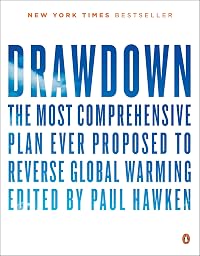
Drawdown: The Most Comprehensive Plan Ever Proposed to Reverse Global Warming
by Paul Hawken (Editor), Katharine Wilkinson (Senior Writer)
On This Page
Description
"In the face of widespread fear and apathy, an international coalition of researchers, professionals, and scientists have come together to offer a set of realistic and bold solutions to climate change. One hundred techniques and practices are described here--some are well known; some you may have never heard of. They range from clean energy to educating girls in lower-income countries to land use practices that pull carbon out of the air. The solutions exist, are economically viable, and show more communities throughout the world are currently enacting them with skill and determination. If deployed collectively on a global scale over the next thirty years, they represent a credible path forward, not just to slow the earth's warming but to reach drawdown, that point in time when greenhouse gases in the atmosphere peak and begin to decline. These measures promise cascading benefits to human health, security, prosperity, and well-being--giving us every reason to see this planetary crisis as an opportunity to create a just and livable world"--Page 4 of cover. show lessTags
Recommendations























Member Reviews
Maybe a decade ago now, I read “Blessed Unrest.” What I took away from this book was that humanity is responding to global warming on a massive scale in a decentralized and intuitive way. People all over the world are working in concert, without the need for centralized planning, or even an awareness of each others work, due to something innate in us.
Well, it seems like Hawken’s faith in humanity has waned over the intervening years. His new book, “Drawdown,” has its foundations not in cultural or spiritual realms, but instead is grounded in hard science, technology, and numbers. The book proclaims that it is “the most comprehensive plan ever proposed to reverse global warming,” and I don’t doubt it. Almost a hundred show more researches worked years to prepare this material, and each of the hundred solutions presented in the books is backed by a thirty-page technical white paper (available on their website), and cumulatively, their models cite tens of thousands of sources and millions of data points.
So, where does all of this get us? In the “plausible” scenario (conservatively optimistic), between 2020 and 2050 we “reduce” atmospheric CO2 emission equivalents by one teraton, and spend a net amount of $30 trillion. Supposedly this will stabilize atmospheric carbon, but not move us significantly into drawdown. In other words, if things go according to plan, we’ll still be stuck somewhere above 400ppm of carbon in the atmosphere at 2050, locking in catastrophic global warming (as the upper region of the “safe” limit is 350ppm).
For all the creative, amazing, and fascinating scenarios drawn up over the course of the book, I dearly wish that more weight was given to the social, political, and cultural aspects of this conversation. Ultimately, our technological “solutions” are nested within this context, and if anything, are more important than the solutions themselves.
So what kind of solutions are we talking about? As you guessed, green energy is part of the picture. But one of the biggest sectors under investigation was our relationship with land (primarily via agriculture and forestry). Other areas include Women and Girls, Buildings and Cities, Transport, Materials, and Coming Attractions (visionary but unproven concepts).
In some ways, this is a reactionary text. Fossil fuel companies knew what climate change was back in the ‘70s and ‘80s. By the ‘90s people understood it was a serious issue, and there were lots of good ideas about what we could do about it. And then the climate change deniers came along, and the whole backlash against preserving the future of humanity. And here we are well into the second decade of the 21st century—with our climate spiraling out of the range in which human habitation can occur, and, at least in the US, a political climate that will sooner implement Universal Basic Income and pay Reparations then address climate change in a substantive way.
In other words, well-meaning NorCal progressives like Hawken are freaking out—and for good reason! I too have found myself engaging in activities explicitly addressing climate change, even though I fundamentally believe that climate change is a surface-level issue that can only be solved by addressing more fundamental systems (such as culture). I don’t think we’re wasting our time to get all analytical on these issues. But I strongly recommend (for myself as much as others), that we don’t lose our felt sense of a connection with the words of mentors and organizations like Charles Eisenstein, Martin Prechtel, Timothy Morton, J. G. Bennett, and the Dark Mountain Project (as well as the younger and more idealistic version of Hawken) that remind us that climate change can only be addressed from a living-systems perspective that goes beyond solar panels, electric vehicles, and closed-loop recycling.
Drawdown is a page-turner for prescient geeks scrambling to hedge against the Anthropocene Extinction. I recommend you go out and get yourself a copy—you’ll be referencing it for years to come. But don’t stop there! Remember to commune with the more-than-human-world in which you’re immersed, make the space to grieve for the violence of these times, and ground into holistic work that lives into the now in a balanced and deeply human way. show less
Well, it seems like Hawken’s faith in humanity has waned over the intervening years. His new book, “Drawdown,” has its foundations not in cultural or spiritual realms, but instead is grounded in hard science, technology, and numbers. The book proclaims that it is “the most comprehensive plan ever proposed to reverse global warming,” and I don’t doubt it. Almost a hundred show more researches worked years to prepare this material, and each of the hundred solutions presented in the books is backed by a thirty-page technical white paper (available on their website), and cumulatively, their models cite tens of thousands of sources and millions of data points.
So, where does all of this get us? In the “plausible” scenario (conservatively optimistic), between 2020 and 2050 we “reduce” atmospheric CO2 emission equivalents by one teraton, and spend a net amount of $30 trillion. Supposedly this will stabilize atmospheric carbon, but not move us significantly into drawdown. In other words, if things go according to plan, we’ll still be stuck somewhere above 400ppm of carbon in the atmosphere at 2050, locking in catastrophic global warming (as the upper region of the “safe” limit is 350ppm).
For all the creative, amazing, and fascinating scenarios drawn up over the course of the book, I dearly wish that more weight was given to the social, political, and cultural aspects of this conversation. Ultimately, our technological “solutions” are nested within this context, and if anything, are more important than the solutions themselves.
So what kind of solutions are we talking about? As you guessed, green energy is part of the picture. But one of the biggest sectors under investigation was our relationship with land (primarily via agriculture and forestry). Other areas include Women and Girls, Buildings and Cities, Transport, Materials, and Coming Attractions (visionary but unproven concepts).
In some ways, this is a reactionary text. Fossil fuel companies knew what climate change was back in the ‘70s and ‘80s. By the ‘90s people understood it was a serious issue, and there were lots of good ideas about what we could do about it. And then the climate change deniers came along, and the whole backlash against preserving the future of humanity. And here we are well into the second decade of the 21st century—with our climate spiraling out of the range in which human habitation can occur, and, at least in the US, a political climate that will sooner implement Universal Basic Income and pay Reparations then address climate change in a substantive way.
In other words, well-meaning NorCal progressives like Hawken are freaking out—and for good reason! I too have found myself engaging in activities explicitly addressing climate change, even though I fundamentally believe that climate change is a surface-level issue that can only be solved by addressing more fundamental systems (such as culture). I don’t think we’re wasting our time to get all analytical on these issues. But I strongly recommend (for myself as much as others), that we don’t lose our felt sense of a connection with the words of mentors and organizations like Charles Eisenstein, Martin Prechtel, Timothy Morton, J. G. Bennett, and the Dark Mountain Project (as well as the younger and more idealistic version of Hawken) that remind us that climate change can only be addressed from a living-systems perspective that goes beyond solar panels, electric vehicles, and closed-loop recycling.
Drawdown is a page-turner for prescient geeks scrambling to hedge against the Anthropocene Extinction. I recommend you go out and get yourself a copy—you’ll be referencing it for years to come. But don’t stop there! Remember to commune with the more-than-human-world in which you’re immersed, make the space to grieve for the violence of these times, and ground into holistic work that lives into the now in a balanced and deeply human way. show less
Maybe the best title ever. It is what it says - the Most Comprehensive Plan Ever Proposed to Reverse Global Warming. In it are 100 environmental practices, ranked from 1 to 100 as most impactful. Most take just two pages, include ample descriptions for the noob, and give a summarized breakdown of the numbers. Tons and tons of researchers and contributors worked to make this book and thousands of references, but it's stylized and written to communicate, not overwhelm. In short, it's brilliant, and one of the most hopeful (and needed) projects I know of.
For me, it felt like environmental science 101. Maybe you have, but I hadn't ever heard of Methane Digesters, Grid Flexibility, Silvopasture, or Utility Scale Photovoltics. Each are show more important for drawing down the amount of carbon in the atmosphere.
However, most important were the practical implications of the research. You might, "What can I actually do to reduce global warming?" This book is the "most comprehensive" answer to that question. So, things like adding solar panels, (eventually) trading our gas car for something electric, etc. everyone knows. Now it feels a little more pressing. But in particular, going to a plant based diet was (I believe) #3 or #4 most impactful practices. Zen master Thich Nhat Hanh has said, making the transition to a plant-based diet may be the most effective way an individual can stop climate change. I didn't realize this... and that doesn't even include the other reasons for going vegetarian.
Two others that surprised me were educating girls globally and family planning (#6 & #7), which go together. When we educate girls, we are improving the lives of families. Children are healthier, happier and fewer in number when girls are educated. This is vital!
Drawdown is also a non-profit, who happened to produce this wonderful book. Learn more at drawdown.org.
This is so important and I'm thankful for the work they're doing. show less
For me, it felt like environmental science 101. Maybe you have, but I hadn't ever heard of Methane Digesters, Grid Flexibility, Silvopasture, or Utility Scale Photovoltics. Each are show more important for drawing down the amount of carbon in the atmosphere.
However, most important were the practical implications of the research. You might, "What can I actually do to reduce global warming?" This book is the "most comprehensive" answer to that question. So, things like adding solar panels, (eventually) trading our gas car for something electric, etc. everyone knows. Now it feels a little more pressing. But in particular, going to a plant based diet was (I believe) #3 or #4 most impactful practices. Zen master Thich Nhat Hanh has said, making the transition to a plant-based diet may be the most effective way an individual can stop climate change. I didn't realize this... and that doesn't even include the other reasons for going vegetarian.
Two others that surprised me were educating girls globally and family planning (#6 & #7), which go together. When we educate girls, we are improving the lives of families. Children are healthier, happier and fewer in number when girls are educated. This is vital!
Drawdown is also a non-profit, who happened to produce this wonderful book. Learn more at drawdown.org.
This is so important and I'm thankful for the work they're doing. show less
Enlightening for sure.
Optimistic too.
Full of solutions and angles on the biggest problem we face.
Dry to read (it's a report, not a narrative)
And a big question at the end: What now? Who is going to pay and change the law before it's too late?
Optimistic too.
Full of solutions and angles on the biggest problem we face.
Dry to read (it's a report, not a narrative)
And a big question at the end: What now? Who is going to pay and change the law before it's too late?
Incredible research ranks exactly what we need to do to reverse climate change. Some of it I knew already (the meat industry worldwide is a real killer and we need silvopasture like yesterday) but some was news to me (just dealing with the pollution that comes from refrigerants could really turn this thing around).
Ultimately, however, I was still left feeling hopeless. Because there is not a snowball's chance in hell that the American government is going to try and do even one damn thing on the list. Thanks a lot, baby boomers! You ruined the world and now you get to die first, leaving your grandkids in an apocalyptic hellscape. Way to go, guys. Way to go.
Ultimately, however, I was still left feeling hopeless. Because there is not a snowball's chance in hell that the American government is going to try and do even one damn thing on the list. Thanks a lot, baby boomers! You ruined the world and now you get to die first, leaving your grandkids in an apocalyptic hellscape. Way to go, guys. Way to go.
This is really a review of the Blinkist summary of the original book. So not entirely fair to the original authors. However life is short and I'm reading a few summaries to allow me to absorb ideas a bit faster.
Here are some snippets that I highlighted as interesting. In other words it is a summary of a summary. I've added some comments of my own.
Project Drawdown is a coalition of scientists and researchers dedicated to changing this equation. Using peer-reviewed science and mathematical models, their goal is to illuminate simple and economically viable solutions that drastically reduce, and even reverse, humanity’s CO2 emissions.
These snippets list some of the most promising solutions to global warming, encouraging individuals, show more communities, businesses and governments to overcome apathy and take action. From tried-and-tested technologies like renewable energy to less intuitive approaches such as strengthening the rights of indigenous people,
Humboldt was one of the first scientists to acknowledge the negative effects humans could have on their environment. He prophetically identified deforestation and the “great masses of steam and gas” released during industrial processes as two major environmental threats.
Despite a clear connection between carbon emissions and global warming, humanity’s carbon footprint is steadily increasing.
At this rate, simply slowing or cutting carbon emissions will not be enough to stop global warming. We need to reach drawdown. [That is, the point where green house gases peak and then decline]
The technology to harvest these renewable energies is becoming increasingly efficient, making them competitive with fossil fuels.
Denmark, meanwhile, already supplies 40 percent of its electricity through wind power. [but assuming every country can do what Denmark has done, is probably wishful thinking....I think it's pretty windy in Denmark ...from the North Sea].
Solar energy is another important renewable that’s already saving 330 million tons of CO2 annually.
In 2015, the global fossil fuel industry received more than $5.3 trillion in direct and indirect subsidies. If that money were put into renewable energies instead, we would be well on our way to saving the planet.
We need to eat less meat, make farming more diverse and reduce our food waste. The meat industry accounts for 20 percent of all greenhouse gas emissions, which come from both the animals themselves and the agriculture needed to feed them.
Modern industrial agriculture is based on cultivating a single crop every year, until the soil becomes saline and unworkable. [This is total oversimplification.....and anyway, soils don't necessarily become saline though exhaustion...but mostly from water tables reaching close to the surface and carrying dissolved salts into the phreatric surface]. Sustainable techniques such as agroforestry embrace complex plant communities that enrich the soil rather than deplete it–and release much less CO2. These techniques treat nature as an interconnected system in which each plant and animal benefits from the existence of all others.
Instead of grazing on deforested land, silvopasture cows are allowed to graze in the forest. Not only do the trees provide shade for the animals, but they also sequester carbon that counterbalances the cow’s methane emissions. [Again, this is fairy-tale science. I've been in these silvopastures in Spain and the carrying capacity for cows is about five percent of an equivalent pasture. The reason is obvious...the trees shade the grass so there is not much grass to graze, Yes you can combine forestry and grazing but don't expect much food.]
Of course, producing food that no one eats doesn’t only squander resources–it also creates unnecessary greenhouse gases. In fact, if we reduced food waste by 50 percent by 2050, we could avoid 26.2 gigatons of carbon emissions. Probably a good idea but not so easy to entirely eliminate food waste....lots of the waste is small scale so hard to capture and do something with the waste or eliminate it].
Cities need to improve their building standards, infrastructure and power supply to save energy. Smog, traffic congestion and a lack of greenery can make
But how can we implement these technologies in our urban environments? One way is for cities to start making them mandatory for new buildings.
If cities worldwide increased localized heating from its current 0.1 percent usage to 10 percent, we could avoid 9.38 gigatons of carbon emissions by 2050.
Traditional modes of transportation must become more fuel-efficient, and should be supplanted by climate-friendly alternatives.
Global trade transport by ship makes up a significant 3 percent of carbon emissions. One technique proven to cut fuel consumption is “slow steaming,” a simple reduction in operating speed. [Seems like a good idea but shipping companies also need to make a profit]
Hybrid cars integrate an electric motor with a classic combustion engine, and are about 30 percent more fuel-efficient than regular cars.
Another mobility alternative that should be subsidized and developed is mass transportation such as public buses, metros and high-speed rail services.
We need to protect forests, peats and wetlands, and restore degraded land. When forests are destroyed, soil health plummets, and the degraded land releases its carbon content into the air. More than 10 percent of annual carbon emissions are caused this way.
Conventional materials need to be recycled after use and replaced by sustainable alternatives.
The dominant chemical used for refrigeration nowadays is called hydrofluorocarbon, or HFC. [It used to be CFC but this was phased put during th'90s
One way to encourage recycling over conventional disposal is via governmental policy. San Francisco, for example, charges households for carrying away garbage for landfill, but takes away recycling material for free.
Targeted education programs can empower individuals around the world to lower their carbon footprints.
Public campaigns, peer-to-peer training and grassroots information sharing will be essential tools in effecting such change.
Prioritizing the education of girls in general would help reduce the world’s carbon emissions, in part because educated women tend to have fewer children. Population size is a controversial talking point in the climate discourse, but better access to reproductive health services simply reflects the wishes of women worldwide;
Technologies such as self-driving cars, ocean farming and carbon capture hold further potential to reverse emissions.
So, how can we reforest the ocean? With the help of kelp and phytoplankton, miniature plant organisms that can provide food, fertilizer and biofuel to other plants, animals and humans. Establishing farms of these microorganisms in the middle of the ocean, a technique known as marine permaculture, could recreate entire ecosystems of algae, fish, seals and sharks.
All in all, the technologies illuminated in this blink might provide hope to the pessimists among us who believe that humanity has, in balance, made our planet worse.
Final summary
It’s not too late! If communities, governments, businesses and organizations come together to act now, we can reverse global warming. The key technologies to reduce carbon emissions and promote their reuptake by the earth are already in place. They include renewable energy, sustainable farming, reforestation and recycling, widespread education programs and innovative future technologies such as self-driving e-cars and ocean farming. If widely implemented, continuously developed and subsidized when necessary, these technologies can save the planet.
Actionable advice: Do something.
Well, there are a lot of good ideas here and humankind will need to implement a lot of them though that will not be easy. It seems to me that the biggest "elephant in the room" that was not tackled at all (presumably because of religious or political sensitivities) is increasing populations. If we cut the world's population by twenty percent then we would get something like a proportionate cut in greenhouse emissions. .......especially if this happened in the industrialised countries. And it actually seems to be happening as women become better educated and families become wealthier.
I'm grateful to Blinkist because it's given me a pretty good idea of what's in the original book but I won't be rushing to read the original. Two stars from me. show less
Here are some snippets that I highlighted as interesting. In other words it is a summary of a summary. I've added some comments of my own.
Project Drawdown is a coalition of scientists and researchers dedicated to changing this equation. Using peer-reviewed science and mathematical models, their goal is to illuminate simple and economically viable solutions that drastically reduce, and even reverse, humanity’s CO2 emissions.
These snippets list some of the most promising solutions to global warming, encouraging individuals, show more communities, businesses and governments to overcome apathy and take action. From tried-and-tested technologies like renewable energy to less intuitive approaches such as strengthening the rights of indigenous people,
Humboldt was one of the first scientists to acknowledge the negative effects humans could have on their environment. He prophetically identified deforestation and the “great masses of steam and gas” released during industrial processes as two major environmental threats.
Despite a clear connection between carbon emissions and global warming, humanity’s carbon footprint is steadily increasing.
At this rate, simply slowing or cutting carbon emissions will not be enough to stop global warming. We need to reach drawdown. [That is, the point where green house gases peak and then decline]
The technology to harvest these renewable energies is becoming increasingly efficient, making them competitive with fossil fuels.
Denmark, meanwhile, already supplies 40 percent of its electricity through wind power. [but assuming every country can do what Denmark has done, is probably wishful thinking....I think it's pretty windy in Denmark ...from the North Sea].
Solar energy is another important renewable that’s already saving 330 million tons of CO2 annually.
In 2015, the global fossil fuel industry received more than $5.3 trillion in direct and indirect subsidies. If that money were put into renewable energies instead, we would be well on our way to saving the planet.
We need to eat less meat, make farming more diverse and reduce our food waste. The meat industry accounts for 20 percent of all greenhouse gas emissions, which come from both the animals themselves and the agriculture needed to feed them.
Modern industrial agriculture is based on cultivating a single crop every year, until the soil becomes saline and unworkable. [This is total oversimplification.....and anyway, soils don't necessarily become saline though exhaustion...but mostly from water tables reaching close to the surface and carrying dissolved salts into the phreatric surface]. Sustainable techniques such as agroforestry embrace complex plant communities that enrich the soil rather than deplete it–and release much less CO2. These techniques treat nature as an interconnected system in which each plant and animal benefits from the existence of all others.
Instead of grazing on deforested land, silvopasture cows are allowed to graze in the forest. Not only do the trees provide shade for the animals, but they also sequester carbon that counterbalances the cow’s methane emissions. [Again, this is fairy-tale science. I've been in these silvopastures in Spain and the carrying capacity for cows is about five percent of an equivalent pasture. The reason is obvious...the trees shade the grass so there is not much grass to graze, Yes you can combine forestry and grazing but don't expect much food.]
Of course, producing food that no one eats doesn’t only squander resources–it also creates unnecessary greenhouse gases. In fact, if we reduced food waste by 50 percent by 2050, we could avoid 26.2 gigatons of carbon emissions. Probably a good idea but not so easy to entirely eliminate food waste....lots of the waste is small scale so hard to capture and do something with the waste or eliminate it].
Cities need to improve their building standards, infrastructure and power supply to save energy. Smog, traffic congestion and a lack of greenery can make
But how can we implement these technologies in our urban environments? One way is for cities to start making them mandatory for new buildings.
If cities worldwide increased localized heating from its current 0.1 percent usage to 10 percent, we could avoid 9.38 gigatons of carbon emissions by 2050.
Traditional modes of transportation must become more fuel-efficient, and should be supplanted by climate-friendly alternatives.
Global trade transport by ship makes up a significant 3 percent of carbon emissions. One technique proven to cut fuel consumption is “slow steaming,” a simple reduction in operating speed. [Seems like a good idea but shipping companies also need to make a profit]
Hybrid cars integrate an electric motor with a classic combustion engine, and are about 30 percent more fuel-efficient than regular cars.
Another mobility alternative that should be subsidized and developed is mass transportation such as public buses, metros and high-speed rail services.
We need to protect forests, peats and wetlands, and restore degraded land. When forests are destroyed, soil health plummets, and the degraded land releases its carbon content into the air. More than 10 percent of annual carbon emissions are caused this way.
Conventional materials need to be recycled after use and replaced by sustainable alternatives.
The dominant chemical used for refrigeration nowadays is called hydrofluorocarbon, or HFC. [It used to be CFC but this was phased put during th'90s
One way to encourage recycling over conventional disposal is via governmental policy. San Francisco, for example, charges households for carrying away garbage for landfill, but takes away recycling material for free.
Targeted education programs can empower individuals around the world to lower their carbon footprints.
Public campaigns, peer-to-peer training and grassroots information sharing will be essential tools in effecting such change.
Prioritizing the education of girls in general would help reduce the world’s carbon emissions, in part because educated women tend to have fewer children. Population size is a controversial talking point in the climate discourse, but better access to reproductive health services simply reflects the wishes of women worldwide;
Technologies such as self-driving cars, ocean farming and carbon capture hold further potential to reverse emissions.
So, how can we reforest the ocean? With the help of kelp and phytoplankton, miniature plant organisms that can provide food, fertilizer and biofuel to other plants, animals and humans. Establishing farms of these microorganisms in the middle of the ocean, a technique known as marine permaculture, could recreate entire ecosystems of algae, fish, seals and sharks.
All in all, the technologies illuminated in this blink might provide hope to the pessimists among us who believe that humanity has, in balance, made our planet worse.
Final summary
It’s not too late! If communities, governments, businesses and organizations come together to act now, we can reverse global warming. The key technologies to reduce carbon emissions and promote their reuptake by the earth are already in place. They include renewable energy, sustainable farming, reforestation and recycling, widespread education programs and innovative future technologies such as self-driving e-cars and ocean farming. If widely implemented, continuously developed and subsidized when necessary, these technologies can save the planet.
Actionable advice: Do something.
Well, there are a lot of good ideas here and humankind will need to implement a lot of them though that will not be easy. It seems to me that the biggest "elephant in the room" that was not tackled at all (presumably because of religious or political sensitivities) is increasing populations. If we cut the world's population by twenty percent then we would get something like a proportionate cut in greenhouse emissions. .......especially if this happened in the industrialised countries. And it actually seems to be happening as women become better educated and families become wealthier.
I'm grateful to Blinkist because it's given me a pretty good idea of what's in the original book but I won't be rushing to read the original. Two stars from me. show less
Over 250 people participated in the research and writing to prepare Drawdown. The Drawdown project listed about 80 strategies that would begin to reverse the amount of carbon dioxide in the earth's atmosphere and begin to reverse global warming. The list includes the most obvious like wind and solar energy and others like changing some agricultural practices. One point that would help change warming is educating girls. When girls get education they tend to marry later and have fewer children. Many of the points listed would not just reduce atmospheric carbon but would be far superior economically to the current practices. Reducing food and water waste would keep more greenhouse gasses out of the atmosphere and save millions of dollars show more as well. Drawdown is not easy reading. There is a chapter for each point, some are more interesting than others and it took a long time to read. Sometimes I could only manage one chapter at a time. I thought reading Drawdown was worth the time and effort. It shows that climate change can be reversed. show less
Admittedly, I failed to finish this book. Yet I'm convinced it was filled with a hundred practical recommendations on how man-made climate change impacts could be lessened or reversed in an economical way without forcing us all to change our lifestyles, become vegetarians, or without giving up our motor vehicles, furnaces, or air conditioners.
But as an audiobook user, I was unable to progress through the book at a pace which suited me, being held captive to the pace of the narrator. In the case of this book, I........found....... the .......... pace.......... of .........the..........book........to...........be..........frustratingly.............sloooooooow.
Patience isn't a virtue of mine, and I found myself anxious to get to the next show more point, and becoming bogged down in the details. The author would present each idea, one at a time, tell you where it ranks compared to other ideas, tell you the total cost of the idea in millions or billions of dollars, tell you the total cost savings of the idea in millions or billions of dollars, explain it, and go on to the next. I'm sure most of the ideas make perfect sense, and can be implemented in a cost saving way, but I'm unsure which governmental body or agency, or business, or organization, will be taking on each challenge to make it happen on a wide enough scale to allow it to make a difference. Perhaps the implementing bodies for his ideas were contained in his final chapters, I just lost patience and never got that far in the book. show less
But as an audiobook user, I was unable to progress through the book at a pace which suited me, being held captive to the pace of the narrator. In the case of this book, I........found....... the .......... pace.......... of .........the..........book........to...........be..........frustratingly.............sloooooooow.
Patience isn't a virtue of mine, and I found myself anxious to get to the next show more point, and becoming bogged down in the details. The author would present each idea, one at a time, tell you where it ranks compared to other ideas, tell you the total cost of the idea in millions or billions of dollars, tell you the total cost savings of the idea in millions or billions of dollars, explain it, and go on to the next. I'm sure most of the ideas make perfect sense, and can be implemented in a cost saving way, but I'm unsure which governmental body or agency, or business, or organization, will be taking on each challenge to make it happen on a wide enough scale to allow it to make a difference. Perhaps the implementing bodies for his ideas were contained in his final chapters, I just lost patience and never got that far in the book. show less
Members
- Recently Added By
Lists

Climate Change
87 works; 7 members

Climate Change
50 works; 1 member

Phi Beta Kappa reading list
260 works; 8 members
Author Information

All Editions
Some Editions
Common Knowledge
- Original publication date
- 2016-04
- First words
- This section highlights the technologies and strategies supplanting energy production from fossil fuels.
- Last words
- (Click to show. Warning: May contain spoilers.)We can return to our role as nurturers, one of the many helpers in this planetary story of collaborative healing.
- Original language
- English
Classifications
- Genres
- Science & Nature, Nonfiction, General Nonfiction, Economics
- DDC/MDS
- 363.738 — Society, government, & culture Social problems and social services Public Safety - Police, Crime Investigation Environmental Issues - Pollution, Recycling, Global Warming Pollution Pollutants by source
- LCC
- TD171.75 .D73 — Technology Environmental technology. Sanitary engineering Environmental technology. Sanitary engineering
- BISAC
Statistics
- Members
- 628
- Popularity
- 46,178
- Reviews
- 13
- Rating
- (3.87)
- Languages
- 5 — Dutch, English, French, German, Hungarian
- Media
- Paper, Audiobook, Ebook
- ISBNs
- 15
- ASINs
- 4