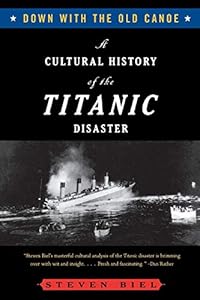
Down with the Old Canoe: A Cultural History of the Titanic Disaster
by Steven Biel
On This Page
Description
"I suggest, henceforth, when a woman talks women's rights, she be answered with the word Titanic, nothing more--just Titanic," wrote a St. Louis man to the St. Louis Post-Dispatch. He was not alone in mining the ship for a metaphor. Everyone found ammunition in the Titanic--suffragists and their opponents; radicals, reformers, and capitalists; critics of technology and modern life; racists and xenophobes and champions of racial and ethnic equality; editorial writers and folk singers, show more preachers and poets.Protestant sermons used the Titanic to condemn the budding consumer society ("We know the end of . . . the undisturbed sensualists. As they sail the sea of life we know absolutely that their ship will meet disaster."). African American toasts and working-class ballads made the ship emblematic of the foolishness of white people and the greed of the rich. A 1950s revival framed the disaster as an "older kind of disaster in which people had time to die." An ever-increasing number of Titanic buffs find heroism and order in the tale. Still in the headlines ("Titanic Baby Found Alive!" the Weekly World News declares) and a figure of everyday speech ("rearranging deck chairs . . ."), the Titanic disaster echoes within a richly diverse, paradoxical, and fascinating America. show lessTags
Recommendations








Member Reviews
I am not a Titanic fanatic or in any way participant in Titanic mania of any sort, but I was drawn to the cultural history revealed by the title of Biel's work. In light of many recent discussions related to revaluating the function of monuments to the confederacy and Robert E. Lee, and controversial nonsense about "critical race theory," and even recent commemorations of the 9/11 tragedy, Biel's work provides much to consider regarding how myth-making can shape the historical memory of a disaster. Biel rightly stays within the broad events surrounding 1912 and later commemorations of the sinking, but there seem to be many opportunities for a dialog with other historical events.
Overall, this was fascinating and excellent study, covering show more attitudes relating to immigration, religion, race, economic status, the suffrage movement, and much more, even for a non-academic reader, like myself. show less
Overall, this was fascinating and excellent study, covering show more attitudes relating to immigration, religion, race, economic status, the suffrage movement, and much more, even for a non-academic reader, like myself. show less
As the subtitle mentions, Down with the Old Canoe is a cultural history of the Titanic; it does not describe the sinking of the ship. Biel divides the book into two sections: "Meanings" and "Memories." In "Meanings" he places the Titanic in the history of its time -- 1912 -- and discusses the sinking in relation to the social issues of that time period including the suffrage and labor movements and the ideas of class and problem of immigration. In this discussion the proper place of women in society (thought by many to be in the home) and the emphasis placed on the upper class passengers in accounts of the disaster are featured. Biel explains how both suffragists and anti-suffragists used the Titanic to bolster their arguments for and show more against the vote for women.
In the "Memories" section, Biel discusses the importance of the Titanic in history from the 1950s through 1990s (when the book was published). He describes the impact of Walter Lord's "A Night to Remember" on the culture in the 1950s, and to a much lesser extent other writings about the Titanic; the Titanic Historical Society; and efforts to discover the Titanic including its discovery and salvage operations in the 1980s.
Highly recommended to people who know something about the Titanic. show less
In the "Memories" section, Biel discusses the importance of the Titanic in history from the 1950s through 1990s (when the book was published). He describes the impact of Walter Lord's "A Night to Remember" on the culture in the 1950s, and to a much lesser extent other writings about the Titanic; the Titanic Historical Society; and efforts to discover the Titanic including its discovery and salvage operations in the 1980s.
Highly recommended to people who know something about the Titanic. show less
Well, this book is nothing if not well-researched. Still, there wasn't really a lot of "new" here. Anyone who knows the history of the eras, and has studied the history of the Titanic, will already have come to many of Biel's conclusions on her own. On the other hand, I can't imagine this particular book being very interesting to someone who is brand new to Titanic history and mythology. Much backstory is needed to understand most of the references and most all popular beliefs about what happened during the Titanic tragedy are dispelled here anyway.
The poem about "Votes for Women/Boats for Women" is one of my favorite bits (see page 30). As one who is very much against most of the philosophies behind the suffragist movement, as well as show more the more modern feminist movements, I found the irony hilarious. I was also surprised at the number of black folk songs that were written about the disaster. I consider myself a pretty knowledgeable Titanic historian, but I'd never considered how the event affected the black community who were treated as lower class citizens of the time.
At the very beginning of the book, I was reminded about my feelings after the 9/11 terrorist attack on the US. I wrote, "I wonder how many people felt the same way about the Titanic as I felt about 9/11---how could this happen to us?" I felt like an attack on America was not possible---like it was not allowed. Later, on page 153, Second Officer Lightoller echoed my thoughts: "I know what the sea can do. But this is different...because we were so sure. Because even though it's happened, it's still unbelievable. I don't think I'll ever feel sure again. About anything."
I can't say that I'm glad I read this...but I don't think it was a waste of time either. My feelings on it are mostly indifferent. I think there was just a bit *too* much research---too much quoting---for my tastes. But, then again, it was expected coming in. show less
The poem about "Votes for Women/Boats for Women" is one of my favorite bits (see page 30). As one who is very much against most of the philosophies behind the suffragist movement, as well as show more the more modern feminist movements, I found the irony hilarious. I was also surprised at the number of black folk songs that were written about the disaster. I consider myself a pretty knowledgeable Titanic historian, but I'd never considered how the event affected the black community who were treated as lower class citizens of the time.
At the very beginning of the book, I was reminded about my feelings after the 9/11 terrorist attack on the US. I wrote, "I wonder how many people felt the same way about the Titanic as I felt about 9/11---how could this happen to us?" I felt like an attack on America was not possible---like it was not allowed. Later, on page 153, Second Officer Lightoller echoed my thoughts: "I know what the sea can do. But this is different...because we were so sure. Because even though it's happened, it's still unbelievable. I don't think I'll ever feel sure again. About anything."
I can't say that I'm glad I read this...but I don't think it was a waste of time either. My feelings on it are mostly indifferent. I think there was just a bit *too* much research---too much quoting---for my tastes. But, then again, it was expected coming in. show less
This book isn't so much about the Titanic itself, as about the effect the sinking of the ship had on culture after the disaster. It looked at such things as gender, class and race; also, songs and poems written about the Titanic; also, the books, tv, and movies that came about (this was published before James Cameron's movie, however).
I wish I would have noticed the subtitle before requesting it from the library (or even before putting it on my tbr... did I? It was too long ago). It just wasn't what I was interested in. I skimmed though a lot of it. Probably the most interesting chapter to me was the one that mainly focused on William Lord's book (written in the 1950s), A Night to Remember. Overall, though, it just wasn't interesting show more to me. show less
I wish I would have noticed the subtitle before requesting it from the library (or even before putting it on my tbr... did I? It was too long ago). It just wasn't what I was interested in. I skimmed though a lot of it. Probably the most interesting chapter to me was the one that mainly focused on William Lord's book (written in the 1950s), A Night to Remember. Overall, though, it just wasn't interesting show more to me. show less
This was a pretty interesting book, if you're interested in the Titanic. I learned a few things and some of the ideas about cultural influences were a bit of a reach, but it was well researched and covered a lot of territory.
A fascinating study of the effects of the Titanic disaster on society, culturally and politically. Great book for those interested in sociology, secondly to buffs of the Great Ocean Liners.
Ratings
Members
- Recently Added By
Lists

Accidents, Disasters, and Tragedies
175 works; 7 members
Author Information

Steven Biel is the executive director of the Mahindra Humanities Center and a senior lecturer on history and literature at Harvard University.
Common Knowledge
- People/Characters
- Roy Acuff; Henry B. Adams; Ernest Allums; Mattye E. Anderson; Pink Anderson; Cornelia T. Andrews (show all 362); Thomas Andrews, shipbuilder; Susan B. Anthony; Anne Archer; Samuel Arline; Martin Arnold; Matthew Arnold; John Jacob Astor IV; Madeleine Astor; Chad Audinet; Fred Clare Baldwin; Robert D. Ballard; Julian Barnes; Katharine Lee Bates; Gail Bederman; Lawrence Beesley; Paul Begala; George Behe; Josephine Beiderhase; Walter Belford; Victor Berger; Kenneth Bilbo; Hugh Birckhead; Dickinson H. Bishop; Jim Bishop; Alice Stone Blackwell; Antoinette Brown Blackwell; Harriot Stanton Blatch; Arna Bontemps; William E. Borah; Karen Bowman; Paul Boyer; Henry Brenner; Harold Bride; David Brinkley; D. Russell Brown; Leadville Johnny Brown; Molly Brown (Margaret Tobin Brown); Rabbit Brown; Rustie Brown; Jay Browne; William Jennings Bryan; W. S. Plumer Bryan; Gavin Bryars; James Bryce; Daniel Buckley; William F. Buckley, Jr.; Billie Burke; George H. W. Bush; Archie Butt (Major Archibald W. Butt); Abraham Cahan; Sheri Calvert; Elizabeth Cameron; James Cameron; Steve Cameron; Helen Churchill Candee; Al Capone; Melinda Capp; Andrew Carnegie; Jimmy Carter; Joseph Carvalho; Frank Casilio; Don Castel; John Chaffee; Hope Chapin; Howard Millar Chapin; Robert Chappaz; Champ Clark; Grover Cleveland; Bill Clinton; George M. Cohan; Christopher Columbus; Archibald Cary Coolidge; Frank Cronican; Walter Cronkite; Price Alexander Crow; Tom Cruise; Mario Cuomo; Clive Cussler; Daniel Davis; Fred Davis; Eugene V. Debs; Philip Del Piano; Edward T. Devine; George Dewey; John Dewey; William P. Dillingham; Dorsey Dixon; Howard Dixon; Washington Dodge; Rheta Childe Dorr; John Dos Passos; Arthur Conan Doyle; W. E. B. Du Bois; E. A. Dupont; Christopher Durang; Bob Dylan; John Eaton; G. W. Edd; William Elkins; Henry Etheridge; Marshall Everett; Geoffrey Evers; Arnold Fanck; Katherine Faulkner; Timothy Ferris; Jack Finney; Francis Fitzhugh; Frederick Fleet; James Flood; Gerald Ford; Gene Fowler; Michael J. Fox; Henry Frederick; William S. Friedman; James Ulmer Gandy; Henry Louis Gates, junior; Henry Louis Gates, senior; Philip Gayle; Harry Geduld; Robert Gibbons; Charles Dana Gibson; Dorothy Gibson; Charlotte Perkins Gilman; Edwin Ginn; Philip Glass; W. B. Glisson; Joseph Goebbels; Emma Goldman; Samuel Gompers; Louis Gorman; Archibald Gracie IV (Colonel); Tammy Grimes; Jack Grimm; Benjamin Guggenheim; Adolf Guttmacher; Charles Haas; Charles Haffer; James Hamilton; Natalie F. Hammond; Alfred Harding; E. H. Harriman; Henry Birkhardt Harris; John Hay; Charles Melville Hays; William Randolph Hearst; Ernest Hemingway; Fletcher Henderson; George Roy Hill; Alfred Hitchcock; Herbert Hoover; Elbert Hubbard; Howard Hughes; Lee Iacocca; J. Bruce Ismay; Blind Lemon Jefferson; Susan Jeffords; Karl Johanssen; Frank Johns; Blind Willie Johnson; Carrie Johnson; Jack Johnson; Mother Jones; Walter B. Jones; Richard Jordan; Edward Kamuda; Karen Kamuda; Edward Austin Kent; Stephen Kern; James E. Kinsella; Wilhelm Klein; Ronald Klubnik; Aileen Kraditor; Robert M. La Follette, Sr.; Christopher Lasch; Lead Belly (Huddie William Ledbetter); Baker P. Lee; John Lehman; Edward Levin; Lawrence Levine; Linda Lichter; Charles Herbert Lightoller; Anne Morrow Lindbergh; Ben Lindsey; Mance Lipscomb; George Lipsitz; Doug Llewellyn; Henry Cabot Lodge; John Logan; Alan Lomax; Stanley Lord; Walter Lord; Harold Godfrey Lowe; A. Lawrence Lowell; Robert Luce; Don Lynch; Owen Lynch; Loretta Lynn; Tom McCluskie; Kirsty MacColl; R. L. McReady; Stuart MacDonald; J. Gresham Machen; C. M. McIntosh; J. H. McKenzie; James McNamara; John McNamara; Guglielmo Marconi; Ken Marschall; Logan Marshall; Walt Mason; Bat Masterson; Edith Wynne Matthison; John Maxtone-Graham; Elaine Tyler May; Henry F. May; Barbara Melosh; Joseph Mikosalek; Inez Milholland; Fred Miller; Zell Miller; Frank D. Millet (Francis Davis Millet); Wilson Mizner; Harriet Monroe; Clarence Moore; Kenneth More; J. Pierpont Morgan; Richard Morris; W. F. Moshier; Lucretia Mott; Thomas H. Mulvey; Nadji Narsani; Jean Negulesco; Howard Nemerov; Richard O'Connor; Jack Odell; James A. O'Gorman; Jo Ann Olvera; Ruben Olvera; James O'May; Charles H. Parkhurst; Leighton Parks; Alice Paul; Charles Pellegrino; David Peterson; John 'Jack' Phillips; Wendell Phillips; Louis F. Post; Neil Postman; Robert Prechtl; William Proxmire; Dan Quayle; Ma Rainey; Claude Rains; William Rauscher; Isidor Rayner; Ronald Reagan; William S. Reaves; Ben Reitman; Debbie Reynolds; Leni Riefenstahl; Geraldo Rivera; Darwin Rizzetto; Morgan Robertson; Jay Rockefeller; Washington Roebling; Theodore Roosevelt; Elihu Root; Morris Rosenfeld; Arthur Henry Rostron; Arnold Rothstein; E. Anthony Rotundo; Michael Rudd; Charles Edward Russell; Agnes Ryan; Joseph Ryan; Charles Sachs; Jacob Samuels; John Singer Sargent; Jean-Paul Sartre; Telly Savalas; Jozef Sawicki; Dru Schillow; P. A. Scott; Herbert Selpin; David O. Selznick; Robert Serling; Anna Howard Shaw; George Bernard Shaw; Hilda Slater; Richard Slotkin; Captain Edward J. Smith; Lucien P. Smith; Eloise Hughes Smith (Mrs. Lucien P. Smith); William Alden Smith; Anna Garlin Spencer; Sylvester Stallone; Elizabeth Cady Stanton; Donald A. Stanwood; Barbara Stanwyck; W. T. Stead; Danielle Steel; Tarn Stephanos; Marie Stewart; Henry Stimson; Ernest M. Stires; Lucy Stone; Ida Straus; Isidor Straus; H. Wayne Summerlin; William Graham Sumner; Warren Susman; Nellie Taft (as Helen H. Taft); William Howard Taft; William Tantum; E. I. Taylor; John B. Thayer; Frank Thompson; Titanic Thompson (Alvin Clarence Thomas); Charles Hanson Towne; Bruce Trinque; Horace Trumbauer; Ted Turner; Samuel Langhorne Clemens (as Mark Twain); Alan Vaughan; Thorstein Veblen; Wyn Craig Wade; Robert Wagner; Clara Warchol; Robert Warren; Booker T. Washington; Lucian B. Watkins; Clifton Webb; Jack Weeks; Robin Werhlin; Lowell Weicker; Orson Welles; Kenneth Westover; Edward J. Wheeler; Alma White; William Allen White; Brand Whitlock; John Whitman; Gertrude Vanderbilt Whitney; Eleanor Elkins Widener; George D. Widener; Harry Elkins Widener; P. A. Widener; Meredith Willson; Woodrow Wilson; Stephen Wise; Mrs. Leonard Wood; H. Rea Woodman; John M. Work; Philip Wylie; Chuck Yeager; Boris Yeltsin
- Important places
- Atlantic Ocean; North Atlantic Ocean; Californian (ship); Carpathia (ship); Titanic; New York, USA (show all 8); New York, New York, USA; Washington, D.C., USA
- Important events
- Gilded Age; Sinking of the Titanic (1912); Discovery of the Titanic (1985); Space Shuttle Challenger Disaster (1986-01-28)
- Canonical DDC/MDS
- 910.91631
- Canonical LCC
- G530.T6
Classifications
- Genres
- Nonfiction, History, General Nonfiction, Travel
- DDC/MDS
- 910.91631 — History & geography Geography & travel modified standard subdivisions of Geography and travel Explorers & Travelers Geography of and travel in areas, regions, places in general Air And Water Atlantic Ocean
- LCC
- G530 .T6 — Geography, Anthropology and Recreation Geography (General) Adventures, shipwrecks, buried treasure, etc.
- BISAC
Statistics
- Members
- 245
- Popularity
- 132,075
- Reviews
- 6
- Rating
- (3.50)
- Languages
- English, German
- Media
- Paper, Ebook
- ISBNs
- 4
- ASINs
- 3