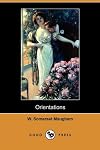
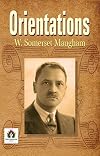
Orientations
by W. Somerset Maugham 
On This Page
Description
This collection of short stories is sure to please fans of the eminently talented British author W. Somerset Maugham. With details drawn from Maugham's first extended period of living abroad, the stories offer a unique glimpse into the early stages of the author's artistic development..
Tags
Recommendations






















Member Reviews
[From the Preface to Liza of Lambeth, Heinemann, The Collected Edition, 1934:]
As soon as I had taken my medical degrees, with the success of Liza of Lambeth to encourage me and the future before me, for I was only twenty-three, I set out for Spain. I spent eight months there and wrote some short stories. To these I added the two I had previously sent to Mr Fisher Unwin and so made up a volume which I called Orientations. […] The title (which indeed might serve as the general title of all my work) very well described what I had in mind, and though I have not looked at this volume since it was published I have a notion that the stories it contains did in fact in a crude and fumbling way suggest the directions in which I was afterwards show more to make further experiments. I am conscious now that my imaginary quotation* seemed a trifle arrogant, for it was unlikely that anyone then should have the least curiosity about my turn of mind; but I meant by it merely that I knew how immature and tentative my work was. The stories were highly praised by the critics and brought me some welcome commissions, but I do not think that in their present form they are worth including in this edition.
[From the Preface to The Trembling of a Leaf, Heinemann, The Collected Edition, 1935:]
I began my career as a writer by writing short stories. I could find no editor to accept them. The first one I ever had taken, and this only after I had made a small reputation for myself with Liza of Lambeth, appeared in an odd magazine called Cosmopolis. A third of it was in English, a third in French and a third in German. The idea was that it would thus find readers in three countries; unfortunately it found readers in none. It came to a sudden end and I was never paid for my work. I came to the conclusion that my stories were too good ever to stand a chance of taking an English editor’s fancy and so published them in a volume called Orientations. I read it again the other day. It sent so many cold shivers down my spine that I thought I must be going to have another attack of malaria. As a measure of precaution I dosed myself with quinine and arsenic. The book was reviewed with kindliness and strangely enough it brought me a commission from Punch to write three stories. I suppose those in Orientations showed promise. Reading them five and thirty years later it seemed to me that here and there they were moving, but they had passages so preposterously unreal that I could hardly believe it possible that I had written them. Their worst fault, however, was their superciliousness. In the arrogance of my youth I sneered at everything that offended my fastidious and narrow prejudices.
_______________________________________________________
*In French, which he invented as an epigraph: "C'est surtout, par ses nouvelles d'un jeune écrivain qu'on peut se rendre compte du tour de son esprit. Il y cherche la voie qui lui est propre dans une série d'essais de genre et de style différents, qui sont comme des orientations, pour trouver son moi littéraire." Ed. show less
As soon as I had taken my medical degrees, with the success of Liza of Lambeth to encourage me and the future before me, for I was only twenty-three, I set out for Spain. I spent eight months there and wrote some short stories. To these I added the two I had previously sent to Mr Fisher Unwin and so made up a volume which I called Orientations. […] The title (which indeed might serve as the general title of all my work) very well described what I had in mind, and though I have not looked at this volume since it was published I have a notion that the stories it contains did in fact in a crude and fumbling way suggest the directions in which I was afterwards show more to make further experiments. I am conscious now that my imaginary quotation* seemed a trifle arrogant, for it was unlikely that anyone then should have the least curiosity about my turn of mind; but I meant by it merely that I knew how immature and tentative my work was. The stories were highly praised by the critics and brought me some welcome commissions, but I do not think that in their present form they are worth including in this edition.
[From the Preface to The Trembling of a Leaf, Heinemann, The Collected Edition, 1935:]
I began my career as a writer by writing short stories. I could find no editor to accept them. The first one I ever had taken, and this only after I had made a small reputation for myself with Liza of Lambeth, appeared in an odd magazine called Cosmopolis. A third of it was in English, a third in French and a third in German. The idea was that it would thus find readers in three countries; unfortunately it found readers in none. It came to a sudden end and I was never paid for my work. I came to the conclusion that my stories were too good ever to stand a chance of taking an English editor’s fancy and so published them in a volume called Orientations. I read it again the other day. It sent so many cold shivers down my spine that I thought I must be going to have another attack of malaria. As a measure of precaution I dosed myself with quinine and arsenic. The book was reviewed with kindliness and strangely enough it brought me a commission from Punch to write three stories. I suppose those in Orientations showed promise. Reading them five and thirty years later it seemed to me that here and there they were moving, but they had passages so preposterously unreal that I could hardly believe it possible that I had written them. Their worst fault, however, was their superciliousness. In the arrogance of my youth I sneered at everything that offended my fastidious and narrow prejudices.
_______________________________________________________
*In French, which he invented as an epigraph: "C'est surtout, par ses nouvelles d'un jeune écrivain qu'on peut se rendre compte du tour de son esprit. Il y cherche la voie qui lui est propre dans une série d'essais de genre et de style différents, qui sont comme des orientations, pour trouver son moi littéraire." Ed. show less
Ratings
Members
- Recently Added By
Lists

The Short Story Collections of W. Somerset Maugham
13 works; 3 members
Author Information

696+ Works 46,538 Members
Writer William Somerset Maugham was born in Paris on January 25, 1874. He attended St. Thomas's Medical School in London. A prolific writer, Maugham produced novels, short stories, plays, and an autobiographical novel, "Of Human Bondage." Although he remains popular for his novels and short stories, when he was alive his plays, now dated, were show more also popular, and in 1908 four of his plays ran simultaneously. Maugham died in Nice, France, on December 16, 1965. (Bowker Author Biography) show less
W. Somerset Maugham has a Legacy Library. Legacy libraries are the personal libraries of famous readers, entered by LibraryThing members from the Legacy Libraries group.
Work Relationships
Is contained in
Common Knowledge
- Canonical title
- Orientations
- Original title
- Orientations
- Original publication date
- 1899
Classifications
Statistics
- Members
- 36
- Popularity
- 796,234
- Reviews
- 1
- Rating
- (4.14)
- Languages
- English
- Media
- Paper, Ebook
- ISBNs
- 19
- ASINs
- 11