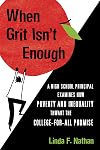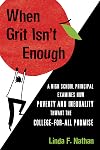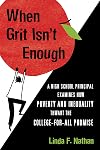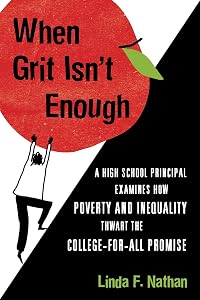
When Grit Isn't Enough: A High School Principal Examines How Poverty and Inequality Thwart the College-for-All Promise
by Linda F. Nathan
On This Page
Description
"Examines major myths informing American education and explores how educators can better serve students, increase college retention rates, and develop alternatives to college that don't disadvantage students on the basis of race or income As the founder and co-headmaster of the Boston Arts Academy (BAA), an urban high school that boasts a 94 percent college acceptance rate, Linda Nathan could have rested on her laurels. But after ushering in fourteen years of graduating classes, Nathan took show more stock of the graduates: of those who went to college, 63 percent graduated and 37 percent dropped out. Although these stats are good, given that the national drop-out and transfer rate from college after the first year is 40 percent, Nathan feels like she failed the students who didn't graduate. This led her to reflect on the assumptions she herself has perpetuated about education: that college is for all, that hard work and determination are enough to get you through, that America is a land of equality. Seeing a rift between these false promises and the lived experiences of her students, Nathan argues that it is time for educators to face these uncomfortable issues head-on and ask the tough questions: How can colleges better acknowledge and address institutional racism and increase retention rates? And for those who sought a career without college, how could high school have paved an alternate path to success? Nathan includes the voices of BAA alumni/ae whose lived experiences provide a window through which to view urban education today and help imagine greater purposes for schooling"-- show lessTags
Recommendations


















Member Recommendations

Member Reviews
Excellent book that names and problematizes the core assumptions and mantras that we repeat to students in poverty. I found it very engaging and hard to put down once picked up. Though the core of the argument was a set of topics we've heard repeatedly raised, I am not sure they have ever been condensed into such a direct and well-written book. The author makes specific recommendations for policy change when it is relevant, and balances personal anecdotes with data -- altogether a well-written book that I've shared with educators in this space for its beating of the timely message that there is no panacea and that universal trendiness should be questioned. I find its message complicated a bit by the author's white skin, which she show more doesn't seem to acknowledge for all that she discusses social class -- a surprising gap.
Like most education books, I didn't find a ton of new interest here. I did emerge with one new insight from this compilation (and I expect others will walk away with different aspects): the focus on grit in schools is a convenient way to shift the burden of student success back onto the students themselves, rather than onto their communities, families, schools, and societies. This makes the core mantra that "if you are gritty, you will be successful" actively dangerous in setting expectations around these students, especially expectations from their middle-class teachers, who may internalize the wrong message despite good intentions.
This is not an academic book. It wants to make change, just like the author's previous principalship at Boston Arts Academy advocates. show less
Like most education books, I didn't find a ton of new interest here. I did emerge with one new insight from this compilation (and I expect others will walk away with different aspects): the focus on grit in schools is a convenient way to shift the burden of student success back onto the students themselves, rather than onto their communities, families, schools, and societies. This makes the core mantra that "if you are gritty, you will be successful" actively dangerous in setting expectations around these students, especially expectations from their middle-class teachers, who may internalize the wrong message despite good intentions.
This is not an academic book. It wants to make change, just like the author's previous principalship at Boston Arts Academy advocates. show less
 This review was written for LibraryThing Early Reviewers.
Linda Nathan has written a thoughtful book about the current state of education in America. During her tenure as founding headmaster of the Boston Arts Academy, Nathan was a vocal proponent of college for all high school graduates. She began to question her original stance as she interviewed BAA alumni and learned of their experiences after high school. In this book Nathan reflects upon five assumptions that drive the college-for-all promise—money need not be an obstacle, race doesn’t matter, all one need do is work harder, everyone can go to college, and dreams will come true if one believes hard enough. She profiles the experiences of BAA graduates, which caused her to question the assumptions she operated under as an educator. show more Her reflections highlight the obstacles that poverty and systemic racism create for young people striving to continue their education beyond secondary school. Nathan does not let herself off the hook. Though her intentions were good, she now recognizes that some of her views were uninformed. The voices of the young people that come through the book give the reader a firsthand account of how the American educational system is often rigged against people of color or in poverty. Nathan does not offer a panacea for correcting the injustices of the system. She does make carefully considered recommendations. She recognizes that there are no easy answers. However, she confidently proclaims the need for change. Anyone with a stake in the American educational system, which should be all Americans, will benefit from reading this thoughtful and compassionate volume. show less
This review was written for LibraryThing Early Reviewers.I received a free advanced reading copy of this book through the Library Thing Early Reviewers program.
Linda F. Nathan is an educator and founder of the Boston Arts Academy (BAA). Like most public high schools in Boston, the student body of the BAA is largely children of color from low-income families, many of them immigrants or children of immigrants. Reflecting on her years as headmaster of the BAA, Nathan recalls her pride in promising students "college for all," and was seemingly successful as the BAA has high graduation rates, high college acceptance rates, and a higher than usual rates of students going on to graduate college. But she also questions whether high schools are properly preparing students for college, or if "college show more for all" is even the promise they should be making.
Much of her data who comes from former students who struggled to complete college and usually not because they couldn't handle the academics. Instead colleges create many barriers to students based on their race and socio-economic status that make it hard for her student to fit into the college culture, get the support they need, and keep on top of all the costs of attending college. And yes, they make mistakes - failing to fill out a form, missing a meeting with a supervisor, not keeping the grade point average up - but while these things are just road bumps for more privileged students, they can end a college career for Nathan's students and others like them. Not only that, but low-income students are often left with crippling debts for the course they did take, but not able to transfer those credits. Even community college, often presented as a good alternative or preparation for a four-year college, has it's own problems and can be exploitative of low-income students.
Nathan also investigates the "no excuses" philosophy common in many charter schools that claim to be preparing poorer children of color for college. While Nathan is very careful to withhold judgment of charter school teachers' emphasis on strict discipline and rote behaviors, it's hard not to read about what Nathan witnesses in this schools and not see it as abusive and ultimately more geared to the needs of adults than the education of children. Again and again, Nathan reveals the idea of "grit" being used to pin any failures of children on their own character rather than question the reality of poverty, racism, and inequality.
Grit is Not Enough is important read for understanding the realities of public education today. Nathan and her former students, as well as present-day students, are voices that need to be heard more in informing our nation's public policy regarding education.
Favorite Passages:
Linda F. Nathan is an educator and founder of the Boston Arts Academy (BAA). Like most public high schools in Boston, the student body of the BAA is largely children of color from low-income families, many of them immigrants or children of immigrants. Reflecting on her years as headmaster of the BAA, Nathan recalls her pride in promising students "college for all," and was seemingly successful as the BAA has high graduation rates, high college acceptance rates, and a higher than usual rates of students going on to graduate college. But she also questions whether high schools are properly preparing students for college, or if "college show more for all" is even the promise they should be making.
Much of her data who comes from former students who struggled to complete college and usually not because they couldn't handle the academics. Instead colleges create many barriers to students based on their race and socio-economic status that make it hard for her student to fit into the college culture, get the support they need, and keep on top of all the costs of attending college. And yes, they make mistakes - failing to fill out a form, missing a meeting with a supervisor, not keeping the grade point average up - but while these things are just road bumps for more privileged students, they can end a college career for Nathan's students and others like them. Not only that, but low-income students are often left with crippling debts for the course they did take, but not able to transfer those credits. Even community college, often presented as a good alternative or preparation for a four-year college, has it's own problems and can be exploitative of low-income students.
Nathan also investigates the "no excuses" philosophy common in many charter schools that claim to be preparing poorer children of color for college. While Nathan is very careful to withhold judgment of charter school teachers' emphasis on strict discipline and rote behaviors, it's hard not to read about what Nathan witnesses in this schools and not see it as abusive and ultimately more geared to the needs of adults than the education of children. Again and again, Nathan reveals the idea of "grit" being used to pin any failures of children on their own character rather than question the reality of poverty, racism, and inequality.
Grit is Not Enough is important read for understanding the realities of public education today. Nathan and her former students, as well as present-day students, are voices that need to be heard more in informing our nation's public policy regarding education.
Favorite Passages:
Deeply held beliefs frequently go unchallenged in societies. They are how we explain phenomena or culture or history. They are often false, yet persist. I believe that these assumptions, or what I've come to call false promises, persist in public education because we hold so tightly to the American ideal of equality. It is this belief that I and many Americans desperately want to be true. It is this belief that we fight for. But it is also this belief that we must fully unpack, deeply understand, and interrogate if we are to uphold our fragile democracy." - p. 6show less
"It is the 'pull yourself up by your bootstraps' ethos to which so many generations of Americans adhere. Yet data repeatedly show hoe poverty, social class, race, and parents' educational attainment more directly influence an individual's success and potential earnings than any individual effort. We clearly do no yet have a level playing field, but this belief is all but impossible to challenge. Whenever we hear of another bootstraps story, we want to generalize. We disregard the fact that luck often plays a major role. And in generalizing and celebrating the individual nature of success, we disregard the imperative to rethink social and economic policies that leave many behind." - p. 8
"In middle- and upper-middle-class families, an invisible safety net typically surrounds young people planning to go on to college. There is usually a family member or friend who will step in and remind a student about the intricacies of student loans and deadlines, or the m any requirements for staying registered once enrolled, or issues that can arise with housing. However, if you are a lower-income student and you miss one or two e-mails or have a change in your adviser, you may find your dreams derailed. It may be tempting to dismiss the examples above as ineptitude or carelessness on the part of individual students, but why must there be different rules, expectations, and outcomes for low-income versus middle- or upper-income students?" - p. 23
"If we allow an assumption like 'race doesn't matter' to prevail, racial issues can be conveniently explained or excused as singular matters to be solved by individual intervention. Singular responses allow us to avoid the actions needed for racial and socio-economic equity and a path toward a healthy and vibrant society and economy." - p. 73-74
"What all the talk about grit seems to miss is the importance of putting children's experience front and center. In other words, when the emphasis on grit ends up as a stand-alone pedagogy, the context of student' life and family circumstances is ignore." - p.76
"We want to allow for growth mindsets in a way that might equalize the playing field, yet we continue to entrap so many of our young people with the assumption that if they just play by the rules, do the right things, they will be successful. Achieving high test scores has become the only way to measure success or to prove that students have learned grit. Equating better test results with healthy learning has reduced many schools to a narrow understanding of learning." - p. 106
"Imagine if American high school students knew that they could study careers in music or finance in a vocational school as either an alternative or precursor to college. Imagine if our community colleges could truly reinvent themselves and be places where students enter the allied health professions or even design professions." - p. 133
"School can be the place where you practice how dreams are realized. School can be where you can build a strong sense of self - an identity that you can belong to a special tribe, like artists, or change-makers, or mathematicians or inventors. To ensure that schools incubate future dreams and dreamers, curriculum, structures, and pedagogy must encourage deep engagement both with teachers and with community members. The walls between school and community can and should be permeable." - p. 161
This review was written for LibraryThing Early Reviewers.I think that When Grit Isn't Enough is an important book reflecting on the status of higher education in students who aren't white, upper-middle class, with college educated parents, etc. The idea of the US meritocracy is so comforting because it makes people who have "achieved it all" feel as if they had a lot of agency in that process, but in fact the entire concept is a flimsy house of cards. One small breath of air will knock it over and expose it as the outright lie that it is. It's easier to think that the people who have achieved greatness deserved it, and not that they were just lucky in that they didn't have to counter the effects of institutional racism (among other things).
I liked that this book really faces the myths of the show more meritocracy head-on, and explains how students of color, poor students, immigrant students, those without college educated parents, can be the smartest, hardest-working students of all time and still not succeed in higher education. There are so many pitfalls in place for students who don't have resources. This book helps to explain and expose those pitfalls.
I have to say that what sort of annoyed me about this book is how much the author seemed to like charter schools. Anything that takes away from public education, in my mind, ultimately cannot serve the needs of anybody but the already well-off. We will never get to a better model of education if there is no public (state) to regulate our schools (whether or not the state is doing a good job of this is another story entirely).
In addition, the author seems to have a very poor view of community colleges. I wish she could have visited the community college where I teach. Of course I'm biased, but I see how much our programs (which do not have to consist of getting an associates and transferring to a university for a bachelor's degree) help serve the students who are not being served by traditional four-year (public or private) schools. I know that community colleges have a long way to go in becoming even better (which is the subject of so many other books), but the rancor the author had just struck me as odd. show less
I liked that this book really faces the myths of the show more meritocracy head-on, and explains how students of color, poor students, immigrant students, those without college educated parents, can be the smartest, hardest-working students of all time and still not succeed in higher education. There are so many pitfalls in place for students who don't have resources. This book helps to explain and expose those pitfalls.
I have to say that what sort of annoyed me about this book is how much the author seemed to like charter schools. Anything that takes away from public education, in my mind, ultimately cannot serve the needs of anybody but the already well-off. We will never get to a better model of education if there is no public (state) to regulate our schools (whether or not the state is doing a good job of this is another story entirely).
In addition, the author seems to have a very poor view of community colleges. I wish she could have visited the community college where I teach. Of course I'm biased, but I see how much our programs (which do not have to consist of getting an associates and transferring to a university for a bachelor's degree) help serve the students who are not being served by traditional four-year (public or private) schools. I know that community colleges have a long way to go in becoming even better (which is the subject of so many other books), but the rancor the author had just struck me as odd. show less
This review was written for LibraryThing Early Reviewers.The education world has seen many trends come and go, as it continues to look for a silver bullet that will cure all of schools’ (and the nation’s) woes. One current trend that is making the rounds is the importance of grit. A longtime hallmark of “no excuses” schools and education advocates, grit has gained new prominence due, in part, to the work of Angela Duckworth. The appeal of grit is undeniable. The pull-yourself-up-by-your-bootstraps, Horatio Alger mentality is as American as apple pie. In a country that prides itself on endless possibilities and Puritan work ethic, grit sounds like the silver bullet education has been waiting for. However, since we do not live in the best of all possible worlds and since one’s fate is show more often determined not just by grit but by a number of other factors, the reality of grit is a good deal murkier than its supporters would have us believe.
In “When Grit Isn’t Enough: A High School Principal Examines How Poverty and Inequality Thwart the College-for-All Promise,” Linda F. Nathan, the founding headmaster of the urban Boston Arts Academy, explores the limits of grit and debunks five long-held beliefs that have permeated not just education but society as a whole. She counters these beliefs by drawing upon interviews with alumni from the Boston Arts Academy as well as findings and work by other researchers and education experts. The result is a thoughtful and thought-provoking look at the challenges that urban students must overcome as well as the problems caused by perpetuating these flawed beliefs.
Nathan offers a convincing analysis of grit’s shortcomings as well as the deficiencies of the five beliefs, which are:
• “Money doesn’t have to be an obstacle”
• “Race doesn’t matter”
• “Just work harder”
• “Everyone can go to college”
• “If you believe, your dreams will come true.”
What is particularly helpful is that Nathan does not fall into the trap of simply dismissing these viewpoints. Instead, she explores why they can be misleading. Another benefit of Nathan’s approach is that, while she expresses concern and skepticism for programs like the Knowledge is Power Program (KIPP) that adopt a “no excuses” approach to teaching, she is, for the most part, evenhanded in her critiques of these programs. This is aided by her willingness to admit her adherence to some of these beliefs when she worked at BAA and when raising her children. Rather than undermining her evaluations, this shows how these views might work within certain contexts but might not apply to all situations.
While the book seemed overly long in some areas (as another reviewer noted, Nathan reiterates many of her points), it was an approachable and sobering look at the problems plaguing education. These problems are too complex for one idea or characteristic to solve them all, and I appreciate Nathan’s willingness to acknowledge this. As a teacher educator, I see “When Grit Isn’t Enough” as a valuable resource for current and future teachers, especially those who want to get another perspective on grit and the “no excuses” approach to education. show less
In “When Grit Isn’t Enough: A High School Principal Examines How Poverty and Inequality Thwart the College-for-All Promise,” Linda F. Nathan, the founding headmaster of the urban Boston Arts Academy, explores the limits of grit and debunks five long-held beliefs that have permeated not just education but society as a whole. She counters these beliefs by drawing upon interviews with alumni from the Boston Arts Academy as well as findings and work by other researchers and education experts. The result is a thoughtful and thought-provoking look at the challenges that urban students must overcome as well as the problems caused by perpetuating these flawed beliefs.
Nathan offers a convincing analysis of grit’s shortcomings as well as the deficiencies of the five beliefs, which are:
• “Money doesn’t have to be an obstacle”
• “Race doesn’t matter”
• “Just work harder”
• “Everyone can go to college”
• “If you believe, your dreams will come true.”
What is particularly helpful is that Nathan does not fall into the trap of simply dismissing these viewpoints. Instead, she explores why they can be misleading. Another benefit of Nathan’s approach is that, while she expresses concern and skepticism for programs like the Knowledge is Power Program (KIPP) that adopt a “no excuses” approach to teaching, she is, for the most part, evenhanded in her critiques of these programs. This is aided by her willingness to admit her adherence to some of these beliefs when she worked at BAA and when raising her children. Rather than undermining her evaluations, this shows how these views might work within certain contexts but might not apply to all situations.
While the book seemed overly long in some areas (as another reviewer noted, Nathan reiterates many of her points), it was an approachable and sobering look at the problems plaguing education. These problems are too complex for one idea or characteristic to solve them all, and I appreciate Nathan’s willingness to acknowledge this. As a teacher educator, I see “When Grit Isn’t Enough” as a valuable resource for current and future teachers, especially those who want to get another perspective on grit and the “no excuses” approach to education. show less
This review was written for LibraryThing Early Reviewers.When Grit Isn’t Enough by Linda F. Nathan is an exciting, sometimes overwhelming, book examining the assumptions we make in this country about how people succeed, especially in school. Nathan is a professor at Harvard University’s Graduate School of Education and founding headmaster of the Boston Arts Academy—BAA--Boston’s only public high school for the visual and performing arts. Drawing on her experience at BAA, reflecting on the graduates of that school, Nathan explores what she considers the five basic assumptions we act on when judging others, particularly those who have “failed”—dropped out of high school, not gone to college (or not graduated), or not “made it” into the middle class.
The five assumptions Nathan show more looks at are:
1. “Money doesn’t have to be an obstacle”
2. “Race doesn’t matter”
3. “Just work harder”
4. “Everyone can go to college”
5. “If you believe, your dreams will come true”
Nathan recognizes the strengths each of these statements can convey to students but she also examines their shortcoming. For students of color, even after getting into college, being one of a few students of color can be an alienating and lonely experience, compounding the difficulties already inherent in the first year of college. Racism in many forms, often unrecognized by the person or group practicing it, can make college success even harder to achieve.
Poverty can also compromise the ability to attend—or continue in—college. Especially for students who are the first in their family to go to college, even the complexities of applying for financial aid can lead to disastrous mistakes that can shut down their chance to go to or remain in college. We underestimate the amount and varying forms of support middle class students have when going through the college application process and navigating their college years, especially that critical first one.
“Just work harder” again implies that a student’s success is solely dependent on his or her individual efforts, ignoring other societal factors, the lack of supports available, the inflexibility of many colleges in working with first generation college students, and other factors that may result even in the best efforts failing.
Nathan questions her own promise to her students at BAA that “everyone can go to college”. While affirming the vital importance of ensuring that vocational programs not be a way to track students of color away from the college experience, Nathan offers thoughtful suggestions, along with some stellar examples, of where high schools can combine with the world of work to ensure that students receive both a rigorous academic education and attain vocational skills and experience that can result in entry into the middle class with or without a traditional college degree.
And lastly, although Nathan provides numerous examples of students who believe in their dreams and realized them, she again cautions that to hold these students up as the norm and not sometimes the exceptions is to place blame on the students that they may not—or may only partially—deserve.
As the title of the book suggests, Nathan believes that the current emphasis on grit does a disservice to students and absolves society of its need to address issues such as racism and poverty. While affirming the need for individual perseverance and determination, she also discusses the ways in which education can help develop those qualities, along with creativity, flexibility, passion, problem-solving, and commitment to community. Nathan believes that the current emphasis on high-stakes testing as the only measure of student success cuts off the development of these other essential traits that need to be nurtured to support student agency and success in college and in life. Further, the “no excuses” school model reinforces a lack of said agency, particularly in students of color who are the primary students in this model school.
Although this review is lengthy, it only highlights a few of Nathan’s insights and discussions of how to make education more productive for the student, the community, and, ultimately, the nation. This is an important work that should be read by everybody concerned with the education of our country’s youth (that would be everybody).
I am grateful to LibraryThing for providing me with a copy of this work. I am grateful to have read it and hope that Nathan’s passionate arguments for creating more educational opportunities and necessary supports are heard by more people. show less
The five assumptions Nathan show more looks at are:
1. “Money doesn’t have to be an obstacle”
2. “Race doesn’t matter”
3. “Just work harder”
4. “Everyone can go to college”
5. “If you believe, your dreams will come true”
Nathan recognizes the strengths each of these statements can convey to students but she also examines their shortcoming. For students of color, even after getting into college, being one of a few students of color can be an alienating and lonely experience, compounding the difficulties already inherent in the first year of college. Racism in many forms, often unrecognized by the person or group practicing it, can make college success even harder to achieve.
Poverty can also compromise the ability to attend—or continue in—college. Especially for students who are the first in their family to go to college, even the complexities of applying for financial aid can lead to disastrous mistakes that can shut down their chance to go to or remain in college. We underestimate the amount and varying forms of support middle class students have when going through the college application process and navigating their college years, especially that critical first one.
“Just work harder” again implies that a student’s success is solely dependent on his or her individual efforts, ignoring other societal factors, the lack of supports available, the inflexibility of many colleges in working with first generation college students, and other factors that may result even in the best efforts failing.
Nathan questions her own promise to her students at BAA that “everyone can go to college”. While affirming the vital importance of ensuring that vocational programs not be a way to track students of color away from the college experience, Nathan offers thoughtful suggestions, along with some stellar examples, of where high schools can combine with the world of work to ensure that students receive both a rigorous academic education and attain vocational skills and experience that can result in entry into the middle class with or without a traditional college degree.
And lastly, although Nathan provides numerous examples of students who believe in their dreams and realized them, she again cautions that to hold these students up as the norm and not sometimes the exceptions is to place blame on the students that they may not—or may only partially—deserve.
As the title of the book suggests, Nathan believes that the current emphasis on grit does a disservice to students and absolves society of its need to address issues such as racism and poverty. While affirming the need for individual perseverance and determination, she also discusses the ways in which education can help develop those qualities, along with creativity, flexibility, passion, problem-solving, and commitment to community. Nathan believes that the current emphasis on high-stakes testing as the only measure of student success cuts off the development of these other essential traits that need to be nurtured to support student agency and success in college and in life. Further, the “no excuses” school model reinforces a lack of said agency, particularly in students of color who are the primary students in this model school.
Although this review is lengthy, it only highlights a few of Nathan’s insights and discussions of how to make education more productive for the student, the community, and, ultimately, the nation. This is an important work that should be read by everybody concerned with the education of our country’s youth (that would be everybody).
I am grateful to LibraryThing for providing me with a copy of this work. I am grateful to have read it and hope that Nathan’s passionate arguments for creating more educational opportunities and necessary supports are heard by more people. show less
This review was written for LibraryThing Early Reviewers.The best part of the book is the author’s willingness to continue to learn, to change assumptions, and to critique past actions based on new information. If only more people were as thoughtful! Her perspective is that of a high school principal in a Boston arts high school and because she was a founder of this school based on high expectations, innovative principles, and incredible student support it is all the more amazing that she is able to look at what she and others accomplished with such honesty.
Using interesting and apt case studies from her high school graduates she thinks through what her students were facing in several pertinent areas and how they might have been better prepared for life after high school. She makes show more specific recommendations for how educators in high school and in college could do things differently that would help. And she makes a compelling case for thinking carefully about the shortcomings of the “grit” concept. She walks a line very carefully when making a case for alternatives to traditional college education. The book is thought provoking, makes you wish for a similar perspective from a seasoned college student affairs professional that could explain how they view these issues. show less
Using interesting and apt case studies from her high school graduates she thinks through what her students were facing in several pertinent areas and how they might have been better prepared for life after high school. She makes show more specific recommendations for how educators in high school and in college could do things differently that would help. And she makes a compelling case for thinking carefully about the shortcomings of the “grit” concept. She walks a line very carefully when making a case for alternatives to traditional college education. The book is thought provoking, makes you wish for a similar perspective from a seasoned college student affairs professional that could explain how they view these issues. show less
This review was written for LibraryThing Early Reviewers.Members
- Recently Added By
Lists

Beacon Press
39 works; 1 member
Author Information

1 Work 40 Members
Linda F. Nathan is the first executive director of the Center for Artistry and Scholarship and has taught at the Harvard Graduate School of Education for fifteen years. Dr. Nathan served as founding headmaster of the Boston Arts Academy, Boston's only public high school for the visual and performing arts.
Classifications
- Genres
- Nonfiction, General Nonfiction, Economics, Business
- DDC/MDS
- 378.1 — Society, government, & culture Education Higher education (Tertiary education) Organization and management; curriculums
- LCC
- LB2351.2 .N37 — Education Theory and practice of education Theory and practice of education Higher education Admissions and entrance requirements
- BISAC
Statistics
- Members
- 38
- Popularity
- 732,880
- Reviews
- 13
- Rating
- (4.14)
- Languages
- English
- Media
- Paper, Audiobook, Ebook
- ISBNs
- 5
- ASINs
- 1