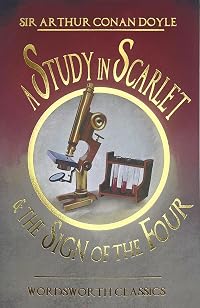
The Sign of Four / A Study in Scarlet
by Sir Arthur Conan Doyle
Sherlock Holmes Original Novels {Conan Doyle} (Collections and Selections — 1-2)
On This Page
Description
"A Study in Scarlet" brings Sherlock Holmes and Dr. John Watson together for the first time, creating one of the most illustrious crime-solving partnerships of all times. In "The Sign of Fou"r, an incredible tale of greed and revenge unfolds as Holmes and Watson accompany a beautiful young woman to the dark heart of London.Tags
Recommendations

















Member Recommendations
Member Reviews
A few brief notes:
-Surprisingly modern, readable prose for a pair of 19th century novellas. Compare, for example, the depictions of India in Doyle's The Sign of Four and Kipling's Kim. Kipling may be more naturalistic, but Doyle is more accessible (i.e. I was not reaching for the dictionary every 10 minutes). When I read an old novel that sounds (relatively) modern, I take that as a mark of the strength of it's influence. That is, the stronger the influence of an older novel on those that came afterward, the more it is likely to have in common with them.
-Having seen many film and TV adaptations of the Sherlock Holmes's* stories, I was surprised by a couple things about the original portrayal of the Holmes character. First, he is not show more the armchair detective I had pictured. He's an action hero--boxing, shooting revolvers, etc. Second, he's not the pontificating old man I remember. If I read *A Study in Scarlet* correctly, Holmes (a recent university graduate) is about 20 years younger than Watson (a pensioned Army doctor, who injury seemed to have shifted from his shoulder to his leg, but never mind that). Third, Holmes is not the ego ideal I expected. Unlike, say, Superman or James Bond, Sherlock Holmes regular says or does reprehensible things that Watson (the narrator) explicitly points out to the reader. I'm thinking here of both Holmes's misogyny and drug addiction. The addiction especially features quite prominently in The Sign of Four, which begins and ends with Sherlock's IV drug use (so extensive that he is described as having track marks). Flawed heroes are, as far as I'm concerned, far more interesting.
-My evaluation of the books might be colored by the fact that I found them historically interestingly. Read on their own, irrespective of their influence, they might seem less...something. I dunno. Even though I don't like lengthy, tedious exposition, I still liked these books. They do something bad, but they do it well. So it all works out in the end, right? show less
-Surprisingly modern, readable prose for a pair of 19th century novellas. Compare, for example, the depictions of India in Doyle's The Sign of Four and Kipling's Kim. Kipling may be more naturalistic, but Doyle is more accessible (i.e. I was not reaching for the dictionary every 10 minutes). When I read an old novel that sounds (relatively) modern, I take that as a mark of the strength of it's influence. That is, the stronger the influence of an older novel on those that came afterward, the more it is likely to have in common with them.
-Having seen many film and TV adaptations of the Sherlock Holmes's* stories, I was surprised by a couple things about the original portrayal of the Holmes character. First, he is not show more the armchair detective I had pictured. He's an action hero--boxing, shooting revolvers, etc. Second, he's not the pontificating old man I remember. If I read *A Study in Scarlet* correctly, Holmes (a recent university graduate) is about 20 years younger than Watson (a pensioned Army doctor, who injury seemed to have shifted from his shoulder to his leg, but never mind that). Third, Holmes is not the ego ideal I expected. Unlike, say, Superman or James Bond, Sherlock Holmes regular says or does reprehensible things that Watson (the narrator) explicitly points out to the reader. I'm thinking here of both Holmes's misogyny and drug addiction. The addiction especially features quite prominently in The Sign of Four, which begins and ends with Sherlock's IV drug use (so extensive that he is described as having track marks). Flawed heroes are, as far as I'm concerned, far more interesting.
-My evaluation of the books might be colored by the fact that I found them historically interestingly. Read on their own, irrespective of their influence, they might seem less...something. I dunno. Even though I don't like lengthy, tedious exposition, I still liked these books. They do something bad, but they do it well. So it all works out in the end, right? show less
The first and second appearances of Sherlock Holmes!
It was a most enjoyable time reading about the first meeting of Watson and Holmes in "A Study in Scarlet". The first part was as charming as I had expected—even more so. The second part threw me for a loop. Mormons! Utah!
Once Holmes had revealed the mystery of the crime, Doyle reveals the hidden mysteries and motivations of the criminal—which one can certainly empathize with.
"The Sign of Four" was a grand adventure that concluded with a look at the criminal's experiences in the Indian Rebellion of 1857. Doyle begs us to examine what we each would have done should we be faced with Jonathan Small's moral dilemmas. It would seem that fate has as much hand in building or destroying a show more man's character as man does.
Certainly, once Small banded with the bandits, he continued haphazardly down the treacherous Left Hand Path of the Damned without once looking back. Small was not a moral man at all (from youth even), unlike the murderer Jefferson Hope in "A Study in Scarlet". Small was motivated by greed, Hope by hunger for Justice denied.
What is Just in this world? Holmes is no philosopher. Holmes is a cold hard ratiocinating machine, who pauses to philosophy only in the melodic tones of his violin and in the blue clouds of tobacco smoke from his pipe. That Cocaine is fuel for his mind is made obvious by Doyle.
Being a pipe smoker myself, I was tickled by all the pipe smoking and cigar puffing going on at 221 B Baker Street. I am as worried as Holmes is about Watson's engagement to Miss Mary Morstan! Gads! What's to become of their living situation?
Holmes is a more peculiar a character than I had thought. I love this about him. It is a pleasure to behold his intellectual prowess. I only wish that I could hear some of his violin improvisations. show less
It was a most enjoyable time reading about the first meeting of Watson and Holmes in "A Study in Scarlet". The first part was as charming as I had expected—even more so. The second part threw me for a loop. Mormons! Utah!
Once Holmes had revealed the mystery of the crime, Doyle reveals the hidden mysteries and motivations of the criminal—which one can certainly empathize with.
"The Sign of Four" was a grand adventure that concluded with a look at the criminal's experiences in the Indian Rebellion of 1857. Doyle begs us to examine what we each would have done should we be faced with Jonathan Small's moral dilemmas. It would seem that fate has as much hand in building or destroying a show more man's character as man does.
Certainly, once Small banded with the bandits, he continued haphazardly down the treacherous Left Hand Path of the Damned without once looking back. Small was not a moral man at all (from youth even), unlike the murderer Jefferson Hope in "A Study in Scarlet". Small was motivated by greed, Hope by hunger for Justice denied.
What is Just in this world? Holmes is no philosopher. Holmes is a cold hard ratiocinating machine, who pauses to philosophy only in the melodic tones of his violin and in the blue clouds of tobacco smoke from his pipe. That Cocaine is fuel for his mind is made obvious by Doyle.
Being a pipe smoker myself, I was tickled by all the pipe smoking and cigar puffing going on at 221 B Baker Street. I am as worried as Holmes is about Watson's engagement to Miss Mary Morstan! Gads! What's to become of their living situation?
Holmes is a more peculiar a character than I had thought. I love this about him. It is a pleasure to behold his intellectual prowess. I only wish that I could hear some of his violin improvisations. show less
Sherlock Holmes is the lead character in four novels and five collections of short stories that were written between 1887 and 1927.
The Collector's Library has bound the first two novels (1887, 1890) together in a small finely-crafted volume. Call me a book snob, but there's something satisfying about reading a cloth-bound gilt-edged book with a ribbon to mark your place. I'll be keeping an eye out for the remaining volumes in this series (I have already started with The Case-Book of Sherlock Holmes.)
*A Study in Scarlet*
Here is where the whole mythology begins.
Dr. Watson, assistant surgeon during the war in India, returned to London wounded from Jezail bullet. An old friend met him in a bar and heard that he is looking for some show more reasonable lodging. This friend connects Watson with his soon-to-be roommate: Sherlock Holmes. Holmes is introduced as a very careful man who considers everything very logically and methodologically. Watson is intrigued.
Within a few chapters we find a dead body, incompetent detectives, and the word RACHE (a literary precursor to redrum?) written on the wall in scarlet.
The book is divided into two halves, with the second beginning on a different continent in an earlier era. A dehydrated man and child are about to die on the Sierra Blanco when they are saved by a wagon train of Mormons making their way to their promised land. It was painful to read the way that the Brit, Doyle, painted the majestic Sierra region of the United States:
"They all preserve, however, the common characteristics of barrenness, inhospitality and misery. There are no inhabitants of this land of despair" (93).
The novel reaches a satisfying conclusion when the two stories are brought together. The villain is caught and a full explanation of his actions are recorded. A Study in Scarlet not only introduced the world to one of the most popular amateur detectives of all time, it takes the reader across continents on an exciting mystery.
*The Sign of the Four*
The second Sherlock Holmes novel reminds the reader immediately of the distance between Nineteenth Century England and Twenty-First Century North America. Here's the first paragraph:
"Sherlock Holmes took his bottle from the corner of the mantelpiece and his hypodermic syringe from its neat morocco case. With his long, white, nervous fingers he adjusted the delicate needle and rolled back his left shirt-cuff. For some little time his eyes rested thoughtfully upon the sinewy forearm and wrist, all dotted and scarred with innumerable puncture-marks. Finally, he thrust the sharp point home, pressed down the tiny piston, and sank back into the velvet-lined armchair with a long sign of satisfaction" (171).
Aside from the disdain of Dr. Watson, this habit (a seven percent solution of cocaine) was apparently an acceptable way to pass the time. Holmes found it difficult to live without a mental challenge—some mystery to be engaged in—so he passed the time with recreational drugs.
Fortunately, a mystery appeared forthwith. Holmes' brilliant powers of deduction are put to the test with a dead body, a peg-legged villain, and small poison blow-darts. The mystery ends with a climax that would be at home in any modern action film.
These two early Sherlock Holmes novels not only provide the reader with good mystery stories, they open a window into the pre-CSI world of Nineteenth Century England. show less
The Collector's Library has bound the first two novels (1887, 1890) together in a small finely-crafted volume. Call me a book snob, but there's something satisfying about reading a cloth-bound gilt-edged book with a ribbon to mark your place. I'll be keeping an eye out for the remaining volumes in this series (I have already started with The Case-Book of Sherlock Holmes.)
*A Study in Scarlet*
Here is where the whole mythology begins.
Dr. Watson, assistant surgeon during the war in India, returned to London wounded from Jezail bullet. An old friend met him in a bar and heard that he is looking for some show more reasonable lodging. This friend connects Watson with his soon-to-be roommate: Sherlock Holmes. Holmes is introduced as a very careful man who considers everything very logically and methodologically. Watson is intrigued.
Within a few chapters we find a dead body, incompetent detectives, and the word RACHE (a literary precursor to redrum?) written on the wall in scarlet.
The book is divided into two halves, with the second beginning on a different continent in an earlier era. A dehydrated man and child are about to die on the Sierra Blanco when they are saved by a wagon train of Mormons making their way to their promised land. It was painful to read the way that the Brit, Doyle, painted the majestic Sierra region of the United States:
"They all preserve, however, the common characteristics of barrenness, inhospitality and misery. There are no inhabitants of this land of despair" (93).
The novel reaches a satisfying conclusion when the two stories are brought together. The villain is caught and a full explanation of his actions are recorded. A Study in Scarlet not only introduced the world to one of the most popular amateur detectives of all time, it takes the reader across continents on an exciting mystery.
*The Sign of the Four*
The second Sherlock Holmes novel reminds the reader immediately of the distance between Nineteenth Century England and Twenty-First Century North America. Here's the first paragraph:
"Sherlock Holmes took his bottle from the corner of the mantelpiece and his hypodermic syringe from its neat morocco case. With his long, white, nervous fingers he adjusted the delicate needle and rolled back his left shirt-cuff. For some little time his eyes rested thoughtfully upon the sinewy forearm and wrist, all dotted and scarred with innumerable puncture-marks. Finally, he thrust the sharp point home, pressed down the tiny piston, and sank back into the velvet-lined armchair with a long sign of satisfaction" (171).
Aside from the disdain of Dr. Watson, this habit (a seven percent solution of cocaine) was apparently an acceptable way to pass the time. Holmes found it difficult to live without a mental challenge—some mystery to be engaged in—so he passed the time with recreational drugs.
Fortunately, a mystery appeared forthwith. Holmes' brilliant powers of deduction are put to the test with a dead body, a peg-legged villain, and small poison blow-darts. The mystery ends with a climax that would be at home in any modern action film.
These two early Sherlock Holmes novels not only provide the reader with good mystery stories, they open a window into the pre-CSI world of Nineteenth Century England. show less
It's barely worth reviewing classics like this, so I'll just say that Sherlock Holmes could have been written yesterday - it still fresh, engaging and genuinely fun to read.
I've never really been into mysteries, but wanted to try some Sherlock Holmes stories before the new movie came out and skewed my perception of them. Plus, I love reading about interesting characters no matter the genre, and it seemed like Holmes must be one, being so culturally pervasive and enduring.
I was fairly entertained for the beginning of the first book that mostly focuses on showing us Holmes's quirky character. As the mystery starts, though, the parts of Holmes's personality that actually made him interesting quickly take a back seat to Holmes simply being calm, collected, and right 100% of the time.
I'm not in a great place to judge the mysteries, but I can say I was expecting something that lets the reader try and make their show more own guesses a little more, or at least shows what the characters are guessing so you can watch them figure it out. Instead, particularly with the first story, Holmes often seemed to find or figure out clues and then withhold them from the reader just to make his explanation in the end more climactic and his character more amazing. The Sign of Four was a little better about this since Holmes was a little more troubled by some things, the mystery was generally more interesting, and it didn't have the problem of being half taken up by the criminal's back story.
Somewhat ridiculously, the main thing that kept flashing through my mind when I read these was that the character House from TV is really very nicely done. I knew he was based somewhat off Holmes, and indeed, it's like they took all the fun things about Holmes and made him more real by admitting the sorts of things that make him quirky and interesting could also make him a bit dysfunctional and irritating in real society. Plus he's also WRONG sometimes.
I do think that there must be a way to do a fun, light version of this sort of character like the original novels seem to try to do. Some characters really can to a certain extent just get by on charm and don't have to be realistically flawed. But...I don't see Holmes that way in these first two stories. I'll likely be trying The Hound of the Baskervilles since I already own it and I hear it's supposed to be the best. Perhaps the character will have become more fleshed out and his portrayal more even by then. show less
I was fairly entertained for the beginning of the first book that mostly focuses on showing us Holmes's quirky character. As the mystery starts, though, the parts of Holmes's personality that actually made him interesting quickly take a back seat to Holmes simply being calm, collected, and right 100% of the time.
I'm not in a great place to judge the mysteries, but I can say I was expecting something that lets the reader try and make their show more own guesses a little more, or at least shows what the characters are guessing so you can watch them figure it out. Instead, particularly with the first story, Holmes often seemed to find or figure out clues and then withhold them from the reader just to make his explanation in the end more climactic and his character more amazing. The Sign of Four was a little better about this since Holmes was a little more troubled by some things, the mystery was generally more interesting, and it didn't have the problem of being half taken up by the criminal's back story.
Somewhat ridiculously, the main thing that kept flashing through my mind when I read these was that the character House from TV is really very nicely done. I knew he was based somewhat off Holmes, and indeed, it's like they took all the fun things about Holmes and made him more real by admitting the sorts of things that make him quirky and interesting could also make him a bit dysfunctional and irritating in real society. Plus he's also WRONG sometimes.
I do think that there must be a way to do a fun, light version of this sort of character like the original novels seem to try to do. Some characters really can to a certain extent just get by on charm and don't have to be realistically flawed. But...I don't see Holmes that way in these first two stories. I'll likely be trying The Hound of the Baskervilles since I already own it and I hear it's supposed to be the best. Perhaps the character will have become more fleshed out and his portrayal more even by then. show less
A Study in Scarlet & The Sign of the Four, two short novels, are the beginning of the Holmes canon. They are racist, sexist, anti-Mormon, and inconsistent, yet enduringly funny, engaging, and entertaining.
I read the study in Scarlet. It was good, but the extended deviation into Latter Day Saints kind of threw me for awhile. I didn't read the Sign of Four. I may go back to it another time. I actually did go back and read The Sign of Four. Another great Sherlock story.
Members
- Recently Added By
Lists

Detective Stories
343 works; 5 members
Author Information

4,013+ Works 170,093 Members
The most famous fictional detective in the world is Arthur Conan Doyle's Sherlock Holmes. However, Doyle was, at best, ambivalent about his immensely successful literary creation and, at worst, resentful that his more "serious" fiction was relatively ignored. Born in Edinburgh, Doyle studied medicine from 1876 to 1881 and received his M.D. in show more 1885. He worked as a military physician in South Africa during the Boer War and was knighted in 1902 for his exceptional service. Doyle was drawn to writing at an early age. Although he attempted to enter private practice in Southsea, Portsmouth, in 1882, he soon turned to writing in his spare time; it eventually became his profession. As a Liberal Unionist, Doyle ran, unsuccessfully, for Parliament in 1903. During his later years, Doyle became an avowed spiritualist. Doyle sold his first story, "The Mystery of the Sasassa Valley," to Chambers' Journal in 1879. When Doyle published the novel, A Study in Scarlet in 1887, Sherlock Holmes was introduced to an avid public. Doyle is reputed to have used one of his medical professors, Dr. Joseph Bell, as a model for Holmes's character. Eventually, Doyle wrote three additional Holmes novels and five collections of Holmes short stories. A brilliant, though somewhat eccentric, detective, Holmes employs scientific methods of observation and deduction to solve the mysteries that he investigates. Although an "amateur" private detective, he is frequently called upon by Scotland Yard for assistance. Holmes's assistant, the faithful Dr. Watson, provides a striking contrast to Holmes's brilliant intellect and, in Doyle's day at least, serves as a character with whom the reader can readily identify. Having tired of Holmes's popularity, Doyle even tried to kill the great detective in "The Final Problem" but was forced by an outraged public to resurrect him in 1903. Although Holmes remained Doyle's most popular literary creation, Doyle wrote prolifically in other genres, including historical adventure, science fiction, and supernatural fiction. Despite Doyle's sometimes careless writing, he was a superb storyteller. His great skill as a popular author lay in his technique of involving readers in his highly entertaining adventures. (Bowker Author Biography) show less

Arthur Conan Doyle has a Legacy Library. Legacy libraries are the personal libraries of famous readers, entered by LibraryThing members from the Legacy Libraries group.
Some Editions
Series

Belongs to Publisher Series
Work Relationships
Is contained in
Common Knowledge
- Canonical title
- The Sign of Four / A Study in Scarlet
- Original title
- A Study in Scarlet; The Sign of the Four
- Original publication date
- 1887 (A Study in Scarlet) (A Study in Scarlet); 1890 (The Sign of Four) (The Sign of Four)
- People/Characters
- Sherlock Holmes; John H. Watson; Inspector Tobias Gregson; Inspector G. Lestrade; Inspector Athelney Jones; Mary Morstan
- Important places
- 221B Baker Street, London, England, UK
- First words
- Introduction
Edgar Allan Poe is generally regarded as the father of the detective story. - Last words
- (Click to show. Warning: May contain spoilers.)And he streched his long, white hand up for it.
- Original language
- English
- Disambiguation notice
- This work contains both A Study in Scarlet and The Sign of Four by Arthur Conan Doyle. It should not be combined with other omnibus editions containing different works, or with either individual work.
Classifications
Statistics
- Members
- 1,274
- Popularity
- 19,226
- Reviews
- 15
- Rating
- (3.92)
- Languages
- 14 — Chinese, Dutch, English, French, German, Italian, Japanese, Latvian, Norwegian (Bokmål), Portuguese, Serbian, Spanish, Swedish, Turkish
- Media
- Paper, Audiobook, Ebook
- ISBNs
- 60
- UPCs
- 2
- ASINs
- 23