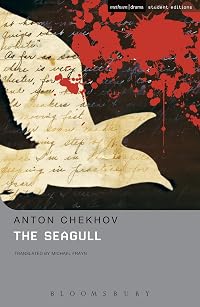
The Seagull
by Anton Chekhov
On This Page
Description
The Seagull is the first of Anton Checkov's four full-length plays. It explores the romantic and artistic tension in the relationships between a young woman, a fading older lady, her playwright son and a popular story writer. The play references Shakespeare's Hamlet both in text and content. It has a cast of eclectic characters whose principle dramas play themselves out off stage and in unvoiced subtext. As this opposed the melodramatic theatre of the day, the play's first reception in 1895 show more was hostile. It later became a huge success.. show less
Tags
Recommendations







Member Reviews
How easy it is, Doctor, to be a philosopher on paper and, how difficult in real life.
The Seagull was a delightful exploration of binary contrasts, a meditation rocking the countryside as a mélange of folk gather by the shore of a lake for some Slavic R&R: adultery and suicide. I am only kidding. Echoing Hemingway, one would imagine all of Mother Rus hanging themselves judging by the pages of its marvelous literature. The contrast between urban and rural is explored as is the space between art and labor. Regret happens to ruminate and the servants receive a whole ruble to divide amongst themselves. There's a play-within-the-play which somehow struck me as did Bergman's Through A Glass Darkly and everyone appears to be quoting Hamlet. show more Substitute a sea gull for an albatross and pen a portrait of the artist (or author) as lecher and Bob's your uncle (but not Vanya). show less
The Seagull was a delightful exploration of binary contrasts, a meditation rocking the countryside as a mélange of folk gather by the shore of a lake for some Slavic R&R: adultery and suicide. I am only kidding. Echoing Hemingway, one would imagine all of Mother Rus hanging themselves judging by the pages of its marvelous literature. The contrast between urban and rural is explored as is the space between art and labor. Regret happens to ruminate and the servants receive a whole ruble to divide amongst themselves. There's a play-within-the-play which somehow struck me as did Bergman's Through A Glass Darkly and everyone appears to be quoting Hamlet. show more Substitute a sea gull for an albatross and pen a portrait of the artist (or author) as lecher and Bob's your uncle (but not Vanya). show less
I saw a brilliant production of this play on Broadway (brought over from London) a few years ago, so I guess I wouldn't say read it, I would say, if you can see a first class production of it that gets the humor and doesn't make Kostya a clueless sad sack, sell part of your book collection to get a ticket. For a writer, it's all about your worst nightmares. For anyone, the final scene between the two failed young lovers, and what follows, is devastating.
But reading it is worthwhile too. Just pick a good translation and remember that the author had a very dry and brutal sense of humor.
As a writer, I am always in awe of Chekhov. His characters, his dramatic structures, his settings, there is nobody like him. He was so good, in every way, show more and apparently once said he could toss off a salable short story about anything, about the ashtray in front of him. He was boasting, but I'm sure it was true. show less
But reading it is worthwhile too. Just pick a good translation and remember that the author had a very dry and brutal sense of humor.
As a writer, I am always in awe of Chekhov. His characters, his dramatic structures, his settings, there is nobody like him. He was so good, in every way, show more and apparently once said he could toss off a salable short story about anything, about the ashtray in front of him. He was boasting, but I'm sure it was true. show less
Summary (on some review-page): The Seagull by Anton Chekhov is a slice-of-life drama set in the Russian countryside at the end of the 19th century. The cast of characters is dissatisfied with their lives. Some desire love. Some desire success. Some desire artistic genius. No one, however, ever seems to attain happiness.
I’m a big fan of L.A. Theatre Works - but not even this fine audiobook-production with Calista Flockhart could save this “self-occupied” play.
A lot of modern existential ideas are at play here - a psychological story about self-centered artists who are unable to connect with each other or get any fulfillment out of life.
I’m now wondering if I should listen to more of Chekhov’s plays.
I’m a big fan of L.A. Theatre Works - but not even this fine audiobook-production with Calista Flockhart could save this “self-occupied” play.
A lot of modern existential ideas are at play here - a psychological story about self-centered artists who are unable to connect with each other or get any fulfillment out of life.
I’m now wondering if I should listen to more of Chekhov’s plays.
This is a review of the performance I saw on May 28, 2011 in Atlanta, and not of the actual play as written.
Chekhov is one of my favorite writers and it pains me to see him performed in this way. It also pains me to trash an Atlanta production of a serious play (I do want to be encouraging, afterall). Atlanta doesn’t often perform Chekhov, or anything halfway serious for that matter. It’s like we’re so afraid of boring the audience we have to make everything into an easy joke, which is why we never put on serious plays. But even when we do tackle Chekhov, we’re still going for those easy laughs.
Yes, I know it’s a comedy. But not in this way. Chekhov was subtle. Somehow this performance managed to make all the characters show more one-dimensional, which is not a word I would otherwise associate with Chekhov. The acting was horrible. There seemed to be entirely too much thought put into the set pieces and the movement of the actors around the stage (and the clever things they did in the background of the main action), and entirely too little attention paid to how the lines were actually delivered.
I don’t know how to write about bad acting. I can write about bad writing, but bad acting I do not have the vocabulary for. It just felt unnatural to my ears. It seems to me that there wasn’t enough attention paid to the silences between the lines, or the pauses where the thought comes before the words. It felt like a torrent of words without a real person behind them.
Anyway, I went home and read a few pages of this play (though in a different translation) just to make sure it wasn’t Chekhov’s fault. It wasn’t.
If anyone from this production is reading this, then I’m sorry if I hurt your feelings and please excuse my harshness. Don't stop trying to tackle hard plays, even if you fail every once in a while. If it’s any consolation, at least the Creative Loafing gave you guys a glowing review. Perhaps I don’t know what I’m talking about. show less
Chekhov is one of my favorite writers and it pains me to see him performed in this way. It also pains me to trash an Atlanta production of a serious play (I do want to be encouraging, afterall). Atlanta doesn’t often perform Chekhov, or anything halfway serious for that matter. It’s like we’re so afraid of boring the audience we have to make everything into an easy joke, which is why we never put on serious plays. But even when we do tackle Chekhov, we’re still going for those easy laughs.
Yes, I know it’s a comedy. But not in this way. Chekhov was subtle. Somehow this performance managed to make all the characters show more one-dimensional, which is not a word I would otherwise associate with Chekhov. The acting was horrible. There seemed to be entirely too much thought put into the set pieces and the movement of the actors around the stage (and the clever things they did in the background of the main action), and entirely too little attention paid to how the lines were actually delivered.
I don’t know how to write about bad acting. I can write about bad writing, but bad acting I do not have the vocabulary for. It just felt unnatural to my ears. It seems to me that there wasn’t enough attention paid to the silences between the lines, or the pauses where the thought comes before the words. It felt like a torrent of words without a real person behind them.
Anyway, I went home and read a few pages of this play (though in a different translation) just to make sure it wasn’t Chekhov’s fault. It wasn’t.
If anyone from this production is reading this, then I’m sorry if I hurt your feelings and please excuse my harshness. Don't stop trying to tackle hard plays, even if you fail every once in a while. If it’s any consolation, at least the Creative Loafing gave you guys a glowing review. Perhaps I don’t know what I’m talking about. show less
This is what I found in my experience: some plays read well - just like any novel, while others have to be performed to be enjoyed fully. To me, "The Seagull" is definitely of the latter type. Even though I've just re-read this play in its original language (my mother tongue) and should have been smitten by Chekhov's prose, I wasn't. Ideas in the dialogues rang true, but the dialogues themselves didn't - again, on stage they probably would. The infusion of drama (some would say melodrama?) and the symbolism are, of course, undeniable. My favorite part was Trigorin's monologue about the essence of a writer's life.
In addition to reading this play, I watched a performance on YouTube:
http://m.youtube.com/?#/watch?v=qiPfPzt8azc
I found that this play had several similarities with the last Chekhov play I read, "Uncle Vanya". There is eventhe young man who tries to shoot himself. In this one, he tries again later and succeeds which made me come away with a much darker impression. Watching the performance did help me with this play but overall, Chekhov feels too bleak for me. I will come back and try him again some day but not right away.
http://m.youtube.com/?#/watch?v=qiPfPzt8azc
I found that this play had several similarities with the last Chekhov play I read, "Uncle Vanya". There is even
Doesn't succeed terribly well as a comedy OR a tragedy, although I found it fairly depressing. I don't understand how it was meant as a comedy at all.
Members
- Recently Added By
Lists

Tonikat reading completed on Librarything journals
329 works; 2 members

Books Read in 2020
4,379 works; 124 members

My Play Collection
769 works; 3 members

Overdue Podcast
806 works; 9 members

Recommended Reading : 600 Classics Reviewed, Editors of Salem Press, 2015
634 works; 6 members

Mustich's 1000 Books to Read Before You Die: A Life Changing List
1,001 works; 19 members

Greatest Books, allegedly
484 works; 9 members

Further Russian Reading
19 works; 3 members

Top Five Books of 2019
387 works; 111 members
Favourite Books
1,819 works; 316 members

Books Read in 2018
4,360 works; 110 members

Books Read in 2017
4,249 works; 129 members
Animals in the Title
498 works; 11 members

Western World's Greatest Books - Project Gutenberg
295 works; 15 members

1890s
49 works; 6 members

19th Century
190 works; 16 members

Next Plays / 2025
352 works; 1 member
Author Information

2,679+ Works 45,000 Members
Anton Pavlovich Chekhov was born in the provincial town of Taganrog, Ukraine, in 1860. In the mid-1880s, Chekhov became a physician, and shortly thereafter he began to write short stories. Chekhov started writing plays a few years later, mainly short comic sketches he called vaudvilles. The first collection of his humorous writings, Motley show more Stories, appeared in 1886, and his first play, Ivanov, was produced in Moscow the next year. In 1896, the Alexandrinsky Theater in St. Petersburg performed his first full- length drama, The Seagull. Some of Chekhov's most successful plays include The Cherry Orchard, Uncle Vanya, and Three Sisters. Chekhov brought believable but complex personalizations to his characters, while exploring the conflict between the landed gentry and the oppressed peasant classes. Chekhov voiced a need for serious, even revolutionary, action, and the social stresses he described prefigured the Communist Revolution in Russia by twenty years. He is considered one of Russia's greatest playwrights. Chekhov contracted tuberculosis in 1884, and was certain he would die an early death. In 1901, he married Olga Knipper, an actress who had played leading roles in several of his plays. Chekhov died in 1904, spending his final years in Yalta. (Bowker Author Biography) show less
Some Editions
Awards and Honors
Notable Lists
Torchlight List (#147)
Series
Belongs to Publisher Series
Work Relationships
Is contained in
Has the adaptation
Has as a student's study guide
Common Knowledge
- Canonical title
- The Seagull
- Original title
- Чайка; Tšaika
- Alternate titles*
- 'n Meeuw
- Original publication date
- 1896
- People/Characters
- Constantine Treplieff; Nina; Masha; Dorn; Peter Sorin; Arkadina (show all 9); Shamraeff; Paulina; Boris Trigorin
- Important places
- Russia
- Related movies
- La petite Lili (2003 | IMDb); The Sea Gull (1968 | IMDb); The Seagull (2018 | IMDb)
- First words
- A corner of the park on Peter Sorin's country estate in Russia.
A section of the park on SORIN's estate. - Last words
- (Click to show. Warning: May contain spoilers.)The fact is, Constantin has shot himself.
- Original language*
- Russisch
*Some information comes from Common Knowledge in other languages. Click "Edit" for more information.
Classifications
- Genre
- Fiction and Literature
- DDC/MDS
- 891.72 — Literature & rhetoric Literatures of other languages East Indo-European and Celtic literatures Russian and East Slavic languages Russian drama
- LCC
- PG3456 .C5 — Language and Literature Slavic languages and literatures. Baltic languages. Albanian language Slavic. Baltic. Albanian Russian literature Individual authors and works 1870-1917 Chekhov
- BISAC
Statistics
- Members
- 1,347
- Popularity
- 17,725
- Reviews
- 22
- Rating
- (3.85)
- Languages
- 16 — Catalan, Czech, Danish, Dutch, English, Finnish, French, German, Greek, Italian, Norwegian (Bokmål), Farsi/Persian, Portuguese, Russian, Spanish, Swedish
- Media
- Paper, Audiobook, Ebook
- ISBNs
- 178
- UPCs
- 1
- ASINs
- 35