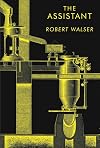
The Assistant
by Robert Walser
On This Page
Description
Joseph, hired to become an inventor's new assistant, arrives one rainy Monday morning at Technical Engineer Karl Tobler's splendid hilltop villa: he is at once pleased and terribly worried, a state soon followed by even stickier psychological complexities. He enjoys the beautiful view over Lake Zurich, in the company of the proud wife, Frau Tobler, and the delicious savory meals. But does he deserve any of these pleasures?Tags
Recommendations

































Member Recommendations
Member Reviews
Der Gehülfe, written in Berlin in 1907, was Walser's second published novel (Geschwister Tanner was the first; in between he wrote another that was never published, apparently a fantasy set in Asia). It's his most conventional work of fiction, and was relatively popular during his own lifetime.
Apparently very closely autobiographical in its details, it's an account of a radically alienated young man, Josef Marti, who spends a few months working as a live-in secretary/bookkeeper for the inventor Karl Tobler (sadly, none of his inventions is chocolate-related!) at his villa in a small town on the shores of Lake Zürich. Josef has been unemployed and in poverty for some time, and he's sucked in by the seductive middle-class comfort of show more the Tobler family despite seeing very clearly how hollow it all is - Tobler is squandering his inherited capital recklessly on luxuries with an unreasonable confidence in his distinctly lacklustre inventions; he is splashing out hospitality to buy his way into local society, there are serious problems in the Toblers' marriage and their relationship with their children; the beautiful house and garden are shoddily built, etc., etc. Even the countryside into which Josef escapes for his Sunday walks is seen to be an illusion compared to the hard reality of the big city...
Interesting, especially since it turns out to be much more Swiss in its language and references than you might have guessed, and it has some very beautiful - and very funny - passages, but I tend to agree with all the people who say that it feels like a wildly original book that falls short of what it could have been through being shoehorned into a traditional format - in that sense it reminded me rather of Virginia Woolf's The Voyage Out. Of course, that's because we all read the later Jakob von Gunten first... show less
Apparently very closely autobiographical in its details, it's an account of a radically alienated young man, Josef Marti, who spends a few months working as a live-in secretary/bookkeeper for the inventor Karl Tobler (sadly, none of his inventions is chocolate-related!) at his villa in a small town on the shores of Lake Zürich. Josef has been unemployed and in poverty for some time, and he's sucked in by the seductive middle-class comfort of show more the Tobler family despite seeing very clearly how hollow it all is - Tobler is squandering his inherited capital recklessly on luxuries with an unreasonable confidence in his distinctly lacklustre inventions; he is splashing out hospitality to buy his way into local society, there are serious problems in the Toblers' marriage and their relationship with their children; the beautiful house and garden are shoddily built, etc., etc. Even the countryside into which Josef escapes for his Sunday walks is seen to be an illusion compared to the hard reality of the big city...
Interesting, especially since it turns out to be much more Swiss in its language and references than you might have guessed, and it has some very beautiful - and very funny - passages, but I tend to agree with all the people who say that it feels like a wildly original book that falls short of what it could have been through being shoehorned into a traditional format - in that sense it reminded me rather of Virginia Woolf's The Voyage Out. Of course, that's because we all read the later Jakob von Gunten first... show less
"Incidentally, I still owe you money, don't I, and I'm almost glad of this. Exterior ties can preserve the life of inner bonds."
This book made me smile almost throughout. The humor in it is so soft and enjoyable, it doesn't take you hostage. It's like a light breeze. The inner and outer dialogues of Joseph Marti, the main character, reflects the little noodle in the human cavity that vacillates constantly between being content/dutiful/grateful/polite and being indignant/rebellious/proud/angry. The book essentially has no plot except for these tiny changes in mood, like the changes in weather, but oh is it well written, with such joy and lightness and humor. I love Robert Walser more with every passing book.
"Mercantile coups are, as a show more rule, most successful when they are initiated telephonically." show less
This book made me smile almost throughout. The humor in it is so soft and enjoyable, it doesn't take you hostage. It's like a light breeze. The inner and outer dialogues of Joseph Marti, the main character, reflects the little noodle in the human cavity that vacillates constantly between being content/dutiful/grateful/polite and being indignant/rebellious/proud/angry. The book essentially has no plot except for these tiny changes in mood, like the changes in weather, but oh is it well written, with such joy and lightness and humor. I love Robert Walser more with every passing book.
"Mercantile coups are, as a show more rule, most successful when they are initiated telephonically." show less
This is a stupendous and unusual character portrait, marred by a cliché plot of financial downfall.
I agree with Brian Verigan's review, especially the idea that "Walser's hero is... a nobody with drastically limited prospects. He not only knows that and has accepted it, he embraces it." But it bears saying that the reason the apprentice's prospects are limited is that he's a little simple-minded, and he realizes that, partially and intermittently, throughout the novel. It's a difficult trick for a novelist: a slightly limited, partly unintelligent narrator can result in a schematic novel, in which we are more amused and detached than immersed and engaged. That happens, for examples, in "The Curious Incident of the Dog in the show more Night-Time," which at times becomes a literary trick or puzzle. But in this book, the narrator also has an enormous capacity to understand people, an inherent kindness, and a joy in his natural surroundings. It's true that each of those capacities is limited: he loves his employer somewhat helplessly, even though he sees some of his employer's flaws; he is kind, but his kindnesses are often ineffectual; and he loves nature, but in a completely unreflective way. And he is aware, sometimes, of each of these traits in himself. He loves to eat and sleep, and take walks in the countryside: those are his certainties. He is also deeply concerned with injustices and social infelicities: those are his ongoing interests. The rest is all a cloud: he knows he has no ambition, but he never succeeds in thinking very much about that; and he knows that he probably has very little cleverness, but he doesn't have the energy to keep his mind on that problem long enough to do anything about it. It's a lovely psychological portrait of a partly simple person who is also deeply reflective.
But the book is flawed. The tremendous psychological portrait of a person who has some kinds of intelligence, and not others -- a portrait that puts so many other such attempts to shame -- is partly ruined by a distracting plot about the plunging finances of the apprentice's boss. We're compelled to worry about the household finances, and the increasingly angry creditors. The plot resembles an old Hollywood movie or fin-de-siecle pulp fiction, with its stock figures of drunkards, bank managers, and suspicious townspeople. Through all of that, Walser continues to develop the remarkable character of the assistant, as if the machinery of financial ruin were somehow necessary to bring out the assistant's character. But it isn't. The novel would have been purer, more convincing, if Walser had the confidence to concentrate on the nature of the assistant. After all, he has a quiet, unchanging nature, so why have an off-the-shelf narrative of ruination blaring away in the background? show less
I agree with Brian Verigan's review, especially the idea that "Walser's hero is... a nobody with drastically limited prospects. He not only knows that and has accepted it, he embraces it." But it bears saying that the reason the apprentice's prospects are limited is that he's a little simple-minded, and he realizes that, partially and intermittently, throughout the novel. It's a difficult trick for a novelist: a slightly limited, partly unintelligent narrator can result in a schematic novel, in which we are more amused and detached than immersed and engaged. That happens, for examples, in "The Curious Incident of the Dog in the show more Night-Time," which at times becomes a literary trick or puzzle. But in this book, the narrator also has an enormous capacity to understand people, an inherent kindness, and a joy in his natural surroundings. It's true that each of those capacities is limited: he loves his employer somewhat helplessly, even though he sees some of his employer's flaws; he is kind, but his kindnesses are often ineffectual; and he loves nature, but in a completely unreflective way. And he is aware, sometimes, of each of these traits in himself. He loves to eat and sleep, and take walks in the countryside: those are his certainties. He is also deeply concerned with injustices and social infelicities: those are his ongoing interests. The rest is all a cloud: he knows he has no ambition, but he never succeeds in thinking very much about that; and he knows that he probably has very little cleverness, but he doesn't have the energy to keep his mind on that problem long enough to do anything about it. It's a lovely psychological portrait of a partly simple person who is also deeply reflective.
But the book is flawed. The tremendous psychological portrait of a person who has some kinds of intelligence, and not others -- a portrait that puts so many other such attempts to shame -- is partly ruined by a distracting plot about the plunging finances of the apprentice's boss. We're compelled to worry about the household finances, and the increasingly angry creditors. The plot resembles an old Hollywood movie or fin-de-siecle pulp fiction, with its stock figures of drunkards, bank managers, and suspicious townspeople. Through all of that, Walser continues to develop the remarkable character of the assistant, as if the machinery of financial ruin were somehow necessary to bring out the assistant's character. But it isn't. The novel would have been purer, more convincing, if Walser had the confidence to concentrate on the nature of the assistant. After all, he has a quiet, unchanging nature, so why have an off-the-shelf narrative of ruination blaring away in the background? show less
Preface: I'm going through old Goodreads reviews of mine, fixing coding errors from when I imported them to this new account. This was the first Walser's I read, and I really, really need to re-read it soon; for those new to Walser, this is not the title to begin with: I would highly recommend Jakob von Gunten instead, followed by The Walk—those links will talk you to my reviews of those respective novels by this master.
Some time in 2012...
I feel like Walser and I are off to a bit of a rocky start. What interests me most about The Assistant and Walser's approach to the main character, Joseph, are precisely the problems I found with the novel. When Walser is writing an incisive and bleak psychological portrait of a borderline show more sociopath, his prose is stunning and his observations often poignant; however, Walser mixes his psychological portraiture with an iterative and boring bourgeois narrative that places Joseph in a classed subject position repeatedly, ad nauseam.
Perhaps The Assistant might have worked better as a short story or novella—these repetitions become cumbersome and detract from Walser's more intriguing character study. I often felt, too, that Walser wants us as readers to be far removed from the characters: the way that he's able to create such a phenomenal narrative distancing is truly astounding here, but with the repetition and cumbersome, often cliched plotting, the distancing causes more rupture than interest, creates more of a rift between the reader and the book itself than the reader and the characters.
I do look forward to reading more Walser, but I suspect it will be some time before I feel ready to tackle another of his books. show less
Some time in 2012...
I feel like Walser and I are off to a bit of a rocky start. What interests me most about The Assistant and Walser's approach to the main character, Joseph, are precisely the problems I found with the novel. When Walser is writing an incisive and bleak psychological portrait of a borderline show more sociopath, his prose is stunning and his observations often poignant; however, Walser mixes his psychological portraiture with an iterative and boring bourgeois narrative that places Joseph in a classed subject position repeatedly, ad nauseam.
Perhaps The Assistant might have worked better as a short story or novella—these repetitions become cumbersome and detract from Walser's more intriguing character study. I often felt, too, that Walser wants us as readers to be far removed from the characters: the way that he's able to create such a phenomenal narrative distancing is truly astounding here, but with the repetition and cumbersome, often cliched plotting, the distancing causes more rupture than interest, creates more of a rift between the reader and the book itself than the reader and the characters.
I do look forward to reading more Walser, but I suspect it will be some time before I feel ready to tackle another of his books. show less
It is supposed to be a very boring book indeed; a book where nothing exciting happens; a book about disintegration of a house on a socio-historical background of Swiss countryside a hundred years ago. I was prepared to read it in small portions months on end. But the language is beautiful (as everyone keeps saying in all reviews), and it does suck you in; the uncanny Swiss words, the impossible syntax - the language does make you uneasy, expectant, interested. Here is a sample: "Der Ernst der männlichen Weltanschauung lag in einem fallen gelassenen und zerbrochenen und seinen Inhalt ausgeschütteten Glas Wein am Boden."
I had to put matches between my eyelids though, to read the poetic descriptions of the nature, which should probably show more rank among the finest prosa sections of the book, so poetic they are. They make up may be 5% of the book (how I like to shove a figure into this text), but are tortuously repetitious with painful seasonal regularity. show less
I had to put matches between my eyelids though, to read the poetic descriptions of the nature, which should probably show more rank among the finest prosa sections of the book, so poetic they are. They make up may be 5% of the book (how I like to shove a figure into this text), but are tortuously repetitious with painful seasonal regularity. show less
If you have read everything else of Walser's that has been translated into English, this book will not add much to your understanding of the author. At its best, for a few paragraphs at a time, it sustains the light touch and playfulness of his short stories. But the rest of the time, it reworks the idea of an impotent servant framed by the decay of the institution that sustains him--something familiar to "Jakob von Gunten" fans. "The Assistant", however, lacks the engaging interactions between underlings that set "Jakob von Gunten" apart. The characters in this novel, once set in motion, seem to plod towards their obvious fate all too mechanically.
You definitely do not read Walser for plot and while this is longer than anything else he show more wrote, it is no exception. Fans enjoy being situated beneath and alongside the characters who would ordinarily be the protagonists; but the less patient will tire of the disengaged, dawdling uselessness of the lead. show less
You definitely do not read Walser for plot and while this is longer than anything else he show more wrote, it is no exception. Fans enjoy being situated beneath and alongside the characters who would ordinarily be the protagonists; but the less patient will tire of the disengaged, dawdling uselessness of the lead. show less
There are the classic Walserian descriptions of nature, awkward social interactions, and a main character whose drive and ambition fluctuate in relation to the amount of daydreaming that occurs on any given day. Still, as a character, Joseph Marti was not quite as developed as I was hoping for him to be. There is also less humor in the book than in either The Tanners or Jakob von Gunten. Still, it's Walser and I like everything he wrote, at least to some degree. This one just not as much as others.
P.S. This is a terrible review. I'm sorry, Robert...you deserve better.
P.S. This is a terrible review. I'm sorry, Robert...you deserve better.
Members
- Recently Added By
Published Reviews
Although Walser satirizes this quintessential predicament of the bourgeoisie, there is a delicacy to his activity. One gathers that the author’s reproof against the foibles of keeping up appearances is offset by his awareness that a reprieve from struggle is merely that.
added by paradoxosalpha
Lists

German Literature
518 works; 55 members

Canon de la narrativa universal del s. XX (cicutadry)
499 works; 3 members
Author Information

274+ Works 6,984 Members
Some Editions
Awards and Honors
Series
Belongs to Publisher Series
Work Relationships
Is contained in
Has as a commentary on the text
Has as a student's study guide
Common Knowledge
- Canonical title
- The Assistant
- Original title
- Der Gehülfe
- Original publication date
- 1908
- People/Characters
- Joseph Marti; Carl Tobler
- First words
- One morning at eight o'clock a young man stood at the door of a solitary, and it appeared, attractive house.
- Original language*
- Alemany
- Disambiguation notice
- 3518376101 1985 softcover German suhrkamp taschenbuch 1110 Sämtliche Werke in zwanzig Bänden Zehnter Band
*Some information comes from Common Knowledge in other languages. Click "Edit" for more information.
Classifications
- Genres
- General Fiction, Fiction and Literature
- DDC/MDS
- 833.912 — Literature & rhetoric German & related literatures German fiction 1900- 1900-1990 1900-1945
- LCC
- PT2647 .A64 .G3613 — Language and Literature German, Dutch and Scandinavian literatures German literature Individual authors or works 1860/70-1960
- BISAC
Statistics
- Members
- 577
- Popularity
- 50,851
- Reviews
- 15
- Rating
- (4.07)
- Languages
- 16 — Catalan, Czech, Dutch, English, Estonian, Finnish, French, German, Hebrew, Italian, Japanese, Norwegian (Bokmål), Portuguese, Slovenian, Spanish, Turkish
- Media
- Paper, Audiobook, Ebook
- ISBNs
- 39
- ASINs
- 15