
Claudio Magris
Author of Danube
About the Author
Image credit: Photo credit: Mariusz Kubik, Warsaw, March 9, 2005
Works by Claudio Magris
El Yardımıyla 2 copies
L'anarchico al bivio: intellettuale e politica nel teatro di Dorst — Author — 2 copies
Austria — Composer — 2 copies
Körlemesine 1 copy
Không tưởng và thức tỉnh 1 copy
Livelli di guardia 1 copy
LA EXPOSICIÓN 1 copy
Die Ausstellung. 1 copy
Dura un attimo il giorno 1 copy
Zakrivljeno vreme u Kremsu 1 copy
Mondo, Romanzo 1 copy
Non luogo a procedere - 2 1 copy
Magris Claudio 1 copy
Austria: la fine e dopo 1 copy
UDHËTIM PA MBARIM 1 copy
Associated Works
The Druggist of Auschwitz: A Documentary Novel (2011) — Preface, some editions — 145 copies, 9 reviews
La contessina Mizzi, ovvero Un giorno in famiglia: commedia in un atto (1899) — Translator, some editions — 6 copies
Tagged
Common Knowledge
- Legal name
- Magris, Claudio
- Birthdate
- 1939-04-10
- Gender
- male
- Education
- University of Turin
- Occupations
- scholar of modern German literature
politician
translator
writer
university professor - Organizations
- Italian Senate
University of Trieste - Awards and honors
- Premio Príncipe de Asturias ( [2004])
Austrian State Prize for European Literature (2005)
Friedenspreis des Deutschen Buchhandels ( [2009])
Vilenica International Literary Prize (2009)
Franz Kafka Prize (2016) - Nationality
- Italy
- Birthplace
- Trieste, Italy
- Places of residence
- Trieste, Italy
- Associated Place (for map)
- Trieste, Italy
Members
Reviews

Ci sono libri che ti guardano per anni dagli scaffali della libreria, di cui senti parlare, ai quali altri scrittori fanno riferimento, tu li guardi, con un misto di diffidenza e senso di inferiorità, e li lasci lì, finché una notte non riesci a dormire, e quasi per caso te li ritrovi in mano.
Questa è la storia della relazione tra me e il capolavoro di Magris.
Pensavo che fosse un libro di viaggio, e infatti lo è, ma il Danubio, il suo stravagante e infinito percorso tra una sorgente show more assimilabile a un rubinetto e una foce che è un canale in un porto, sono il pretesto per un viaggio attraverso l'Europa, la sua storia e la sua letteratura, i suoi popoli e le sue contraddizioni.
Davvero un monumento, nonostante per molti versi la storia l'abbia superato, a causa della caduta del muro di Berlino e di tutta la frana che quella caduta ha provocato.
Ma resta la certezza che che acque del Danubio siano più potenti della piccola storia degli uomini, a meno che qualcuno non chiuda il rubinetto ... show less
Questa è la storia della relazione tra me e il capolavoro di Magris.
Pensavo che fosse un libro di viaggio, e infatti lo è, ma il Danubio, il suo stravagante e infinito percorso tra una sorgente show more assimilabile a un rubinetto e una foce che è un canale in un porto, sono il pretesto per un viaggio attraverso l'Europa, la sua storia e la sua letteratura, i suoi popoli e le sue contraddizioni.
Davvero un monumento, nonostante per molti versi la storia l'abbia superato, a causa della caduta del muro di Berlino e di tutta la frana che quella caduta ha provocato.
Ma resta la certezza che che acque del Danubio siano più potenti della piccola storia degli uomini, a meno che qualcuno non chiuda il rubinetto ... show less

Magris travels from the source(s) of the Danube in Bavaria to its mouth(s) in the Black Sea, and we get some entertaining reflections on what he sees along the way, but this isn’t so much a conventional travel book as a crash course in Central European literatures and cultures. For a lot of the time, he is seeing the world less through his own eyes than through those of the writers who have lived there and written about those places. Not just the big names, the Kafkas, Musils and Canettis, show more but also a lot of more obscure writers whom you’re unlikely to know about unless you have a special interest in a given area. He tells us about them in charming, witty style, so that we take in the information without it ever quite coming across like a lecture course.
The book is also fun, of course, because without quite realising it, Magris was capturing a snapshot of an epoch in Central European history that was just about to end: he was travelling in the very last years of the Iron Curtain. He often stops to reflect on the political realities of the places he is travelling through, and on the recent history that has made them what they are, but this isn’t really a political book. If you want to read in detail about the horrors of Ceaușescu‘s Romania or post-1968 Czechoslovakia, you will need to look elsewhere. Magris is recording them as countries in which writers are constrained but can still find interesting things to say. show less
The book is also fun, of course, because without quite realising it, Magris was capturing a snapshot of an epoch in Central European history that was just about to end: he was travelling in the very last years of the Iron Curtain. He often stops to reflect on the political realities of the places he is travelling through, and on the recent history that has made them what they are, but this isn’t really a political book. If you want to read in detail about the horrors of Ceaușescu‘s Romania or post-1968 Czechoslovakia, you will need to look elsewhere. Magris is recording them as countries in which writers are constrained but can still find interesting things to say. show less
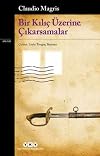
Çağdaş Avrupa edebiyatının yaşayan en büyük isimlerinden Claudio Magris’ten gerçek ile kurmacanın sınırlarının muğlaklaştığı ve hakikatin sözcüklerle inşa edildiği bir anlatı.
Bir Kılıç Üzerine Çıkarsamalar, Nazilerin partizanlara karşı savaşmaları şartıyla İtalya’nın kuzeydoğusunda bağımsız bir yurt vaat ettiği Don Kazaklarının gizemli generali Krasnov’un ölümünü araştıran bir İtalyan rahibin tarih, hafıza, yaşamöyküsü show more üzerinden gerçeklikle kurduğu felsefi ilişkinin romanı.
Magris edebiyat ile hayatın ortak sorusuna en iyi şekilde karşılık veriyor: Bir kişi veya olay hakkında nasıl emin olabiliriz? show less
Bir Kılıç Üzerine Çıkarsamalar, Nazilerin partizanlara karşı savaşmaları şartıyla İtalya’nın kuzeydoğusunda bağımsız bir yurt vaat ettiği Don Kazaklarının gizemli generali Krasnov’un ölümünü araştıran bir İtalyan rahibin tarih, hafıza, yaşamöyküsü show more üzerinden gerçeklikle kurduğu felsefi ilişkinin romanı.
Magris edebiyat ile hayatın ortak sorusuna en iyi şekilde karşılık veriyor: Bir kişi veya olay hakkında nasıl emin olabiliriz? show less

There are certain books that are sui generis and this is one of those books. In part, it reminded me of the cultural stories that the first historian, Herodotus, included in his original work , The Histories, that provides the foundation for the idea of written history. While he focuses on the mind of men who have lived and ruled and dreamed on and about the Danube, ultimately Magris's work is different and as a result unique in its aspect. Danube is both a catalog of histories and myths show more about a place over time. The place is a river that begins in a geographic region but also begins in a time and continues to exist through generations of changes to this day.
Included in the journey down the Danube through history are stories of people and places and times; stories that are both historical and fictional, mythical and real. These stories complement a travelogue that highlights places and times and people and more. Most interesting and important for this reader were the stories of literature that derives from the residents and the being of the river. The names are familiar and include: Kafka, Freud, Wittgenstein, Marcus Aurelius, Musil, Ovid, Celine, Von Rezzori, and others, some of whom I encountered for the first time in this work.
The book begins with a discussion of the sources of the Danube -- sources of the river which "were the object of investigations, conjectures or information of Herodotus, Strabo, Caesar, Pliny, Ptolemy, the Pseudo-Scymnus, Seneca, Mela and Eratosthenes." These sources and the river that they feed have been the subject of history, politics, philosophy, mythology, and geography for millennia during which the Roman and the Holy Roman Empires rose and fell along with subsequent cities and countries into the twentieth century.
Early in the book the Danube is described as "a sinuous master of irony, of that irony which created the greatness of Central European culture," and as such it is the central conduit of Mitteleuropa and all that it implies. The river encompasses many great cities such as Ulm "of the old Germany of the Holy Roman Empire", yet also the birthplace of Albert Einstein. And of course there is Vienna which is in some ways at the center of the Danube journey if for no other reason than its cultural impact that extends to the new world and to this day, decades after the documentation of the journey of the Danube.
Another highlight on the journey is Passau where we are reminded of the literature and art inspired by the Danube. The author narrates the story of Siegfried from the Song of the Niebelungs ( a story also found in the Nordic saga the Edda) and shares the love and loyalty that is rendered there. Yet it is also a region that inspired the twentieth-century literature of Kafka. The juxtaposition of Kafka with the ancient legends leads to an even stranger one when moving on to Linz one finds the journey progressing (regressing?) through a city that Hitler once planned to recreate into a "refuge of his old age, the place he yearned to retire to after consolidating the Reich that was to last a thousand years". Yet, fortunately for lovers of literature Linz was also the home of the novelist Adalbert Stifter who, even if you have not heard of him (and I had not), was capable of prose comparable to that of Flaubert's Education Sentimentale. It is this same river that also inspired works by Musil and Svevo. It is this literature that inspires Magris to comment as follows:
"Men without qualities, those landlocked armchair explorers, have their contraceptives always in their pockets, and Mitteleuropean culture taken as a whole is also a large-scale process of intellectual contraception. Whereas on the epic sea is Aphrodite born, and there--as Conrad writes -- we conquer forgiveness for our sins and the salvation of our immortal souls; we remember that once we were gods."(p 137)
The stories of the Danube continue to abound in this epic work. Included are the names like Hegel and Canetti and Roth; the historical figures like Eichmann and Princess Elisabeth and Vlad the Impaler; the music of Schubert and Mozart and Strauss. All are epitomized for this reader by Schubert's Wanderer Fantasy and Strauss's Blue Danube Waltz. Even the geography of the river itself begins and ends in myth.
There is more and it flows from the richness, the depth, and the historical grandeur of this book. It is one whose deepness reaches realms that make the challenge of reading it (it is not an "easy read") worthwhile. Finally it is one of the most erudite and intelligent books I have read and that makes it also one of the most enjoyable and interesting. show less
Included in the journey down the Danube through history are stories of people and places and times; stories that are both historical and fictional, mythical and real. These stories complement a travelogue that highlights places and times and people and more. Most interesting and important for this reader were the stories of literature that derives from the residents and the being of the river. The names are familiar and include: Kafka, Freud, Wittgenstein, Marcus Aurelius, Musil, Ovid, Celine, Von Rezzori, and others, some of whom I encountered for the first time in this work.
The book begins with a discussion of the sources of the Danube -- sources of the river which "were the object of investigations, conjectures or information of Herodotus, Strabo, Caesar, Pliny, Ptolemy, the Pseudo-Scymnus, Seneca, Mela and Eratosthenes." These sources and the river that they feed have been the subject of history, politics, philosophy, mythology, and geography for millennia during which the Roman and the Holy Roman Empires rose and fell along with subsequent cities and countries into the twentieth century.
Early in the book the Danube is described as "a sinuous master of irony, of that irony which created the greatness of Central European culture," and as such it is the central conduit of Mitteleuropa and all that it implies. The river encompasses many great cities such as Ulm "of the old Germany of the Holy Roman Empire", yet also the birthplace of Albert Einstein. And of course there is Vienna which is in some ways at the center of the Danube journey if for no other reason than its cultural impact that extends to the new world and to this day, decades after the documentation of the journey of the Danube.
Another highlight on the journey is Passau where we are reminded of the literature and art inspired by the Danube. The author narrates the story of Siegfried from the Song of the Niebelungs ( a story also found in the Nordic saga the Edda) and shares the love and loyalty that is rendered there. Yet it is also a region that inspired the twentieth-century literature of Kafka. The juxtaposition of Kafka with the ancient legends leads to an even stranger one when moving on to Linz one finds the journey progressing (regressing?) through a city that Hitler once planned to recreate into a "refuge of his old age, the place he yearned to retire to after consolidating the Reich that was to last a thousand years". Yet, fortunately for lovers of literature Linz was also the home of the novelist Adalbert Stifter who, even if you have not heard of him (and I had not), was capable of prose comparable to that of Flaubert's Education Sentimentale. It is this same river that also inspired works by Musil and Svevo. It is this literature that inspires Magris to comment as follows:
"Men without qualities, those landlocked armchair explorers, have their contraceptives always in their pockets, and Mitteleuropean culture taken as a whole is also a large-scale process of intellectual contraception. Whereas on the epic sea is Aphrodite born, and there--as Conrad writes -- we conquer forgiveness for our sins and the salvation of our immortal souls; we remember that once we were gods."(p 137)
The stories of the Danube continue to abound in this epic work. Included are the names like Hegel and Canetti and Roth; the historical figures like Eichmann and Princess Elisabeth and Vlad the Impaler; the music of Schubert and Mozart and Strauss. All are epitomized for this reader by Schubert's Wanderer Fantasy and Strauss's Blue Danube Waltz. Even the geography of the river itself begins and ends in myth.
There is more and it flows from the richness, the depth, and the historical grandeur of this book. It is one whose deepness reaches realms that make the challenge of reading it (it is not an "easy read") worthwhile. Finally it is one of the most erudite and intelligent books I have read and that makes it also one of the most enjoyable and interesting. show less
Lists
Awards


You May Also Like


Associated Authors
Statistics
- Works
- 87
- Also by
- 20
- Members
- 3,438
- Popularity
- #7,396
- Rating
- 4.0
- Reviews
- 70
- ISBNs
- 373
- Languages
- 22
- Favorited
- 10
