On This Page
Description
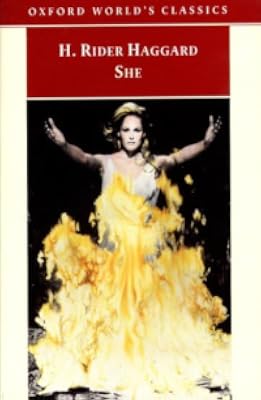
This classic work of fantasy begins with scholar Ludwig Horace Holly being visited by an old friend who is ailing. The friend passes the guardianship of his 5-year-old son on to Holly. Fast forward twenty-five years: the hapless orphan is now a handsome and capable young man (Leo) whose past holds a series of remarkable secrets. Holly and Leo travel to Africa to unravel Leo's family secrets and encounter a seemingly immortal tribal leader, Ayesha, whose power and influence are virtually show more impossible to overcome. show lessTags
Recommendations



















Member Recommendations


Member Reviews
"Time Hath No Power Against Identity"
Such a rare and joyful pleasure when a 'classic' proves equal to its reputation. At once a rollicking adventure tale and a rumination on the folly of vanity (both personal and cultural), She was an engaging read throughout. Haggard's prose remain effective 140 years later and the narrative brings the same thrills (and chills, make no mistake) that it must have done a century and a half ago.
The effect of this work on the burgeoning field of imaginative/speculative fiction was profound and numerous strains of its influence can be seen today in stories of fantasy, horror, and imagination.
Such a rare and joyful pleasure when a 'classic' proves equal to its reputation. At once a rollicking adventure tale and a rumination on the folly of vanity (both personal and cultural), She was an engaging read throughout. Haggard's prose remain effective 140 years later and the narrative brings the same thrills (and chills, make no mistake) that it must have done a century and a half ago.
The effect of this work on the burgeoning field of imaginative/speculative fiction was profound and numerous strains of its influence can be seen today in stories of fantasy, horror, and imagination.
She by H. Rider Haggard is an adventure novel that was originally published in 1887 after being previously serialized in a magazine. This fantasy adventure is the story of Cambridge professor Horace Holly and his ward Leo Vincey and their journey to a lost kingdom in the African interior. While the story is very unbelievable, I enjoyed being reminded of how I felt as a child when I would watch old Tarzan movies on “Jungle Theatre”.
This story about a two thousand year old sorceress, “She-Who-Must-Be-Obeyed” and her tribe of cannibals is sheer balderdash but there were touches of misogynistic attitudes, a great deal of racism, and definite colonial attitudes that gives the reader a good look at the mindset of imperialist show more Victorians in the 1880s. Although the story is dated, it is a fact that this book was a trailblazer of original adventure stories, and is well remembered and at times copied even today. show less
This story about a two thousand year old sorceress, “She-Who-Must-Be-Obeyed” and her tribe of cannibals is sheer balderdash but there were touches of misogynistic attitudes, a great deal of racism, and definite colonial attitudes that gives the reader a good look at the mindset of imperialist show more Victorians in the 1880s. Although the story is dated, it is a fact that this book was a trailblazer of original adventure stories, and is well remembered and at times copied even today. show less
An interesting book indeed. This book, along with King Solomon's Mines, established the universe in which seemingly every subsequent adventure story would be set. Everything you need is here, the Victorian era, lost civilizations, gentlemen explorers, and mysteries that time should have forgotten. The climatic ending of the novel involves a harrowing underground adventure that would make for a good summer blockbuster. Every time you see Indiana Jones or Lara Croft leap across a bottomless pit, know that this is the source.
One hundred and twenty-five years on, style can be a potential roadblock. Like many popular Victorian novelists, Haggard can be damned slow sometimes. Stop apologizing that your pen is inadequate to describe the show more indescribable and get on with it! The book is not near as bad as Sir Walter Scott can be, since Haggard wrote after the invention of photography; he had no need to describe things in exhaustive detail for people who had never been more than 50 miles from home. The thing to know is you can just skip or skim parts that seem slow, and that will keep your interest up without harming the narrative.
However, for all that thick prose, you can see a different world through Haggard's works. Some of the things I enjoy about Victorian adventure novels are the places one can visit in the imagination, and the shift in perspective to see the world as the Victorians did. Here we have a work of popular literature with large sections of Greek and Latin, implying both the author had the capacity to compose it, and at least some of the readers to understand it. When our gentlemen adventurers meet the titular She, a great deal of time is spent in philosophical discourse. Since Ayesha has been roughing it for 2500 years, she is in dire need of intellectual stimulation. How different this feels than Robert E. Howard!
The lost civilization is located 10 days journey from the coast between Delagoa [Maputo] Bay and the Zambesi river, inside the rift valley volcanoes therein. Rift valleys always make for dramatic landscapes. Also, the history of Arab trade on the east coast of Africa becomes important to the story. I never knew there was a distinction between original Arabs, al-'Arab al-'Ariba, and the descendants of Ishmael, al-'Arab al-mostareba.
The dramatic action of the book is most moral. There are harrowing escapes and acts of derring-do, but the true conflict arises from the irresistible attraction our gentlemen explorers feel towards She. She is a creature of supernatural beauty and wisdom, but one who still shares the weaknesses of human nature. Both men love her, almost against their will. I say almost, because they are of divided minds. She is a wicked creature, but they are so smitten with her that they excuse her wrongs even against themselves. They know this, but cannot resist her charms. It is the characteristic sin of males, writ large upon a fantastic backdrop. How many powerful men have been ruined by a pretty face?
Ayesha herself is remarkably flawed. She has been given unnaturally long life and superior powers of reasoning, but her conscience has not grown to match. Like a Greek goddess, she is powerful, yet strangely petty. She can have anything she wants, the problem is what she wants. The wicked acts she commits are indeed small, the problem is that she has no sense of the responsibilities that go with great power, and that great things are expected of those who have been given much.
While I do like Haggard's work, I would be interested to see this same idea in another author's hands, Tim Powers for example. The cause of this whole expedition was Ayesha's murder of the remote ancestor of one of our gentlemen heroes. This remarkable man refused to abandon his wife for Ayesha in her glorified state, and in a rage she slew him. Twenty-three centuries later, his ancestor simply acquiesces. He is literally powerless against Ayesha. Why was his ancestor made of sterner stuff? There is a mystery here that goes unexplored.
While Robert E. Howard may not have philosophical discourses between his characters, Solomon Kane at least would find the grace to resist She. show less
One hundred and twenty-five years on, style can be a potential roadblock. Like many popular Victorian novelists, Haggard can be damned slow sometimes. Stop apologizing that your pen is inadequate to describe the show more indescribable and get on with it! The book is not near as bad as Sir Walter Scott can be, since Haggard wrote after the invention of photography; he had no need to describe things in exhaustive detail for people who had never been more than 50 miles from home. The thing to know is you can just skip or skim parts that seem slow, and that will keep your interest up without harming the narrative.
However, for all that thick prose, you can see a different world through Haggard's works. Some of the things I enjoy about Victorian adventure novels are the places one can visit in the imagination, and the shift in perspective to see the world as the Victorians did. Here we have a work of popular literature with large sections of Greek and Latin, implying both the author had the capacity to compose it, and at least some of the readers to understand it. When our gentlemen adventurers meet the titular She, a great deal of time is spent in philosophical discourse. Since Ayesha has been roughing it for 2500 years, she is in dire need of intellectual stimulation. How different this feels than Robert E. Howard!
The lost civilization is located 10 days journey from the coast between Delagoa [Maputo] Bay and the Zambesi river, inside the rift valley volcanoes therein. Rift valleys always make for dramatic landscapes. Also, the history of Arab trade on the east coast of Africa becomes important to the story. I never knew there was a distinction between original Arabs, al-'Arab al-'Ariba, and the descendants of Ishmael, al-'Arab al-mostareba.
The dramatic action of the book is most moral. There are harrowing escapes and acts of derring-do, but the true conflict arises from the irresistible attraction our gentlemen explorers feel towards She. She is a creature of supernatural beauty and wisdom, but one who still shares the weaknesses of human nature. Both men love her, almost against their will. I say almost, because they are of divided minds. She is a wicked creature, but they are so smitten with her that they excuse her wrongs even against themselves. They know this, but cannot resist her charms. It is the characteristic sin of males, writ large upon a fantastic backdrop. How many powerful men have been ruined by a pretty face?
Ayesha herself is remarkably flawed. She has been given unnaturally long life and superior powers of reasoning, but her conscience has not grown to match. Like a Greek goddess, she is powerful, yet strangely petty. She can have anything she wants, the problem is what she wants. The wicked acts she commits are indeed small, the problem is that she has no sense of the responsibilities that go with great power, and that great things are expected of those who have been given much.
While I do like Haggard's work, I would be interested to see this same idea in another author's hands, Tim Powers for example. The cause of this whole expedition was Ayesha's murder of the remote ancestor of one of our gentlemen heroes. This remarkable man refused to abandon his wife for Ayesha in her glorified state, and in a rage she slew him. Twenty-three centuries later, his ancestor simply acquiesces. He is literally powerless against Ayesha. Why was his ancestor made of sterner stuff? There is a mystery here that goes unexplored.
While Robert E. Howard may not have philosophical discourses between his characters, Solomon Kane at least would find the grace to resist She. show less
This novel won me over, but it's not reflected in my initial impression: a quaint 19th century image of Africa as the European adventurer's romantic playground, abounding with MacGuffins to be discovered. The MacGuffin of choice for this outing is a seemingly immortal woman's kingdom, lying somewhere inland from the coast of Zanzibar (now Tanzania) where the swamps are naturally thickest. While there's a long-lasting family grudge to be motivated by, our heroes seem driven mostly by the thought of wandering into the unknown just to see what happens. Solid pacing and detailed narrative are the primary selling features as the Brits tough it out with stiff upper lips, struggling through deadly swamp gases, cannibals and other hazards like show more men's men. Haggard perilously stakes everything on successfully introducing She to the stage, a build-up that lasts to the halfway point.
Surprisingly, She delivers real tension into the story. She has power and presence, her affect on the adventurers is overwhelming, and a sequence of revelations and key plot points are well orchestrated. Aeysha is like Galadriel from Lord of the Rings, but amoral and somewhat maddened by a lost love. Stiff upper lips mean nothing to her, and she rules the story like she rules her kingdom. It only partly ends like I expected, in a way that I doubt would play well if directly translated to a Hollywood screen (I haven't seen any versions) but it has real impact in novel form. It's what it says on the can, a solid adventure story, and it's only somewhat saddled by 19th century style, language and views. I hear at least some of the sequels are also worthwhile. show less
Surprisingly, She delivers real tension into the story. She has power and presence, her affect on the adventurers is overwhelming, and a sequence of revelations and key plot points are well orchestrated. Aeysha is like Galadriel from Lord of the Rings, but amoral and somewhat maddened by a lost love. Stiff upper lips mean nothing to her, and she rules the story like she rules her kingdom. It only partly ends like I expected, in a way that I doubt would play well if directly translated to a Hollywood screen (I haven't seen any versions) but it has real impact in novel form. It's what it says on the can, a solid adventure story, and it's only somewhat saddled by 19th century style, language and views. I hear at least some of the sequels are also worthwhile. show less
I have wanted to read She for so long, at first enflamed by the knowledge that one of my favourite writers, J. R. R. Tolkien, loved it and was inspired by show more it, and many years small embers were added to to the pile from various places where the author H. Rider Haggard was touted to be a juggernaut of adventure fiction. Having read She, the praise is well-deserved. Haggard is an excellent writer of adventure, and I was surprised to find that even elements of Gothic mystery and even a pinch of Lovecraftian horror permeated through the text, most stronger in the latter half. Haggard even goes philosophical in certain sections, and these too are rendered with polished prose and deep thoughts—and never once did they feel like asides from the main yarn but a natural part of its unravelling.
“Is there no man that will draw my veil and look upon my face, for it is very fair? Unto him who draws my veil shall I be, and peace will I give him, and sweet children of knowledge and good works.”
And a voice cried, “Through all those who seek after thee desire thee, behold! Virgin art thou, and Virgin shall thou go till Time be done. No man is there born of woman who may draw thy veil and live, nor shall be. By Death only can thy veil be drawn, oh Truth!”
And Truth stretched out her arms and wept, because those who sought her might not find her, nor look upon her face to face.
And in all this, the titular character ‘She’ takes the spotlight with her Ozymandian pride, her Siren-like beauty, her Circean infatuation, and her cynical philosophy (which we never truly excavate). He loves deeply as she hates, her mirth is as deep as her sorrow, and her moods are fickle but at the same time measured. She is an awesome figure in the realm of stories, a terrible and sublime villain, cruel and cunning to those who oppose her, yet warm and friendly to those who find favour with her.
Go and read She and meet She. show less
Fascinating document, but I had high hopes for this book, and it didn't quite live up to them. Much as I love stories about imperious, sexually dominant women, Ayesha just didn't live up to her hype -- she was cold and beautiful, yes, but also irritatingly vapid and coquettish. Hard to root for her. Still, plenty of stuff to mull over here, relating to sex, race, class, etc.
I read “She” to see the inspiration behind Tolkien’s Galadriel and C.S. Lewis’s The White Witch. It’s wild that they are both based on the same character! It’s also super interesting to me that Lewis decided to make his version of Ayesha the actual devil, while Tolkien decided to make his version of Ayesha good to the core.
Ayesha’s title, “She-who-must-be-obeyed,” reminded me of the name for the Harry Potter series villain, Voldemort, referred to as “He-who-must-not-be-named.” And the character Job, in my opinion, was clearly the inspiration for Tolkien to create Samwise Gamgee.
A word of caution, though: only read “She” if you are willing to wade through a foul swamp of racism and misogyny to get to the good show more stuff. This was written in the Victorian Era, and it shows. All of Haggard’s storytelling decisions are affected by his racist and misogynistic beliefs. I knew that going in, so for me, this was more of a research read than a fun read. And while the beginning and middle are pretty riveting plot-wise, towards the end it loses steam and starts to drag unnecessarily. And it has an ending that was a total letdown for me as a reader (but has very interesting implications for how Haggard viewed Ayesha as a powerful woman).
All things considered, it gets 4 stars from me for being an interesting, innovative and one-of-a-kind read. show less
Ayesha’s title, “She-who-must-be-obeyed,” reminded me of the name for the Harry Potter series villain, Voldemort, referred to as “He-who-must-not-be-named.” And the character Job, in my opinion, was clearly the inspiration for Tolkien to create Samwise Gamgee.
A word of caution, though: only read “She” if you are willing to wade through a foul swamp of racism and misogyny to get to the good show more stuff. This was written in the Victorian Era, and it shows. All of Haggard’s storytelling decisions are affected by his racist and misogynistic beliefs. I knew that going in, so for me, this was more of a research read than a fun read. And while the beginning and middle are pretty riveting plot-wise, towards the end it loses steam and starts to drag unnecessarily. And it has an ending that was a total letdown for me as a reader (but has very interesting implications for how Haggard viewed Ayesha as a powerful woman).
All things considered, it gets 4 stars from me for being an interesting, innovative and one-of-a-kind read. show less
Members
- Recently Added By
Lists

The Guardian's 1000 Novels Everyone Must Read
1,005 works; 550 members

1001 Books You Must Read Before You Die
1,448 works; 1,134 members

Read the book and saw the movie
1,170 works; 195 members

Folio Society
831 works; 53 members

Cawthorn and Moorcock's Fantasy: The 100 Best Books
110 works; 7 members

Anti-heroines in fiction
59 works; 9 members

Western World's Greatest Books - Project Gutenberg
295 works; 15 members

Lovecraft's 'Supernatural Horror in Literature' Reading List
216 works; 8 members

Publisher's Weekly Bestsellers Prior to 1895 in Chronological Order
95 works; 6 members

Newark Public Library's 1904 List of a Thousand of the Best Novels
95 works; 5 members

Jones and Newman's Horror: The 100 Best Books
100 works; 4 members
A Novel Cure
742 works; 23 members

Speculative Fiction to Read
706 works; 32 members

Plan to Read Books
75 works; 1 member

Best Horror Mega-List
342 works; 6 members

The League of Extraordinary Gentlemen
87 works; 4 members

The Seven-League Shelf
57 works; 3 members

Books Read in 2021
5,361 works; 114 members

Stories set on African soil
183 works; 2 members
XB-1: Osobnosti zanru doporucuji
67 works; 1 member

Favorite Epistolary Fiction
143 works; 144 members

el
1,139 works; 1 member
Author Information

Sir Henry Rider Haggard (1856-1925) is best remembered for his 34 adventure fantasy novels set in exotic locations. As a child, Haggard, whose father was an English barrister, was considered dim-witted and was inclined to daydreaming. His parents ended his formal education when he was seventeen, and he was sent to work in South Africa, where his show more imagination was inspired by the people, animals, and jungle. He became close friends with authors Rudyard Kipling and Andrew Lang. Haggard's most popular books are King Solomon's Mines (1886) and She (1887). He also wrote short stories, as well as nonfiction on topics such as gardening, English farming, and rural life, interests which led to duties on government commissions concerned with land maintenance. For his literary contributions and his government service, Haggard was knighted in 1912. Several of Haggard's novels have been filmed. She was filmed in 1965, starring Ursula Andress. King Solomon's Mines was filmed with Stewart Granger and Deborah Kerr in 1950, and again with Richard Chamberlain and Sharon Stone in 1985. Also, the novel Allan Quatermain was filmed as Allan Quatermain and the Lost City of Gold with Richard Chamberlain and Sharon Stone in 1986. (Bowker Author Biography) show less
1 Work 3,252 Members

91+ Works 3,438 Members
Some Editions
Awards and Honors
Notable Lists
Series

Belongs to Publisher Series
Henry Rider Haggard (Band 01)
I delfini [Bompiani] (15)
Livro B (29)
Tus libros (35)
La memoria [Sellerio] (342)
Armed Services Edition (881)
Airmont Classics (146)
Work Relationships
Is contained in
Has the adaptation
Inspired
Has as a commentary on the text
Common Knowledge
- Canonical title
- She
- Original title
- She: A History of Adventure
- Alternate titles*
- La donna eterna
- Original publication date
- 1886
- People/Characters
- Ayesha; Ludwig Horace Holly; Leo Vincey
- Important places
- Africa; Kor, Africa
- Related movies
- La colonne de feu (1899 | IMDb); She (1935 | IMDb); She (1965 | IMDb); She (2001 | IMDb)
- Epigraph
- In earth and skie and sea /
Strange thynges ther be. - Dedication
- I inscribe this history to Andrew Lang in token of personal regard and of my sincere admiration for his learning and his works
- First words
- In giving to the world the record of what, looked at as an adventure only, is I suppose one of the most wonderful and mysterious experiences ever undergone by mortal men, I feel it incumbent on me to explain what my exact con... (show all)nection with it is.
The narrator of She, Ludwig Horace Holly, is conspicuous for his lack of family. (Introduction) - Quotations
- She-who-must-be-obeyed
- Last words
- (Click to show. Warning: May contain spoilers.)And when that final development ultimately occurs, as I have no doubt it must and will occur, in obedience to a fate that never swerves and a purpose that cannot be altered, what will be the part played therein by that beautiful Egyptian Amenartas, the Princess of the royal race of the Pharoahs, for the love of whom the Priest Kallikrates broke his vows to Isis, and pursued by the inexorable vengeance of the outraged Goddess, fled down the coast of Libya to meet his doom at Kor?
(Click to show. Warning: May contain spoilers.)He was right, too. (Introduction) - Original language
- English
- Disambiguation notice
- This is a comic book adaptation of "She". Please, do not combine with the original novel of H. Rider Haggard.
*Some information comes from Common Knowledge in other languages. Click "Edit" for more information.
Classifications
Statistics
- Members
- 3,254
- Popularity
- 5,268
- Reviews
- 75
- Rating
- (3.44)
- Languages
- 18 — Arabic, Czech, Danish, Dutch, English, Esperanto, Finnish, French, German, Irish, Italian, Korean, Norwegian (Bokmål), Polish, Portuguese, Russian, Spanish, Swedish
- Media
- Paper, Audiobook, Ebook
- ISBNs
- 238
- UPCs
- 1
- ASINs
- 102
