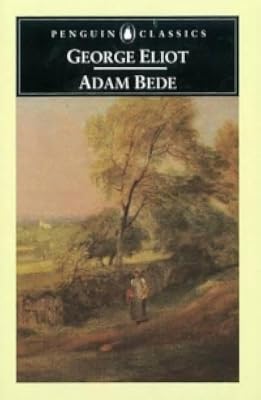
Adam Bede
by George Eliot
On This Page
Description
Adam Bede follows the lives of a fictional rural community. The life and expectations of the good carpenter Adam Bede are disrupted when the local lord takes liberties below his station and his conscience. The novel is a discussion of class and education and also of religion, with the female Methodist preacher Dinah Morris coming to the fore as the novel progresses..
Tags
Recommendations










Member Recommendations


Member Reviews
George Eliot published Adam Bede, her first novel, in 1859 to great acclaim. This richly detailed novel tells the story of Adam, a carpenter, and his love for Hetty Sorrel, a vain young woman who falls in love with the local gentleman, Captain Arthur Donnithorne. Using this love triangle as her foundation, Eliot painstakingly illustrates the intricacies of rural life at the turn of the eighteenth century.
The characters in George Eliot’s Adam Bede exist along a continuum of human weakness. From Hetty and Arthur, who give in too easily to their illicit passion, to Adam’s mother Lisbeth, whose temperament warps an otherwise honest character, all the way to Dinah, a pinnacle of correct behavior and Christian compassion.
Adam is situated show more toward the upper end of that continuum. He is a stoic and honest man, with good intentions and sincere passions. He is a hard worker and trustworthy, respected among his peers and even admired by the small town’s gentry. But Eliot does not give her reader an unflawed hero. Adam is proud and severe in his judgment of others. He is also blind to the failings of the woman he loves. This ultimate but innocent fault will nearly cost him his happiness when the truth of all that has occurred between Hetty and Arthur finally comes to light.
Despite its pastoral setting and overall bucolic tone, there is a serious scandal at the heart of the novel. Eliot’s frank, forthright treatment of Arthur and Hetty’s love affair, and its ensuing complications, turn this seemingly quiet novel into a careful investigation of morality and human limitations.
Eliot’s real skill lies in portraying the rural setting as well as each of her characters with as much detail as possible. This makes for a layered novel, filled with a number of multifaceted moral dilemmas: Will Dinah consent to marry Adam’s brother Seth, even though she feels called to continue her ministry? Will Adam eventually understand Hetty’s true character? How will Adam negotiate his long-standing friendship with Arthur after the scandal is revealed?
Adam Bede is read less often than Eliot’s purported masterpiece Middlemarch and for good reason. Although a highly accomplished first novel and a rewarding and entertaining read, Adam Bede does contain a certain number of conspicuous flaws. The structure for instance, lacks a certain shape and economy. Eliot takes some time to get her plot moving and there are even a few chapters which appear to be superfluous. These small failings, however, only indicate how accomplished Eliot already was at the time she published Adam Bede and provide a wonderful discussion base for her later novels.
George Eliot’s Adam Bede is a deeply psychological work which delves into the darker corners of human weakness using the complex realities of love, friendship, sorrow and forgiveness to paint its splendid portrait. show less
The characters in George Eliot’s Adam Bede exist along a continuum of human weakness. From Hetty and Arthur, who give in too easily to their illicit passion, to Adam’s mother Lisbeth, whose temperament warps an otherwise honest character, all the way to Dinah, a pinnacle of correct behavior and Christian compassion.
Adam is situated show more toward the upper end of that continuum. He is a stoic and honest man, with good intentions and sincere passions. He is a hard worker and trustworthy, respected among his peers and even admired by the small town’s gentry. But Eliot does not give her reader an unflawed hero. Adam is proud and severe in his judgment of others. He is also blind to the failings of the woman he loves. This ultimate but innocent fault will nearly cost him his happiness when the truth of all that has occurred between Hetty and Arthur finally comes to light.
Despite its pastoral setting and overall bucolic tone, there is a serious scandal at the heart of the novel. Eliot’s frank, forthright treatment of Arthur and Hetty’s love affair, and its ensuing complications, turn this seemingly quiet novel into a careful investigation of morality and human limitations.
Eliot’s real skill lies in portraying the rural setting as well as each of her characters with as much detail as possible. This makes for a layered novel, filled with a number of multifaceted moral dilemmas: Will Dinah consent to marry Adam’s brother Seth, even though she feels called to continue her ministry? Will Adam eventually understand Hetty’s true character? How will Adam negotiate his long-standing friendship with Arthur after the scandal is revealed?
Adam Bede is read less often than Eliot’s purported masterpiece Middlemarch and for good reason. Although a highly accomplished first novel and a rewarding and entertaining read, Adam Bede does contain a certain number of conspicuous flaws. The structure for instance, lacks a certain shape and economy. Eliot takes some time to get her plot moving and there are even a few chapters which appear to be superfluous. These small failings, however, only indicate how accomplished Eliot already was at the time she published Adam Bede and provide a wonderful discussion base for her later novels.
George Eliot’s Adam Bede is a deeply psychological work which delves into the darker corners of human weakness using the complex realities of love, friendship, sorrow and forgiveness to paint its splendid portrait. show less
Wow...what a read. What a classic. George Eliot has drawn characters here that will stick with you long after you have read the last page.
The proud, honest, hard-working but also hot-tempered and unforgiving Adam Bede - the beautiful but vain and inexperienced Hetty Sorrel - the landlords grandson Arthur Donnithorne, who so easily deceives himself unable to fight temptation, and the merciful Methodist preacher Dinah Morris - and then - as a voice of experience -you have the kind and wise preacher and the I-will-tell-the-truth-no-matter-what Mrs. Poyser. Her "lectures" have a profound effect - not least when the landlord come to visit with another scheme.
Well, it's the thought-life of the characters that I so enjoy - their struggles show more with faith, love, temptation, forgiveness, loss - Eliot has such a keen understanding of the human nature, it's flaws and strengths - and although an agnostic herself, Eliot has developed people of Christian faith with deep warmth, grace and honesty. It's remarkable.
I like the way Adam will find his way of reconciling with God and other people - and the way Dinah have to learn to value the "earthly" aspect of the spiritual life. And how Arthur come to realise that he's not perfect after all. And Hetty.... Well, reader....you just have to find out for yourself about her. show less
The proud, honest, hard-working but also hot-tempered and unforgiving Adam Bede - the beautiful but vain and inexperienced Hetty Sorrel - the landlords grandson Arthur Donnithorne, who so easily deceives himself unable to fight temptation, and the merciful Methodist preacher Dinah Morris - and then - as a voice of experience -you have the kind and wise preacher and the I-will-tell-the-truth-no-matter-what Mrs. Poyser. Her "lectures" have a profound effect - not least when the landlord come to visit with another scheme.
Well, it's the thought-life of the characters that I so enjoy - their struggles show more with faith, love, temptation, forgiveness, loss - Eliot has such a keen understanding of the human nature, it's flaws and strengths - and although an agnostic herself, Eliot has developed people of Christian faith with deep warmth, grace and honesty. It's remarkable.
I like the way Adam will find his way of reconciling with God and other people - and the way Dinah have to learn to value the "earthly" aspect of the spiritual life. And how Arthur come to realise that he's not perfect after all. And Hetty.... Well, reader....you just have to find out for yourself about her. show less
This book bears the name of an individual, but at times, it seems misnamed since there are other strong figures, such as Hetty Sorrel and Dinah Morris, on whom the narrative focuses. Still, Adam is a strong character, an example of a genuinely good man. He has faults, but these stem from his highly-principled nature and are softened by suffering.
A key minor character is Mr. Irwine, the local rector. Before writing this novel, Eliot had written a series of stories featuring clergymen (collected in her first book, Scenes of Clerical Life. After reading the first half of the third of these, “Janet’s Repentance,” her publisher, John Blackwood, complained, “When are you going to give us a really good active clergyman, neither show more absurdly evangelical nor absurdly High Church?” Perhaps that’s what Eliot set out to do when she created Mr. Irwine before the other characters ran away with the tale.
Then again, the core of the plot, the fate of Hetty Sorrel, was related to Eliot by her aunt, so that’s likely to have been the germ of the book from the start. I’ll find out more when I get to the next chapter of Haight’s biography of the author, which I’m reading in sync with Eliot’s books.
Contrasting with Hetty is Dinah, a Methodist lay preacher. It’s harder to create a convincing portrait of a thoroughly good person than one who is flawed, but in Dinah, Eliot draws a second good character alongside Adam. This struck me particularly because Eliot had found and then lost religious faith. Yet Dinah’s fervor is rendered with no trace of irony.
Eliot’s famed psychological acuity is on full display in this book, but at times I wished she explained less and let the plot and dialogue show us more. This is especially so with the self-absorbed Hetty (a forerunner of Rosamunde in Middlemarch). By the time Eliot writes of “a little trivial soul like Hetty’s,” I was impatient, having gotten the point.
To appreciate Eliot, you must also allow time for her detailed descriptions of the countryside, its produce, its seasons, and its dwellers. These depictions are nostalgic without being sentimental. She also has a gift for epigram, for instance, “It is so very rarely that facts hit that nice medium required by our own enlightened opinions and refined taste!”
I became so immersed in the world Eliot shows that I felt I was still in it for hours after finishing the book. This is one hallmark of a great book, one that outweighs the quibbles I’ve noted. show less
A key minor character is Mr. Irwine, the local rector. Before writing this novel, Eliot had written a series of stories featuring clergymen (collected in her first book, Scenes of Clerical Life. After reading the first half of the third of these, “Janet’s Repentance,” her publisher, John Blackwood, complained, “When are you going to give us a really good active clergyman, neither show more absurdly evangelical nor absurdly High Church?” Perhaps that’s what Eliot set out to do when she created Mr. Irwine before the other characters ran away with the tale.
Then again, the core of the plot, the fate of Hetty Sorrel, was related to Eliot by her aunt, so that’s likely to have been the germ of the book from the start. I’ll find out more when I get to the next chapter of Haight’s biography of the author, which I’m reading in sync with Eliot’s books.
Contrasting with Hetty is Dinah, a Methodist lay preacher. It’s harder to create a convincing portrait of a thoroughly good person than one who is flawed, but in Dinah, Eliot draws a second good character alongside Adam. This struck me particularly because Eliot had found and then lost religious faith. Yet Dinah’s fervor is rendered with no trace of irony.
Eliot’s famed psychological acuity is on full display in this book, but at times I wished she explained less and let the plot and dialogue show us more. This is especially so with the self-absorbed Hetty (a forerunner of Rosamunde in Middlemarch). By the time Eliot writes of “a little trivial soul like Hetty’s,” I was impatient, having gotten the point.
To appreciate Eliot, you must also allow time for her detailed descriptions of the countryside, its produce, its seasons, and its dwellers. These depictions are nostalgic without being sentimental. She also has a gift for epigram, for instance, “It is so very rarely that facts hit that nice medium required by our own enlightened opinions and refined taste!”
I became so immersed in the world Eliot shows that I felt I was still in it for hours after finishing the book. This is one hallmark of a great book, one that outweighs the quibbles I’ve noted. show less
“Our deeds determine us, as much as we determine our deeds, and until we know what has been or will be the peculiar combination of outward with inward facts, which constitutes a man's critical actions, it will be better not to think ourselves wise about his character."
Published in 1859 and set in the fictional rural English village of Hayslope in 1799, this is the story of a town, focusing on two women and two men of different temperaments. Adam Bede is smitten by pretty Hetty Sorrel, a farmgirl, who dreams of becoming a lady of wealth and leisure. She is attracted to the squire’s son, Captain Arthur Donnithorne. Arthur does not mind a dalliance but is not about to marry a woman of lower social standing. Dinah Morris is a Methodist show more minister – a woman in this role would have been quite rare for the time. Dinah’s kind compassionate nature is contrasted with Hetty’s flightiness and frivolity. Adam’s serious principled disposition is contrasted with Arthur’s reckless selfishness.
To say this is a love triangle is to sell it short. It is a novel of many dimensions, including changing times on the cusp of a new century, restrictions due to social class, the role of women, religion, education, infatuation, shame, and manslaughter. Strengths of this book include the depth of the psychological development of the characters the depiction of their gradual transformations. It conveys an emotional depth that echoes through time. The story touched me deeply, especially in the climactic scenes. If I have one criticism, it is the denouement, which seems long and dragged out. Though definitely Victorian in its tone and style, it has the trappings of a timeless story of human nature. I enjoyed it very much. show less
Published in 1859 and set in the fictional rural English village of Hayslope in 1799, this is the story of a town, focusing on two women and two men of different temperaments. Adam Bede is smitten by pretty Hetty Sorrel, a farmgirl, who dreams of becoming a lady of wealth and leisure. She is attracted to the squire’s son, Captain Arthur Donnithorne. Arthur does not mind a dalliance but is not about to marry a woman of lower social standing. Dinah Morris is a Methodist show more minister – a woman in this role would have been quite rare for the time. Dinah’s kind compassionate nature is contrasted with Hetty’s flightiness and frivolity. Adam’s serious principled disposition is contrasted with Arthur’s reckless selfishness.
To say this is a love triangle is to sell it short. It is a novel of many dimensions, including changing times on the cusp of a new century, restrictions due to social class, the role of women, religion, education, infatuation, shame, and manslaughter. Strengths of this book include the depth of the psychological development of the characters the depiction of their gradual transformations. It conveys an emotional depth that echoes through time. The story touched me deeply, especially in the climactic scenes. If I have one criticism, it is the denouement, which seems long and dragged out. Though definitely Victorian in its tone and style, it has the trappings of a timeless story of human nature. I enjoyed it very much. show less
Our title character is a good man and a simple one. He sees the world in black and white. Work hard, take care of your family, and you will lead a good life. He falls in love with an impetuous young woman named Hetty. Unfortunately, Hetty has fallen for the wealthy Captain Arthur Donnithorne, a man above her station, but one who is still susceptible to the young woman’s charms.
I loved the character of Dinah. She could be perceived as a killjoy or prude, but she never cane across to me like that. She is Hetty’s cousin and is a Methodist preacher who travels the countryside serving in local communities. Keep in mind, this was at a time when it was unusual for a woman to travel about on her own, much less to serve as a leader in the show more church. She has a fierce strength and independence and doesn’t give into the pleas from her family to give up her calling.
When she is asked about being a woman preacher, this is what she says…
“When God makes His presence felt through us, we are like the burning bush: Moses never took any heed what sort of bush it was—he only saw the brightness of the Lord.”
****SPOILERS*****
Dinah: When she does finally fall for Adam, she still doesn’t agree to marry until he declares that he will never stand in the way of her duties as a preacher and he fully supports her. I was a bit heartbroken from Adam’s brother Seth, since he’s the one who originally pursued Dinah.
Hetty’s story is so heartbreaking. I can’t imagine feeling so hopeless and abandoned. In the midst of her panic about her pregnancy she didn’t trust anyone with her secret and so she was unwilling to look for other options. Even though her life was spared, her future was still going to be full of grief and guilt no matter what.
SPOILERS OVER
BOTTOM LINE: I loved it. It reminded me so much of Tess of the d’Urbervilles and The Return of the Native (both of which were published decades after this one). It’s an intense look at the desperation of one woman and the man who loved her. I appreciated the rich depth of characters like Dinah and Adam. I also liked that Arthur wasn't a one-note cad. He easily could have been, but instead we see the situation from his point of view as well.
“What destroys us most effectively is not a malign fate but our own capacity for self-deception and for degrading our own best self.”
“What greater thing is there for two human souls, than to feel that they are joined for life--to strengthen each other in all labor, to rest on each other in all sorrow, to minister to each other in all pain, to be one with each other in silent unspeakable memories at the moment of the last parting?”
“Our deeds determine us, as much as we determine our deeds.” show less
I loved the character of Dinah. She could be perceived as a killjoy or prude, but she never cane across to me like that. She is Hetty’s cousin and is a Methodist preacher who travels the countryside serving in local communities. Keep in mind, this was at a time when it was unusual for a woman to travel about on her own, much less to serve as a leader in the show more church. She has a fierce strength and independence and doesn’t give into the pleas from her family to give up her calling.
When she is asked about being a woman preacher, this is what she says…
“When God makes His presence felt through us, we are like the burning bush: Moses never took any heed what sort of bush it was—he only saw the brightness of the Lord.”
****SPOILERS*****
Dinah: When she does finally fall for Adam, she still doesn’t agree to marry until he declares that he will never stand in the way of her duties as a preacher and he fully supports her. I was a bit heartbroken from Adam’s brother Seth, since he’s the one who originally pursued Dinah.
Hetty’s story is so heartbreaking. I can’t imagine feeling so hopeless and abandoned. In the midst of her panic about her pregnancy she didn’t trust anyone with her secret and so she was unwilling to look for other options. Even though her life was spared, her future was still going to be full of grief and guilt no matter what.
SPOILERS OVER
BOTTOM LINE: I loved it. It reminded me so much of Tess of the d’Urbervilles and The Return of the Native (both of which were published decades after this one). It’s an intense look at the desperation of one woman and the man who loved her. I appreciated the rich depth of characters like Dinah and Adam. I also liked that Arthur wasn't a one-note cad. He easily could have been, but instead we see the situation from his point of view as well.
“What destroys us most effectively is not a malign fate but our own capacity for self-deception and for degrading our own best self.”
“What greater thing is there for two human souls, than to feel that they are joined for life--to strengthen each other in all labor, to rest on each other in all sorrow, to minister to each other in all pain, to be one with each other in silent unspeakable memories at the moment of the last parting?”
“Our deeds determine us, as much as we determine our deeds.” show less
[b:Adam Bede|20563|Adam Bede|George Eliot|https://i.gr-assets.com/images/S/compressed.photo.goodreads.com/books/1631823184l/20563._SY75_.jpg|21503633] is George Eliot's first novel and I found the plotting and themes less sophisticated than those of [b:Middlemarch|19089|Middlemarch|George Eliot|https://i.gr-assets.com/images/S/compressed.photo.goodreads.com/books/1568307771l/19089._SY75_.jpg|1461747]. Her beautiful descriptions and sympathetic insight into human behaviour are already present, though. [b:Adam Bede|20563|Adam Bede|George Eliot|https://i.gr-assets.com/images/S/compressed.photo.goodreads.com/books/1631823184l/20563._SY75_.jpg|21503633] is a tale of rural life set in the final year of the 18th century. The village on which show more the narrative focuses is as yet untouched by the industrial revolution. Eliot comments on how the world has changed since, in a fashion that still seems oddly contemporary than more 150 years later:
There's the seed of critique of capitalism in there, although I might be projecting. The tone of this interjection notwithstanding, Eliot does not depict her setting as an idyllic, comfortable, and just place. The titular Adam is an intelligent, hard-working, and determined workman who lives with his alcoholic father, querulous mother, passive brother, and devoted dog. He is well-respected in his neighbourhood and a good friend of the manor lord's heir. The stability of his life is overturned by tragedy, which the reader sees inexorably approaching but he is unaware of until it is too late to avert the consequences.
Adam is in love with and engaged to be married to Hetty, a beautiful young girl from a farming family. Unbeknownst to him, she has been seduced by his friend Arthur, the manor heir, who gets her pregnant then leaves. Hetty runs away from home in terror, fails to find her seducer, and abandons her baby to die of exposure. For this she is arrested and very nearly hanged, her sentence being commuted to transportation at the last minute. She then dies off-page, leaving her family, Adam, and Arthur heartbroken and horrified. While pregnant and running away, Hetty encounters a landlady who immediately works out what happened:
'Dratchell' is such a good word. Incidentally, I was impressed at how obvious Hetty's pregnancy was, despite Eliot never actually using the word pregnant and only referring to it indirectly with extreme delicacy. The narrative itself and many of the characters condemn both Hetty and Arthur for the weakness of character that leads them to get involved. Inevitably, though, Hetty is the one who really suffers for it. Adam comments explicitly upon this in response to Arthur's desire to make amends:
Adam's accent is written phonetically throughout, which slowed my reading until I got used to it. A few other characters' speech is also presented in this style, notably Adam's mother, but by no means all the farming folk use so many apostrophes.
[b:Adam Bede|20563|Adam Bede|George Eliot|https://i.gr-assets.com/images/S/compressed.photo.goodreads.com/books/1631823184l/20563._SY75_.jpg|21503633] is full of flawed, often annoying, but compelling and sympathetically-depicted characters. Notable examples include Mrs Poyser, who is exhaustingly demanding to her family and maids yet more willing and able to stand up to the aristocratic landlord than her husband. Her intelligence and strength of character do not go unremarked by others. I liked this gossipy exchange between the rector and his mother, both keen observers of local doings:
Another memorable character is the schoolmaster Mr Massey, an absurdly extreme misogynist who constantly makes comments like this:
He hates women so much that he never bothers them, does all his own housework, and essentially claims that men make better wives than women, even boasting of how good his homemade bread is. Amazing. Despite this nonsense, he supports Adam in his heartbroken hour of need. Indeed, several persons whose daily conversation is full of petty complaints come into their own during a crisis. In contrast to the wide variety of flaws exhibited by every other character, Dinah the Methodist preacher is a paragon of patience and kindness. A less deft writer could have made her unbearably angelic, but somehow Eliot avoids this. I think Dinah's independence and determination to go her own way (or rather, where she believes God wants her to go) give her more personality than, say, young female martyrs I've come across in Dickens novels.The scene in which she persuades Hetty to confess to killing her baby is genuinely moving and powerful. Although there is an obvious moral message throughout the novel, it does not overwhelm the essentially humanistic and sympathetic approach. Eliot is explicit about this in chapter 17 'In which the story pauses a little'. Here she expounds her aims as a novelist to celebrate the mundane, realistic, and less-than-beautiful:
While I did not delight in [b:Adam Bede|20563|Adam Bede|George Eliot|https://i.gr-assets.com/images/S/compressed.photo.goodreads.com/books/1631823184l/20563._SY75_.jpg|21503633] to the same degree as [b:Middlemarch|19089|Middlemarch|George Eliot|https://i.gr-assets.com/images/S/compressed.photo.goodreads.com/books/1568307771l/19089._SY75_.jpg|1461747], I found it an involving and nuanced retelling of a sad old story. Eliot's writing is wonderful and I am eager to read more of her novels, particularly [b:Daniel Deronda|304|Daniel Deronda|George Eliot|https://i.gr-assets.com/images/S/compressed.photo.goodreads.com/books/1632587921l/304._SY75_.jpg|313957]. show less
Leisure is gone - gone where the spinning-wheels are gone, and the pack-horses, and the slow waggons, and the pedlars, who brought bargains to the door on sunny afternoons. Ingenious philosophers tell you, perhaps, that the great work of the steam-engine is to create leisure for mankind. Do not believe them: it only creates a vacuum for eager thought to rush in. Even idleness is eager now - eager for amusement: prone to excursion trains, art museums, periodical literature, and exciting novels: prone even to scientific theorising, and cursory peeps through microscopes. Old Leisure was quite a different personage: he only read one newspaper, innocent of leaders, and was free from that periodicity of sensations which we call post-time.
There's the seed of critique of capitalism in there, although I might be projecting. The tone of this interjection notwithstanding, Eliot does not depict her setting as an idyllic, comfortable, and just place. The titular Adam is an intelligent, hard-working, and determined workman who lives with his alcoholic father, querulous mother, passive brother, and devoted dog. He is well-respected in his neighbourhood and a good friend of the manor lord's heir. The stability of his life is overturned by tragedy, which the reader sees inexorably approaching but he is unaware of until it is too late to avert the consequences.
"Ah, it's plain enough what sort of business it is," said the wife. "She's not a common flaunting dratchell, I can see that. She looks like a respectable country girl, and she comes from a good way off, to judge by her tongue."
'Dratchell' is such a good word. Incidentally, I was impressed at how obvious Hetty's pregnancy was, despite Eliot never actually using the word pregnant and only referring to it indirectly with extreme delicacy. The narrative itself and many of the characters condemn both Hetty and Arthur for the weakness of character that leads them to get involved. Inevitably, though, Hetty is the one who really suffers for it. Adam comments explicitly upon this in response to Arthur's desire to make amends:
"That doesn't alter th' evil: her ruin can't be undone. I hate that talk o' people, as if there was a way o' making amends for everything. They'd more need to be brought to see as the wrong they do can never be altered. When a man's spoiled his fellow-creatur's life, he has no right to comfort himself with thinking that good may come out of it: somebody else's good doesn't alter her shame and misery."
Adam's accent is written phonetically throughout, which slowed my reading until I got used to it. A few other characters' speech is also presented in this style, notably Adam's mother, but by no means all the farming folk use so many apostrophes.
[b:Adam Bede|20563|Adam Bede|George Eliot|https://i.gr-assets.com/images/S/compressed.photo.goodreads.com/books/1631823184l/20563._SY75_.jpg|21503633] is full of flawed, often annoying, but compelling and sympathetically-depicted characters. Notable examples include Mrs Poyser, who is exhaustingly demanding to her family and maids yet more willing and able to stand up to the aristocratic landlord than her husband. Her intelligence and strength of character do not go unremarked by others. I liked this gossipy exchange between the rector and his mother, both keen observers of local doings:
"Well, I like that woman even better than her cream-cheeses," said Mrs. Irvine. "She has the spirit of three men, with that pale face of hers; and she says such sharp things."
"Sharp! Yes, her tongue is like a new-set razor. She's quite original in her talk, too; one of those untaught wits that helps to stock a country with proverbs. I told you that capital thing I heard her say about Craig - that he was like a cock who thought the sun had risen to hear him crow. Now that's Aesop's fable in a sentence."
"But it will be a bad business if the old gentleman turns them out of the farm next Michaelmas, eh?" said Mrs. Irwine.
"Oh, that must not be; and Poyser is such a good tenant, that Donnithorne is likely to think twice, and digest his spleen rather than turn them out. But if he should give them notice at Lady-day, Arthur and I must move heaven and earth to mollify him. Such old parishioners as they are must not go."
"Ah, there's no knowing what may happen before Lady-day," said Mrs. Irwine. It struck me on Arthur's birthday that the old man was a little shaken: he's eighty-three, you know. It's really an unconscionable age. It's only women who have the right to live as long as that."
Another memorable character is the schoolmaster Mr Massey, an absurdly extreme misogynist who constantly makes comments like this:
"Nonsense! It's the silliest lie a sensible man like you ever believed, to say a woman makes a house comfortable. It's a story got up, because the women are there, and something must be found for 'em to do. I tell you there isn't a thing under the sun that needs to be done at all, but what a man can do better than a woman, unless it's bearing children, and they do that in a poor makeshift way; it had better ha' been left to the men."
He hates women so much that he never bothers them, does all his own housework, and essentially claims that men make better wives than women, even boasting of how good his homemade bread is. Amazing. Despite this nonsense, he supports Adam in his heartbroken hour of need. Indeed, several persons whose daily conversation is full of petty complaints come into their own during a crisis. In contrast to the wide variety of flaws exhibited by every other character, Dinah the Methodist preacher is a paragon of patience and kindness. A less deft writer could have made her unbearably angelic, but somehow Eliot avoids this. I think Dinah's independence and determination to go her own way (or rather, where she believes God wants her to go) give her more personality than, say, young female martyrs I've come across in Dickens novels.
These fellow-mortals, every one, must be accepted as they are: you can neither straighten their noses, nor brighten their wit, nor rectify their dispositions; and it is these people - amongst whom your life is passed - that it is needful you should tolerate, pity, and love: it is these more or less ugly, stupid, inconsistent people, whose movements of goodness you should be able to admire - for whom you should cherish all possible hopes, all possible patience. And I would not, even if I had the choice, be the clever novelist who could create a world so much better than this, in which we get up in the morning to do our daily work, that you would be likely to turn a harder, colder eye on the dusty streets and the common green fields - on the real breathing men and women, who can be chilled by your indifference or injured by your prejudice; who can be cheered and helped onward by your fellow-feeling, your forbearance, your outspoken, brave justice.
So I am content to tell my simple story, without trying to make things seem better than they were; dreading nothing, indeed, but falsity, which in spite of one's best efforts, there is reason to dread. Falsehood is so easy, truth so difficult.
While I did not delight in [b:Adam Bede|20563|Adam Bede|George Eliot|https://i.gr-assets.com/images/S/compressed.photo.goodreads.com/books/1631823184l/20563._SY75_.jpg|21503633] to the same degree as [b:Middlemarch|19089|Middlemarch|George Eliot|https://i.gr-assets.com/images/S/compressed.photo.goodreads.com/books/1568307771l/19089._SY75_.jpg|1461747], I found it an involving and nuanced retelling of a sad old story. Eliot's writing is wonderful and I am eager to read more of her novels, particularly [b:Daniel Deronda|304|Daniel Deronda|George Eliot|https://i.gr-assets.com/images/S/compressed.photo.goodreads.com/books/1632587921l/304._SY75_.jpg|313957]. show less
When I read Silas Marner, I felt like I'd read a well-written story where nothing interesting had happened. After reading Adam Bede, I know why I felt that way-- Eliot just can't do something interesting in a mere two hundred pages. She takes her time: time to build the characters, time to let them work their ways into situations. It can take a long time, but it's time well-spent, because once she has everything in place, this novel just takes off. Hetty Sorrel's cross-country flight is amazing and captivating and heart-rending. You feel what she is feeling every step of the way, you feel her anguish and triumph and despair. Especially the despair. Eliot's prose is amazing: Hetty, having failed to find her lover Arthur and make him show more account for what has happened to her, sits by a dark pool in the night and tries to drown herself in it, but she doesn't have the strength of character to do even that. And so, "She set her teeth when she thought of Arthur: she cursed him, without knowing what her cursing would do: she wished he too might know desolation, and cold, and a life of shame that he dare not end by death." Fabulous! All the other characters are just as well drawn, from the title character to Dinah Morris to the random villagers, and Eliot does a fantastic job of making them all people you empathize with and understand, no matter what they do. I was swept up in this book (though admittedly, the last fifty or so pages drag a bit), and I will eagerly seek out more Eliot now. (originally written June 2009)
I recently reread this, but I don't have much more to say beyond that it's even better the second time around. Eliot sketches her characters with such detail, such precision: everyone of them is a real person whose every action you understand and sympathize with, even those who in simpler versions of this story would be out-and-out villains. Knowing what's coming makes it even better (though the ending drags even more), as you can see exactly how the characters' actions proceed inexorably from their natures. I love this book. I need to read more Eliot, and soon. (added November 2009) show less
I recently reread this, but I don't have much more to say beyond that it's even better the second time around. Eliot sketches her characters with such detail, such precision: everyone of them is a real person whose every action you understand and sympathize with, even those who in simpler versions of this story would be out-and-out villains. Knowing what's coming makes it even better (though the ending drags even more), as you can see exactly how the characters' actions proceed inexorably from their natures. I love this book. I need to read more Eliot, and soon. (added November 2009) show less
Members
- Recently Added By
Lists

1001 Books You Must Read Before You Die
1,448 works; 1,136 members

The Guardian's 1000 Novels Everyone Must Read
1,005 works; 552 members

Favourite 19th century fiction
257 works; 62 members

Top Five Books of 2013
1,562 works; 715 members

Favourite Books
1,820 works; 316 members

Female Author
1,234 works; 66 members

Favorite Long Books
330 works; 42 members

Recommend the 20 best books you've read in the last five years
2,168 works; 603 members

Unread books
1,063 works; 83 members
Folio Society
831 works; 53 members
150 Best Novels Selected by Brander Matthews (1883)
150 works; 7 members

Western World's Greatest Books - Project Gutenberg
295 works; 15 members
Harold Bloom - The Western Canon: C. The Democratic Age
336 works; 15 members

Global Reads: Books Set in the United Kingdom and Ireland
109 works; 5 members
LibraryThingers' 1001 Books You Must Read Before You Die
442 works; 29 members

How to Read a Book's Recommended Reading List
309 works; 10 members
Readable Classics
110 works; 15 members
Didactic Fiction
29 works; 3 members

One Book, Many Authors
441 works; 40 members
19th Century
190 works; 16 members

Newark Public Library's 1904 List of a Thousand of the Best Novels
98 works; 5 members

1,001 BYMRBYD Concensus
723 works; 27 members

Top Five Books of 2017
757 works; 230 members
Lamont's Hundred Best Novels (1947)
100 works; 4 members
Out of Copyright
244 works; 14 members

Allie's Favourite 150 Books
145 works; 3 members
Good, Smart, Clean Fiction
46 works; 4 members
Books with a Character's Name as the Title
130 works; 10 members

SHOULD Read Books!
354 works; 9 members
F. B. Perkins' List of 100 Best Fiction
100 works; 5 members
Victorian Period
113 works; 10 members
First Novels
373 works; 17 members
Five star books
1,767 works; 110 members

Books on my Kindle
162 works; 3 members

1850s
17 works; 2 members
Books Read in 2015
3,299 works; 126 members

University literature
145 works; 5 members
Trinity College Booklist (1951): Class Ten, English Literature
358 works; 5 members

Books Read in 2022
5,226 works; 115 members

2024. Nuestro año literario (Faustino Sánchez)
20 works; 1 member

Recommended Reading : 600 Classics Reviewed, Editors of Salem Press, 2015
634 works; 6 members
School Made Us Read It
380 works; 197 members

Books Read in 2024
4,727 works; 128 members
Books You Read For University
184 works; 3 members

Books That Changed Our Perspective
423 works; 168 members

My TBR
371 works; 3 members

AP Lit
363 works; 6 members

Greatest Books, allegedly
484 works; 9 members

Tagged 19th Century
104 works; 7 members

Books Read in 2021
5,361 works; 114 members

Fiction with Men's Given Names in the Title
302 works; 10 members

W. S. Maugham's Reading Suggestions for Spiritual Enrichment: British
24 works; 3 members

el
1,139 works; 1 member
Author Information

384+ Works 62,263 Members
George Eliot was born Mary Ann Evans on a Warwickshire farm in England, where she spent almost all of her early life. She received a modest local education and was particularly influenced by one of her teachers, an extremely religious woman whom the novelist would later use as a model for various characters. Eliot read extensively, and was show more particularly drawn to the romantic poets and German literature. In 1849, after the death of her father, she went to London and became assistant editor of the Westminster Review, a radical magazine. She soon began publishing sketches of country life in London magazines. At about his time Eliot began her lifelong relationship with George Henry Lewes. A married man, Lewes could not marry Eliot, but they lived together until Lewes's death. Eliot's sketches were well received, and soon after she followed with her first novel, Adam Bede (1859). She took the pen name "George Eliot" because she believed the public would take a male author more seriously. Like all of Eliot's best work, The Mill on the Floss (1860), is based in large part on her own life and her relationship with her brother. In it she begins to explore male-female relations and the way people's personalities determine their relationships with others. She returns to this theme in Silas Mariner (1861), in which she examines the changes brought about in life and personality of a miser through the love of a little girl. In 1863, Eliot published Romola. Set against the political intrigue of Florence, Italy, of the 1490's, the book chronicles the spiritual journey of a passionate young woman. Eliot's greatest achievement is almost certainly Middlemarch (1871). Here she paints her most detailed picture of English country life, and explores most deeply the frustrations of an intelligent woman with no outlet for her aspirations. This novel is now regarded as one of the major works of the Victorian era and one of the greatest works of fiction in English. Eliot's last work was Daniel Deronda. In that work, Daniel, the adopted son of an aristocratic Englishman, gradually becomes interested in Jewish culture and then discovers his own Jewish heritage. He eventually goes to live in Palestine. Because of the way in which she explored character and extended the range of subject matter to include simple country life, Eliot is now considered to be a major figure in the development of the novel. She is buried in Highgate Cemetery, North London, England, next to her common-law husband, George Henry Lewes. (Bowker Author Biography) show less
Some Editions
Awards and Honors
Notable Lists
Series
Belongs to Publisher Series
Collins Classics (3)
Everyman's Library (27)
The World's Classics (63)
Reader's Enrichment Series (RE 700)
Doubleday Dolphin (C62)
The Pocket Library (PL-507)
Airmont Classics (103)
Work Relationships
Is contained in
The Best-Known Novels of George Eliot: Adam Bede, The Mill on the Floss, Silas Marner, Romola by George Eliot
The Works of George Eliot: Vol. I - Adam Bede, The Mill on the Floss, Romola; Vol. II -- Middlemarch: A Study of Provincial life, Daniel Deronda; Vol. III -- Felix Holt, The Radical, Silas Marner, The Lifted Veil, Brother Jacob,Scenes from Clerical Life by George Eliot (indirect)
Classic British Fiction: Six novels by George Eliot, in a single file, improved 8/23/2010 by George Eliot
Jane Eyre/ Wuthering Heights/ Little Women/ Adam Bede/ Emma/ Pride and Prejudice by Trident Press International
Complete Works of George Eliot, vol. 1: Scenes of Clerical Life, Silas Marner, Adam Bede by George Eliot
Works of George Eliot. The Mill on the Floss, Daniel Deronda, Adam Bede, Middlemarch, The Lifted Veil & more. (mobi) by George Eliot
George Eliot's Works: Adam Bede/Daniel Deronda/Felix Holt and Clerical Life/Middlemarch/Mill on the Floss/Romola (6 vols) by George Eliot
Novels of George Eliot in Five Volumes with Illustrations: Adam Bede; The Mill in the Floss; Silas Marner; Clerical Life; Felix Holt; Middlemarch by George Eliot
George Elliot Works: 7 books - Middlemarch, Adam Bede, Daniel Deronda, Romola, Impressions of Theophrastus Such..., Silas Marner, Felix Holt, the Radical (George Elliot Works, 7 of ? in set) by George Elliot
George Eliot Collection: The Complete Novels, Short Stories, Poems and Essays (Middlemarch, Daniel Deronda, Scenes of Clerical Life, Adam Bede, The Lifted Veil...) by George Eliot
The Spanish Gypsy and Other Poems. Scenes of Clerical Life, Adam Bede, Romola, Felix Holt The Radical., Daniel Deronda, Miscellaneous Essays: Impressions of Theophrastus Such, The Lifted Veil, and Brother Jacob by George Eliot
George Eliot's Works (Six Volumes): Adam Bede, Scenes of Clerical Life, Middlemarch, The Mill On the Floss, Daniel Deronda, Felix Holt (The Radical), The Spanish Gypsy, Jubal and Other Poems, Romola, Theophrastus Such by George Eliot
Has the adaptation
Is abridged in
One hundred best novels condensed: 3 of 4 see note: Adam Bede; Tess of the D'Urbervilles; Don Quixote; East Lynne; Count of Monte Cristo; Paul and Virginia; Tom Brown's School Days; Waverley; Dombey and Son; Romola; Legend of Sleepy Hollow; Last of the Mohicans; Wreck of the "Grosvenor"; Right of Way; Coniston; Far from the Madding Crowd; Woman in White; Deemster; Waterloo; Hypatia; Kidnapped; Oliver Twist; Gil Blas; Peg Woffington; Virginians by Edwin Atkins Grozier
Has as a study
Has as a supplement
Has as a commentary on the text
Has as a student's study guide
Common Knowledge
- Canonical title
- Adam Bede
- Original publication date
- 1859
- People/Characters
- Adam Bede; Seth Bede; Dinah Morris; Hetty Sorrel; Arthur Donnithorne; Lisbeth Bede (show all 10); Rachel Poyser; Martin Poyser; Bartle Massey; Rev. Adolphus Irwine
- Important places
- Hayslope, Loamshire, England; England, UK
- Related movies
- Adam Bede (1991 | IMDb); Adam Bede (1915 | IMDb); Adam Bede (1918 | IMDb)
- First words
- With a single drop of ink for a mirror, the Egyptian sorceror undertakes to reveal to any chance comer far-reaching visions of the past.
When Marian Evans left her native Warwickshire in 1851 for London to assist John Chapman as editor and write for the Westminster Review, she took with her the memory of people and places that appear, transformed, in th... (show all)e fiction published under her pseudonym 'George Eliot'. (Introduction)
It is near the end of June, in 1807. (Epilogue)
The germ of 'Adam Bede' was an anecdote told me by my Methodist Aunt Samuel (the wife of my Father's younger brother): an anecdote from her own experience. (Appendix 1: George Eliot's History of Adam Bede)
At the Lent Assizes for the Town of Nottingham, held on Thursday, March 11, 1802, before the Hon. Sir Robert Graham, Knt. one of the Barons of his Majesty's Court of Exchequer, Mary Voce, aged 24, wife of ---Voce, bricklayer,... (show all) was indicted for the willful murder of her daughter, Elizabeth Voce, an infant, in the parish of St. Mary, in the town of Nottingham, by administering a certain poisonous substance, called arsenic, mized in water in a tea-cup, to the said Elizabeth Voce, of which she languished a few hours in extreme agony, and then expired. (Appendix 2) - Quotations
- What a look of yearning love it was that the mild grey eyes turned on the strong dark-eyed man!
- Last words
- (Click to show. Warning: May contain spoilers.)Come in, Adam, and rest; it has been a hard day for thee. (Epilogue)
(Click to show. Warning: May contain spoilers.)The ending both reinforces the ethical messages of the duty and fellow-feeling and hints at the centrality of the working man in the forward progress of society in the new century. (Introduction)
(Click to show. Warning: May contain spoilers.)"I shall write to him the first thing when we get home."
(Click to show. Warning: May contain spoilers.)The book would have been published at Christmas, or rather, early in December, but that Bulwer's "What will he do with it?" was to be published by Blackwoods at that time, and it was thought that this novel might interfere with mine. (Appendix 1: George Eliot's History of Adam Bede)
(Click to show. Warning: May contain spoilers.)May we be found frequently invoking Heaven to keep us back from presumptuous sins, that they may not have dominion over us, that we may be innocent, and free from the great Transgression. (Appendix 2) - Publisher's editor
- Briggs, Julia; Vasey, Lindeth; Edwards, Marcella
- Canonical DDC/MDS
- 823.8
Classifications
Statistics
- Members
- 4,855
- Popularity
- 2,937
- Reviews
- 78
- Rating
- (3.85)
- Languages
- 11 — Catalan, Czech, English, Finnish, French, German, Hungarian, Italian, Norwegian (Bokmål), Romanian, Spanish
- Media
- Paper, Audiobook, Ebook
- ISBNs
- 250
- UPCs
- 3
- ASINs
- 175