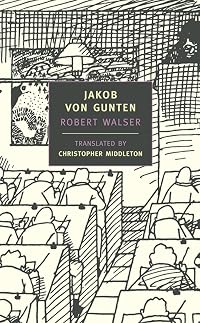
Jakob von Gunten
by Robert Walser
On This Page
Description
The Swiss writer Robert Walser is one of the quiet geniuses of twentieth-century literature. Largely self-taught and altogether indifferent to worldly success, Walser wrote a range of short stories, essays, as well as four novels, of which Jakob von Gunten is widely recognized as the finest. The book is a young man's inquisitive and irreverent account of life in what turns out to be the most uncanny of schools. It is the work of an outsider artist, a writer of uncompromising originality and show more disconcerting humor, whose beautiful sentences have the simplicity and strangeness of a painting by Henri Rousseau. show lessTags
Recommendations






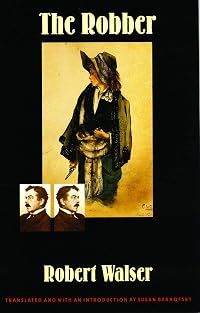



















Member Recommendations
Member Reviews
I joined the reading group The Catherine Project and was assigned to the group reading Jakob von Gunten, a book which sounded more interesting than it turned out to be. In our first discussion group, someone questioned whether the word here in the novel's opening sentence ("One learns very little here...") might refer to the book itself and not merely the school Jakob is attending. While the answer is probably no, the question is justified: the novel is frustratingly afactual. Jakob, writing what might be labeled a thought book, expends more ink on his fluctuating feelings than details about the Benjamenta Institute, a school which trains boys for service in private homes and repeatedly contradicts himself, often within the same show more paragraph. Readers never learn where the school is or what subjects are taught—they aren't even provided an understanding of Jakob's reasons for apparently running away from home to enroll. Worse, the strong sexual undertones in everything he writes, regardless of the sex of the person he is writing about, are never clearly resolved.
Instead, Jakob's vague descriptions of events fail to explain the odd situations he finds himself in or adequately describe his own behavior. Readers are left to interpret what exactly happened on his visit to a "restaurant...with hostesses", where he spends all his money on drinks for himself and a Polish hostess and plays an unexplained game with her called Saying Hello, going so far as to kiss her garter, presumably on her thigh where garters are worn.
In another scene, Fraülein Benjamenta, his instructress, takes him on an underground journey to the "hall of poverty and deprivation", where she makes him kiss the earth, then to visit to the "Wall of Worries", which he is forced to fondle, and on to "freedom"—where she stops him from reading the wrong kind of book—and "calamity", which he must bravely face, before ending up swimming in the "river of despair". Afterwards, he finds himself in the classroom, with Fraülein Benjamenta still standing behind him. Jakob opens this section vacillating whether this episode is significant or not and ends wondering whether he dreamed it or not.
Another person in the group thought the novel seemed more like vignettes the author strung together like leftovers. Given the book's lack of a plot until it is nearly finished and cryptic ending, this characterization is reasonable regardless of its accuracy. Fraülein Benjamenta dies from her lack of a romantic relationship and Jakob leaves with Herr Benjamenta, her brother, to "start something together" although Jakob never clarifies what this something is.
To Jakob von Gunten's ending line—"So now Adieu, Benjamenta Institute."—I would add, bon débarras: good riddance. show less
Instead, Jakob's vague descriptions of events fail to explain the odd situations he finds himself in or adequately describe his own behavior. Readers are left to interpret what exactly happened on his visit to a "restaurant...with hostesses", where he spends all his money on drinks for himself and a Polish hostess and plays an unexplained game with her called Saying Hello, going so far as to kiss her garter, presumably on her thigh where garters are worn.
In another scene, Fraülein Benjamenta, his instructress, takes him on an underground journey to the "hall of poverty and deprivation", where she makes him kiss the earth, then to visit to the "Wall of Worries", which he is forced to fondle, and on to "freedom"—where she stops him from reading the wrong kind of book—and "calamity", which he must bravely face, before ending up swimming in the "river of despair". Afterwards, he finds himself in the classroom, with Fraülein Benjamenta still standing behind him. Jakob opens this section vacillating whether this episode is significant or not and ends wondering whether he dreamed it or not.
Another person in the group thought the novel seemed more like vignettes the author strung together like leftovers. Given the book's lack of a plot until it is nearly finished and cryptic ending, this characterization is reasonable regardless of its accuracy.
To Jakob von Gunten's ending line—"So now Adieu, Benjamenta Institute."—I would add, bon débarras: good riddance. show less
The rabbit hole down which the protagonist/narrator Jakob tumbles is a school for training butlers. In an earlier time, a similar youth might have entered a monastery to obey without question the commands of a master, and to love the rules of its book. Jakob is ambivalent about whether he believes in God, so he chooses this option instead. Nonetheless, he is a seeker. Like Siddhartha or Francis of Assisi, he renounces his well-situated family and comfortable home to embark on a life of self-abnegation. So is he a saint or the prodigal son?
The book contains many echoes of the Bible and other spiritual literature, especially when, just like his namesake, Jakob grabs another character by the ankles and vows not to let her loose until his show more wish is granted (the motif of falling to the feet of another is repeated twice).
Walser’s writing is rich, both in its descriptions of life in the institute and in street scenes and daydreams. His insights into Jakob are sharp. “Alles Verbotene lebt auf hundertfache Art und Weise; also lebt nur lebendiger, was tot sein sollte,” notes Jakob in his diary while musing on the delights of forbidden fruit. A tantalizing glimpse of it comes at the halfway point in the story. Immediately after this, the youth is led by the hand on a phantasmagoric journey that is an evocative sublimation of erotic desire and experience. A masterpiece of writing, and possibly a model for the magic theater passage in Hesse’s Steppenwolf.
The school Jakob enters doesn’t seem entirely on the level, but that doesn’t matter to him. It may even add to its attraction, given the masochistic personality that unfolds in the course of this book. In keeping with his self-abnegation, the resolution of his ambivalent yearnings does not come in the form of an inner decision as much as in an exterior event. A character representing one pole dies, a symbolically rich plot element, and Jakob passively acquiesces to the remaining option. Is Jakob a saint? Perhaps not quite. He fits better in another, closely-related tradition, that of the holy fool.
By the way, this book is available for free as a download since it is out-of-copyright. show less
The book contains many echoes of the Bible and other spiritual literature, especially when, just like his namesake, Jakob grabs another character by the ankles and vows not to let her loose until his show more wish is granted (the motif of falling to the feet of another is repeated twice).
Walser’s writing is rich, both in its descriptions of life in the institute and in street scenes and daydreams. His insights into Jakob are sharp. “Alles Verbotene lebt auf hundertfache Art und Weise; also lebt nur lebendiger, was tot sein sollte,” notes Jakob in his diary while musing on the delights of forbidden fruit. A tantalizing glimpse of it comes at the halfway point in the story. Immediately after this, the youth is led by the hand on a phantasmagoric journey that is an evocative sublimation of erotic desire and experience. A masterpiece of writing, and possibly a model for the magic theater passage in Hesse’s Steppenwolf.
The school Jakob enters doesn’t seem entirely on the level, but that doesn’t matter to him. It may even add to its attraction, given the masochistic personality that unfolds in the course of this book. In keeping with his self-abnegation, the resolution of his ambivalent yearnings does not come in the form of an inner decision as much as in an exterior event. A character representing one pole dies, a symbolically rich plot element, and Jakob passively acquiesces to the remaining option. Is Jakob a saint? Perhaps not quite. He fits better in another, closely-related tradition, that of the holy fool.
By the way, this book is available for free as a download since it is out-of-copyright. show less
A bit more amusing than I expected: Walser belongs to the rather over-populated group of middle-class intellectuals who write about their experience of living with the lower classes, but he is one of the few to do so not out of mere necessity or political conviction, but from a sheer bloody-minded refusal to fit into the groove that life had set out for him. With its combination of arrogance, self-disgust, and clumsy affection for the people he encounters, Walser's fictionalised account of his time as a student at a run-down training school for domestic servants reminded me rather of Thomas Bernhard's memoir of working in a grocery store in Der Keller (of course, Walser's experience was 40 years earlier than Bernhard's). Walser goes off show more into allegorical dream-sequences where Bernhard indulges his taste for linguistic exuberance, but the principle is much the same: the main difference is that Walser is a rather milder soul, and lacks Bernhard's sustained anger with the world. show less
One day I shall be laid low by a stroke, and then everything, all these confusions, this longing, this unknowing, all this, the gratitude and ingratitude, this telling lies and self-deception, this thinking that one knows and yet never knowing anything, will come to an end. But I want to live, no matter what.
(I am numb towards this novel. Such is presently immune to interpretation. Okay I checked: no response)
Walser's novel exudes a refined decadence. There are echoes of uproar and decay along the margins of Jakob's observations. Jakob Von Gunten has arrived at a vocational institute to be trained as a domestic. Immediately, the protagonist notices that there isn't much instruction, not much activity at all. He details his classmates show more and accomplishes a self-portrait in the process. This is a petulant being, yet one who aches for earnestness. He aspires and ascribes himself to different forms of historical glory. All the while the owners of the institute confide in him as their own grasp on life loosens and slips. I hated the first half of this novel. It was the gradual inclusion of the adults in the panorama which saved the work for me. show less
(I am numb towards this novel. Such is presently immune to interpretation. Okay I checked: no response)
Walser's novel exudes a refined decadence. There are echoes of uproar and decay along the margins of Jakob's observations. Jakob Von Gunten has arrived at a vocational institute to be trained as a domestic. Immediately, the protagonist notices that there isn't much instruction, not much activity at all. He details his classmates show more and accomplishes a self-portrait in the process. This is a petulant being, yet one who aches for earnestness. He aspires and ascribes himself to different forms of historical glory. All the while the owners of the institute confide in him as their own grasp on life loosens and slips. I hated the first half of this novel. It was the gradual inclusion of the adults in the panorama which saved the work for me. show less
How does one begin to write even an on-the-fly review of such a novel, one that should be experienced as a series of deceptively simple vignettes in the young life of the titular character and be relished as Walser carries one along with Jakob's singular voice? Jakob von Gunten is also a difficult novel from which to quote given how the reader manages to catch small glimpses of how the narrative voice will develop and evolve, something that this reviewer would not wish to ruin for any future reader of this very precious book.
Walser really is a master at the microcosmic: the Benjamenta Institute—where Jakob installs himself to learn (or not learn) the ways of the world—truly is the world. Just as The Walk and The Assistant offer show more microcosmic and often claustrophobic scenes that suggest their application to society and culture at large, so, too, does Jakob von Gunten.
In all of these works—which, to date, are the only works by Walser I've had the chance to read—Walser gives us searing and incisive psychological portraits of his protagonists; at the same time, Walser is superbly nonjudgmental in presenting both their virtues and their vices. His humanism and compassion is evident, as well as an overarching concern with morality, class divisions, the function of dreams and fantasies in forging a creative and cosmopolitan place in society, and the ways in which industrialization and urbanization (always in the background in Walser's work, but a prevalent motif all the same) cause individuals to lose some sense of a shared, common history.
Jakob's voice is that of a child and yet he is also emphatically not a child. Instead, Walser suggests that there is no distinction to be made between childhood and adulthood; in so doing, he also breaks down other dualistic and dichotomous categories, causing Jakob's precarious, playful, perverse, and inquisitive questioning of the world in which he lives to become the questions that we all pose when faced with change of any sort.
(And despite the quick nature of this review, it seems Modern World Lit has decided to feature it. MWL is a great resource: check it out if you don't already know about it.) show less
Walser really is a master at the microcosmic: the Benjamenta Institute—where Jakob installs himself to learn (or not learn) the ways of the world—truly is the world. Just as The Walk and The Assistant offer show more microcosmic and often claustrophobic scenes that suggest their application to society and culture at large, so, too, does Jakob von Gunten.
In all of these works—which, to date, are the only works by Walser I've had the chance to read—Walser gives us searing and incisive psychological portraits of his protagonists; at the same time, Walser is superbly nonjudgmental in presenting both their virtues and their vices. His humanism and compassion is evident, as well as an overarching concern with morality, class divisions, the function of dreams and fantasies in forging a creative and cosmopolitan place in society, and the ways in which industrialization and urbanization (always in the background in Walser's work, but a prevalent motif all the same) cause individuals to lose some sense of a shared, common history.
Jakob's voice is that of a child and yet he is also emphatically not a child. Instead, Walser suggests that there is no distinction to be made between childhood and adulthood; in so doing, he also breaks down other dualistic and dichotomous categories, causing Jakob's precarious, playful, perverse, and inquisitive questioning of the world in which he lives to become the questions that we all pose when faced with change of any sort.
(And despite the quick nature of this review, it seems Modern World Lit has decided to feature it. MWL is a great resource: check it out if you don't already know about it.) show less
If only my German were better! I am sure that reading Jakob von Gunten in the original would only heighten my (already quite high) estimation of Robert Walser. Writing in 1909, Walser seems to be the missing link between the petty nihilism of Dostoevsky’s Notes from Underground, Nietzsche’s emphatic “I” (cf. Why I Write Such Good Books), and Kafka’s bewildering bureaucracy. Taken all together, they each serve as a response--specifically an absurdist response--to industrialization and the increasingly impersonalized bureaucratic world.
Like the Underground Man, Jakob von Gunten is an unreliable narrator who mischievously delights in self-contradiction. Both are rogues. Knaves. Both take a special pride in their lowliness, and show more cultivate it as an end in itself. Both aspire to be zeros, and for both, that aspiration itself paradoxically makes them a Someone rather than No One. Both are fetishists with strong masochistic streaks. Both are bored. Both share a dark, cynical humor.
Jakob von Gunten is not a man who has humbly and virtuously given up his life of privilege for a life of service; he is an insouciant playboy who enrolls himself at the Benjamenta Institute on a whim, making a game of being trained to serve. For Jakob, the goal is not to become a butler, but to go on being disciplined indefinitely by the brother-sister duo who run the institute. Indefinite disciplining requires that Jakob succeed just enough to interest the siblings, but not enough for him to graduate.
Jakob von Gunten is always himself and never himself. The more he tries to shrug off his semi-aristocratic past, the more he embodies it. Cleverness runs in the von Gunten family. I mean the way genteel hyper-self-consciousness results in the subtle flaunting of privilege via tact. Jakob’s semi-mad journal reveals that he is at the center of a paradox: to be a good servant entails taking pride in one’s work, which undermines the very concept of servility. Humility and pride rub up against one another: von Gunten is titillated by this friction. He fetishizes it.
Although Coetzee called Jakob an “almost forgotten classic,” once one reads Walser, one feels his descendents are legion. Fleur Jaeggy’s Sweet Days of Discipline is a brilliant homage to Walser the man, and Jakob the character. It would not surprise me if Dennis Cooper’s Marbled Swarm was modeled after Jakob’s speeches, or if Chuck Palaniuk’s entire comic-neurotic oeuvre is inspired by Walser. Bulgakov too has a Walserian flavor. Kafka loved him, as did Walter Benjamin. I’m a bit miffed I didn’t read this book earlier in life! show less
Like the Underground Man, Jakob von Gunten is an unreliable narrator who mischievously delights in self-contradiction. Both are rogues. Knaves. Both take a special pride in their lowliness, and show more cultivate it as an end in itself. Both aspire to be zeros, and for both, that aspiration itself paradoxically makes them a Someone rather than No One. Both are fetishists with strong masochistic streaks. Both are bored. Both share a dark, cynical humor.
Jakob von Gunten is not a man who has humbly and virtuously given up his life of privilege for a life of service; he is an insouciant playboy who enrolls himself at the Benjamenta Institute on a whim, making a game of being trained to serve. For Jakob, the goal is not to become a butler, but to go on being disciplined indefinitely by the brother-sister duo who run the institute. Indefinite disciplining requires that Jakob succeed just enough to interest the siblings, but not enough for him to graduate.
Jakob von Gunten is always himself and never himself. The more he tries to shrug off his semi-aristocratic past, the more he embodies it. Cleverness runs in the von Gunten family. I mean the way genteel hyper-self-consciousness results in the subtle flaunting of privilege via tact. Jakob’s semi-mad journal reveals that he is at the center of a paradox: to be a good servant entails taking pride in one’s work, which undermines the very concept of servility. Humility and pride rub up against one another: von Gunten is titillated by this friction. He fetishizes it.
Although Coetzee called Jakob an “almost forgotten classic,” once one reads Walser, one feels his descendents are legion. Fleur Jaeggy’s Sweet Days of Discipline is a brilliant homage to Walser the man, and Jakob the character. It would not surprise me if Dennis Cooper’s Marbled Swarm was modeled after Jakob’s speeches, or if Chuck Palaniuk’s entire comic-neurotic oeuvre is inspired by Walser. Bulgakov too has a Walserian flavor. Kafka loved him, as did Walter Benjamin. I’m a bit miffed I didn’t read this book earlier in life! show less
Flights of fancy that resemble Baron Munchausen (marching as a Napoleonic soldier into Russia, flying across Arabia and India, descending into mysterious inner sanctums) collide with utter despair. Urbane philosophizing contrasts with crass dreams of wealth and success. And all the while, the life of Jakob von Gunten in the mysterium cum world of discipline that is the Benjamenta Institute gives insight into the mental compartmentalization and aspirations of a young man awash.
The locus of this novel's first person narrative is an ever shifting mix of the ordinary, the outrageous, the comical, and the impoverished. The Middleton translation is superb, capturing the essence of what its protagonist terms his cheekiness, which at times show more becomes hilarity. A series of "entries" forms the essence of the book, evolving, distorting, and reflecting the workings of young Jakob's mind, while he lives secreted away in his castle, the Benjamin Institute, as life rushes wildly past on the streets of Berlin outside.
Note: I was quite fortunate to read Walser's Berlin Stories right before taking up Jakob von Gunten. Much of the source material for von Gunten can be found there.
Note II: The novel contains an eerie premonition of the author's own death some 48 years later, when it describes a sudden stroke taking down the future Jakob. Pictures of Walser, dead in the snow of a heart attack while on a walk, form a sort of bookend to this, Walser's early novel reflecting on his life in Berlin. show less
The locus of this novel's first person narrative is an ever shifting mix of the ordinary, the outrageous, the comical, and the impoverished. The Middleton translation is superb, capturing the essence of what its protagonist terms his cheekiness, which at times show more becomes hilarity. A series of "entries" forms the essence of the book, evolving, distorting, and reflecting the workings of young Jakob's mind, while he lives secreted away in his castle, the Benjamin Institute, as life rushes wildly past on the streets of Berlin outside.
Note: I was quite fortunate to read Walser's Berlin Stories right before taking up Jakob von Gunten. Much of the source material for von Gunten can be found there.
Note II: The novel contains an eerie premonition of the author's own death some 48 years later, when it describes a sudden stroke taking down the future Jakob. Pictures of Walser, dead in the snow of a heart attack while on a walk, form a sort of bookend to this, Walser's early novel reflecting on his life in Berlin. show less
Members
- Recently Added By
Lists

The Guardian's 1000 Novels Everyone Must Read
1,005 works; 552 members

German Literature
518 works; 56 members

Favorite Coming of Age Novels.
164 works; 51 members

1900s (Decade, not century)
73 works; 17 members

Canon de la narrativa universal del siglo XX
254 works; 6 members

Best School Stories
219 works; 22 members
Lithub: 50 Great Classic Novels Under 200 pages
50 works; 10 members

Best Books Set in Boarding Schools
160 works; 57 members

Short and Sweet
246 works; 24 members

Academia in Fiction
158 works; 23 members

Cooper
79 works; 1 member

Fiction with Men's Given Names in the Title
302 works; 11 members
Talk Discussions
Past Discussions
Jakob von Gunten in Book talk (June 2012)
Author Information

274+ Works 6,984 Members
Some Editions
Awards and Honors
Series
Belongs to Publisher Series
Common Knowledge
- Canonical title
- Jakob von Gunten
- Original title
- Jakob von Gunten
- Alternate titles
- Institute Benjamenta
- Original publication date
- 1909
- People/Characters
- Jakob von Gunten; Fraulein Benjamenta; Kraus; Herr Benjamenta; Beanpole Peter; Schacht (show all 17); Schilinski; Fuchs; Tremala; Johann von Gunten; Herr Walchli; Herr Blosch; Parson Strecker; Doctor Merz; Herr von Bergen; Headmaster Wyss; Schoolmaster Bur
- Important places
- The Benjamenta Institute/Benjamenta's Boys' School
- First words
- One learns very little here, there is a shortage of teachers, and none of us boys of the Benjamenta Institute will come to anything, that is to say, we shall all be something very small and subordinate later in life.
- Quotations
- ...I imagine that it would be unspeakably lovely to die with the terrible knowledge that I have offended whomsoever I love the most and have filled them with bad opinions of me. Nobody will understand that, or only someone wh... (show all)o can sense tremblings of beauty in defiance.
...I love so deeply every kind of compulsion, because it allows me to take joy in what is illicit. - Last words
- (Click to show. Warning: May contain spoilers.)I don't want to think of anything more now. Not even of God? No! God will be with me. What should I need to think of Him? God goes with thoughtless people. So now adieu, Benjamenta Institute.
- Blurbers
- Hesse, Hermann; Sontag, Susan
- Original language
- German
Classifications
- Genres
- General Fiction, Fiction and Literature
- DDC/MDS
- 833.912 — Literature & rhetoric German & related literatures German fiction 1900- 1900-1990 1900-1945
- LCC
- PT2647 .A64 .Z868313 — Language and Literature German, Dutch and Scandinavian literatures German literature Individual authors or works 1860/70-1960
- BISAC
Statistics
- Members
- 1,448
- Popularity
- 16,312
- Reviews
- 34
- Rating
- (3.91)
- Languages
- 18 — Basque, Catalan, Czech, Danish, Dutch, English, Finnish, French, German, Hebrew, Italian, Norwegian (Bokmål), Polish, Portuguese, Russian, Spanish, Swedish, Turkish
- Media
- Paper, Audiobook, Ebook
- ISBNs
- 54
- ASINs
- 13