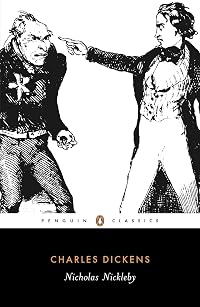
Nicholas Nickleby
by Charles Dickens
On This Page
Description
In nineteenth-century England, a young orphan boy lives in the squalid surroundings of a workhouse until he becomes involved with a gang of thieves.Tags
Recommendations




Member Recommendations
souloftherose Both books are early Dickens' novels and written in an episodic, picaresque style. Although Nicholas Nickleby is more plot-driven than The Pickwick Papers and contains some darker themes, both works are fundamentally happy Dickens novels and readers who enjoy one would probably enjoy the other.
40
Member Reviews
Swinging from the deplorable to the humorous to humility and kindness, this book has it all. Nicholas, a sweet soul with a temper, makes enemies of his wealthy uncle and a despicable teacher in his first job as his assistant. Saving a mistreated worker in the teacher’s household, Smike, they join an acting troupe—until they must rush back to London to save Nicholas’s sister from the machinations of that uncle. There he lands a job with the most noble businessmen, and slowly he tries to right wrongs inflicted on Smike and many others. Dickens’ sympathy for Smike, with a mental disability, is astounding for his time. I adored this book. Sometimes I wanted to bail because of the descriptions of the wicked treatment of small boys, show more but I’m glad I stuck it out. Dickens had a huge heart, and this book delves deeply into it. Highly recommended. show less
Spoilers. Do not read if you fear them.
I think that this is the most satisfying of Dickens's novels.
But then, I say that about all of his novels, after each re-read. Except for Martin Chuzzlewit. : /
Dickens is one writer I'll probably never review, because my reviews would be longer than the novels, so multi-layered as they are.
The most satisfying scene:
It was one of the brimstone-and-treacle mornings, and Mrs. Squeers had entered school according to custom with the large bowl and spoon, followed by Miss Squeers and the amiable Wackford: who during his father's absence, had taken upon himself such minor branches of the executive as kicking the pupils with his nailed boots, pulling the hair of some of the smaller boys, pinching the show more others in aggravating places, and rendering himself in various similar ways a great comfort and happiness to his mother. Their entrance, whether by premeditation or a simultaneous impulse, was the signal of revolt. While one detachment rushed to the door and locked it, and another mounted the desks and forms, the stoutest (and consequently the newest) boy seized the cane, and, confronting Mrs. Squeers with a stern countenance, snatched off her cap and beaver-bonnet, put it on his own head, armed himself with the wooden spoon and bade her on pain of death, go down upon her knees and take a dose directly. Before that estimable lady could recover herself, or offer the slightest retaliation, she was forced into a kneeling posture by a crowd of shouting tormentors, and compelled to swallow a spoonful of the odious mixture, rendered more than usually savoury by the immersion in the bowl of Master Wackford's head, whose ducking was entrusted to another rebel. show less
I think that this is the most satisfying of Dickens's novels.
But then, I say that about all of his novels, after each re-read. Except for Martin Chuzzlewit. : /
Dickens is one writer I'll probably never review, because my reviews would be longer than the novels, so multi-layered as they are.
The most satisfying scene:
It was one of the brimstone-and-treacle mornings, and Mrs. Squeers had entered school according to custom with the large bowl and spoon, followed by Miss Squeers and the amiable Wackford: who during his father's absence, had taken upon himself such minor branches of the executive as kicking the pupils with his nailed boots, pulling the hair of some of the smaller boys, pinching the show more others in aggravating places, and rendering himself in various similar ways a great comfort and happiness to his mother. Their entrance, whether by premeditation or a simultaneous impulse, was the signal of revolt. While one detachment rushed to the door and locked it, and another mounted the desks and forms, the stoutest (and consequently the newest) boy seized the cane, and, confronting Mrs. Squeers with a stern countenance, snatched off her cap and beaver-bonnet, put it on his own head, armed himself with the wooden spoon and bade her on pain of death, go down upon her knees and take a dose directly. Before that estimable lady could recover herself, or offer the slightest retaliation, she was forced into a kneeling posture by a crowd of shouting tormentors, and compelled to swallow a spoonful of the odious mixture, rendered more than usually savoury by the immersion in the bowl of Master Wackford's head, whose ducking was entrusted to another rebel. show less
Although not one of Dickens' most renowned works, I very much enjoyed Nicholas Nickleby. The son of a country gentleman ruined by bad advice, Nicholas Nickleby seeks the help of his Uncle Ralph when his father dies leaving the family destitute. Ralph Nickleby is a scheming, miserly usurer, and instead of helping his brother's family, sends Nicholas to work for a vicious schoolmaster, installs his sister Kate and their mother in a hovel of a flat, and forces Kate to work long hours as a seamstress. After many trials, however, good wins out and the bad get their just desserts.
As always, Dickens' side characters are simply delightful, and even the evil ones are entertaining. There are some very funny scenes which help counterbalance the show more horrors of the ill-treatment of the schoolboys at the beginning. The gender stereotypes were more pronounced in this novel as opposed to Bleak House, for instance, and I wished that Kate had a little more backbone. All in all, however, I enjoyed spending more time with Dickens' storytelling and the inestimable Simon Vance's narration. show less
As always, Dickens' side characters are simply delightful, and even the evil ones are entertaining. There are some very funny scenes which help counterbalance the show more horrors of the ill-treatment of the schoolboys at the beginning. The gender stereotypes were more pronounced in this novel as opposed to Bleak House, for instance, and I wished that Kate had a little more backbone. All in all, however, I enjoyed spending more time with Dickens' storytelling and the inestimable Simon Vance's narration. show less
Nicholas's father left him, his sister, and his mother without a home or any money at all at his death, and so they seek help from a rich uncle, who turns out to be the great villain of the plot. Nicholas must seek his own fortune and meets an outstanding variety of characters along the way, who run the spectrum from angelic to despicable with plenty of comic relief in between. It reads like a Shakespearean comedy on a grand and intricate scale, complete with a coming-of-age story and multiple marriages at the end. I loved it. I absolutely loved it.
Before there was Scrooge, there was Ralph Nickleby. Years before “A Christmas Carol,” Charles Dickens had already created a character in “Nicholas Nickleby” who could have given Scrooge lessons in miserliness.
The novel, published in 1838, opens with the death of Ralph's brother, making him responsible for his brother's widow and her two grown but not yet independent children, Nicholas and Kate. First he moves them into much more humble accommodations, then finds Nicholas a position as a tutor in a boy's school far from London. With the brother out of the way, he uses pretty Kate to entice two playboy noblemen into some business dealings, unmindful of what might happen to Kate afterward.
Nicholas soon discovers the headmaster at show more the school to be abusive toward the boys in his care. He flees with one of those boys and finds himself for a time with a wandering theater group before learning of his sister's situation. When he returns to rescue her, a long struggle between uncle and nephew begins, with many complications and adventures.
“Nicholas Nickleby” was not a successful novel in its day, at least in comparison with “Oliver Twist,” but it is hard to understand why. While it may not be one of the best novels Dickens wrote, it provides nonstop entertainment (except for one chapter that is obviously just padding and could be skipped without missing any of the story). It would make an excellent entry-level Dickens novel for those intimidated by that author's reputation for meandering plots and multitudes of characters. Here the plot rarely strays far from the Nicklebys, and the characters, while plentiful, are easy to keep straight. If the reader becomes confused about who a character is, Dickens soon enough makes it clear.
This was one of the early Dickens novels. He was still learning the game he would soon master, but we can already find evidence of some of the writer's greatest personal interests and concerns, among them the plight of boys in schools operated for profit, young women coerced into careers in the sex trade and the theater, his greatest love, perhaps even including writing.
There's humor here (Mrs. Nickleby ranks among his greatest comic characters), an abundance of romance (the clergy will have all the weddings they can handle by the end of the novel) and all the plot twists a reader could want. It's a massive novel, of course, but this is Dickens in an age when writers were paid for bulk. When a novel is this much fun, however, size is more blessing than curse. show less
The novel, published in 1838, opens with the death of Ralph's brother, making him responsible for his brother's widow and her two grown but not yet independent children, Nicholas and Kate. First he moves them into much more humble accommodations, then finds Nicholas a position as a tutor in a boy's school far from London. With the brother out of the way, he uses pretty Kate to entice two playboy noblemen into some business dealings, unmindful of what might happen to Kate afterward.
Nicholas soon discovers the headmaster at show more the school to be abusive toward the boys in his care. He flees with one of those boys and finds himself for a time with a wandering theater group before learning of his sister's situation. When he returns to rescue her, a long struggle between uncle and nephew begins, with many complications and adventures.
“Nicholas Nickleby” was not a successful novel in its day, at least in comparison with “Oliver Twist,” but it is hard to understand why. While it may not be one of the best novels Dickens wrote, it provides nonstop entertainment (except for one chapter that is obviously just padding and could be skipped without missing any of the story). It would make an excellent entry-level Dickens novel for those intimidated by that author's reputation for meandering plots and multitudes of characters. Here the plot rarely strays far from the Nicklebys, and the characters, while plentiful, are easy to keep straight. If the reader becomes confused about who a character is, Dickens soon enough makes it clear.
This was one of the early Dickens novels. He was still learning the game he would soon master, but we can already find evidence of some of the writer's greatest personal interests and concerns, among them the plight of boys in schools operated for profit, young women coerced into careers in the sex trade and the theater, his greatest love, perhaps even including writing.
There's humor here (Mrs. Nickleby ranks among his greatest comic characters), an abundance of romance (the clergy will have all the weddings they can handle by the end of the novel) and all the plot twists a reader could want. It's a massive novel, of course, but this is Dickens in an age when writers were paid for bulk. When a novel is this much fun, however, size is more blessing than curse. show less
Of course this is a classic, and it deserves to be, so we can go right past the “Is this a good book?” question.
The story was originally published in a series of 19 monthly installments. Dickens knew how to make a story engaging — 19 episodes is a long way to go, keeping the reader interested and compelled to find out what happens next, over and over again, episode to episode. That’s genius.
The story starts with an accounting of the background of the Nickleby family tree, leading up to where the action starts with the death of Nicholas’s father and the impoverishment of his family — Nicholas, his sister Kate, and their mother.
The family is thrown into a kind of moral and existential battle with the world, having been show more expelled from a comfortable if not idyllic life. They depend on the good wishes of Nicholas’s uncle Ralph, and Ralph is pretty short on good wishes.
And the world Nicholas, Kate, and their mother encounter is not full of picnics and rainbows. I won’t try to catalogue the corruption, the cruelty, the pettiness, and the venality. The highlights are the schoolmaster Squeers and good old Ralph himself. Both have bottomless senses of morality, if you can call them that at all. And both are unforgettable, iconic characters.
The plot is better than simple good vs. evil, but it’s that, too. Nicholas and Kate are almost preternaturally good, like angels sent from another world to punish the wrong and avenge the wronged. The plot is a collision between the world of corruption and cruelty championed by Squeers and Ralph and the world of virtue championed by Nicholas and Kate.
Dickens’ world in the novel has a moral physics — it’s a character in itself. I don’t want to say too much and spoil the ending(s) for anyone who doesn’t already know. But there are some natural laws at work in the moral world Dickens creates — greed leads to self-loathing, virtue leads to happiness, and one good turn really does lead to another. On that last point, Nicholas is a virtual magnet of good karma.
The London that Dickens portrays is a hell of pretense, class arrogance, parasitism, all with a bass line of desperation. A portrait of a culture and an economy that is fatally diseased, lacking the interventions of people like Nicholas, Kate, and the Cheerybles. The Cheerybles uniquely combine the virtues of success, charity, loyalty, . . . you name it. They are the patch of color in a gray London fog of petty malice. Nicholas and Kate are warriors taking up the same cause. I think I’ve mixed some metaphors.
While I’m thinking about it, something about Kate. I think a book called “The Life and Adventures of Kate Nickleby” would be fascinating. I wish I had the skill to write it. While Kate manifests the distinct feminine virtues of the time — she’s quiet, beautiful, and has charms to almost tame even the savage Ralph (at least momentarily) — her story is a feminine mirror of Nicholas’s. And I think, if we filled out the action, e.g., how she manages the deprecations, insults, and terrors dealt by Ralph, Sir Mulberry, and Arthur Gride, how she protects her mother’s pride and even temper, we’d find much more complexity in her story and depth to her character than may be apparent.
Smike is another character with depth worth reflecting on. He’s not so much a warrior as he is a victim, but a victim who will not sacrifice pride. He and Newman Noggs are survivors in hell, survivors in the sense in which they preserve character when they could be tempted into amoral vengeance (not ruling out moral vengeance, which is one of the games of the day).
Also one comparison that brings out the point about Dickens’ moral physics. As I read, I thought of de Sade’s book, Justine (written about fifty years earlier and set in an almost equally decadent France). De Sade’s maybe too obvious message in the book is that virtue doesn’t pay (after all, its subtitle is “The Misfortunes of Virtue”). In his moral universe, virtue is for losers. None of those natural laws of Dickens’ universe hold.
Dickens’ novel can almost be read as a rejection of de Sade’s world and an affirmation of the potential for the goodness embodied in Nicholas (and Kate). Dickens makes the point very sharply when he says, “In short, the poor Nicklebys were social and happy; while the rich Nickleby was alone and miserable.” show less
The story was originally published in a series of 19 monthly installments. Dickens knew how to make a story engaging — 19 episodes is a long way to go, keeping the reader interested and compelled to find out what happens next, over and over again, episode to episode. That’s genius.
The story starts with an accounting of the background of the Nickleby family tree, leading up to where the action starts with the death of Nicholas’s father and the impoverishment of his family — Nicholas, his sister Kate, and their mother.
The family is thrown into a kind of moral and existential battle with the world, having been show more expelled from a comfortable if not idyllic life. They depend on the good wishes of Nicholas’s uncle Ralph, and Ralph is pretty short on good wishes.
And the world Nicholas, Kate, and their mother encounter is not full of picnics and rainbows. I won’t try to catalogue the corruption, the cruelty, the pettiness, and the venality. The highlights are the schoolmaster Squeers and good old Ralph himself. Both have bottomless senses of morality, if you can call them that at all. And both are unforgettable, iconic characters.
The plot is better than simple good vs. evil, but it’s that, too. Nicholas and Kate are almost preternaturally good, like angels sent from another world to punish the wrong and avenge the wronged. The plot is a collision between the world of corruption and cruelty championed by Squeers and Ralph and the world of virtue championed by Nicholas and Kate.
Dickens’ world in the novel has a moral physics — it’s a character in itself. I don’t want to say too much and spoil the ending(s) for anyone who doesn’t already know. But there are some natural laws at work in the moral world Dickens creates — greed leads to self-loathing, virtue leads to happiness, and one good turn really does lead to another. On that last point, Nicholas is a virtual magnet of good karma.
The London that Dickens portrays is a hell of pretense, class arrogance, parasitism, all with a bass line of desperation. A portrait of a culture and an economy that is fatally diseased, lacking the interventions of people like Nicholas, Kate, and the Cheerybles. The Cheerybles uniquely combine the virtues of success, charity, loyalty, . . . you name it. They are the patch of color in a gray London fog of petty malice. Nicholas and Kate are warriors taking up the same cause. I think I’ve mixed some metaphors.
While I’m thinking about it, something about Kate. I think a book called “The Life and Adventures of Kate Nickleby” would be fascinating. I wish I had the skill to write it. While Kate manifests the distinct feminine virtues of the time — she’s quiet, beautiful, and has charms to almost tame even the savage Ralph (at least momentarily) — her story is a feminine mirror of Nicholas’s. And I think, if we filled out the action, e.g., how she manages the deprecations, insults, and terrors dealt by Ralph, Sir Mulberry, and Arthur Gride, how she protects her mother’s pride and even temper, we’d find much more complexity in her story and depth to her character than may be apparent.
Smike is another character with depth worth reflecting on. He’s not so much a warrior as he is a victim, but a victim who will not sacrifice pride. He and Newman Noggs are survivors in hell, survivors in the sense in which they preserve character when they could be tempted into amoral vengeance (not ruling out moral vengeance, which is one of the games of the day).
Also one comparison that brings out the point about Dickens’ moral physics. As I read, I thought of de Sade’s book, Justine (written about fifty years earlier and set in an almost equally decadent France). De Sade’s maybe too obvious message in the book is that virtue doesn’t pay (after all, its subtitle is “The Misfortunes of Virtue”). In his moral universe, virtue is for losers. None of those natural laws of Dickens’ universe hold.
Dickens’ novel can almost be read as a rejection of de Sade’s world and an affirmation of the potential for the goodness embodied in Nicholas (and Kate). Dickens makes the point very sharply when he says, “In short, the poor Nicklebys were social and happy; while the rich Nickleby was alone and miserable.” show less
This is the first time I have ever managed to finish a book by Charles Dickens. It was actually recommended to me as one of his more accessible novels, so thanks to the recommender for a good choice. One of the things that makes it more readable than [b:Oliver Twist|18254|Oliver Twist|Charles Dickens|http://photo.goodreads.com/books/1327868529s/18254.jpg|3057979] or [b:Great Expectations|2623|Great Expectations|Charles Dickens|http://photo.goodreads.com/books/1327920219s/2623.jpg|2612809]is that at the start of the book the protagonist is an adult, not a child. This means that he has a bit more agency and doesn't just spend the first 200 pages getting neglected and mistreated as in the other two Dickens novels I've attempted.
That's the show more good part. I have two main beefs with Dickens' writing in general and this particular novel is no exception. Beef number 1 is just a stylistic one. In his attempt to maintain a light and cheerful tone, the author's attempts at irony are often just saying the opposite. So when Dickens describes "those stories of engrossing interest which are to be found in the more antiquated spelling-books" we all undersstand that he means that the stories are dull. In that sense it's technically irony, but it's irony without purpose. Frequently he confuses saying-the-opposite with irony, but irony needs to have a purpose, a reason that the speaker is distancing themself from the statement they are making - eg. in this case the purpose might be to lampoon the person who thinks these stories are interesting, but no-one thinks this. Without purpose it's just a moment of dissonance, of negativity. So, the point here is that a light, chirpy writing style needs to have wit, or it just comes across as sarcastic. In passages Dickens has loads of wit, in other long sections there was just not enough to engage me.
Beef number two (remember we were counting beefs. Stay with me) is the characterisation, or should I say caricaturisation. There are no characters in this book, there are only cliches and types and because they are so paper thin all the characters are eventually unlikeable. Remember that moment in one of the David Tennant series of Dr Who when he joins in a soccer game and is brilliant at it? Instead of liking him more, I liked him much, much less. The character of Nicholas Nickleby has a kind of moral sonic screwdriver that solves all problems and quickly becomes tedious. We want our heroes to fail sometimes and we want them to make compromises. Or at least I do. Dickens' enduring popularity and respect obviously make that generalisation incorrect. Having said that, I actually found Nicholas Nickleby to be the least unlikeable character. The baddies are so relentlessly evil that it's impossible to think of them as human and the goodies are so weak, stupid, helpless or unlikely as to be highly punchable within five pages of their introduction.
Finally I'll note that I don't take pleasure in seeing people get their comeuppance. When a miserable person who did terrible things suffers for their actions, it's a sad occasion, not a cause for gloating and celebration (this is not a spoiler as there are many baddies in this book, so you'll have to read to find out where and whether just deserts are distributed). Dickens' vindictive kind of morality differs so greatly from mine as to be somewhat offensive and I couldn't enjoy scenes that I think I was supposed to rub my hands at.
So, this book is a good choice if you want to say you've read Dickens, or if you love Dickens, but otherwise, read [b:Jane Eyre|10210|Jane Eyre|Charlotte Brontë|http://photo.goodreads.com/books/1327867269s/10210.jpg|2977639] for an idea of what 19th century literature can be. show less
That's the show more good part. I have two main beefs with Dickens' writing in general and this particular novel is no exception. Beef number 1 is just a stylistic one. In his attempt to maintain a light and cheerful tone, the author's attempts at irony are often just saying the opposite. So when Dickens describes "those stories of engrossing interest which are to be found in the more antiquated spelling-books" we all undersstand that he means that the stories are dull. In that sense it's technically irony, but it's irony without purpose. Frequently he confuses saying-the-opposite with irony, but irony needs to have a purpose, a reason that the speaker is distancing themself from the statement they are making - eg. in this case the purpose might be to lampoon the person who thinks these stories are interesting, but no-one thinks this. Without purpose it's just a moment of dissonance, of negativity. So, the point here is that a light, chirpy writing style needs to have wit, or it just comes across as sarcastic. In passages Dickens has loads of wit, in other long sections there was just not enough to engage me.
Beef number two (remember we were counting beefs. Stay with me) is the characterisation, or should I say caricaturisation. There are no characters in this book, there are only cliches and types and because they are so paper thin all the characters are eventually unlikeable. Remember that moment in one of the David Tennant series of Dr Who when he joins in a soccer game and is brilliant at it? Instead of liking him more, I liked him much, much less. The character of Nicholas Nickleby has a kind of moral sonic screwdriver that solves all problems and quickly becomes tedious. We want our heroes to fail sometimes and we want them to make compromises. Or at least I do. Dickens' enduring popularity and respect obviously make that generalisation incorrect. Having said that, I actually found Nicholas Nickleby to be the least unlikeable character. The baddies are so relentlessly evil that it's impossible to think of them as human and the goodies are so weak, stupid, helpless or unlikely as to be highly punchable within five pages of their introduction.
Finally I'll note that I don't take pleasure in seeing people get their comeuppance. When a miserable person who did terrible things suffers for their actions, it's a sad occasion, not a cause for gloating and celebration (this is not a spoiler as there are many baddies in this book, so you'll have to read to find out where and whether just deserts are distributed). Dickens' vindictive kind of morality differs so greatly from mine as to be somewhat offensive and I couldn't enjoy scenes that I think I was supposed to rub my hands at.
So, this book is a good choice if you want to say you've read Dickens, or if you love Dickens, but otherwise, read [b:Jane Eyre|10210|Jane Eyre|Charlotte Brontë|http://photo.goodreads.com/books/1327867269s/10210.jpg|2977639] for an idea of what 19th century literature can be. show less
Members
- Recently Added By
Lists

1001 Books You Must Read Before You Die
1,448 works; 1,133 members

The Guardian's 1000 Novels Everyone Must Read
1,005 works; 550 members

Favorite Dickens novels?
16 works; 27 members

Read the book and saw the movie
1,170 works; 195 members

Favourite 19th century fiction
257 works; 62 members

Favourite Books
1,819 works; 309 members

Unread books
1,063 works; 86 members

Favorite Long Books
330 works; 42 members
Folio Society
831 works; 53 members
Books I've Read More Than Once
602 works; 49 members

150 Best Novels Selected by Brander Matthews (1883)
150 works; 7 members
Books That Changed Me
158 works; 47 members

Best Books Set in Boarding Schools
160 works; 57 members
...read all, pay nowt (Books set in Yorkshire)
86 works; 14 members
LibraryThingers' 1001 Books You Must Read Before You Die
442 works; 30 members
Best School Stories
219 works; 22 members
Harold Bloom - The Western Canon: C. The Democratic Age
336 works; 15 members
Newark Public Library's 1904 List of a Thousand of the Best Novels
95 works; 5 members

Books You Bought in 2013
35 works; 3 members

Movie Adaptations
111 works; 4 members
Good, Smart, Clean Fiction
46 works; 4 members

Rory Gilmore Book Club
193 works; 5 members

CCE 1000 Good Books List
1,033 works; 12 members

Books Read in 2023
5,547 works; 145 members

Books I Own But Haven't Read
144 works; 2 members
F. B. Perkins' List of 100 Best Fiction
100 works; 5 members
Our Favorite Comfort Reads
334 works; 200 members

Mustich's 1000 Books to Read Before You Die: A Life Changing List
1,001 works; 19 members

Books Read in 2026
1,919 works; 66 members

Recommended Reading : 600 Classics Reviewed, Editors of Salem Press, 2015
634 works; 6 members
The Complete Rory Gilmore Reading List
506 works; 5 members

Books Bought & Received as Gifts in 2014
81 works; 1 member

Greatest Books, allegedly
484 works; 9 members

A Reading List
100 works; 3 members

Books Read in 2021
5,361 works; 113 members

Books Read in 2018
4,360 works; 110 members
Books with a Character's Name as the Title
129 works; 9 members

Fiction with Men's Given Names in the Title
302 works; 10 members

Charles Dickens books
17 works; 1 member
Talk Discussions
Past Discussions
EP DLE Charles Dickens's THE LIFE AND ADVENTURES OF NICHOLAS NICKLEBY in Easton Press Collectors (July 2023)
Group Read: Nicholas Nickleby by Charles Dickens in 75 Books Challenge for 2018 (May 2018)
Author Information

2,578+ Works 313,139 Members
Charles Dickens, perhaps the best British novelist of the Victorian era, was born in Portsmouth, Hampshire, England on February 7, 1812. His happy early childhood was interrupted when his father was sent to debtors' prison, and young Dickens had to go to work in a factory at age twelve. Later, he took jobs as an office boy and journalist before show more publishing essays and stories in the 1830s. His first novel, The Pickwick Papers, made him a famous and popular author at the age of twenty-five. Subsequent works were published serially in periodicals and cemented his reputation as a master of colorful characterization, and as a harsh critic of social evils and corrupt institutions. His many books include Oliver Twist, David Copperfield, Bleak House, Great Expectations, Little Dorrit, A Christmas Carol, and A Tale of Two Cities. Dickens married Catherine Hogarth in 1836, and the couple had nine children before separating in 1858 when he began a long affair with Ellen Ternan, a young actress. Despite the scandal, Dickens remained a public figure, appearing often to read his fiction. He died in 1870, leaving his final novel, The Mystery of Edwin Drood, unfinished. (Bowker Author Biography) show less
Some Editions
Awards and Honors
Awards
Notable Lists
Series
Belongs to Publisher Series
Prisma Klassieken (10)
D'ací i d'allà (105)
Winkler Weltliteratur Dünndruckausgabe (Dickens 11)
Collins Classics (37)
Penguin English Library, 2012 series (2012-09)
Everyman's Library (238)
insel taschenbuch (1304)
Work Relationships
Is contained in
Contains
Is retold in
Has the adaptation
Is abridged in
Inspired
Has as a student's study guide
Common Knowledge
- Canonical title
- Nicholas Nickleby
- Original title
- The Life and Adventures of Nicholas Nickleby
- Original publication date
- 1839; 1838-1839 as serial, 1839 as book
- People/Characters
- Nicholas Nickleby; Kate Nickleby; Mr Ralph Nickleby; Mrs Nickleby; Smike; Newman Noggs (show all 26); Wackford Squeers; Mrs Squeers; Fanny Squeers; John Browdie; Vincent Crummles; Mrs Crummles; The Infant Phenomenon; Sir Mulberry Hawk; Lord Frederick Verisopht; Alfred Mantalini; Mrs Mantalini; Madeline Bray; Walter Bray; Charles Cheeryble; Ned Cheeryble; Tim Linkinwater; Miss La Creevy; Arthur Gride; Peg Sliderskew; Baron Von Koldwethout of Grogzwig
- Important places
- London, England, UK; Dotheboys Hall (Yorkshire, England); Devon, England, UK; Yorkshire, England, UK; Portsmouth, Hampshire, England, UK; Grogzwig, Germany
- Related movies
- Nicholas Nickleby (2002 | IMDb); The Life and Adventures of Nicholas Nickleby (1982 | IMDb); The Life and Adventures of Nicholas Nickleby (2001 | IMDb); The Life and Adventures of Nicholas Nickleby (1947 | IMDb)
- First words
- There once lived, in a sequestered part of the county of Devonshire, one Mr Godfrey Nickleby: a worthy gentleman, who, taking it into his head rather late in life that he must get married, and not being young enough or rich e... (show all)nough to aspire to the hand of a lady of fortune, had wedded an old flame out of mere attachment, who in her turn had taken him for the same reason.
[Introduction] When Dickens started writing Nicholas Nickleby on 6 February 1838 -- the day before his twenty-sixth birthday -- he was riding the crest of a wave.
[G. K. Chesterton Introduction] Romance is perhaps the highest point of human expression, except indeed religion to which it is closely allied. - Quotations
- . . . if the government had one object more at heart than another, that one object was the welfare and advantage of the United Metropolitan Improved Hot Muffin and Crumpet Baking and Punctual Delivery Company. (Chapter 2)
- Last words
- (Click to show. Warning: May contain spoilers.)Through all the spring and summertime, garlands of fresh flowers, wreathed by infant hands, rested on the stone; and, when the children came to change them lest they should wither and be pleasant to him no longer, their eyes filled with tears, and they spoke low and softly of their poor dead cousin.
(Click to show. Warning: May contain spoilers.)[Introduction] Ralph Nickleby would have said the same.
(Click to show. Warning: May contain spoilers.)[G. K. Chesterton Introduction] Dickens is the voice of them, and a very divine voice; because he was perhaps the only one of the unsuccessful men that was ever successful. - Original language
- English
Classifications
Statistics
- Members
- 7,815
- Popularity
- 1,445
- Reviews
- 111
- Rating
- (3.93)
- Languages
- 14 — Catalan, Czech, Danish, Dutch, English, Finnish, French, German, Italian, Farsi/Persian, Portuguese, Russian, Spanish, Swedish
- Media
- Paper, Audiobook, Ebook
- ISBNs
- 342
- UPCs
- 9
- ASINs
- 239