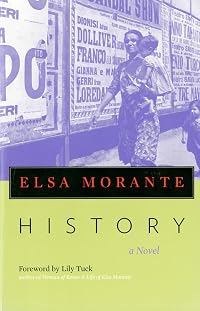
History
by Elsa Morante
On This Page
Description
History was written nearly thirty years after Elsa Morante and Alberto Moravia spent a year in hiding among remote farming villages in the mountains south of Rome. There she witnessed the full impact of the war and first formed the ambition to write an account of what history - the great political events driven by men of power, wealth, and ambition - does when it reaches the realm of ordinary people struggling for life and bread. The central character in this powerful and unforgiving novel show more is Ida Mancuso, a schoolteacher whose husband has died and whose feckless teenage son treats the war as his playground. A German soldier on his way to North Africa rapes her, falls in love with her, and leaves her pregnant with a boy whose survival becomes Ida's passion. Around these two other characters come and go, each caught up by the war which is like a river in flood. We catch glimpses of bombing raids, street crimes, a cattle car from which human cries emerge, an Italian soldier succumbing to frostbite on the Russian front, the dumb endurance of peasants who have lived their whole lives with nothing and now must get by with less than nothing. show lessTags
Recommendations


















Member Recommendations


Member Reviews
Un capolavoro, basta questa parola per definire questo libro, per me, di una bellezza sconvolgente. Uno sguardo spietato e al tempo stesso struggente, straziante ma anche dolcissimo, sul periodo dell’ultima guerra e che fa da sfondo al racconto delle vicende di Ida, Nino, Useppe, Davide e di tantissimi altri personaggi che li accompagnano in quegli anni difficili e durissimi.
Letto la prima volta alla sua uscita nel 1974 è un libro da leggere e rileggere, assolutamente.
Letto la prima volta alla sua uscita nel 1974 è un libro da leggere e rileggere, assolutamente.
This should be called Social History: A Novel with a Heart. It should be called A Novel With a Heart that Wriggles to Live and Struggle and Snarl and Nip like a Pup at the Bitch's Teat, Squirms with a Perfect Limerence that Will be Written in Heartbrimming Prose by Signora Morante So that It Will Never Be Forgotten, Tosses Its Curls and Pastes a Sneer on Its Pomegranate Lips and Puffs Out the Chest of Its Slight but Sturdy Frame and Says It's a Joke a Joke All a Joke, Shakes Itself Apart with a Fear that Means Crumbling Bones, Infected Blood, Grands Mals, a Fire Consuming All and All the Kids and Animals Run from the Fire, and Shivers and Resolves into a Joy that Can't be Beat, that a Little Boy Named Useppe Brought into the World with show more him by a Miraculous Transubstantiation Just by Being Born, that All the Kids and Animals Fly Away to America or Heaven, that We'll Always Be Together. That sounds like a book that would leave the reader abject and trembling a time or two, but come ever back in the spirit of that always-togethermanship and lead you home.
But this book is also subtitled: And that trembling, that shivering, that shaking, tossing, squirming, wriggling, all the way back into the safety of the womb, that's just your sickness, your epilepsy, your failure to thrive, no grands mals, grand narratives, capital letters here, except one, because the Fear is back, consuming all the kids and animals, and we'll never be together, because everyone's dead. I can't remember ever feeling so wrung out and wasted by a book with so much human spirit and happiness-against-the-odds in it. The fact that the Italian Left condemned this book on grounds of ideological purity is so repulsive and, as capital-H history, the gross kind, currently in 2011 slouches toward the future with a wave of "we (always together) are the 99%" protests that purport to be about a kinder and fairer society, it's worth saying a little prayer that we all err, when we err, on the side of love. And that somehow this time love doesn't leave us victims of the 1% that start wars and co-opt ideas into ideologies and hoard all the safety and love they can for themselves. When they cause the mass society to exist in a perpetual state of threat and insecurity, they are damaging and destroying humans. Late capitalism is a war of the few on the many--trite and true--and opposing economic equality is a war crime. show less
But this book is also subtitled: And that trembling, that shivering, that shaking, tossing, squirming, wriggling, all the way back into the safety of the womb, that's just your sickness, your epilepsy, your failure to thrive, no grands mals, grand narratives, capital letters here, except one, because the Fear is back, consuming all the kids and animals, and we'll never be together, because everyone's dead. I can't remember ever feeling so wrung out and wasted by a book with so much human spirit and happiness-against-the-odds in it. The fact that the Italian Left condemned this book on grounds of ideological purity is so repulsive and, as capital-H history, the gross kind, currently in 2011 slouches toward the future with a wave of "we (always together) are the 99%" protests that purport to be about a kinder and fairer society, it's worth saying a little prayer that we all err, when we err, on the side of love. And that somehow this time love doesn't leave us victims of the 1% that start wars and co-opt ideas into ideologies and hoard all the safety and love they can for themselves. When they cause the mass society to exist in a perpetual state of threat and insecurity, they are damaging and destroying humans. Late capitalism is a war of the few on the many--trite and true--and opposing economic equality is a war crime. show less
http://nwhyte.livejournal.com/2514718.html
I think this is one of the best novels I've read about the second world war and its aftermath - the life of a child in Rome in the 1940s, conceived in violence, his (secretly Jewish) mother and brother doing their best to survive in awful circumstances. While others spout political certainties (whether of ideology or geopolitical alliance), the harsh reality for those whose lives are wrecked by conflict remains the same. Each chapter, covering a year, is prefaced by a headline summary of the major political developments of that year as a sort of political canvas against which the domestic drama plays out. It is not fast-paced, but I found it intensely absorbing, and it deserves to be much better show more known in the English-speaking world. show less
I think this is one of the best novels I've read about the second world war and its aftermath - the life of a child in Rome in the 1940s, conceived in violence, his (secretly Jewish) mother and brother doing their best to survive in awful circumstances. While others spout political certainties (whether of ideology or geopolitical alliance), the harsh reality for those whose lives are wrecked by conflict remains the same. Each chapter, covering a year, is prefaced by a headline summary of the major political developments of that year as a sort of political canvas against which the domestic drama plays out. It is not fast-paced, but I found it intensely absorbing, and it deserves to be much better show more known in the English-speaking world. show less
What an amazing book. A morbid tale of failure and death in Rome around the last few years of WW2 and the few years after that is compellingly readable.
I enjoyed the writing and the vividness of the characters - flawed, and highly believable. I also learned of the disaster of those years in Italy - which, for me, casts a new light on the lives of all those Italian migrants of the 1950s.
I came across the book in Motherlands, a recently published book of the Australian descendant of Italian migrants who is searching for her roots. I owe the author a debt. I got the English translation of the book via an inter-library loan organized by my local library on the Sunshine Coast - I count myself as very lucky that such institutions exist, and show more deliver such a service. show less
I enjoyed the writing and the vividness of the characters - flawed, and highly believable. I also learned of the disaster of those years in Italy - which, for me, casts a new light on the lives of all those Italian migrants of the 1950s.
I came across the book in Motherlands, a recently published book of the Australian descendant of Italian migrants who is searching for her roots. I owe the author a debt. I got the English translation of the book via an inter-library loan organized by my local library on the Sunshine Coast - I count myself as very lucky that such institutions exist, and show more deliver such a service. show less
“History: A Novel” by Elsa Morante may be the bleakest novel I’ve ever read. It is the story of one woman’s attempt to survive and protect her two children while living in Rome during World War II. The main character, Ida Mancuso, loses everything through events that are entirely beyond her control. Unlike most war novels which are written from the perspective of soldiers, this novel presents the war from the perspective of civilians caught in the conflict and with little idea of what is going on or why. Published in 1974, the story likely was informed by events in the life of the author. Morante’s husband, author Alberto Moravia, was an opponent of Mussolini’s fascist government and the two of them spent a year hiding in show more the mountains south of Rome during part of the war. The character Ida (or “Iduzza”) was born to a hard-drinking, politically vocal father (Giuseppe Ramundo) from the Calabria region of Italy and a Jewish mother (Nora Almagià – apparently the accent on the “a” gives away the Jewish origin of the name) from Padua. Ida marries Alfio Mancuso from Messina. Soon after, her father dies of cirrhosis of the liver and her husband dies of cancer. Ida is left to raise her son Antonio (“Nino”) in Rome during the war. The book is divided into sections covering 1941-1947 and nothing happy ever happens to Ida. In 1941, a German soldier passing through literally bumps into Ida on her way home from shopping and decides to rape her. He is killed 3 days later on an air convoy over the Mediterranean and Ida later finds she is pregnant. The child (named Giuseppe and affectionately known as “Useppe”) is born in 1941. Throughout the story, Ida must contend with the wanderlust of Nino (who eventually joins the Italian resistance) and the fragile health of Useppe who doesn’t get much to eat (and later turns out to have epilepsy). At one point, Nino brings home a delightful dog “Blitz” (brown with a white star on his belly) who watches over Useppe. Unfortunately, “Blitz” is killed when Ida’s apartment building is bombed while she and Useppe are out shopping. Useppe and Ida must live in a refugee shelter in Pietralata (along with a large family nicknamed “the Thousand”). Ida lives in constant fear of the Nazis due to her Jewish background. In one memorable scene she witnesses Jews crowded in cattle cars waiting to be deported to the extermination camps:
“The interior of the cars, scorched by the lingering summer sun, continued to reecho with that incessant sound. In its disorder, babies’ cries overlapped with quarrels, ritual chanting, meaningless mumbles, senile voices calling for mother; others that conversed, aside, almost ceremonious, and others that were even giggling. And at times, over all this, sterile, bloodcurdling screams rose; or others, of a bestial physicality, exclaiming elementary words like “water!” “air!” From one of the last cars, dominating all the other voices, a young woman would burst out, at intervals, with convulsive, piercing shrieks, typical of labor pains.”
At a low point, she must steal food to keep Useppe going. The story also relates the resistance efforts of Nino and his band, including the escaped Jewish student David Segre (aka Carlo Vivaldi, aka “Pytor”) whose parents and sister were exterminated by the Nazis. There are several depressing scenes here too – for example when Segre, after shooting a German soldier, continues kicking the German’s head until he dies.
After the war, things don’t get any better. Nino takes to making money on the black market and is killed when his truck is wrecked after being chased by the police. Useppe’s epilepsy is a continual worry, especially since Ida has to leave him alone while she works as a school teacher. Fortunately, Nino had been given another dog – an Abruzzi shepherd named “Bella” – and “Bella” becomes Useppe’s only friend and protector. Useppe and “Bella” have some enjoyable adventures, but his epilepsy eventually catches up with him. Ida lives out her remaining 9 years of life in an institution. And that’s it – nothing happy. The only “uplifting” thing about this book is the beautiful way the dogs “Blitz” and “Bella” are portrayed with great affection by the author. She lets the reader into their canine minds and lets us see things from their perspective as devoted friends and protectors of their owners. The loyalty of dogs is one of the finest things in nature, and Morante does a wonderful job with this aspect of the book. show less
“The interior of the cars, scorched by the lingering summer sun, continued to reecho with that incessant sound. In its disorder, babies’ cries overlapped with quarrels, ritual chanting, meaningless mumbles, senile voices calling for mother; others that conversed, aside, almost ceremonious, and others that were even giggling. And at times, over all this, sterile, bloodcurdling screams rose; or others, of a bestial physicality, exclaiming elementary words like “water!” “air!” From one of the last cars, dominating all the other voices, a young woman would burst out, at intervals, with convulsive, piercing shrieks, typical of labor pains.”
At a low point, she must steal food to keep Useppe going. The story also relates the resistance efforts of Nino and his band, including the escaped Jewish student David Segre (aka Carlo Vivaldi, aka “Pytor”) whose parents and sister were exterminated by the Nazis. There are several depressing scenes here too – for example when Segre, after shooting a German soldier, continues kicking the German’s head until he dies.
After the war, things don’t get any better. Nino takes to making money on the black market and is killed when his truck is wrecked after being chased by the police. Useppe’s epilepsy is a continual worry, especially since Ida has to leave him alone while she works as a school teacher. Fortunately, Nino had been given another dog – an Abruzzi shepherd named “Bella” – and “Bella” becomes Useppe’s only friend and protector. Useppe and “Bella” have some enjoyable adventures, but his epilepsy eventually catches up with him. Ida lives out her remaining 9 years of life in an institution. And that’s it – nothing happy. The only “uplifting” thing about this book is the beautiful way the dogs “Blitz” and “Bella” are portrayed with great affection by the author. She lets the reader into their canine minds and lets us see things from their perspective as devoted friends and protectors of their owners. The loyalty of dogs is one of the finest things in nature, and Morante does a wonderful job with this aspect of the book. show less
This book is called “La Storia” in Italian. It’s called “History: A novel” in English. Its layout is interesting. Its events take place from about 1940 (the first chapter is called “194….” and left ambiguous) to 1952. Each chapter is one of these years. And each chapter starts out with a bulletin-like news roundup of great events of that year. Then, the chapter settles into the story of a family of poor Roman Italians, and the people whose lives theirs intersect with. Their life is grim. They are already poor and marginal people, and things keep going from bad to worse. We meet the widow Ida (Iduzza) who is raped by a German soldier at the beginning, her son Nino (Ninarieddu and various other complicated nicknames), and show more her other son, progeny of the rape, Useppe (really, Giuseppe). We follow their lives as they gain and lose canine family members, lose their apartment to a bombing, live with various other characters in a very grim concrete structure during the war, meet Jewish escapee and Partisan fighter Carlo Vivaldi/David Segre, and then struggle to pick up their lives again after the war, an impossible task. The narrator tells everyone’s story as if it had equal importance with the “great events” that mark the beginning of each chapter. Morante meant to show that those anonymous masses were just as important in the great scheme of things as the powerful leaders of the time. It was a heartbreaking story.
Right after I finished reading this book, the Occupy Wall Street movement started, and one of the early and continuing products of that movement, the “We are the 99%” website, gripped my attention. It is made up of anonymous people, members of the masses, who write down their trials and tribulations on a poster and hold it up for the camera. Sometimes these are short and to the point. Sometimes they are long and involved. Most of them will make you sad, a few will make you roll your eyes, but none will leave you completely unmoved. I have been reading it off and on for a few weeks (it is hard to read because I get teared up and have to stop), and yesterday, it struck me that it’s a modern, free form, “Storia” only it’s written by the characters rather than an author. Is it a good thing that the characters are taking control of their voices and becoming authors? I think it is exciting, even though it is often sad. After all, our lives are not more heartbreaking than the lives of those people who struggled to survive in Italy during World War II, but life still cries out against injustices and oppressions, and the release of such a voice is bound to have some impact.
I wish Morante were still alive – I would love to see her reaction to current events. I wonder if regular people’s struggles will ever make it into a news bulletin such as those that opened her chapters. And I answer myself, it has in the past, if they organized (like they are doing now) and refused to have their voices silenced. I am glad I am alive now and seeing these things happening around me. I am also glad to have read this book, which was a best seller in Italy immediately following the war, but which I had never heard of until my LT book group decided to read it. I am grateful to urania and the Salon for introducing me to Elsa Morante and the beautiful, heartbreaking History: A Novel. show less
Right after I finished reading this book, the Occupy Wall Street movement started, and one of the early and continuing products of that movement, the “We are the 99%” website, gripped my attention. It is made up of anonymous people, members of the masses, who write down their trials and tribulations on a poster and hold it up for the camera. Sometimes these are short and to the point. Sometimes they are long and involved. Most of them will make you sad, a few will make you roll your eyes, but none will leave you completely unmoved. I have been reading it off and on for a few weeks (it is hard to read because I get teared up and have to stop), and yesterday, it struck me that it’s a modern, free form, “Storia” only it’s written by the characters rather than an author. Is it a good thing that the characters are taking control of their voices and becoming authors? I think it is exciting, even though it is often sad. After all, our lives are not more heartbreaking than the lives of those people who struggled to survive in Italy during World War II, but life still cries out against injustices and oppressions, and the release of such a voice is bound to have some impact.
I wish Morante were still alive – I would love to see her reaction to current events. I wonder if regular people’s struggles will ever make it into a news bulletin such as those that opened her chapters. And I answer myself, it has in the past, if they organized (like they are doing now) and refused to have their voices silenced. I am glad I am alive now and seeing these things happening around me. I am also glad to have read this book, which was a best seller in Italy immediately following the war, but which I had never heard of until my LT book group decided to read it. I am grateful to urania and the Salon for introducing me to Elsa Morante and the beautiful, heartbreaking History: A Novel. show less
The great Italian novel of the Second World War, is ostensibly the story of Madonna and Child. It focuses on Ida’s struggles to survive the Nazi occupation and bombing of Rome, and to ensure the survival of the child conceived during a rape by a German soldier in the early days of the war.
At the same time, as the colon in the title intimates, it is an examination on a larger scale than Levi’s The Juggler of the relationship between literature and history: history is a novel, so horrific are the events portrayed in it that they beggar disbelief. The novel becomes history, reflects it, stores it, (re)creates it. The book is framed by a summary of the main historical events starting from 1900, from a Marxist point of view, in which show more humanity is described as the victims of the capitalist war industry, that wars are started not as conflicts over territory but as ways of consuming the products of an already existing war industry. Who is to say that she is wrong? This summary is then intensified in a month-by-month break down of each year before each of the seven parts into which the book is divided. Against this historical ‘background’ the gritty details of Ida’s story are set in context. And yet what is the real history? The events described in the summary, or the real suffering undergone by the victims of war – as fictionalized in this novel...
Read the full review on The Lectern:
http://thelectern.blogspot.com/2007/05/history-novel-elsa-morante.html show less
At the same time, as the colon in the title intimates, it is an examination on a larger scale than Levi’s The Juggler of the relationship between literature and history: history is a novel, so horrific are the events portrayed in it that they beggar disbelief. The novel becomes history, reflects it, stores it, (re)creates it. The book is framed by a summary of the main historical events starting from 1900, from a Marxist point of view, in which show more humanity is described as the victims of the capitalist war industry, that wars are started not as conflicts over territory but as ways of consuming the products of an already existing war industry. Who is to say that she is wrong? This summary is then intensified in a month-by-month break down of each year before each of the seven parts into which the book is divided. Against this historical ‘background’ the gritty details of Ida’s story are set in context. And yet what is the real history? The events described in the summary, or the real suffering undergone by the victims of war – as fictionalized in this novel...
Read the full review on The Lectern:
http://thelectern.blogspot.com/2007/05/history-novel-elsa-morante.html show less
Members
- Recently Added By
Lists

The Guardian's 1000 Novels Everyone Must Read
1,005 works; 549 members

Books Set in Italy
167 works; 19 members

Italian Literature
558 works; 40 members

The 100 Best Books of All Time by Norwegian Book Club (World Library)
104 works; 23 members

Historical Fiction
889 works; 90 members

Favorite Long Books
330 works; 42 members

Female Author
1,234 works; 66 members

Best Historical Fiction
620 works; 258 members
20th Century Literature
1,161 works; 55 members
Female Protagonist
1,056 works; 57 members

Best War Stories
87 works; 16 members

Canon de la narrativa universal del siglo XX
254 works; 6 members
Books About World War II
102 works; 29 members

1970s
657 works; 23 members
Favourite Books
1,820 works; 316 members

Books about World War II
241 works; 22 members

War Literature
101 works; 19 members

Five star books
1,767 works; 110 members
LibraryThingers' 1001 Books You Must Read Before You Die
442 works; 29 members

A High School Trip to Italy
55 works; 7 members

Books Set in Rome
98 works; 2 members

Llibres que he llegit el 2013
47 works; 1 member

le donne raccontano
116 works; 1 member

Mustich's 1000 Books to Read Before You Die: A Life Changing List
1,001 works; 20 members

THE WAR ROOM
813 works; 24 members

Canon de la narrativa universal del s. XX (cicutadry)
499 works; 3 members
Lista dei 100 migliori libri italiani degli ultimi 200 anni
100 works; 1 member
.
396 works; 1 member
Author Information

65+ Works 3,853 Members
Prolific and highly successful, Elsa Morante distinguished herself as a novelist, short story writer, and poet. The Marxist critic Gyorgy Lukacs hailed Morante's early House of the Liars (1948) as "the greatest modern Italian novel," but it was Arthur's Island (1957) that brought her international fame and an independent income. Her great show more financial triumph was, however, History (1974), which was the first Italian novel to be marketed with high-pressure promotional advertising, making use of publisher, mass media, and political party resources to push sales up to 600,000 copies in less than six months. Morante married Alberto Moravia in 1941, and they separated in 1962. (Bowker Author Biography) show less
Some Editions
Awards and Honors
Distinctions
Notable Lists
Series
Belongs to Publisher Series
Gyldendals små grå (20)
Work Relationships
Is contained in
Contains
Common Knowledge
- Canonical title
- History
- Original title
- La storia: romanzo
- Original publication date
- 1974 (original Italian) (original Italian); 1977 (English translation) (English translation)
- People/Characters
- Ida Ramundo; Useppe Ramundo; Antonio 'Nino' Ramundo; Davide Segre
- Important places
- Rome, Italy
- Important events
- World War II
- Epigraph
- Er is in geen enkele mensentaal een woord
dat de proefdieren kan troosten
die het waarom van hun dood niet kennen.
Een overlevende van Hirosjima
Trans.: There is no word in the human language capable
of con... (show all)soling the guinea pigs who do not know
the reason of their death.
A survivor of Hiroshima
... dat Gij deze dingen voor wijzen en verstandigen verborgen hebt,
doch aan kinderkens geopenbaard...
... want zo is het een welbehagen geweest voor U.
Lucas 10:21
Trans.:...thou hast these things from the wi... (show all)se and prudent,
and hast revealed them unto babes...
for so it seemed good in thy sight.
Luke 10:21 - Dedication
- Por el analfabeto a quien escribo
Trans.: To the illiterate for whom I write
(Vallejo) - First words
- Op een dag in januari van het jaar 1941 slenterde een Duitse soldaat, die op doorreis was en van een vrije middag profiteerde, in zijn eentje door de wijk San Lorenzo in Rome.
1900-1905
The latest scientific discoveries concerning the structure of matter mark the beginning of the atomic century. - Last words
- (Click to show. Warning: May contain spoilers.)...and History continues...
- Blurbers
- Kazin, Alfred
- Original language
- Italian
Classifications
- Genres
- Fiction and Literature, General Fiction, Historical Fiction
- DDC/MDS
- 853.912 — Literature & rhetoric Italian, Romanian & related literatures Italian fiction 1900- 20th Century 1900-1945
- LCC
- PQ4829 .O615 .S813 — Language and Literature French, Italian, Spanish and Portuguese literatures Italian literature Individual authors, 1900-1960
- BISAC
Statistics
- Members
- 1,588
- Popularity
- 14,402
- Reviews
- 32
- Rating
- (4.16)
- Languages
- 18 — Catalan, Danish, Dutch, English, Finnish, French, German, Greek, Hebrew, Italian, Norwegian (Nynorsk), Norwegian (Bokmål), Norwegian, Russian, Spanish, Swedish, Turkish, Portuguese (Portugal)
- Media
- Paper, Audiobook, Ebook
- ISBNs
- 80
- ASINs
- 22