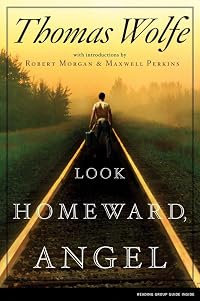
Look Homeward, Angel
by Thomas Wolfe
On This Page
Description
The works of Thomas Wolfe cemented his legacy as one of the very best of the American Southern writers. Wolfe's largely autobiographical novel features Eugene Gant, who pines for a more expansive life after being born to a father whose bouts of maniacal raving are fueled by a prodigious appetite for drink.Tags
Recommendations









Member Recommendations

Member Reviews
Six-word review: We are made of lost things.
Extended review:
It's easy to see why this opus won passionate admiration and a place among the most influential novels of the early twentieth century. It's also easy to see why admiring imitators would have done better to choose some other sort of sincere flattery. Like any other distinctive stylist--Van Gogh comes to mind--only Wolfe is Wolfe, and it's best that others not try to be him.
I feel remiss in having failed to read this novel for more than half a century beyond the time when it was first recommended to me. If I had come to it sooner, I might have recognized traces of its unique character in other readings that I can only now reflect on in retrospect. I might also have had enough show more time by now to come to a full recognition of what the author did in these many pages.
On the one hand, there are beautiful, moving, lyrical passages, such as his paean to the lost young love (page 372), and insights of notable psychological reach: "Unknowingly, he had begun to build up in himself a vast mythology for which he cared all the more deeply because he realized its untruth. Brokenly, obscurely, he was beginning to feel that it was not truth that men live for--the creative men--but for falsehood." (page 183)
And, as if to counterbalance numerous prolix outflowings of overwrought prose, there is on occasion marvelous economy of phrase: "elegant young ensigns out of college, with something blonde and fluffy at their sides" (page 418). And: "As that spring ripened he felt entirely, for the first time, the full delight of loneliness." Some of those, however, are cloyingly sugar-coated, as with all the instances of "lilac darkness" and the abundance of pearl and nacreous light.
On the other hand, there are numerous instances of questionable use of showoff words such as "phthisic" and "inchoate" (nine of the latter, including the absurd "a wild inchoate scream," page 227). When Wolfe springs words such as "gabular" and "ptotic" and "adyts" into the text, I seldom feel, as I do, for instance, with Oscar Wilde, that they belong to his peculiarly erudite vocabulary and flow naturally from his thought; but rather that he has gone to some little trouble to acquire them and that they are there more to impress than to honor precision.
Also noted: frequent suffocating passages swamped in bobbing, floating adverbs: these, for instance, gathered from two almost randomly chosen facing pages (135 and 136): stiffly, desperately, richly, moistly, sparsely, slightly, fiercely, beautifully, brightly, leafily, softly, musically, lazily, swinishly, cleanly, cynically (twice), belligerently, silently, contemptuously, toughly, thinly, pugnaciously, quietly.
Nonetheless, the novel drew me on; I didn't choose to abandon it. I found depths and revelations in this protracted coming-of-age tale, with its permeating theme of loss, that rewarded my attention. I also noticed that it made me write a little oddly for a while afterward, in much the same way that I start to talk a little funny after I've been bingeing on BBC costume dramas. My note immediately upon finishing it says this: "Style is at once lyrical and juvenile, erudite and ostentatious. Characters never seem to be, but constantly becoming. Does not draw conclusions or look for a simple answer anywhere. At times seems breathless and at times breathes wordlessly." show less
Extended review:
It's easy to see why this opus won passionate admiration and a place among the most influential novels of the early twentieth century. It's also easy to see why admiring imitators would have done better to choose some other sort of sincere flattery. Like any other distinctive stylist--Van Gogh comes to mind--only Wolfe is Wolfe, and it's best that others not try to be him.
I feel remiss in having failed to read this novel for more than half a century beyond the time when it was first recommended to me. If I had come to it sooner, I might have recognized traces of its unique character in other readings that I can only now reflect on in retrospect. I might also have had enough show more time by now to come to a full recognition of what the author did in these many pages.
On the one hand, there are beautiful, moving, lyrical passages, such as his paean to the lost young love (page 372), and insights of notable psychological reach: "Unknowingly, he had begun to build up in himself a vast mythology for which he cared all the more deeply because he realized its untruth. Brokenly, obscurely, he was beginning to feel that it was not truth that men live for--the creative men--but for falsehood." (page 183)
And, as if to counterbalance numerous prolix outflowings of overwrought prose, there is on occasion marvelous economy of phrase: "elegant young ensigns out of college, with something blonde and fluffy at their sides" (page 418). And: "As that spring ripened he felt entirely, for the first time, the full delight of loneliness." Some of those, however, are cloyingly sugar-coated, as with all the instances of "lilac darkness" and the abundance of pearl and nacreous light.
On the other hand, there are numerous instances of questionable use of showoff words such as "phthisic" and "inchoate" (nine of the latter, including the absurd "a wild inchoate scream," page 227). When Wolfe springs words such as "gabular" and "ptotic" and "adyts" into the text, I seldom feel, as I do, for instance, with Oscar Wilde, that they belong to his peculiarly erudite vocabulary and flow naturally from his thought; but rather that he has gone to some little trouble to acquire them and that they are there more to impress than to honor precision.
Also noted: frequent suffocating passages swamped in bobbing, floating adverbs: these, for instance, gathered from two almost randomly chosen facing pages (135 and 136): stiffly, desperately, richly, moistly, sparsely, slightly, fiercely, beautifully, brightly, leafily, softly, musically, lazily, swinishly, cleanly, cynically (twice), belligerently, silently, contemptuously, toughly, thinly, pugnaciously, quietly.
Nonetheless, the novel drew me on; I didn't choose to abandon it. I found depths and revelations in this protracted coming-of-age tale, with its permeating theme of loss, that rewarded my attention. I also noticed that it made me write a little oddly for a while afterward, in much the same way that I start to talk a little funny after I've been bingeing on BBC costume dramas. My note immediately upon finishing it says this: "Style is at once lyrical and juvenile, erudite and ostentatious. Characters never seem to be, but constantly becoming. Does not draw conclusions or look for a simple answer anywhere. At times seems breathless and at times breathes wordlessly." show less
I spent a pleasant couple of weeks with this 500 page classic of American literature. I really enjoyed it, but then again I am a sucker for coming-of-age stories. This one is perhaps a bit loftier than most, and goes beyond just the coming-of-age theme, but at the heart of it all, that's what it is. It is also the story of a family, an odd and morbid Southern family full of quirky members, including my favorite, Ben Gant. I quickly became enamored with his constant scowling and stock response of "Oh, for God's sake. Listen to this, won't you?" as he nods to his invisible Angel. Wolfe's dense and fanciful prose represents a writing style not often seen in today's literature. Perhaps modern readers don't have the attention span necessary show more to cope with such detail. But it really resonated with me. I loved how he associated specific repetitive descriptions with different characters. The reader comes to expect certain words and phrases to pop up whenever a particular character appears in the narrative. It's both comforting and satisfying. Wolfe's writing is very self-indulgent, though, and when considering that his fiction is merely thinly-disguised autobiography, it makes me think that he was probably a pretty annoying guy in real life. There are more than a few self-important passages in this book, and he certainly goes off on some questionable tangents. But overall, this is a true American classic, and anyone who would deny it is probably just jealous. show less
[Look Homeward, Angel] by Thomas Wolfe
[Max Perkins, Editor of Genius] by A. Scott Berg
“No leaf hangs for me in the forest; I shall lift no stone upon the heels; I shall find no door in any city. There is one voyage, the first, the last, the only one.”
Reading Thomas Wolfe is to mourn anew, each and every time. Forget the recent movement to abuse his writing as indulgent and overblown. Forget the neo-literary community, perched on a corpse they declare bloated, all the while picking and tearing with sour beaks. Attacking our heroes is the newest fad, and a distasteful one. And Wolfe isn’t the only classic that has suffered at the hands of revisionary criticism. Hemingway is now all too often considered boring and over simple and show more stereotypically uber-masculine; Fitzgerald’s work superficial and derivative, perhaps even plagiarized from his wife.
Thankfully, A. Scott Berg, with his [Editor of Genius], saw these men through the eyes of Max Perkins, the man who discovered them and midwifed their work. As the title suggests, Perkins saw them all as geniuses, particularly Wolfe. The editor had an intimidating task in distilling Wolfe’s mammoth text. Recent critics have tried to debunk the story about the manuscript’s delivery, but Berg quotes Wolfe’s agent, Madeline Boyd, requesting a truck to pick up the full work. As Perkins read, he was enchanted by the poetic and epic book. Working closely with the author, he reorganized and whittled, often foiled by Wolfe’s ability to replace several pages of new writing for the one or two cut. In the end, the book was an epic coming of age Southern tale. While the story still sags occasionally, the pay off in the last chapter is worth the effort. Eugene is ushered through his transformed hometown by the ghost of his deceased brother, assured that his journey is the only journey in life. It is easily one of the most perfect passages ever written.
Reading Berg’s history along with Wolfe’s debut, [Look Homeward, Angel] is a revelation. Seeing a photo of Wolfe standing next to a crate, filled with loose paper reaching up to knee-height, with a caption noting it’s one of three crates containing a manuscript, give Perkins’ the credit he’s due for translating the Wolfe’s beasts. But Wolfe is revealed, too. [Look Homeward, Angel]’s hero, Eugene Gant, is Wolfe himself – introverted, bookish, out of place in every circumstance except with a pen in his hand; overshadowed by a large and eccentric Southern family but a keen observer. In fact, the book was banned from Wolfe’s hometown after it was published because people were so angry with their fictionalized treatment. Reading about Gant’s youth and transformation into a writer is echoed in Perkins’ biography.
The most affecting passages in the biography are the ones detailing Perkins and Wolfe’s relationship. With five daughters, Perkins found the son he’d always wanted in Wolfe. And Wolfe had found a supportive and loving father. W.O. Gant, the substitute in [Look Homeward, Angel] for Wolfe’s real father, is an acerbic drunk with a piercing tongue. Nothing is ever good enough for W.O., and he casts himself as the eternal victim of the world’s conspiracies. Wolfe flourished under Perkins’ encouraging, and the two were easily one of the most creative partnerships ever seen.
Hemingway and Fitzgerald are showcased in Perkins’ story, as well. Not only the pugilistic bombast and the petulant child that have been substituted for their names over the years. But the secret creative zeal they both harbored, and the fragile egos that refuted the desperate need to create. Hemingway and Fitzgerald reacted in two very different ways during these battles. At one point in Perkins’ story, Fitzgerald is confined to bed with ‘grippe,’ sick to the bone over his financial situation, criticism of his work, and the progress of his next writing project. His treatment was to write about the illness, penning an article about all his daily aches and pains. Hemingway, on the other hand, was constantly on the defensive, raging against the world. Berg recounts him stringing up a tuna he’d caught and using it as a punching bag after someone told him tuna fishing was easy.
Given the genius Perkins corralled in just these three, it’s hard to believe he also edited Ring Lardner, Marjorie Kinnan Rawlings, James Jones, and Taylor Caldwell. And the biography is a rich source for other authors to seek out: Nancy Hale, Marcia Davenport, Martha Gellhorn, Will James, Etta Shiber, and Christine Watson – many would never have been known without Perkins’ eye for talent.
Though Perkins and Wolfe were estranged toward the end of Wolfe’s life, their love and admiration for one another never faltered. Wolfe’s last writing was a note from his deathbed remembering a climb to the top of a tall building with Perkins, the power and glory of life laid out before them. Perkins believed Wolfe was lost to the world much too early – and reading these two books is a testament to that obvious truth.
Bottom Line: The epitome of literary classics.
5 bones!!!!!
All time favorites. show less
[Max Perkins, Editor of Genius] by A. Scott Berg
“No leaf hangs for me in the forest; I shall lift no stone upon the heels; I shall find no door in any city. There is one voyage, the first, the last, the only one.”
Reading Thomas Wolfe is to mourn anew, each and every time. Forget the recent movement to abuse his writing as indulgent and overblown. Forget the neo-literary community, perched on a corpse they declare bloated, all the while picking and tearing with sour beaks. Attacking our heroes is the newest fad, and a distasteful one. And Wolfe isn’t the only classic that has suffered at the hands of revisionary criticism. Hemingway is now all too often considered boring and over simple and show more stereotypically uber-masculine; Fitzgerald’s work superficial and derivative, perhaps even plagiarized from his wife.
Thankfully, A. Scott Berg, with his [Editor of Genius], saw these men through the eyes of Max Perkins, the man who discovered them and midwifed their work. As the title suggests, Perkins saw them all as geniuses, particularly Wolfe. The editor had an intimidating task in distilling Wolfe’s mammoth text. Recent critics have tried to debunk the story about the manuscript’s delivery, but Berg quotes Wolfe’s agent, Madeline Boyd, requesting a truck to pick up the full work. As Perkins read, he was enchanted by the poetic and epic book. Working closely with the author, he reorganized and whittled, often foiled by Wolfe’s ability to replace several pages of new writing for the one or two cut. In the end, the book was an epic coming of age Southern tale. While the story still sags occasionally, the pay off in the last chapter is worth the effort. Eugene is ushered through his transformed hometown by the ghost of his deceased brother, assured that his journey is the only journey in life. It is easily one of the most perfect passages ever written.
Reading Berg’s history along with Wolfe’s debut, [Look Homeward, Angel] is a revelation. Seeing a photo of Wolfe standing next to a crate, filled with loose paper reaching up to knee-height, with a caption noting it’s one of three crates containing a manuscript, give Perkins’ the credit he’s due for translating the Wolfe’s beasts. But Wolfe is revealed, too. [Look Homeward, Angel]’s hero, Eugene Gant, is Wolfe himself – introverted, bookish, out of place in every circumstance except with a pen in his hand; overshadowed by a large and eccentric Southern family but a keen observer. In fact, the book was banned from Wolfe’s hometown after it was published because people were so angry with their fictionalized treatment. Reading about Gant’s youth and transformation into a writer is echoed in Perkins’ biography.
The most affecting passages in the biography are the ones detailing Perkins and Wolfe’s relationship. With five daughters, Perkins found the son he’d always wanted in Wolfe. And Wolfe had found a supportive and loving father. W.O. Gant, the substitute in [Look Homeward, Angel] for Wolfe’s real father, is an acerbic drunk with a piercing tongue. Nothing is ever good enough for W.O., and he casts himself as the eternal victim of the world’s conspiracies. Wolfe flourished under Perkins’ encouraging, and the two were easily one of the most creative partnerships ever seen.
Hemingway and Fitzgerald are showcased in Perkins’ story, as well. Not only the pugilistic bombast and the petulant child that have been substituted for their names over the years. But the secret creative zeal they both harbored, and the fragile egos that refuted the desperate need to create. Hemingway and Fitzgerald reacted in two very different ways during these battles. At one point in Perkins’ story, Fitzgerald is confined to bed with ‘grippe,’ sick to the bone over his financial situation, criticism of his work, and the progress of his next writing project. His treatment was to write about the illness, penning an article about all his daily aches and pains. Hemingway, on the other hand, was constantly on the defensive, raging against the world. Berg recounts him stringing up a tuna he’d caught and using it as a punching bag after someone told him tuna fishing was easy.
Given the genius Perkins corralled in just these three, it’s hard to believe he also edited Ring Lardner, Marjorie Kinnan Rawlings, James Jones, and Taylor Caldwell. And the biography is a rich source for other authors to seek out: Nancy Hale, Marcia Davenport, Martha Gellhorn, Will James, Etta Shiber, and Christine Watson – many would never have been known without Perkins’ eye for talent.
Though Perkins and Wolfe were estranged toward the end of Wolfe’s life, their love and admiration for one another never faltered. Wolfe’s last writing was a note from his deathbed remembering a climb to the top of a tall building with Perkins, the power and glory of life laid out before them. Perkins believed Wolfe was lost to the world much too early – and reading these two books is a testament to that obvious truth.
Bottom Line: The epitome of literary classics.
5 bones!!!!!
All time favorites. show less
Some people go through a second childhood, for me it’s more like a second adolescence, going back to read books that impressed some of my high school friends.
This thick novel, a defiantly autobiographical Bildungsroman about a budding writer named Eugene Gant, was more readable than I expected, despite the pathetic exclamations and long grocery lists of description, as well as the echoes of Milton, Shakespeare, and other writers. The author is intoxicated by life and by language, and seems intent on fixing the entirety of both in a towering stack of paper. Some passages strain credulity, as when the author describes the protagonist’s infancy, whether in cataloguing the smells of his childish world for page after page, or recording show more his precocious intuition, while playing with alphabet blocks, that language was the key to unlocking the world.
Beyond the wild profligacy of language, so often justly commented upon, are hard little carefully-crafted insights such as this: “he forgave, for it was necessary to forget.” It was these, as well as the telling, original descriptions littered throughout the book that kept my attention more than the events of Eugene’s life. Then there’s another awkward matter: although I’m no fan of revising the canon on the basis of our current ideas of political correctness, the misogyny and racism were hard to me to get with, even if those particular aspects of the book might not have bothered many of Wolfe’s Asheville contemporaries. Oh the other hand, it’s understandable the author couldn’t go home again: he had used friends, relatives, and neighbors transparently for his incisive, unflattering caricatures.
At times it felt as if the book would go on forever, but the narrative pace picked up as the climax, the death of the protagonist’s brother Ben, approached. In describing the death scene itself, all the traits Wolfe had already established for the members of the Gant family interact in an extended way under the strain, the mingled love and hate acutely observed. This scene, followed by a richly imaginative denouement, are among the strongest of the entire book.
On balance, this is a book with flashes of towering genius, with enough rewards to balance out the flaws. On my scale, three stars is shorthand for a good read, although this rating can apply to a book of skillful, consistent workmanship as well as an unbalanced product of greatness. Look Homeward, Angel is for me an example of the latter. show less
This thick novel, a defiantly autobiographical Bildungsroman about a budding writer named Eugene Gant, was more readable than I expected, despite the pathetic exclamations and long grocery lists of description, as well as the echoes of Milton, Shakespeare, and other writers. The author is intoxicated by life and by language, and seems intent on fixing the entirety of both in a towering stack of paper. Some passages strain credulity, as when the author describes the protagonist’s infancy, whether in cataloguing the smells of his childish world for page after page, or recording show more his precocious intuition, while playing with alphabet blocks, that language was the key to unlocking the world.
Beyond the wild profligacy of language, so often justly commented upon, are hard little carefully-crafted insights such as this: “he forgave, for it was necessary to forget.” It was these, as well as the telling, original descriptions littered throughout the book that kept my attention more than the events of Eugene’s life. Then there’s another awkward matter: although I’m no fan of revising the canon on the basis of our current ideas of political correctness, the misogyny and racism were hard to me to get with, even if those particular aspects of the book might not have bothered many of Wolfe’s Asheville contemporaries. Oh the other hand, it’s understandable the author couldn’t go home again: he had used friends, relatives, and neighbors transparently for his incisive, unflattering caricatures.
At times it felt as if the book would go on forever, but the narrative pace picked up as the climax, the death of the protagonist’s brother Ben, approached. In describing the death scene itself, all the traits Wolfe had already established for the members of the Gant family interact in an extended way under the strain, the mingled love and hate acutely observed. This scene, followed by a richly imaginative denouement, are among the strongest of the entire book.
On balance, this is a book with flashes of towering genius, with enough rewards to balance out the flaws. On my scale, three stars is shorthand for a good read, although this rating can apply to a book of skillful, consistent workmanship as well as an unbalanced product of greatness. Look Homeward, Angel is for me an example of the latter. show less
Rating: 2.5* of five
The Book Report: Oliver Cole's a drunk, Eliza Cole's a shrew, they have six kids and she doesn't like him, or childbirth, or poverty, or much of anything else that I can see. Oliver likes his youngest, Eugene, better than any of them (so do I, but that's not sayin' a lot), and spends what tiny about of love Eliza hasn't nagged and bitched and niggled and criticized and belittled out of him on the kid.
Eugene grows up in a boardinghouse called Dixieland in Asheville, North Carolina. OOOPSIE! I mean Altamont, Catawba. Wolfe didn't want anyone to know he was writing autobiography, see, so he invented a city and a state! Wow! And then he wrote about the people around him honestly, forthrightly, and in a stream-of-Faulkner show more style that was then très chic and is even now described as modernistic. EIGHTY PLUS YEARS LATER IT'S NOT EXPERIMENTAL OR MODERN ANYMORE, BOYS AND GIRLS, IT'S PART OF THE TOOLKIT.
Ahem. Sorry.
So Eugene grows up, and we do too, and then leaves home, and we do too, and then everything comes to a screeching halt.
Thank GAWD for small mercies.
My Review: I am no fan of the coming-of-age novel, and I don't often read them. I read this one when I was fifteen, because I wanted to impress a hot boy I was trying to get into my bed, and he thought this was the coolest book ever. I read it every damn day in study hall so he'd notice me, which he did, and we ended up talking about the book for hours.
And that was ALL I got. Yip-yap-yop about Eugene's life and his deepness and ohdeargawdpleasekillmenow stuff about the damn BOOK!!
I don't think I've ever forgiven the book for not getting me laid.
But upon mature reflection, I still dislike the book, for better (more adult, anyway) reasons. One is that even editing legend Max Perkins couldn't give Wolfe a deft enough hand to tell this story in so demanding a style as stream-of-consciousness without it spilling over into self-indulgence and sloppy, untidy, unnecessary sentimentality.
Another is Eugene/Tom's misogyny. I yield to no one in my distaste for the Cult of Female Superiority, whether motivated by “chivalry” or by feminism. Women ain't better than men, but likewise they ain't worse either. Wolfe's woman, mama Eliza, is a horrible gorgon of a vicious emasculating harridan. She has depths to her nastiness and pretension that are entirely credible. What she lacks is the balancing of REASONS for these things. In the first two zillion words, which detail the lives of Eliza and Oliver, Eliza emerges fully formed as a castrating slime. She was born this way? I doubt me much this is true.
Lastly comes Wolfe's conceit. In this Bildungs-barely-roman, he relives the first years of his life...an ordinary, unremarkable one...seemingly in real time. Why? What for? Here is the nub of my objection to coming-of-age stories: We've all come of age, so what makes your story special? In Wolfe's case, I do not see the special. It is entirely possible that I am resistant to his specialness because the story is so boring to me. But I quite simply can not fathom what makes this dreary, low-class, hag-ridden tribe of ciphers anything I should care enough about to do more than put a coin in the charity box to help feed. show less
The Book Report: Oliver Cole's a drunk, Eliza Cole's a shrew, they have six kids and she doesn't like him, or childbirth, or poverty, or much of anything else that I can see. Oliver likes his youngest, Eugene, better than any of them (so do I, but that's not sayin' a lot), and spends what tiny about of love Eliza hasn't nagged and bitched and niggled and criticized and belittled out of him on the kid.
Eugene grows up in a boardinghouse called Dixieland in Asheville, North Carolina. OOOPSIE! I mean Altamont, Catawba. Wolfe didn't want anyone to know he was writing autobiography, see, so he invented a city and a state! Wow! And then he wrote about the people around him honestly, forthrightly, and in a stream-of-Faulkner show more style that was then très chic and is even now described as modernistic. EIGHTY PLUS YEARS LATER IT'S NOT EXPERIMENTAL OR MODERN ANYMORE, BOYS AND GIRLS, IT'S PART OF THE TOOLKIT.
Ahem. Sorry.
So Eugene grows up, and we do too, and then leaves home, and we do too, and then everything comes to a screeching halt.
Thank GAWD for small mercies.
My Review: I am no fan of the coming-of-age novel, and I don't often read them. I read this one when I was fifteen, because I wanted to impress a hot boy I was trying to get into my bed, and he thought this was the coolest book ever. I read it every damn day in study hall so he'd notice me, which he did, and we ended up talking about the book for hours.
And that was ALL I got. Yip-yap-yop about Eugene's life and his deepness and ohdeargawdpleasekillmenow stuff about the damn BOOK!!
I don't think I've ever forgiven the book for not getting me laid.
But upon mature reflection, I still dislike the book, for better (more adult, anyway) reasons. One is that even editing legend Max Perkins couldn't give Wolfe a deft enough hand to tell this story in so demanding a style as stream-of-consciousness without it spilling over into self-indulgence and sloppy, untidy, unnecessary sentimentality.
Another is Eugene/Tom's misogyny. I yield to no one in my distaste for the Cult of Female Superiority, whether motivated by “chivalry” or by feminism. Women ain't better than men, but likewise they ain't worse either. Wolfe's woman, mama Eliza, is a horrible gorgon of a vicious emasculating harridan. She has depths to her nastiness and pretension that are entirely credible. What she lacks is the balancing of REASONS for these things. In the first two zillion words, which detail the lives of Eliza and Oliver, Eliza emerges fully formed as a castrating slime. She was born this way? I doubt me much this is true.
Lastly comes Wolfe's conceit. In this Bildungs-barely-roman, he relives the first years of his life...an ordinary, unremarkable one...seemingly in real time. Why? What for? Here is the nub of my objection to coming-of-age stories: We've all come of age, so what makes your story special? In Wolfe's case, I do not see the special. It is entirely possible that I am resistant to his specialness because the story is so boring to me. But I quite simply can not fathom what makes this dreary, low-class, hag-ridden tribe of ciphers anything I should care enough about to do more than put a coin in the charity box to help feed. show less
Alone. This is a difficult concept to consider when thinking about the greatness both in size and content of Thomas Wolfe's first novel, Look Homeward Angel. The inclusion of so much of the world and so many other voices almost drowns out the voice of Eugene Gant, the narrator of this immense and impressive novel. But perhaps we should begin a consideration of this novel with the question of destiny. This is what we read in the first paragraph:
"A destiny that leads the English to the Dutch is strange enough; but one that leads from Epsom into Pennsylvania, and thence into the hills that shut in Altamont over the proud coral cry of the cock, and the soft smile of an angel, is touched by that dark miracle of chance which makes new magic show more in a dusty world."
Is this destiny that of Eugene as well? And is it mere chance or will Eugene have a will to make his way in this world? This shows the direction of the story and, as it expands to take in the Gant family of Father, Mother, and siblings in Altamont, I was impressed with the translation of a country's manifest destiny into a town's and into a family's and beyond that the personal story and destiny of one Eugene Gant.
This translation of destiny is a story of coming of age told in what we today might call a "mash-up" of styles that leave the reader looking for structure among the historical commentaries, classical allusions, family rows, and soaring beauty of many more lyrical passages. The last of these alone made the book worth reading. Yes, it is worth persevering the Whitmanesque size of the narrative for some further passages of the beauty in the world that destiny had bequeathed to young Eugene Gant. While he is young and pursuing an education that seems unconventional, in spite of his attendance at the traditional schools, he is living a life of isolation from most of the world around him. There are exceptions, his relationship with his brother Ben is particularly poignant; yet there is a yearning for escape, from family and from Altamont to a world where Eugene may not feel quite so alone.
His estrangement from his own family is both exacerbated and caused by unlikable qualities from his father's boorish drunkenness to Steve's abusive behavior to his mother Eliza's self-centeredness. She is focused on a miserliness that builds a material fortune but does nothing for Eugene. With all his struggles Eugene remains detached from family and home; he seeks some solace with another family, the Leonards, and finds an "angel" in Margaret Leonard. But the stone angels outside his home remain a symbol that has warmth only in an ironical sense.
Wolfe writes near the end of the book that Eugene "stood for the last time by the angels of his father's porch . . . like a man who stands upon a hill above the town he has left, yet does not say 'The town is near,' but turns his eyes upon the distant soaring ranges" (p 508). This is where his true destiny lies. This, perhaps, is a place where he will no longer feel the pangs of isolation or, perhaps, it is merely a dream of a destiny denied as yet. For this reader it is not unlike the statement of another young man, Stephen Dedalus, who at the end of A Portrait of an Artist as a Young Man says, "I go to encounter for the millionth time the reality of experience and to forge in the smithy of my soul the uncreated conscience of my race." show less
"A destiny that leads the English to the Dutch is strange enough; but one that leads from Epsom into Pennsylvania, and thence into the hills that shut in Altamont over the proud coral cry of the cock, and the soft smile of an angel, is touched by that dark miracle of chance which makes new magic show more in a dusty world."
Is this destiny that of Eugene as well? And is it mere chance or will Eugene have a will to make his way in this world? This shows the direction of the story and, as it expands to take in the Gant family of Father, Mother, and siblings in Altamont, I was impressed with the translation of a country's manifest destiny into a town's and into a family's and beyond that the personal story and destiny of one Eugene Gant.
This translation of destiny is a story of coming of age told in what we today might call a "mash-up" of styles that leave the reader looking for structure among the historical commentaries, classical allusions, family rows, and soaring beauty of many more lyrical passages. The last of these alone made the book worth reading. Yes, it is worth persevering the Whitmanesque size of the narrative for some further passages of the beauty in the world that destiny had bequeathed to young Eugene Gant. While he is young and pursuing an education that seems unconventional, in spite of his attendance at the traditional schools, he is living a life of isolation from most of the world around him. There are exceptions, his relationship with his brother Ben is particularly poignant; yet there is a yearning for escape, from family and from Altamont to a world where Eugene may not feel quite so alone.
His estrangement from his own family is both exacerbated and caused by unlikable qualities from his father's boorish drunkenness to Steve's abusive behavior to his mother Eliza's self-centeredness. She is focused on a miserliness that builds a material fortune but does nothing for Eugene. With all his struggles Eugene remains detached from family and home; he seeks some solace with another family, the Leonards, and finds an "angel" in Margaret Leonard. But the stone angels outside his home remain a symbol that has warmth only in an ironical sense.
Wolfe writes near the end of the book that Eugene "stood for the last time by the angels of his father's porch . . . like a man who stands upon a hill above the town he has left, yet does not say 'The town is near,' but turns his eyes upon the distant soaring ranges" (p 508). This is where his true destiny lies. This, perhaps, is a place where he will no longer feel the pangs of isolation or, perhaps, it is merely a dream of a destiny denied as yet. For this reader it is not unlike the statement of another young man, Stephen Dedalus, who at the end of A Portrait of an Artist as a Young Man says, "I go to encounter for the millionth time the reality of experience and to forge in the smithy of my soul the uncreated conscience of my race." show less
This is the story of Eugene Gant, a southerner whose goal eventually becomes going to Harvard. It appears to be somewhat autobiographical as Thomas Wolfe grew up in the South and eventually went to Harvard. How much of Eugene Gant's story is also Thomas Wolfe's story is much less clear. Eugene is the youngest of a very dysfunctional family. His father hates his mother's family and she cannot stand his. The father had been a successful businessman but is erratic in the extreme and very alcoholic. His mother is excessively concerned about expenses wanting every cent to me invested in her passion, real estate. She knows the value of every parcel but is totally blind to the value and the problems of her family members, her spouse and her show more children. The children act out in rebellion in all directions.
Eugene, being the youngest, is his mother's last chance to get parenting right. He's her darling and can do no wrong, much to the dismay of his older siblings. They got punished for what he now gets away with. He gets support where they got nothing or less than they needed. He turns inward and becomes the scholar they never were. He reads Latin and Greek, reads and writes poetry, thinks about Gods and mythical creatures. They are real to him. They allow him to escape the dysfunction around him. Yet as he grows he sees more and more of what is around him. This is where my problem reading this book began. What was around Eugene was the South of the early twentieth century. As I read many classics I have to remember that was then and this is now and hold off seeing their lives with my eyes. We've moved on. Yet around Eugene is so much that is now repugnant. Wolfe is thoroughly comfortable with the N-word. It and it's variants are used hundreds of times in this book. Most importantly there seems to be no recognition that anything was wrong with this. After a while I found myself shutting down. My empathy for him diminished as he showed no empathy for those around him. Disappointing. I would have loved to see this book in a more positive light.
Back to the story. The mother in her penny-pinching mode has made their home into a boarding house. Many stories surround the less than savory boarders that pass through. Mother seems to totally ignore the fact that many of the boarders are prostitutes. She sees failings in none of then, just her husband and children. Her husband gets progressively ill and is cared for by one of the older girls. The mother always dismisses her husband's illness with there's nothing wrong, or he'll survive, or that's just his way to get attention – never any empathy. This constant theme is heightened when one of Eugene's older brothers gets sick. He was the one who escaped by becoming a sailor and often was never home. As he was dying he refused to even let his mother see him. He wanted no part of her false empathy. His death brought this into stark resolution, even for Eugene.
Eugene escapes by going back to college, becoming a star pupil and preparing to go to Harvard. At the end I was wanted nothing more to do with this dysfunction. It was clear that Wolfe was an impressive writer. The lyricism of his prose reminded me of Thomas Mann, my favorite writer. Wolfe's prose was constantly spinning a situation, wandering almost aimlessly, had many unconnected observations all reminding me of Joyce. Those qualities kept me reading. show less
Eugene, being the youngest, is his mother's last chance to get parenting right. He's her darling and can do no wrong, much to the dismay of his older siblings. They got punished for what he now gets away with. He gets support where they got nothing or less than they needed. He turns inward and becomes the scholar they never were. He reads Latin and Greek, reads and writes poetry, thinks about Gods and mythical creatures. They are real to him. They allow him to escape the dysfunction around him. Yet as he grows he sees more and more of what is around him. This is where my problem reading this book began. What was around Eugene was the South of the early twentieth century. As I read many classics I have to remember that was then and this is now and hold off seeing their lives with my eyes. We've moved on. Yet around Eugene is so much that is now repugnant. Wolfe is thoroughly comfortable with the N-word. It and it's variants are used hundreds of times in this book. Most importantly there seems to be no recognition that anything was wrong with this. After a while I found myself shutting down. My empathy for him diminished as he showed no empathy for those around him. Disappointing. I would have loved to see this book in a more positive light.
Back to the story. The mother in her penny-pinching mode has made their home into a boarding house. Many stories surround the less than savory boarders that pass through. Mother seems to totally ignore the fact that many of the boarders are prostitutes. She sees failings in none of then, just her husband and children. Her husband gets progressively ill and is cared for by one of the older girls. The mother always dismisses her husband's illness with there's nothing wrong, or he'll survive, or that's just his way to get attention – never any empathy. This constant theme is heightened when one of Eugene's older brothers gets sick. He was the one who escaped by becoming a sailor and often was never home. As he was dying he refused to even let his mother see him. He wanted no part of her false empathy. His death brought this into stark resolution, even for Eugene.
Eugene escapes by going back to college, becoming a star pupil and preparing to go to Harvard. At the end I was wanted nothing more to do with this dysfunction. It was clear that Wolfe was an impressive writer. The lyricism of his prose reminded me of Thomas Mann, my favorite writer. Wolfe's prose was constantly spinning a situation, wandering almost aimlessly, had many unconnected observations all reminding me of Joyce. Those qualities kept me reading. show less
Members
- Recently Added By
Published Reviews
"Kan De finne om ikkje meir enn ei bok til som kjem på høgd med den av Thomas Wolfe, da har De verkelig gjort ein gjerning." Olav Duun
Da Eliza Gant hadde født yngstebarnet, Eugene, "hadde hun stirret dypt ned i de mørke øynene og sett noe som hun visste skulle gløde der inne bestandig, en dyp utilgjengelig og uoppløselig ensomhet, hun visste det var en fremmed som hadde fått liv i det show more mørke fanget hennes, en gjenganger i sitt eget sinn, ensom når han var alene og ensom når han var midt i verden. Fortapt."
Utkom første gang på norsk i 1933. show less
Da Eliza Gant hadde født yngstebarnet, Eugene, "hadde hun stirret dypt ned i de mørke øynene og sett noe som hun visste skulle gløde der inne bestandig, en dyp utilgjengelig og uoppløselig ensomhet, hun visste det var en fremmed som hadde fått liv i det show more mørke fanget hennes, en gjenganger i sitt eget sinn, ensom når han var alene og ensom når han var midt i verden. Fortapt."
Utkom første gang på norsk i 1933. show less
added by kirstenlund
Lists

1001 Books You Must Read Before You Die
1,448 works; 1,133 members

Radcliffe's 100 Best Novel of the 20th Century
100 works; 32 members

Favorite Coming of Age Novels.
164 works; 51 members

Recommend the 20 best books you've read in the last five years
2,168 works; 601 members

Unread books
1,063 works; 85 members

20th Century Literature
1,161 works; 55 members

Books Set in North Carolina
84 works; 7 members
1,001 BYMRBYD Concensus
723 works; 27 members

Modernism
140 works; 8 members

Five star books
1,767 works; 110 members

Excessive, Maximalist, Encyclopedic
10 works; 1 member
1920s
141 works; 6 members

Lamont's Hundred Best Novels (1947)
100 works; 4 members

Schwob Nederland
207 works; 2 members

Blue Pyramid 1,276 Best Books of All Time
1,248 works; 32 members

Classics Reading List
16 works; 1 member
Canon de la narrativa universal del s. XX (cicutadry)
499 works; 3 members

Recommended Reading : 600 Classics Reviewed, Editors of Salem Press, 2015
634 works; 6 members

Mustich's 1000 Books to Read Before You Die: A Life Changing List
1,001 works; 19 members

AP Lit
363 works; 6 members

1964 College Preparatory Reading List
202 works; 8 members

I Could Live There
185 works; 12 members

Mensa for Kids Excellence in Reading Award Program (Grades 9-12)
116 works; 3 members
Mensa for Kids Excellence in Reading Award Program (Grades 9-12)
116 works; 5 members

Books You Couldn't Finish
202 works; 29 members
Literary Travelogue of the United States Challenge
133 works; 6 members

For Further Reading: A List of 160 Novels from 15 Literatures
160 works; 4 members

.
396 works; 1 member
Author Information

147+ Works 8,956 Members
Thomas Wolfe was born in Asheville, North Carolina on October 3, 1900. He graduated from the University of North Carolina and Harvard University. He taught at New York University from 1924 to 1930. His four long autobiographical novels are Look Homeward, Angel; Of Time and the River; The Web and the Rock; and You Can't Go Home Again. He also wrote show more short stories that were collected in The Hills Beyond and From Death to Morning. He wrote several plays including Welcome to Our City. From an early bout with pneumonia, he suffered from tuberculosis of the lungs, which led to fatal tuberculosis of the brain. He died following brain surgery on September 15, 1938 at age 37. (Bowker Author Biography) show less
Some Editions
Awards and Honors
Notable Lists
Greatest Books algorithm (182)
Series
Belongs to Publisher Series
Work Relationships
Is contained in
Contains
Has the adaptation
Is abridged in
Is an expanded version of
Has as a study
Has as a supplement
Has as a commentary on the text
Common Knowledge
- Canonical title
- Look Homeward, Angel
- Original title
- Look Homeward, Angel: A Story of the Buried Life
- Alternate titles*
- Schau heimwärts, Engel! eine Geschichte von begrabnen Leben
- Original publication date
- 1929
- People/Characters
- Eugene Gant
- Important places
- Altamont, Catawba, USA
- Related movies
- Look Homeward, Angel (1972 | IMDb)
- Epigraph
- ... a stone, a leaf, an unfound door; of a stone, a leaf, a door. And of all the forgotten faces. Naked and alone we came into exile. In her dark womb we did not know our mother's face; from the prison of her flesh have we c... (show all)ome into the unspeakable and incommunicable prison of this earth. Which of us has known his brother? Which of us has looked into his father's heart? Which of us has not remained forever prison-pent? Which of us is not forever a stranger and alone? O waste of loss, in the hot mazes, lost, among bright stars on this most weary unbright cinder, lost! Remembering speechlessly we seek the great forgotten language, the lost lane-end into heaven, a stone, a leaf, an unfound door. Where? When? O lost, and by the wind grieved, ghost, come back again.
- Dedication
- To A.B.
"Then, as all my soules bee,
Emparadis'd in you, (in whom alone
I understand, and grow and see,)
The rafters of my body, bone
Being still with you, the Muscle, Sinew, and Veine,
Which tile thi... (show all)s house, will come againe." - First words
- A destiny that leads the English to the Dutch is strange enough; but one that leads from Epsom into Pennsylvania, and thence into the hills that shut in Altamont over the proud coral cry of the cock, and the soft stone smile ... (show all)of an angel, is touched by that dark miracle of chance which makes new magic in a dusty world.
- Last words
- (Click to show. Warning: May contain spoilers.)Yet, as he stood for the last time by the angels of his father's porch, it seemed as if the Square already were far and lost; or, I should say, he was like a man who stands upon a hill above the town he has left, yet does not say "The town is near," but turns his eyes upon the distant soaring ranges.
- Blurbers
- Frazier, Charles; Kostova, Elizabeth; Gay, William; Conroy, Pat
- Original language*
- Englisch; Englisch USA; englisch
- Canonical DDC/MDS
- 813.52
- Canonical LCC
- PS3545.O337
*Some information comes from Common Knowledge in other languages. Click "Edit" for more information.
Classifications
Statistics
- Members
- 3,913
- Popularity
- 4,036
- Reviews
- 55
- Rating
- (3.93)
- Languages
- 11 — Czech, Dutch, English, French, German, Italian, Norwegian (Bokmål), Russian, Slovenian, Spanish, Swedish
- Media
- Paper, Audiobook, Ebook
- ISBNs
- 67
- ASINs
- 107