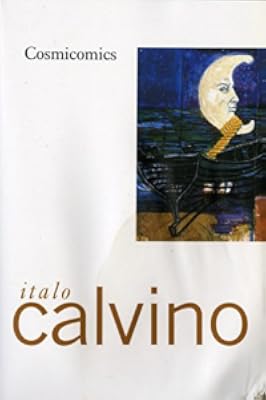
Cosmicomics
by Italo Calvino
There are 16 current discussions about this work.
On This Page
Description
Enchanting stories about the evolution of the universe, with characters that are fashioned from mathematical formulae and cellular structures. "Naturally, we were all there, - old Qfwfq said, - where else could we have been? Nobody knew then that there could be space. Or time either: what use did we have for time, packed in there like sardines?"--Publisher description.Tags
Recommendations
























Member Recommendations

Member Reviews
Now that's good Calvino. Funny, detailed, multi-layered, beautifully written and ever so clever without losing track of the story it tells.
On one level, this is a story about a... let's call him a man, because he's definitely male even if he isn't really human, an eternal being named Qfwfq. It's his life, from childhood to maturity. Only his life takes place over the entire age of the universe, from Big Bang to the 1960s on Earth. Each story builds on some scientific factoid, and then creates a very human-although-not-human story from it with Qfwfq as the narrator. Sometimes he's a dinosaur, sometimes he's a bodiless cosmic being watching as the universe creates itself... or if HE creates it?
Because on another level, this is a story show more about what IS. And HOW it is. How we create the world by seeing it, experiencing it, how others create images of us and how others' images of us help us create ourselves. How telling stories can bring things into being. We all create our own universe, we all evolve, and the universe itself keeps on expanding and expanding in all of the directions it can whiz. show less
On one level, this is a story about a... let's call him a man, because he's definitely male even if he isn't really human, an eternal being named Qfwfq. It's his life, from childhood to maturity. Only his life takes place over the entire age of the universe, from Big Bang to the 1960s on Earth. Each story builds on some scientific factoid, and then creates a very human-although-not-human story from it with Qfwfq as the narrator. Sometimes he's a dinosaur, sometimes he's a bodiless cosmic being watching as the universe creates itself... or if HE creates it?
Because on another level, this is a story show more about what IS. And HOW it is. How we create the world by seeing it, experiencing it, how others create images of us and how others' images of us help us create ourselves. How telling stories can bring things into being. We all create our own universe, we all evolve, and the universe itself keeps on expanding and expanding in all of the directions it can whiz. show less
Qwfwq personifies nebular matter, or tiny amoebas, or mathematical concepts to reveal certain emotional truths. In the first story some characters are caught halfway in between the gravitational pulls of the earth and the moon and must literally chose between two worlds. In another a mollusk possesses as rich a sensory and poetic internal life as anyone else because he can intuit the world around him through the contents of the ocean secretions he consumes.
I felt like Qwfwq was less a trillion-year-old shapeshifter and more an old man full of tall tales. So when you brought up a fact in your science textbook like time and space itself is curved, he'll respond with "not just curved but notched and pocketed, one time me and a beautiful show more woman were free-falling through empty space and we landed in one of those pockets and let me tell you things got steamy in there!"
Which brings me to the best joke about Cosmicomics: how horny old Qwfwq is. He's been around for trillions of years and witnessed godlike perspectives but a good majority of these stories are about his attempts to win over another proto-amphibiod, or chunk of stellar dust, or she-mollusk who is both inexplicably female and the most beautiful thing in the galaxy. show less
I felt like Qwfwq was less a trillion-year-old shapeshifter and more an old man full of tall tales. So when you brought up a fact in your science textbook like time and space itself is curved, he'll respond with "not just curved but notched and pocketed, one time me and a beautiful show more woman were free-falling through empty space and we landed in one of those pockets and let me tell you things got steamy in there!"
Which brings me to the best joke about Cosmicomics: how horny old Qwfwq is. He's been around for trillions of years and witnessed godlike perspectives but a good majority of these stories are about his attempts to win over another proto-amphibiod, or chunk of stellar dust, or she-mollusk who is both inexplicably female and the most beautiful thing in the galaxy. show less
A perfect exposition of science fiction, Italo Calvino's Cosmicomics is a tender and dreamlike weaving of stories that touch upon the sheer wonder both the universe and consciousness itself. Calvino begins each story with an established scientific conjecture, thereafter placing an anthropomorphic and wildly fictitious annotation of the universe at various stages or for lack of a better word, times. Narrating from entities personified through equations and representations, predominantly through the central character Qfwfq, Calvino wistfully describes the universe through fleeting instances of love, attraction, loss, creation and change.
The stories range from the concrete to the fluid, including a time when reaching the moon is as simple show more as climbing a ladder, the astronomical paranoia induced from simple messages sent from distant observers and millennia, where a dinosaur ponders the significance, perhaps even the power of its own extinction, to the familial colloid particles, uncertain of their new inertia, being torn apart in the creation of matter and planets. Though all have a human feel, it is a joyous exposition of the unfathomable, alien events we cannot ponder enough.
The sentience that Calvino gives to the entities persisting and changing throughout Cosmicomics is an appreciation not only of the scientific beauty of the universe, but of the beauty of his fiction. show less
The stories range from the concrete to the fluid, including a time when reaching the moon is as simple show more as climbing a ladder, the astronomical paranoia induced from simple messages sent from distant observers and millennia, where a dinosaur ponders the significance, perhaps even the power of its own extinction, to the familial colloid particles, uncertain of their new inertia, being torn apart in the creation of matter and planets. Though all have a human feel, it is a joyous exposition of the unfathomable, alien events we cannot ponder enough.
The sentience that Calvino gives to the entities persisting and changing throughout Cosmicomics is an appreciation not only of the scientific beauty of the universe, but of the beauty of his fiction. show less
Cosmicomics is a collection of fanciful short fiction inspired by scientific quotes, which flower into metaphors for something more human than what forumulae and calculations can encompass. Measurable distance becomes emotional distance, cosmic clashes become mere one-upmanship, etc. On the one hand these seem like the lazy mental exercises of a child-like imagination. On the other, I could not similarly write a 12-page compelling story about what it would feel like to be a mollusk. It is the personification that makes it work, makes the science relateable in terms of human emotion. I could feel the science, not just understand it.
Unlike most anthologies or collections, these really ought to be read together as a whole since they all show more bear the same peculiar style. The first paragraph of each story, italicized and devoted to a scientific fact or theory, is key to establishing the context of what follows. This bit of grounding makes it possible to follow Calvino's imaginative forays, whether it is into impossible spaces like the single point that presaged the Big Bang or inside the mind of the last dinosaur. The imagery can be startling, and the metaphors are all built-in.
My personal favourites are 'How Much Shall We Bet?' and 'The Dinosaurs', but the first story 'The Distance to the Moon' (an inspiration for Pixar's "La Luna") is that of most readers. If its magic reaches you then carry on. Otherwise you'd best stop there because it will only get more strange, albeit strangely wonderful. show less
Unlike most anthologies or collections, these really ought to be read together as a whole since they all show more bear the same peculiar style. The first paragraph of each story, italicized and devoted to a scientific fact or theory, is key to establishing the context of what follows. This bit of grounding makes it possible to follow Calvino's imaginative forays, whether it is into impossible spaces like the single point that presaged the Big Bang or inside the mind of the last dinosaur. The imagery can be startling, and the metaphors are all built-in.
My personal favourites are 'How Much Shall We Bet?' and 'The Dinosaurs', but the first story 'The Distance to the Moon' (an inspiration for Pixar's "La Luna") is that of most readers. If its magic reaches you then carry on. Otherwise you'd best stop there because it will only get more strange, albeit strangely wonderful. show less
Oh, the wacky world of Calvino, for whom history and science are playthings. Here in Cosmicomics Calvino takes on origins of the universe, manifesting in twelve creation myths of a sort. Most of the stories feature a narrative told by Qfwfq, and aged something-or-other that seems to have born witness to origins ranging from the universe itself to the development of the conch shell. This latter narrative is "The Spiral" and was the story I enjoyed the most. Each story begins with a italicized blurb of real science, which is then the springboard for Qfwfq's fanciful narratives. One of the most clever aspects is the anthropomorphizing of pre-anthro existence, and Calvino occasionally meditates on the value of "signs" before there were, show more "signs." This reflects, no doubt, the influence of Saussure, the Swiss semiotician who, along with Roland Barthes, had a significant impact on Calvino's literature. Calvino's imagination is boundless, and the stories are as much of love, unrequited and not, and microexistence, as they are of the actual devices that serve as the foci of each story.
I'm not sure this book will land well with everyone. I had started it almost sixteen years ago, and put it aside. I picked it up again because I knew I could start again and it is a digestible 153 pages. I'm glad I did, especially for the dry and quirky humor that is a trademark of Calvino. It must be noted that William Weaver's gifts as a translator are on full display (if you find yourself under-appreciating translation, I strongly recommend the wonderful Experiences in translation by Umberto Eco). Calvino asks for some investment, but if you walk through the door he opens, you'll likely be glad that you did. show less
I'm not sure this book will land well with everyone. I had started it almost sixteen years ago, and put it aside. I picked it up again because I knew I could start again and it is a digestible 153 pages. I'm glad I did, especially for the dry and quirky humor that is a trademark of Calvino. It must be noted that William Weaver's gifts as a translator are on full display (if you find yourself under-appreciating translation, I strongly recommend the wonderful Experiences in translation by Umberto Eco). Calvino asks for some investment, but if you walk through the door he opens, you'll likely be glad that you did. show less
The form for the short stories in this book is that Calvino takes one of man’s latest findings about the universe or evolution, states it in the first paragraph, and then builds a creative, impossible story around it, narrated by a being called ‘Qfwfq’, and including others with mathematical or scientific type names, such as Dean (k)yK, or Mrs. Ph(i)Nk0.
These intelligent, human like beings inhabit space particles or live hundreds of millions of years, and yet have foibles like little attractions and jealousies, or needing to scratch themselves on the early grainy matter of the solar system. Children will play marbles with atoms along spacetime’s curves. A newly evolved creature on land will argue with the old Uncle who believes show more that land-living is going to be a ‘limited phenomeon’. Two beings will bet on events in the early universe, starting with supernova formation and then quickly getting into mundane things in mankind’s history on the earth, begging the question whether what we do is pre-ordained or not. Observers on earth and distant planets will communicate with signs that take 100 million years to reach one another. A sightless mollusk will make the eyes of others possible, and ‘see’ his loved one through the images collected by those eyes.
In short, in all this dancing across time and space, anything is possible, and the stories are uniquely playful. While the concepts and names sound nerdy, there is a lightness throughout Calvino’s writing. In making his characters transcend the limitations we humans are bound to, he seems to gently point out how small we are in the universe, but at the same time how One we are with it, and to each other. show less
These intelligent, human like beings inhabit space particles or live hundreds of millions of years, and yet have foibles like little attractions and jealousies, or needing to scratch themselves on the early grainy matter of the solar system. Children will play marbles with atoms along spacetime’s curves. A newly evolved creature on land will argue with the old Uncle who believes show more that land-living is going to be a ‘limited phenomeon’. Two beings will bet on events in the early universe, starting with supernova formation and then quickly getting into mundane things in mankind’s history on the earth, begging the question whether what we do is pre-ordained or not. Observers on earth and distant planets will communicate with signs that take 100 million years to reach one another. A sightless mollusk will make the eyes of others possible, and ‘see’ his loved one through the images collected by those eyes.
In short, in all this dancing across time and space, anything is possible, and the stories are uniquely playful. While the concepts and names sound nerdy, there is a lightness throughout Calvino’s writing. In making his characters transcend the limitations we humans are bound to, he seems to gently point out how small we are in the universe, but at the same time how One we are with it, and to each other. show less
I first read this in high school, having enjoyed Calvino's Mr. Palomar, and I found this book even more to my liking. On this reread, it strikes me that though I suspect no one would classify this book as science fiction, the book reminds me of nothing so much as the robot fables of Stanislaw Lem, as depicted in The Cyberiad and Mortal Engines-- Calvino uses ostensibly scientific jumping-off points to tell stories that, despite usually being about strange creatures from the dawn of the universe, are actually about people and all their quirks and foibles writ large. My favorite in the collection remains "The Light-Years", which I once read aloud in Science Fiction Club, a highly amusing look at the lengths one man takes to preserve his show more reputation with observers in distant galaxies. (originally written December 2007) show less
Members
- Recently Added By
Lists

501 Must-Read Books
529 works; 72 members

Magic Realism
371 works; 52 members

Italian Literature
558 works; 43 members

20th Century Literature
1,161 works; 54 members

Short Story Collections and Anthologies
261 works; 40 members

1960s, Best books published therein
254 works; 22 members
EU Fiction: 1950-2022
223 works; 70 members

Pleasant Surprises: Books That Exceeded Our Expectations
418 works; 143 members
Favourite Books
1,820 works; 311 members

Experimental Literature
141 works; 19 members

Short and Sweet
246 works; 24 members

SHOULD Read Books!
354 works; 9 members

Speculative Fiction from around the World
610 works; 18 members

Recommended Literary Books
111 works; 1 member

National Book Award winners
65 works; 11 members

Mind Expanding Books by hackerkid
581 works; 8 members

SF & Fantasy in Translation
95 works; 18 members

Fiction for Readers Who Love Science and Math
57 works; 15 members

I 100 migliori libri italiani degli ultimi 200 anni -- Opere fuori lista
40 works; 1 member
Talk Discussions
Current Discussions
📚APR 2026 Cosmicomics #6 GAMES WITHOUT END in GoodThings I've Read (May 7)
📚APR 2026 Cosmicomics #9 THE DINOSAURS in GoodThings I've Read (April 28)
📚APR 2026 Cosmicomics #8 HOW MUCH SHALL WE BET? in GoodThings I've Read (April 27)
📚APR 2026 Cosmicomics #7 THE AQUATIC UNCLE in GoodThings I've Read (April 26)
📚APR 2026 Cosmicomics #2 AT DAYBREAK in GoodThings I've Read (April 21)
📚APR 2026 Cosmicomics #5 WITHOUT COLORS in GoodThings I've Read (April 16)
📚APR 2026 Cosmicomics #4 ALL AT ONE POINT in GoodThings I've Read (April 13)
📚APR 2026 Cosmicomics #3 A SIGN IN SPACE in GoodThings I've Read (April 8)
📚APR 2026 Cosmicomics #1 THE DISTANCE OF THE MOON in GoodThings I've Read (April 6)
📚APR 2026 Cosmicomics INTRODUCTION in GoodThings I've Read (March 29)
📚APR 2026 Cosmicomics FINAL THOUGHTS in GoodThings I've Read (March 29)
Oops. Another duplicate. in GoodThings I've Read (March 29)
Oops. Duplicate in GoodThings I've Read (March 29)
📚APR 2026 Cosmicomics #10 THE FORM OF SPACE in GoodThings I've Read (March 29)
📚APR 2026 Cosmicomics #11 THE LIGHT-YEARS in GoodThings I've Read (March 29)
📚APR 2026 Cosmicomics #12 THE SPIRAL in GoodThings I've Read (March 29)
Author Information

403+ Works 70,447 Members
Italo Calvino 1923-1984 Novelist and short story writer Italo Calvino was born in Cuba on October 15, 1923, and grew up in Italy, graduating from the University of Turin in 1947. He is remembered for his distinctive style of fables. Much of his first work was political, including Il Sentiero dei Nidi di Ragno (The Path of the Nest Spiders, 1947), show more considered one of the main novels of neorealism. In the 1950s, Calvino began to explore fantasy and myth as extensions of realism. Il Visconte Dimezzato (The Cloven Knight, 1952), concerns a knight split in two in combat who continues to live on as two separates, one good and one bad, deprived of the link which made them a moral whole. In Il Barone Rampante (Baron in the Trees, 1957), a boy takes to the trees to avoid eating snail soup and lives an entire, fulfilled life without ever coming back down. Calvino was awarded an honorary degree from Mount Holyoke College in 1984 and died in 1985, following a cerebral hemorrhage. At the time of his death, he was the most translated contemporary Italian writer and a contender for the Nobel Prize for Literature. (Bowker Author Biography) show less
Some Editions
Awards and Honors
Series
Belongs to Publisher Series
Work Relationships
Is contained in
Contains
Common Knowledge
- Canonical title
- Cosmicomics
- Original title
- Le cosmicomiche
- Original publication date
- 1965 (Italiaans) (Italiaans); 1983 (Nederlands) (Nederlands)
- People/Characters
- Qfwfq
- First words
- Una volta, secondo Sir George H. Darwin, la Luna era molto vicina alla Terra. Furono le maree che a poco a poco la spinsero lontano: le maree che lei Luna provoca nelle acque terrestri e in cui la Terra perde lentamente energ... (show all)ia.
At one time, according to Sir George H. Darwin, the Moon was very close to the Earth. Then the tides gradually pushed her far away: the tides that the Moon herself causes in the Earth’s waters, where the Earth slowly loses ... (show all)energy. - Last words
- (Click to show. Warning: May contain spoilers.)E in fondo a ognuno di quegli occhi abitavo io, ossia abitava un altro me, una delle immagini di me, e si incontrava con l'immagine di lei, la più fedele immagine di lei, nell'ultramondo che s'apre attraversando la sfera semiliquida delle iridi, il buio delle pupille, il palazzo di specchi delle rètine, nel vero nostro elemento che si estende senza rive né confini.
- Original language*
- Italiaans
- Disambiguation notice
- There is a later, expanded work "Complete Cosmicomics" / Tutte le cosmicomiche" that contains significant amount of material that does not exist in this, original edition. Please keep the different editions separate.
Dutch... (show all): Kosmikomische verhalen. This first edition (Bert Bakker, 1983; isbn 90-6019-984-7) only contains the transl. stories from Le cosmicomiche. The second, extended edition (De Bezige Bij, 2010; isbn 978-90-234-5800-5) contains the transl. stories from Tutte le cosmicomiche. Please do not combine the two editions.
*Some information comes from Common Knowledge in other languages. Click "Edit" for more information.
Classifications
- Genres
- Fiction and Literature, General Fiction, Science Fiction
- DDC/MDS
- 853.914 — Literature & rhetoric Italian, Romanian & related literatures Italian fiction 1900- 20th Century 1945-1999
- LCC
- PZ3 .C13956 .C — Language and Literature Fiction and juvenile belles lettres Fiction and juvenile belles lettres Fiction in English
- BISAC
Statistics
- Members
- 3,521
- Popularity
- 4,712
- Reviews
- 57
- Rating
- (4.08)
- Languages
- 20 — Catalan, Czech, Danish, Dutch, English, Finnish, French, German, Greek, Hebrew, Hungarian, Italian, Japanese, Korean, Polish, Portuguese, Russian, Spanish, Swedish, Turkish
- Media
- Paper, Audiobook, Ebook
- ISBNs
- 46
- ASINs
- 27