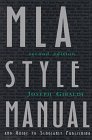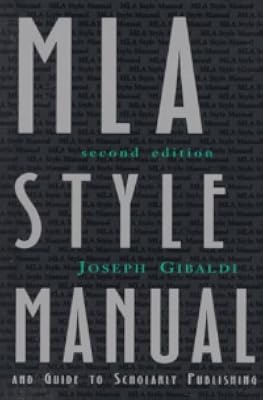
MLA Style Manual and Guide to Scholarly Publishing
by Joseph Gibaldi
On This Page
Description
Provides information on stylistic aspects of research papers, theses, and dissertations, including sections on writing fundamentals, MLA documentation style, and copyright law.Tags
Recommendations










Member Reviews
This is the only style guide that I could imagine reading cover to cover. And I'm a boring guy, but still: that says something. It says the humanities will make your life better with elegance, like a crisp oxford shirt. Out of the three big styles with which I have good familiarity, I'd describe APA in a word as "clear"; Chicago as "thorough"; and MLA as "flexible," and for writers as opposed to readers there's no doubt that the latter is the most rewarding to work with, as you decide how to weave a citation into a quote and the quote into your paragraph, as you think about the most elegant (again) way to direct a reader to a source. This third edition fixes the second-biggest problem with MLA, which was the ungodly mess involved in web show more citation; it doesn't fix the biggest problem, which remains in-text citation of works that aren't books, like, what's the easiest way to do a lit review of a hundred papers if you're a psychologist, say, other than use APA so you can insert years in your citations instead of stupid abbreviated titles; or, what's the best way of citing magazine articles if you're in media studies, other than by paper and date (pedantic) or by stupid abbreviated titles like "Hello" and "Death" and "Umbrella stand." But that's not the end of, nor does it match my complaints about the other styles, and the price of admission is almost earned back by the fun of going through the chapter of lists to see which countries and LAtin phrases and langauges and geographical terms and works of literature are worthy of standardized MLA-sanctioned abbreviations and which are not. It is to laugh, the MLA, you flock of winking parvenus. show less
The third edition (2008) features a foreword by Domna Stanton, a former president of the MLA. This self-indulgent albeit interesting foreword provides clues that help explain how scholarly writing has successfully subverted itself and, sad to say, become marginal in contemporary American culture.
Just as in 2005 Domna Stanton chose, in Michael Drout's words, "the weakest possible ground to make any kind of substantive argument" to defend academic freedom, so here in 2008 she chooses the least rhetorically effective position from which to encourage the use of proper style by budding scholarly writers: the historical and cultural contingency of standards.
Just as in 2005 Domna Stanton chose, in Michael Drout's words, "the weakest possible ground to make any kind of substantive argument" to defend academic freedom, so here in 2008 she chooses the least rhetorically effective position from which to encourage the use of proper style by budding scholarly writers: the historical and cultural contingency of standards.
Ratings
Members
- Recently Added By
Lists

Books Read In 2009
43 works; 1 member
Author Information
8 Works 7,994 Members
Some Editions
Common Knowledge
- Canonical title
- MLA Style Manual and Guide to Scholarly Publishing
- Original publication date
- 1985
Classifications
- Genre
- Reference
- DDC/MDS
- 808.027 — Literature & rhetoric Literature, rhetoric & criticism Rhetoric and collections of literary texts from more than two literatures Rhetoric and anthologies Authorship techniques, plagiarism, editorial techniques Editing and scholarly writing
- LCC
- PN147 .G444 — Language and Literature Literature (General) Literature (General) Authorship
- BISAC
Statistics
- Members
- 640
- Popularity
- 45,480
- Reviews
- 2
- Rating
- (3.92)
- Languages
- English
- Media
- Paper
- ISBNs
- 5
- ASINs
- 4