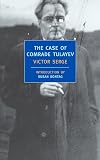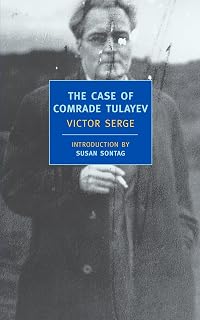
The Case of Comrade Tulayev
by Victor Serge
On This Page
Description
One cold Moscow night, Comrade Tulayev, a high government official, is shot dead on the street, and the search for the killer begins. In this panoramic vision of the Soviet Great Terror, the investigation leads all over the world, netting a whole series of suspects whose only connection is their innocence--at least of the crime of which they stand accused. But "The Case of Comrade Tulayev," unquestionably the finest work of fiction ever written about the Stalinist purges, is not just a story show more of a totalitarian state. Marked by the deep humanity and generous spirit of its author, the legendary anarchist and exile Victor Serge, it is also a classic twentieth-century tale of risk, adventure, and unexpected nobility to set beside Ernest Hemingway's" For Whom the Bell Tolls" and Andre Malraux's "Man's Fate." show lessTags
Recommendations























Member Recommendations

by uru
Member Reviews
An excellently broad and empathetic story written with the style of classical Russian narrative, that moves through a selection of diverse characters living in Stalin's Russia. Serge's writing allows the characters to become individual figures that are also metaphors for the block unity of the Soviet people. The last few pages conclude with a letter that is reminiscent of Charlie Chaplin's speech in The Great Dictator, with a powerful philosophical punch, highlighting the author's divided opinion on the utopian ideals of the October Revolution, and the complexity of its aftermath. Sometimes the writing is a little dated (nearly all of the characters are male; at times the writing is too obvious) but the book is extremely enjoyable, show more often funny, and well paced. show less
This book is set during the late 1930's, at the height of the Stalinist purges. Comrade Tulayev, a high party official, is assassinated in a random, unplanned crime of opportunity by an anonymous clerk. The system demanded convictions, and thus began a series of prosecutions of innocent long-time party members. They are arrested and interrogated. In some cases, false confessions are elicited. Some of those arrested are exiled; some are executed.
No one is exempt. Even High Commissar Erchov, who was the official initially conducting the investigation, is arrested. Even men who were close friends with Stalin. Even Deportee Ryzhik, who prior to his arrest, had lived for many years thousands of miles from the scene of the crime, in exile in show more a remote Siberian village peopled only by a few peasants and one government official stationed there as his guard.
This book was recommended to me after I read The Whisperers, a nonfiction history of the Stalinist years and its effects on ordinary Soviet people. While The Case of Comrade Tulayev explores similar issues, the people it focuses on are, ironically, some of the very people who created the system that allowed the purges to occur. Highly recommended. show less
No one is exempt. Even High Commissar Erchov, who was the official initially conducting the investigation, is arrested. Even men who were close friends with Stalin. Even Deportee Ryzhik, who prior to his arrest, had lived for many years thousands of miles from the scene of the crime, in exile in show more a remote Siberian village peopled only by a few peasants and one government official stationed there as his guard.
This book was recommended to me after I read The Whisperers, a nonfiction history of the Stalinist years and its effects on ordinary Soviet people. While The Case of Comrade Tulayev explores similar issues, the people it focuses on are, ironically, some of the very people who created the system that allowed the purges to occur. Highly recommended. show less
Within the first chapter, Comrade Tulayev, a Central Party Committee member of some importance is shot dead on the streets of Moscow by a person of nearly no importance and on the spur of the moment. For the rest of the book, Serge introduces the reader to a disparate group of Communist personalities who ultimately have in common only their unsought candidacy for `guilt' or their role in the persecution of the accused, or both - the two categories were far from mutually exclusive. None of the accused actually had anything to do with the murder, but that was entirely beside the point. The system demanded victims.
Serge develops convincing and intriguing portrayals: of the (for-now) Party security chief Erchov; Gordayev, his grasping show more underling; the brilliant economic historian Kiril Rublev; Makeyev, the voraciously ambitious and brutal rural chief; Kondratiev, the Soviet agent assigned to do a status report on the Spanish Civil War and then called home rather abruptly; and others equally compelling.
The confessed guilt of the accused is compelled, which has nothing at all to do with finding the murderer of Comrade Tulayev. However, one of the accused escapes trial and execution by the caprice of The Chief, another by deceiving the seemingly indomitable interrogator, Zvyeryeva. Having done time in Stalin's gulag, Serge transfers some of his experiences to the book's characters (for example, his refusal to confess).
Serge paints a picture of a dark land where the rulers have been abandoned true aims of the Revolution to a desire for power that would be naked but for its clothing in revolutionary jargon. The ruling elite consume one another seriatim as needed to maintain their status. And yet there are those who retain their humanity, remain true to their revolutionary ideals, and their individuality.
[A minor quibble: The NYRB Classics series usually benefits from excellent introductions. Susan Sontag's introduction left this reader feeling slightly dull and poorly-read after attempting to grasp Sontag's brilliance. Others will no doubt have greater success in that effort.]
The Case of Comrade Tulayev deserves a place in the first rank of books on Stalin's totalitarian prison state, along side Darkness at Noon: A Novel and Judgment on Deltchev. Highest recommendation. Simply brilliant. show less
Serge develops convincing and intriguing portrayals: of the (for-now) Party security chief Erchov; Gordayev, his grasping show more underling; the brilliant economic historian Kiril Rublev; Makeyev, the voraciously ambitious and brutal rural chief; Kondratiev, the Soviet agent assigned to do a status report on the Spanish Civil War and then called home rather abruptly; and others equally compelling.
The confessed guilt of the accused is compelled, which has nothing at all to do with finding the murderer of Comrade Tulayev. However, one of the accused escapes trial and execution by the caprice of The Chief, another by deceiving the seemingly indomitable interrogator, Zvyeryeva. Having done time in Stalin's gulag, Serge transfers some of his experiences to the book's characters (for example, his refusal to confess).
Serge paints a picture of a dark land where the rulers have been abandoned true aims of the Revolution to a desire for power that would be naked but for its clothing in revolutionary jargon. The ruling elite consume one another seriatim as needed to maintain their status. And yet there are those who retain their humanity, remain true to their revolutionary ideals, and their individuality.
[A minor quibble: The NYRB Classics series usually benefits from excellent introductions. Susan Sontag's introduction left this reader feeling slightly dull and poorly-read after attempting to grasp Sontag's brilliance. Others will no doubt have greater success in that effort.]
The Case of Comrade Tulayev deserves a place in the first rank of books on Stalin's totalitarian prison state, along side Darkness at Noon: A Novel and Judgment on Deltchev. Highest recommendation. Simply brilliant. show less
Here's a real corker for you. The setting is late 1930s Moscow. Joseph Stalin and his henchmen are in the process of committing one of the twentieth century's greatest crimes in the rounding up, framing, trial and execution of their fellow Communists. This period has become known as The Great Terror. Wikipedia describes it as a period ". . . of campaigns of political repression and persecution . . . that involved a large-scale purge of the Communist Party and government officials, repression of peasants ("dekulakization"), Red Army leadership, and the persecution of unaffiliated persons. It was characterized by widespread police surveillance, suspicion of "saboteurs", imprisonment, and executions." The toll is estimated to range from 20 show more to 50 million people. Just think of that for a moment: 30 million deaths as a statistical uncertainty.
Victor Serge was the son of Russian political exiles who fled the Czar's tyranny. He did not set foot in Russia in support the Bolshevik Revolution until 1919 at age 28. Unlike many of his fellow revolutionaries, Serge had grown up in the democratic West where speech went for the most part unpunished, though even there he was jailed for his political activities. Perhaps it was inevited then that in 1928 he was arrested for criticizing Stalin's rule. André Gide was part of the international literary front that demanded his release. Fortunately Serge had actually been born in Brussels, which made him a foreign national. Yet as a Communist Party functionary for some nine years he came to know the workings of the Soviet government and its players well. THE CASE OF COMRADE TULAYEV is his novelistic expose about how The Great Terror affected the lives of Soviet citizens of all kinds. The ease with which Stalin's "rivals" were framed and executed is almost beyond belief. Fortunately we have Robert Conquest's superb THE GREAT TERROR to corroborate Serge's vision in excruciating detail.
The story starts with a young Moscow resident who finds himself in possession of a Colt pistol. When he happens across Colonel Tulayev, who is involved with the current purge, his unhesitating and automatic impulse is to shoot the man dead. Police whistles sound. He flees, is never caught. Stalin and his goons then take advantage of the "public outrage" created by the murder to do away in utterly random fashion with a number of old Bolsheviks. The ease with which they choose others for destruction—and then are subsequently destroyed themselves—takes the breath away. Included in the frame up is Artyem Makeyev who perhaps suffers the least in anticipation of his arrest. He is a peasant lad for whom the Revolution was great fun. Afterward he rises to a position of regional power through sheer naked ambition and a command of the socialist clichés. Kiril Kirillovitch Rublev by contrast is a thinker and scholar, a gentle, honest man whom the reader comes to admire. It is through Rublev and others that we really begin to understand the terrible campaign, not only of calumny, but of fear and terror they endured while awaiting inevitable arrest. The dread and anticipation of the knock on the door in the middle of the night is something Serge conveys almost too well. He has the gift of making all of the main characters—even the real rats like Intelligence Chief Erchov; Central Committee member Popov; and frameup artist Zvyeryeva—sympathetic.
What I found startling was Serge's consistently wonderful writing, originally in French (translated into English by Willard Trask). And to think he wrote the book while on the run between Paris, Agen, Marseille, the Dominican Republic and Mexico during the years 1940-42. The book credited with bringing the show trials to the public's attention was Arthur Koestler's DARKNESS AT NOON, published in 1941. Victor Serge, it is important to note, was writing his indictment before that, but he languished in exile, died in 1947 and an English translation of the book did not appear until 1950. Susan Sontag writes the informative preface in which she discusses both Serge's fascinating biography, as well as why Koestler and not Serge got all the credit for bringing the show trials to light. This is a fascinating novel that deserves far greater recognition than it has so far received. Many thanks to New York Review Books for republishing this masterpiece. show less
Victor Serge was the son of Russian political exiles who fled the Czar's tyranny. He did not set foot in Russia in support the Bolshevik Revolution until 1919 at age 28. Unlike many of his fellow revolutionaries, Serge had grown up in the democratic West where speech went for the most part unpunished, though even there he was jailed for his political activities. Perhaps it was inevited then that in 1928 he was arrested for criticizing Stalin's rule. André Gide was part of the international literary front that demanded his release. Fortunately Serge had actually been born in Brussels, which made him a foreign national. Yet as a Communist Party functionary for some nine years he came to know the workings of the Soviet government and its players well. THE CASE OF COMRADE TULAYEV is his novelistic expose about how The Great Terror affected the lives of Soviet citizens of all kinds. The ease with which Stalin's "rivals" were framed and executed is almost beyond belief. Fortunately we have Robert Conquest's superb THE GREAT TERROR to corroborate Serge's vision in excruciating detail.
The story starts with a young Moscow resident who finds himself in possession of a Colt pistol. When he happens across Colonel Tulayev, who is involved with the current purge, his unhesitating and automatic impulse is to shoot the man dead. Police whistles sound. He flees, is never caught. Stalin and his goons then take advantage of the "public outrage" created by the murder to do away in utterly random fashion with a number of old Bolsheviks. The ease with which they choose others for destruction—and then are subsequently destroyed themselves—takes the breath away. Included in the frame up is Artyem Makeyev who perhaps suffers the least in anticipation of his arrest. He is a peasant lad for whom the Revolution was great fun. Afterward he rises to a position of regional power through sheer naked ambition and a command of the socialist clichés. Kiril Kirillovitch Rublev by contrast is a thinker and scholar, a gentle, honest man whom the reader comes to admire. It is through Rublev and others that we really begin to understand the terrible campaign, not only of calumny, but of fear and terror they endured while awaiting inevitable arrest. The dread and anticipation of the knock on the door in the middle of the night is something Serge conveys almost too well. He has the gift of making all of the main characters—even the real rats like Intelligence Chief Erchov; Central Committee member Popov; and frameup artist Zvyeryeva—sympathetic.
What I found startling was Serge's consistently wonderful writing, originally in French (translated into English by Willard Trask). And to think he wrote the book while on the run between Paris, Agen, Marseille, the Dominican Republic and Mexico during the years 1940-42. The book credited with bringing the show trials to the public's attention was Arthur Koestler's DARKNESS AT NOON, published in 1941. Victor Serge, it is important to note, was writing his indictment before that, but he languished in exile, died in 1947 and an English translation of the book did not appear until 1950. Susan Sontag writes the informative preface in which she discusses both Serge's fascinating biography, as well as why Koestler and not Serge got all the credit for bringing the show trials to light. This is a fascinating novel that deserves far greater recognition than it has so far received. Many thanks to New York Review Books for republishing this masterpiece. show less
Unheralded superlative work. Craftsmanship excellent. Thoughts, feelings of characters well written. Tragedy portrayed with perfect distance from characters -- not too impersonal, but not so personal that you lose a sense of the objectivity of the tragic injustice. Serge expresses eloquently how devotion of a true believer allows intelligent revolutionaries to violate their innocence and confess. Not unrelated to contemporary culture. Serge preceded Solzhynitsyn, Shamalov, Pasternak, Olga Ivanskaya in their exposing the Soviet justice system. Particularly poignant was Serge's portrayal of Kondratiev's meeting with "the Chief." He never mentions Stalin's name. Serge connects and ties the novel together in the final short chapters. How an show more innocent, solitary bureaucrat gives a pistol to a party stalwart who impulsively shoots an apparatchik, only to activate the execution of innocent victims. Written over several years from Paris, Marseille, Dominical Republic and Mexico, this work stands out as memorable literature transcending its Stalinist setting. Serge died of heart attack in Mexico City, 1947. Like other fine writers who died early, this work makes you wish he had lived longer to write more. show less
This book is a forgotten masterpiece! Its author, Victor Serge, was born in Belgium in 1890, of exiled russian parents, become an anarchist, went to revolutionary Russia in 1919 where he fought for the Bolsheviks, then became a left oppositionist to Stalin, being expelled from the Party, emprisioned and deported to Central Asia, then expelled from the Soviet Union in 1936 as a result of an international campaign. He died in Mexico in 1947. Of his many works, this novel is widely regarded as his fictional masterpiece, considered by many as the finest piece of literature ever written about the stalinist purges. This is indeed a wonderfully conceived work, with a structure that in a certain sense seems to mirror conditions under Stalin's show more reign: Tulayev, a member of the Central Committee of the USSR Communist Party is murdered by mere chance, in the first chapter, by an anonymous disgruntled moscovite youth. Then, in suceeding chapters, members of government, party funcionaries, and known oppositionists (all of them entirely innocent of this particular crime,) are charged of being part of a wide conspiracy, arrested and interrogated. As the action unfolds, the diverse independent characters become ever more connected, at least in the perpective of the officials in charge of the investigation, not a few of which end up also arrested as conspirators... After a number of life sentences for the supposed plot are passed on and duly executed, the true culprit discover, by chance, in the last chapter, the tragic dimensions his act has produced. The way the main investigator of the case deals with the anonymous letter he receives from the murderer is a telling parable of a totalitariam state contempt for the truth. All this evolved story is written with such a superb wit, and even brilliancy at times, that the reading of this book is made into an indelible experience. show less
I hate to spoil the love in but The Case of Comrade Tulayev didn't really work for me. The book might as well be a collection of short stories of individuals affected by the murder of Tulayev. Some of the characters featured in their respective chapters are interesting but many are pretty mundane. Even those who do get a simple narrative, which allows us to become involved with them, do suffer under the weight of Serge's Soviet ruminations. Again, some of this is interesting but when it goes on solidly for a densely packed 350 pages it does become tiresome. As Susan Sontag says in her unfairly disparaging introduction this isn't something as straightforward as Solzhenitsyn.
I guess that's what I was hoping for here and why I was show more disappointed. It's an interesting era and Serge does a very good job of bringing to light the senseless stupidity, horror and justification of the purges but there's a bit too much ideology for my tastes and not enough fiction. show less
I guess that's what I was hoping for here and why I was show more disappointed. It's an interesting era and Serge does a very good job of bringing to light the senseless stupidity, horror and justification of the purges but there's a bit too much ideology for my tastes and not enough fiction. show less
Members
- Recently Added By
Published Reviews
ThingScore 100
The post-1934 spy fever may have had a core of rationality when it began, or was inaugurated, but its special feature was the sheer mania and panic in which it engulfed society, becoming an exhausting, unstoppable thing in itself. At one point (Doris Lessing describes it somewhere in her account of abandoning communism) medieval instruments of torture were taken from Russian museums and show more deployed in the cellars and interrogation pits of Stalin’s police. The image is perfect for evoking the choking medieval nightmare of plague-dread, xenophobia, and persecution that enveloped the Soviet Union and destroyed the last remnants of its internationalism. If the characters and automatons of The Case of Comrade Tulayev understand any one thing, it is the idea that the enemy is everywhere, and everyone...
Given the contempt Serge always felt for Stalin’s collaborators, a remarkable feature of The Case of Comrade Tulayev is its chiaroscuro, in one passage the monstrous figure of “The Chief” is represented as a prisoner of fate, only pretending to arbitrate the destiny of a sixth of the earth’s surface and of every one of its inhabitants... In its remorseless emphasis on the ineluctable along with its insistence on the vitality of individual human nature, The Case of Comrade Tulayev is one of the most Marxist novels ever written—as it is also one of the least. show less
Given the contempt Serge always felt for Stalin’s collaborators, a remarkable feature of The Case of Comrade Tulayev is its chiaroscuro, in one passage the monstrous figure of “The Chief” is represented as a prisoner of fate, only pretending to arbitrate the destiny of a sixth of the earth’s surface and of every one of its inhabitants... In its remorseless emphasis on the ineluctable along with its insistence on the vitality of individual human nature, The Case of Comrade Tulayev is one of the most Marxist novels ever written—as it is also one of the least. show less
added by SnootyBaronet
Lists

1001 Books You Must Read Before You Die
1,448 works; 1,137 members

The Guardian's 1000 Novels Everyone Must Read
1,005 works; 549 members

Russian Literature
187 works; 36 members

The Top Ten: Writers Pick Their Favorite Books
240 works; 33 members

1,001 BYMRBYD Concensus
723 works; 27 members

Trinity College Booklist (1951): Class Nine, Foreign Literatures
161 works; 3 members
Talk Discussions
Past Discussions
The Case of Comrade Tulayev in Fans of Russian authors (February 2016)
Author Information

84+ Works 3,562 Members
Victor Serge (1890-1947), best known as a novelist, was an active participant in the anarchist movement before becoming a committed Bolshevik once he reached Russia in 1939. An eloquent critic of tyranny no matter its form, Serge was a leading member of the Left Opposition in its struggle against Joseph Stalin, a cause that ultimately resulted in show more his exile from Russia. Ian Birchall is an independent writer and translator. His translations from the French include the writings of Victor Serge and Alfred Rosmer. He is on the editorial board of Revolutionary History and is a long-standing member of the British Socialist Workers Party. show less
Some Editions
Awards and Honors
Series
Belongs to Publisher Series
Common Knowledge
- Canonical title
- The Case of Comrade Tulayev
- Original title
- L'Affaire Toulaev
- Original publication date
- 1949 (original French) (original French); 1951 (English translation) (English translation)
- Original language
- Russian
Classifications
- Genres
- General Fiction, Fiction and Literature, Historical Fiction
- DDC/MDS
- 843.912 — Literature & rhetoric French Literature French fiction 1900- 20th Century 1900-1945
- LCC
- PQ2637 .E49 .A6513 — Language and Literature French, Italian, Spanish and Portuguese literatures French literature Modern literature 1900-1960
- BISAC
Statistics
- Members
- 861
- Popularity
- 31,890
- Reviews
- 12
- Rating
- (4.17)
- Languages
- 10 — Dutch, English, French, German, Greek, Italian, Norwegian (Bokmål), Portuguese, Spanish, Swedish
- Media
- Paper, Audiobook, Ebook
- ISBNs
- 27
- ASINs
- 11