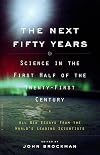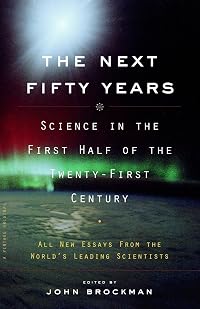
The Next Fifty Years: Science in the First Half of the Twenty-first Century
by John Brockman (Editor)
On This Page
Description
A brilliant ensemble of the world's most visionary scientists provides twenty-five original never-before-published essays about the advances in science and technology that we may see within our lifetimes. Theoretical physicist and bestselling author Paul Davies examines the likelihood that by the year 2050 we will be able to establish a continuing human presence on Mars. Psychologist Mihaly Csikszentmihalyi investigates the ramifications of engineering high-IQ, geneticially happy babies. show more Psychiatrist Nancy Etcoff explains current research into the creation of emotion-sensing jewelry that could gauge our moods and tell us when to take an anti-depressant pill. And evolutionary biologist Richard Dawkins explores the probability that we will soon be able to obtain a genome printout that predicts our natural end for the same cost as a chest x-ray. (Will we want to read it? And will insurance companies and governments have access to it?) This fascinating and unprecedented book explores not only the practical possibilities of the near future, but also the social and political ramifications of the developments of the strange new world to come. Also includes original essays by: Lee Smolin Martin Rees Ian Stewart Brian Goodwin Marc D. Hauser Alison Gopnik Paul Bloom Geoffrey Miller Robert M. Sapolsky Steven Strogatz Stuart Kauffman John H. Holland Rodney Brooks Peter Atkins Roger C. Schank Jaron Lanier David Gelernter Joseph LeDoux Judith Rich Harris Samuel Barondes Paul W. Ewald show lessTags
Recommendations







Member Reviews
I picked this up with the express purpose of waving it about 35 years from now and yelling in my old man's voice "Where's my [this book's equivalent of a] jetpack?" While it's interesting, I don't think I'll bother.
That the book is over 10 years old and obviously a bit dated (yes, e-books did become a thing; no, AFAIK we still haven't proven that breast cancer is caused by infection) isn't its major problem. Rather, it is that the editor seems to have first decided which authors he wanted to include and only after getting their contributions realising that a lot of them ended up writing about the same issues. So we get a bunch of articles that skirt the same issues (biochemistry, genetics, and Moore's Law in every single chapter) while show more others that might have been at least as interesting (say, the environment, or energy) are all but completely absent. Plus, of course, if you want to be pessimistic you could argue that all these things we might achieve over the next half- (or third-) century depends on us not spending that time killing each other and handing political power to people who still think the world is 6,000 years old, and there's nobody here who's not a "pure" scientist willing to look beyond their own field to society at large.
That said, sure, there are some very interesting essays here, promising a few decades of increaing awarness of complexity, leavin us with some very intriguing ethical issues to face (or ignore, if you want Dawkins' opinion). show less
That the book is over 10 years old and obviously a bit dated (yes, e-books did become a thing; no, AFAIK we still haven't proven that breast cancer is caused by infection) isn't its major problem. Rather, it is that the editor seems to have first decided which authors he wanted to include and only after getting their contributions realising that a lot of them ended up writing about the same issues. So we get a bunch of articles that skirt the same issues (biochemistry, genetics, and Moore's Law in every single chapter) while show more others that might have been at least as interesting (say, the environment, or energy) are all but completely absent. Plus, of course, if you want to be pessimistic you could argue that all these things we might achieve over the next half- (or third-) century depends on us not spending that time killing each other and handing political power to people who still think the world is 6,000 years old, and there's nobody here who's not a "pure" scientist willing to look beyond their own field to society at large.
That said, sure, there are some very interesting essays here, promising a few decades of increaing awarness of complexity, leavin us with some very intriguing ethical issues to face (or ignore, if you want Dawkins' opinion). show less
When I first got this book (2003), I was very excited about the concept of a book of short essays on what we expect to see over the next fifty years of science. But now as I look at it, I am disappointed by the author selection: Lee Smolin next to Martin Rees, and Paul Davies next to Richard Dawkins? How is a layperson supposed to know who to trust and who might be a little off their rockers?* Then there's poor Ian Stewart predicing that the Poincare conjecture won't be proved by 2050; the book was sadly out of date no more than two weeks after I finished reading it. Basically, some of the essays probably do have merit, but since it most likely takes someone knowledgeable in that field to be able to say so, this book has little overall show more to offer. Might be entertaining again come 2050, though :)
*For the record, when it comes to pointificating on science, my money is on Rees and Dawkins. show less
*For the record, when it comes to pointificating on science, my money is on Rees and Dawkins. show less
Interesting collection of technological/scientific predictions. Since the book is somewhat dated, some predictions have been shown to be correct/incorrect. I appreciated the predictions for the life sciences, medicine, and psychology.
Very likely completely off but stimulating ideas. Lots of different authors so quality varies.
This is a book for those who wish to be entertained for a few hours. However, if you're looking for serious predictions on the future, you ought to go where everyone else goes: back to bed.
Essays by really smart people. Much like the great stuff on Brockman's www.edge.com site.
375713425
Members
- Recently Added By
Lists

Futurism Works
25 works; 6 members
Author Information

All Editions
Awards and Honors
Notable Lists
Common Knowledge
- Canonical title
- The Next Fifty Years: Science in the First Half of the Twenty-first Century
- Original title
- The next fifty years. Science in the first half of the twenty-first century
Classifications
Statistics
- Members
- 410
- Popularity
- 75,996
- Reviews
- 10
- Rating
- (3.51)
- Languages
- 9 — Czech, Dutch, English, German, Hungarian, Italian, Portuguese, Spanish, Turkish
- Media
- Paper, Audiobook, Ebook
- ISBNs
- 12
- ASINs
- 1