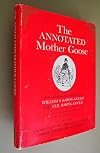
The Annotated Mother Goose: Nursery Rhymes Old and New, Arranged and Explained
by William Stuart Baring-Gould, Ceil. Baring-Gould
On This Page
Description
Marginal notations explain the satire, politics and other subtle allusions which underlie this collection of children's rhymes.Tags
Recommendations

















Member Reviews
I'm bound to agree with the reviewer who complained about the layout, which defies reason, though to a large extent I find that this problem is common with many annotated editions of classic works (but this one is especially bad). Also common is the tendency of annotators to take themselves and their insights way too seriously: a good fifteen percent of the annotations could have been dealt with under a single heading: Katherine Elwes Thomas got it all wrong. I think the whole book might better be arranged with simple notes before or after each rhyme--the proliferation of Arabic numerals that deface even the shortest lyrics is worse than distracting, especially when it takes your mind off the rhyme and leads to...yet another refutation show more of Katherine Elwes Thomas! One begins to wonder whether the world really reeded an annotated Mother Goose. For a genre that's most of all about the fun of rhyme and meter, and of nonsense, the annotations are disappointingly, well, unfun and deflating. show less
Well, that's it. I finally gave up on the Annotated Mother Goose that I've been trying to read on and off for the last 5 years after getting to page 200 of a 350 page book. But why? It has an introduction, notes, complete texts and illustrations from the most wonderful Mother Goose artists! The subject is interesting, the notes (should have been) just as interesting. It might have been fun to read -- except for the horrible, irritating, just plain ridiculous layout of the text. First of all, the font was teeny tiny--not just the notes, but the main text, the nursery rhymes themselves were very difficult to see even in a strong light. The ink seemed almost grey instead of black! Then the notes themselves were in even smaller font. Ugh! show more On top of that, the notes were not at the bottom of the page directly under the nursery rhyme it refers to, or at the end of the book so that the page doesn't look cluttered, but on the right and left margins of the page. Since the notes sometimes were longer than the nursery rhyme itself, it often overlapped onto the next margin or even the next page, so that one had to constantly turn over pages to go back and forth between the nursery rhyme and its notes! It became increasingly annoying the farther one read. And then the information in the notes was at times haphazard. It would usually give bibliographic information about when the nursery rhyme first appeared in print, variations, and sometimes an explanation of an image or word, sometimes some historical context. Sometimes nothing at all would be explained. In the end I just couldn't see wasting my energy for so little enjoyment. show less
Even though it’s entirely impossible to have a truly complete collection of Mother Goose nursery rhymes, this annotated collection by the Baring-Goulds is an admirable attempt. It holds an astounding number of nursery rhymes, both familiar and more obscure, which I found rather delightful to peruse. Discovering new rhymes and recollecting old ones seems to be the entire point of the collection, since the authors admit that they omitted some of the most commonplace pieces because they had no real place among “Mother Goose nursery rhymes” (which are arguably a subset of their own within children’s literature) as well as the more obscure and oddly placed poems that were often added by publishers to pad collections. This may seem show more like an oversight, since obscurity and commonality have their place in collections with even a modicum of academic tone, but the collection is already large enough and there are other sources for this material. My only real complaint about this volume is that their annotations left me slightly disappointed. The poems were in no sense completely annotated, since some pieces had no accompanying text at all, and the authors tended to ramble on about various topics which seemed to have very little bearing on many of the poems in question. Once I stopped reading the annotations, though, I regained my interest in the book and focused on simply enjoying the nursery rhymes themselves - with only quick jaunts to the margins if I felt particularly inquisitive about specific poems. Since this collection was published some time ago, I wouldn’t be surprised if there was a more modernized (and complete) academic Mother Goose collection, which I shall have to seek out for my own library. show less
Intersting, certainly, but these annotated versions tend to overdo it. This should not be your introduction to these poems, because all the notes tend to destroy the fun and dull your spontaneous reaction to what you read. Only after having these engrained in you should you study them as in this book--if you care that deeply.
Long, thorough, wonderful resource for scholars and fans. Families could use it, but don't leave it around where young readers can browse through and catch the bawdy backgrounds of some of the rhymes actually aimed at adults. I particularly loved the illustrations. Mostly 'clip art' but still, so many cool drawings by some of the original big names.
This book gives far more information on mother goose rhymes, and far more of the rhymes themselves, than I thought existed. This is an excellent resource for a primary school teacher, or any person who is interested in the meanings, sources, and variations of nursery rhymes.
I would NOT recommend this book to be in an elementary or middle school library based on the historical forthrightness of some of the rhymes. For example, in chapter one, there is a short rhyme that jokes about burning the Pope (which also calls him a fagot). Also in this chapter, there is a list showing how many times murder, violence, etc, is mentioned in the mother goose rhymes in attempt of spurring a nursery rhyme reformation.
Members
- Recently Added By
Lists

Favorite Childhood Books
1,646 works; 513 members

Academic Studies of Fairy Tales and Folklore
28 works; 6 members
Author Information

11 Works 2,988 Members
1 Work 673 Members
All Editions
Series
Belongs to Publisher Series
Common Knowledge
- Canonical title
- The Annotated Mother Goose: Nursery Rhymes Old and New, Arranged and Explained
- Original publication date
- 1962
- People/Characters
- Bobby Shaftoe; Mother Goose; Elsie Marley
- Epigraph
- "...smooth stones from the brook of time, worn round by constant friction of tongues long silent." -- Andrew Lang
- Dedication
- This book is for our daughter, Judy, and our son, Bill.
- First words
- They are the beloved heritage of Nobody-Really-Knows how many countries or how many centuries.
- Last words
- (Click to show. Warning: May contain spoilers.)You, Too, can be a "Mother Goose" collector!
Classifications
- Genres
- Children's Books, Fiction and Literature, Poetry
- DDC/MDS
- 398.8 — Society, government, & culture Customs, etiquette & folklore Folklore & Folktales Rhymes and rhyming games
- LCC
- PZ8.3 .M85 .B — Language and Literature Fiction and juvenile belles lettres Fiction and juvenile belles lettres Juvenile belles lettres
- BISAC
Statistics
- Members
- 684
- Popularity
- 41,792
- Reviews
- 10
- Rating
- (4.11)
- Languages
- English
- Media
- Paper
- ISBNs
- 11
- ASINs
- 16