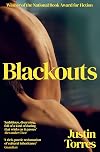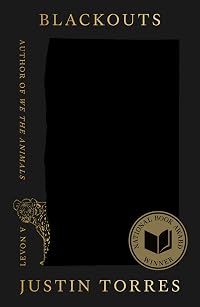
Blackouts
by Justin Torres
On This Page
Description
A Most Anticipated Read The New York Times * The Guardian * Lit Hub * The Rumpus * The Stacks * Publishers Weekly From the bestselling author of We the Animals, Blackouts mines lost histories--personal and collective. Out in the desert in a place called the Palace, a young man tends to a dying soul, someone he once knew briefly, but who has haunted the edges of his life. Juan Gay--playful raconteur, child lost and found and lost, guardian of the institutionalized--has a project to pass along show more to this new narrator. It is inspired by a true artifact of a book, Sex Variants: A Study in Homosexual Patterns, which contains stories collected in the early twentieth century from queer subjects by a queer researcher, Jan Gay, whose groundbreaking work was then co-opted by a committee, her name buried. As Juan waits for his end, he and the narrator trade stories--moments of joy and oblivion--and resurrect lost loves, lives, mothers, fathers, minor heroes. The past is with us, beside us, ahead of us; what are we to create from its gaps and erasures? Inspired by Kiss of the Spider Woman, Pedro Páramo, Voodoo Macbeth, the book at its own center and the woman who created it, oral histories, and many more texts, images, and influences, Justin Torres's Blackouts is a work of fiction that sees through the inventions of history and narrative. An extraordinary work of creative imagination, it insists that we look long and steady at the world we have inherited and the world we have made--a world full of ghostly shadows and flashing moments of truth. show lessTags
Recommendations




























Member Recommendations


Member Reviews
Deep into the pages of the novel “Blackouts” by Justin Torres, one of the included illustrations is a sketch comparing two vaginas–one a homosexual subject physically unharmed, the other with flesh tears caused by mutual sex play. Notes, not blacked out, indicate, in the context of scientific research, the gynecology of homosexuality is to be left to our censored imaginations. Real queer history, as represented by this sketch and other artifacts of the 1930s, is presented to us paratextually in the frames of “Blackout’s” fiction. “Blackout’s” postmodernism compels us to ask: Is the book before us a creation of its author or a creation of its characters?
A much-blacked-out copy of the 1941 medical text “Sex Variants: show more A Study of Homosexual Patterns”, is in the possession of Juan Gay, an older terminally-ill resident of a derelict sanitarium somewhere in the U.S. desert. Juan has been spending his last days on a project to reconstruct the redacted history of the study’s instigator, a pioneering lesbian sociologist who conducted hundreds of interviews with queer subjects in her goal to demystify and normalize queer life. The patriarchal medical establishment co-opted her work to misconstrue historical testimonies into scientized pathologies of homosexuality as a psychiatric disorder and criminal activity. Juan is visited by a twenty-seven-year-old man named Nene, a drifter and sex hustler, and the novel’s narrator. The two were roommates in a mental hospital ten years earlier. Juan is a lover, but also a queer role model for Nene. At night, sharing Juan’s deathbed, the men share tales from their difficult personal histories growing up queer. During the day, as Juan sleeps and his health declines, Nene pores over the study, trying to draw sense from both its intactnesses and erasures. Torres’s text includes extracts from the non-fictional study throughout the novel and inside the fiction. The dying Juan enlists Nene to continue the project, his poioumena. Between material layers of the project, Torres presents the characters’s deathbed conversations regarding their troubled youths and families, experiences with ex-lovers and anonymous sex, the synopsis of subtextual children’s books, mental illness, the marginalization of Puerto Rican identity, and extemporaneously imagined movie screenplays about queer characters–embedded sub-fictions deployed to restore erasures and forbidden histories. Like the unedited footage of a documentary film, Torres gives order to the truthful breaks and ruptures–real advertisements, letters, photographs, and illustrations–while also acknowledging the necessity to incorporate fictionalized accounts of real people. Torres’s metafictional endnotes recall Nabokov’s fictionalized commentaries in his novel “Pale Fire,” and there are clear intertextual homages to Rulfo’s novel “Pedro Páramo” and Puig’s “Kiss of the Spider Woman.” Juan teaches Nene that marginalized people acquire identity through a literarily-defined world. Through a view of history both true and imagined, Nene discovers queer history, instead of criminal and immoral, to be brave and inclusive. A grandly subversive inheritance, hidden in omissions, subtext, endnotes, uncatalogued letters and photos, under redactions, and shared in whispers down generations.
Michel Foucault, the French philosopher and postmodernist, in his 1977 essay "Nietzsche, Genealogy, History", analyzed Nietzsche's use of genealogy as a way of critiquing traditional historical methods, of uncovering origins and power relations in established historical narratives. Nietzsche argued morality has a history that changes over time. They used genealogy to mean the lineage of societal beliefs and practices we live by today. Foucault writes that attitudes and dispositions toward sex and discipline do not move improvingly forward in time, but are contingent upon authorized passions and prejudices. Genealogy-history examines the origins of a specific concept of moral goodness, and a similar critique can be found in “Blackouts” regarding the genesis of attitudes about gender, sexual preference, and ways of defining and disciplining criminality. Foucault writes that attempting to capture the exact and pure essence of things such as primordial identity is a mistake, there is no perfect origin. Nietzsche wrote that the theological origin of humanity once made sense, Adam and Eve created in the perfect shadowless light of the first morning, everything from a plan with meaning. Nietzsche says, after Darwin the path of human sovereignty on Earth was blocked by a monkey standing at the entrance. And Foucault writes that the history of Enlightenment, claiming devotion to truth and precise scientific methods, is in fact made from the passions of its scholars’s hatreds, fanaticisms, and competitions. Personal conflicts forged the weapons of reason. Foucault writes that a genealogy approach to history unmasks the errors and accidents and dispels the chimeras of either divine or so-called rational origin. There is a single drama when a new idea or event develops: the domination between people. Successful understandings of history belong to those capable of dominating who is right and who gets listened to and why. Against this, Foucault suggests a new historical sense acknowledging causality and origin, acknowledging the plurality that went into the ideas and movements history represents, and breaking free from the history of identities we inherited. Some knowledge inherited from our complex past must be sacrificed, knowledge that was not simply objective but was the result of instinct, passion, chance, and sometimes malice–knowledge arising from a will to knowledge. What was, was the result of subjective emotions and desires. What was never an inevitable eternal truth can be rethought, reinterpreted, and reshaped.
“Blackouts” employs such a strategy of reconstructedness both in its literary and artifactual elements to prove how queer history contains the possibilities of counter-narrative and counter-history. The novel creates coherence out of fracture, its subjects imagined, historical, and sometimes dramatized emerge de-pathologized and human. And the true stories of unsung heroes are reclaimed. show less
A much-blacked-out copy of the 1941 medical text “Sex Variants: show more A Study of Homosexual Patterns”, is in the possession of Juan Gay, an older terminally-ill resident of a derelict sanitarium somewhere in the U.S. desert. Juan has been spending his last days on a project to reconstruct the redacted history of the study’s instigator, a pioneering lesbian sociologist who conducted hundreds of interviews with queer subjects in her goal to demystify and normalize queer life. The patriarchal medical establishment co-opted her work to misconstrue historical testimonies into scientized pathologies of homosexuality as a psychiatric disorder and criminal activity. Juan is visited by a twenty-seven-year-old man named Nene, a drifter and sex hustler, and the novel’s narrator. The two were roommates in a mental hospital ten years earlier. Juan is a lover, but also a queer role model for Nene. At night, sharing Juan’s deathbed, the men share tales from their difficult personal histories growing up queer. During the day, as Juan sleeps and his health declines, Nene pores over the study, trying to draw sense from both its intactnesses and erasures. Torres’s text includes extracts from the non-fictional study throughout the novel and inside the fiction. The dying Juan enlists Nene to continue the project, his poioumena. Between material layers of the project, Torres presents the characters’s deathbed conversations regarding their troubled youths and families, experiences with ex-lovers and anonymous sex, the synopsis of subtextual children’s books, mental illness, the marginalization of Puerto Rican identity, and extemporaneously imagined movie screenplays about queer characters–embedded sub-fictions deployed to restore erasures and forbidden histories. Like the unedited footage of a documentary film, Torres gives order to the truthful breaks and ruptures–real advertisements, letters, photographs, and illustrations–while also acknowledging the necessity to incorporate fictionalized accounts of real people. Torres’s metafictional endnotes recall Nabokov’s fictionalized commentaries in his novel “Pale Fire,” and there are clear intertextual homages to Rulfo’s novel “Pedro Páramo” and Puig’s “Kiss of the Spider Woman.” Juan teaches Nene that marginalized people acquire identity through a literarily-defined world. Through a view of history both true and imagined, Nene discovers queer history, instead of criminal and immoral, to be brave and inclusive. A grandly subversive inheritance, hidden in omissions, subtext, endnotes, uncatalogued letters and photos, under redactions, and shared in whispers down generations.
Michel Foucault, the French philosopher and postmodernist, in his 1977 essay "Nietzsche, Genealogy, History", analyzed Nietzsche's use of genealogy as a way of critiquing traditional historical methods, of uncovering origins and power relations in established historical narratives. Nietzsche argued morality has a history that changes over time. They used genealogy to mean the lineage of societal beliefs and practices we live by today. Foucault writes that attitudes and dispositions toward sex and discipline do not move improvingly forward in time, but are contingent upon authorized passions and prejudices. Genealogy-history examines the origins of a specific concept of moral goodness, and a similar critique can be found in “Blackouts” regarding the genesis of attitudes about gender, sexual preference, and ways of defining and disciplining criminality. Foucault writes that attempting to capture the exact and pure essence of things such as primordial identity is a mistake, there is no perfect origin. Nietzsche wrote that the theological origin of humanity once made sense, Adam and Eve created in the perfect shadowless light of the first morning, everything from a plan with meaning. Nietzsche says, after Darwin the path of human sovereignty on Earth was blocked by a monkey standing at the entrance. And Foucault writes that the history of Enlightenment, claiming devotion to truth and precise scientific methods, is in fact made from the passions of its scholars’s hatreds, fanaticisms, and competitions. Personal conflicts forged the weapons of reason. Foucault writes that a genealogy approach to history unmasks the errors and accidents and dispels the chimeras of either divine or so-called rational origin. There is a single drama when a new idea or event develops: the domination between people. Successful understandings of history belong to those capable of dominating who is right and who gets listened to and why. Against this, Foucault suggests a new historical sense acknowledging causality and origin, acknowledging the plurality that went into the ideas and movements history represents, and breaking free from the history of identities we inherited. Some knowledge inherited from our complex past must be sacrificed, knowledge that was not simply objective but was the result of instinct, passion, chance, and sometimes malice–knowledge arising from a will to knowledge. What was, was the result of subjective emotions and desires. What was never an inevitable eternal truth can be rethought, reinterpreted, and reshaped.
“Blackouts” employs such a strategy of reconstructedness both in its literary and artifactual elements to prove how queer history contains the possibilities of counter-narrative and counter-history. The novel creates coherence out of fracture, its subjects imagined, historical, and sometimes dramatized emerge de-pathologized and human. And the true stories of unsung heroes are reclaimed. show less
This book won the National Book Award and after reading it, I can say that the judges really had no choice in the matter. It manages to be intelligent, innovative and full of heart, which is a lot for one book. The scaffolding for this novel is two men in a room, a small room in an old building in New Mexico, the curtains drawn. Juan is dying and his friend, who he last saw decades ago in a mental health facility, has come to spend these last days with him in this over-heated room, as they talk about their own pasts and read a bit from an old book called Sex Variants, where each page has been altered, words blacked out, making a new text. The also discuss the person who spear-headed the book's creation, her history and how she convinced show more a male doctor to be the head of the project, because she couldn't get traction as a woman, and how she was ultimately disappointed in what resulted.
This is the kind of book that ranges far and wide while staying in the same place. It's clever and intelligent, with the erasures revealing more than the original text did. It shares a format with Puig's Kiss of the Spider Woman, a connection that Torres points out. It's a novel that deserves to be read slowly and ideally as a physical book, the object itself playing a part in how well this book holds together, with illustrations and photos enhancing the story being told. show less
This is the kind of book that ranges far and wide while staying in the same place. It's clever and intelligent, with the erasures revealing more than the original text did. It shares a format with Puig's Kiss of the Spider Woman, a connection that Torres points out. It's a novel that deserves to be read slowly and ideally as a physical book, the object itself playing a part in how well this book holds together, with illustrations and photos enhancing the story being told. show less
What is the source of our identity? Every historical narrative has the potential for a counter-narrative, as demonstrated by Blackouts, which also implies that each of us has identity ruptures and gaps—the book's title blackouts—that are kept together by narrative continuity.
I was reminded of Nabokov's lyricism and intricacy by the narrative. The story is slowly, gradually revealed through vignettes that this reader found fascinating. As the essence is revealed the book became more and more incredibly engaging to read. Adding to this was the creative use of blacked-out source materials in conjunction with the story. The result is a book that deserves the accolades that it has received.
Juan and Nene's extended deathbed conversation show more about sex, family ostracism, Puerto Rican identity and films they love like Kiss of the Spider Woman (an inspiration for this novel), is a way of imaginatively restoring some of that "forbidden" material. show less
I was reminded of Nabokov's lyricism and intricacy by the narrative. The story is slowly, gradually revealed through vignettes that this reader found fascinating. As the essence is revealed the book became more and more incredibly engaging to read. Adding to this was the creative use of blacked-out source materials in conjunction with the story. The result is a book that deserves the accolades that it has received.
Juan and Nene's extended deathbed conversation show more about sex, family ostracism, Puerto Rican identity and films they love like Kiss of the Spider Woman (an inspiration for this novel), is a way of imaginatively restoring some of that "forbidden" material. show less
National Book Award winner that you can't help appreciating and admiring for its writing, more than appreciate reading it. Justin Torres is amazing - I loved "We The Animals," but this takes his skills to a whole other level. The book alone could be a semester course in Queer Studies - there are so many layers. The basic premise is the narrator, presumably destitute, travels to find ancient Juan Gay, at the Palace, which seems like a decrepit public nursing home (though explained later). Juan is dying and wants the narrator to finish a life-long research project on Jan Gay (real person) and the book Sex Variants (real book, 1940s). It all comes across a bit like a fever dream, but in the time Juan has left, the two men share stories and show more confidences and Juan reveals his personal connection (fictional?) to Jan and the book - and maybe this book is the finished product? "there were three stories Juan wanted to alloy: (1) the story of how I'd arrived at the Palace...(2) the story of the Sex Variants study itself, Jan Gay's story....(3) the final story, Juan's own," (113) The title works on several levels too- from physical blackouts - both men were institutionalized for mental illness, which is how they met long ago - to memory lapse, to the 'blackout' poems the author has created and included from the original text of Sex Variants, to the blacking out of queer history, which is also facing a dark future. Torres says it "about reading absence." Truly a masterpiece and deserving of its literary prize, but definitely not a casual read. show less
Clearly inspired by [b:Kiss of the Spider Woman|588242|Kiss of the Spider Woman|Manuel Puig|https://i.gr-assets.com/images/S/compressed.photo.goodreads.com/books/1403179094l/588242._SY75_.jpg|765288] (1976) by Manuel Puig, I enjoyed this novel’s recreation of the tender, caring bond that develops between two rather different men in Puig’s novel as they pass the time in a small cell-like space (literally a cell in Puig, figuratively here) talking, imagining life through the lens of film, and through being their true selves countering a dominant ideology that pathologizes queerness.
Juan, an elder man on his deathbed, wants his young visitor to take up the work of recording queer history and identity begun in a lengthy old research show more report in his possession, which was co-opted and misused for their own purposes by straight male doctors decades ago. Reflecting this erasure, the volumes themselves are mostly blacked out and images of its pages are printed here in the style of creating found poetry, which is not usually something I have much interest in but it works quite well in this context. And as Juan fades into delirium near the end of the novel, reality is further erased until the arrival of the ultimate “blackout”, if I may.
There is not so much a plot though as a rich and complex characterization of these two men and the bond that was created between them over only eighteen days they shared being forced into a mental institution prior to the younger’s suicide attempt and subsequent departure, that then survived a decade of no contact, and which is now revived and developed after the unnamed narrator has tracked down the dying Juan in his small, dark room.
Through the skillful dialogue that is most of the book, Torres shows these two men sharing their lives with each other and in their relationship demonstrating the love of neighbor that should be striven for even as we often come up short.
4.5 show less
Juan, an elder man on his deathbed, wants his young visitor to take up the work of recording queer history and identity begun in a lengthy old research show more report in his possession, which was co-opted and misused for their own purposes by straight male doctors decades ago. Reflecting this erasure, the volumes themselves are mostly blacked out and images of its pages are printed here in the style of creating found poetry, which is not usually something I have much interest in but it works quite well in this context. And as Juan fades into delirium near the end of the novel, reality is further erased until the arrival of the ultimate “blackout”, if I may.
There is not so much a plot though as a rich and complex characterization of these two men and the bond that was created between them over only eighteen days they shared being forced into a mental institution prior to the younger’s suicide attempt and subsequent departure, that then survived a decade of no contact, and which is now revived and developed after the unnamed narrator has tracked down the dying Juan in his small, dark room.
Juan was dying, but only in the light, and only in the body. In the dark, his voice filled the room, sharper and more alive than I.
Through the skillful dialogue that is most of the book, Torres shows these two men sharing their lives with each other and in their relationship demonstrating the love of neighbor that should be striven for even as we often come up short.
4.5 show less
Poetically written novel in the form of an intimate discussion between two men – one older and one younger, who originally met in a mental hospital ten years earlier. Juan, the older man, is nearing the end of life. The younger man is not named but Juan calls him “Nene.” They tell each other stories, focused on family relationships, past experiences, and mental health “treatments.” It specifically refers to an outdated (real) psychiatric book called Sex Variants: A Study in Homosexual Patterns.
The term “Blackouts” of the title refers to both blackouts experienced by the characters (which they analyze during their storytelling sessions) and blacked out (redacted) pages of the Variants book, where the remaining words create show more poetry. It has an atmosphere of intimacy. It contains a number of literary references, and a commentary on misunderstandings of homosexuality (previously classified as a mental condition). I am not quite sure how well it works as a novel. I prefer a little more of a storyline, but it’s definitely creative and I appreciate it as a work of art. show less
The term “Blackouts” of the title refers to both blackouts experienced by the characters (which they analyze during their storytelling sessions) and blacked out (redacted) pages of the Variants book, where the remaining words create show more poetry. It has an atmosphere of intimacy. It contains a number of literary references, and a commentary on misunderstandings of homosexuality (previously classified as a mental condition). I am not quite sure how well it works as a novel. I prefer a little more of a storyline, but it’s definitely creative and I appreciate it as a work of art. show less
This novel slips in and out of time and dreams while presenting the 20th century history of official studies of homosexual behavior—or sexual variance, as it is termed—but not noticeably venturing beyond men attracted to men and women attracted to women. The two main characters, a young man at loose ends and the dying Juan Gay, who has taken his name from the lesbian Jan Gay, whose collection of interviews with lesbians was appropriated without credit by the authors of Sex Variants: A Study of Homosexual Patterns. Scenes from the lives of both men are entangled with Jan Gay's and form a powerful pattern of life outside of what the majority find comfortable.
Members
- Recently Added By
Published Reviews
ThingScore 100
A marginalised history is salvaged from real‑life medical records in this strange and glorious novel
added by jeremybakernz
“Torres’ intricate web of narratives is gripping from beginning to end. His richly drawn characters are passionate . . .”
added by jeremybakernz
It’s as though the magician has stepped forward at the end of the show to explain the trick, and disappeared himself in the process. Torres haunts this book full of ghosts like a ghost himself, and with this novel, he has passed the haunting on, creating the next link in a queer chain from Jan to Juan to nene to you.
added by jeremybakernz
Lists

National Book Award - Fiction
78 works; 10 members

National Book Award Finalists - Fiction
377 works; 12 members

2024 Tournament of Books
18 works; 9 members

Books Read in 2024
4,623 works; 126 members

Books Read in 2026
1,952 works; 66 members

Books Read in 2025
4,091 works; 97 members
Author Information

4+ Works 2,204 Members
Some Editions
Awards and Honors
Common Knowledge
- Canonical title
- Blackouts
- Original publication date
- 2023-10-10
- People/Characters
- Juan Gay; Jan Gay; nene
- Important places
- The Palace
- Epigraph
- Poetry loses some of its charm through the suggestion that it might be an expression of the writer's sexual maladjustment. But as a matter of fact it is beginning to seem that all imaginative writings are attempts to find lib... (show all)idinous satisfaction in fantasy.
The author has .... tendencies); ....
made no attempt to estimate what proportion of imaginative writing may be the work of ... confined ... has accepted the fact that human beings reveal themselves in whatever they read or write.
GEORGE W. HENRY, M.D. - Dedication
- VALENCIA MARTINEZ & to my DAVID, the most brilliant and most useful i have ever met
- First words
- I came to the Palace because the man I sought kept a room there. He stood at the point of egress, supporting himself against the door frame, not just thing, but skeletal; lips shrunken and chapped; the skin of his face pulled... (show all) taut over the skull. I led him back to bed, where he looked at me, kind but wild. His eyes burned with life, as if the spirit had left the flesh and concentrated there, in irises bright and glassy, the milk of the whites unsullied.
- Last words
- (Click to show. Warning: May contain spoilers.)But for a moment Juan holds the frame and will not let me go.
- Original language
- English
- Canonical DDC/MDS
- 813.6
- Canonical LCC
- PS3620.O5897
Classifications
Statistics
- Members
- 705
- Popularity
- 40,405
- Reviews
- 17
- Rating
- (3.64)
- Languages
- English, French, Italian, Spanish
- Media
- Paper, Audiobook, Ebook
- ISBNs
- 12
- ASINs
- 3