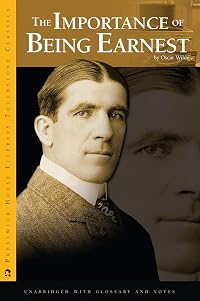
The Importance of Being Earnest
by Oscar Wilde 
On This Page
Description
The Importance of Being Earnest is the last play Oscar Wilde ever wrote, and remains his most enduringly popular. It makes fun of social graces in the late Victorian era. Two seemingly unrelated parties are thrown into ridiculous entanglement when their fake identities, maintained in order to escape social responsibilities, grow ever more complicated to uphold..
Tags
Recommendations







Member Recommendations

NancyAf Both plays are hilarious comedies of manners with the interplay between the sexes at the forefront.
20


susanbooks Maurice mentions Oscar Wilde a couple of times & you can imagine the characters in the novel and the play socializing in some drawing room together
Member Reviews
Divertente, divertentissimo, una risata a ogni pagina, ironico, pungente, anche avvincente verso la fine, con personaggi così reali e allo stesso tempo così assurdi, che pronunciano con estrema naturalezza frasi che paiono senza senso, ma che a ben vedere sono poi il fior fiore degli aforismi di Wilde. Uno spaccato della società vittoriana sempre attualissimo… insomma, in due parole: l’opera di un genio!
E poi, chi non desidera un amico come Bunbury?!?!?! XD
http://www.naufragio.it/iltempodileggere/3613
E poi, chi non desidera un amico come Bunbury?!?!?! XD
http://www.naufragio.it/iltempodileggere/3613
Short and sweet, Oscar Wilde's popular play The Importance of Being Earnest packs a lot into its three brief acts. On the surface it seems frivolous, a mere satire of Victorian social mores, and even on this level it is entertaining. Its farcical nature – a man invents a brother named 'Ernest' to disguise his second life, and hilarity ensues when 'Ernest' comes to visit his country home – has the sort of fun, easy chaos of a sitcom episode in which similar shenanigans might occur. Though less quotable than Wilde's other works, Earnest still has dialogue that sparkles, as the author enlivens the prattle of these stuffy people with lines that they would not have the wit to conjure themselves.
But beyond this crowd-pleasing level, The show more Importance of Being Earnest endures. Its characters' determination to take trivial matters seriously and serious matters trivially reminds one disconcertingly of how many real people indeed behave, and while the insufferably snobby airs of the likes of Lady Bracknell are still unappealing to me, it's satisfying to see them skewered. And Wilde's play is nothing so trite as a parody – rather, it's as though Wilde wrote a straightforward play but recognised and delighted in the absurdity of such things, and just couldn't help but sprinkle his own genius on it. What would be contrived in a run-of-the-mill farce – for example, the two women both determined to be attracted only to men named 'Ernest' – takes on additional layers against the backdrop of such authorial genius, and we find ourselves comparing the ways and importance of being earnest/Ernest.
There's also a charmingly human integrity behind the play. It was Wilde's last smash hit before his spectacular downfall; the play being pulled due to his infamous conviction for homosexuality. It's rather touching to see him shine so bright and carelessly here, and rather tragic to know his ascension would soon see him fly too close to the sun (or rather, to Queensberry's son). I remember reading somewhere that 'earnest' was code among Wilde's gay scene for 'homosexual', and while this is disputed by literary detectives, it is rather fantastic to think of that and know that 'The Importance of Being Earnest' was up there in lights in London's West End, with Wilde smiling secretly, even as the unwitting crowds who poured through the doors would not have accepted the importance he placed on being, well, 'earnest'. Even if this speculation is not true – though I hope it is – the play still finds good eating in showing its characters living a double life and riding over the conniptions this causes among the duller people around him. Both feather and maul, The Importance of Being Earnest hides a lot of steel beneath its silk. In keeping with its themes, there's a serious weight beneath its triviality. show less
But beyond this crowd-pleasing level, The show more Importance of Being Earnest endures. Its characters' determination to take trivial matters seriously and serious matters trivially reminds one disconcertingly of how many real people indeed behave, and while the insufferably snobby airs of the likes of Lady Bracknell are still unappealing to me, it's satisfying to see them skewered. And Wilde's play is nothing so trite as a parody – rather, it's as though Wilde wrote a straightforward play but recognised and delighted in the absurdity of such things, and just couldn't help but sprinkle his own genius on it. What would be contrived in a run-of-the-mill farce – for example, the two women both determined to be attracted only to men named 'Ernest' – takes on additional layers against the backdrop of such authorial genius, and we find ourselves comparing the ways and importance of being earnest/Ernest.
There's also a charmingly human integrity behind the play. It was Wilde's last smash hit before his spectacular downfall; the play being pulled due to his infamous conviction for homosexuality. It's rather touching to see him shine so bright and carelessly here, and rather tragic to know his ascension would soon see him fly too close to the sun (or rather, to Queensberry's son). I remember reading somewhere that 'earnest' was code among Wilde's gay scene for 'homosexual', and while this is disputed by literary detectives, it is rather fantastic to think of that and know that 'The Importance of Being Earnest' was up there in lights in London's West End, with Wilde smiling secretly, even as the unwitting crowds who poured through the doors would not have accepted the importance he placed on being, well, 'earnest'. Even if this speculation is not true – though I hope it is – the play still finds good eating in showing its characters living a double life and riding over the conniptions this causes among the duller people around him. Both feather and maul, The Importance of Being Earnest hides a lot of steel beneath its silk. In keeping with its themes, there's a serious weight beneath its triviality. show less
Lo so, è imperdonabile essere arrivati alla mia età senza avere letto questo libro, anche se, alla luce del fatto che Il ritratto di Dorian Gray mi lascia un po' freddina, forse è anche normale.
Se non che ringrazio il sospetto, che mi ha tenuto lontano da questo come da altri libri famosi, perché, oltre che a riconciliarmi con Wilde, mi ha permesso di tracciare un divertente parallelo tra i personaggi della piece e certi caratteri che si incontrano in quella specie di palcoscenico collettivo che si chiama FB. Certo, il buon Oscar non si sarebbe mai potuto immaginare come ci saremmo ridotti, eppure quanti sputasentenze informatici mentono come i due Ernesti, quante consigliatrici da due soldi sembrano Lady Bracknell, e quante show more fanciulle più o meno giovani (che hanno però pur sempre 35 anni) sono fintamente ingenue come Cecily e Gwendolyn?
Un vero capolavoro la cui brevità ne rende facile la lettura compulsiva. show less
Se non che ringrazio il sospetto, che mi ha tenuto lontano da questo come da altri libri famosi, perché, oltre che a riconciliarmi con Wilde, mi ha permesso di tracciare un divertente parallelo tra i personaggi della piece e certi caratteri che si incontrano in quella specie di palcoscenico collettivo che si chiama FB. Certo, il buon Oscar non si sarebbe mai potuto immaginare come ci saremmo ridotti, eppure quanti sputasentenze informatici mentono come i due Ernesti, quante consigliatrici da due soldi sembrano Lady Bracknell, e quante show more fanciulle più o meno giovani (che hanno però pur sempre 35 anni) sono fintamente ingenue come Cecily e Gwendolyn?
Un vero capolavoro la cui brevità ne rende facile la lettura compulsiva. show less
If you try to take this literally, it is ludicrous, so don’t. It is a delicately crafted confection of spun sugar: sweet but sharp, beautiful, brittle, and engineered to amuse. “An iridescent filament of fantasy”, as critic William Archer described the opening performance on Valentine’s Day 1895.
“In matters of grave importance, style, not sincerity, is the vital thing.” Gwendolen
This play is a social comedy that celebrates surfaces: the flexible importance of etiquette (as long as it's underpinned by money), and the essential veneer of politeness - especially when insulting someone. It is chock full of often contrary epigrams, even from Algy’s dryly droll manservant, Lane. “The deadly importance of the triviality is show more everything”, as Sir John Gielgud said of this play, aping Wilde’s style.
Plot
Jack and Algernon are wealthy, single, shallow young men in Victorian London. Jack wants to marry Algy’s cousin Gwendolen (daughter of Lady Bracknell), but matters are complicated when Algy finds Jack’s cigarette case, with a puzzling dedication engraved in it, from Cecily. Algy is intrigued, and not at all convinced by Jack’s explanation.
“The truth is rarely pure and never simple.” Algernon
The plot is clever and silly, and really just a framework for exploring ideas about society, marriage, education, and food. Food features a great deal, in all three acts, even though it has no real bearing on the plot at all.
This play has given us A Hand-bag, the double life of a Bunburyist (written just before Wilde’s own double life “quite exploded”, like poor Bunbury), the impossibility of eating muffins in an agitated manner, and two much quoted and paraphrased lines:
* “To lose one parent, Mr Worthing, may be regarded as a misfortune; to lose both looks like carelessness.” Lady Bracknell
* “All women become like their mothers. That is their tragedy. No man does, and that is his.” Algernon
The ending is apparently happy, despite only one of two key points being definitively resolved. Perhaps that’s to placate Cecily:
“I don't like novels that end happily. They depress me so much.”
No matter. Wilde’s wit is the thing.
Then and Now
The original audience would have laughed at the portrayal of themselves, or those in their circle. Our modern society seems so very different, but we are still there, in the play: Lady Bracknell’s alternative facts (quoted below), Miss Prism’s trashy trilogy, being swayed by the vagaries of fashion, and torn between pleasure and duty, comfort eating, and even the difficulty of finding suitable childcare. We should laugh at ourselves, as much as them.
I have nothing in common with Cecily Cardew except a first name, but the novelty of encountering another Cecily was a small part in its initial appeal and is an even smaller part of my enduring fondness for it. I have read and seen it (including an operatic adaptation) many times, and acted in it once (but not as Cecily).
WH Auden described this as “The only pure verbal opera in English.” Who am I (or you) to disagree?
A Hand-bag!
“To be born, or at any rate bred, in a hand-bag, whether it had handles or not, seems to me to display a contempt for the ordinary decencies of family life that reminds one of the worst excesses of the French Revolution.” Lady Bracknell
Picture of baby in “a somewhat large, black leather hand-bag, with handles to it”.
Lady Bracknell would have been early 40s, but aged Edith Evans’ cinematic exaggeration is the performance that sticks, regardless of how subsequent actors deliver it:
https://www.youtube.com/watch?v=oyuoUwxCLMs
Alternative Facts
Lady Bracknell has many questions to assess a suitor, including their all-important address(es):
Lady Bracknell. “What number in Belgrave Square?”
Jack. “149.”
Lady Bracknell. [Shaking her head.] “The unfashionable side. I thought there was something. However, that could easily be altered.”
Jack. “Do you mean the fashion, or the side?”
Lady Bracknell. [Sternly.] “Both, if necessary, I presume.”
Quotes Grouped by Subject
These are hidden for brevity. No real plot spoilers.
Food Quotes
“I hate people who are not serious about meals. It is so shallow of them.” Algernon
The play is rife with storms over teacups, muffins, cucumber sandwiches (lack thereof), and cake, none of which affect the plot, but all of which shine a dark light on the characters.
Jack. “How you can sit there, calmly eating muffins when we are in this horrible trouble, I can’t make out. You seem to me to be perfectly heartless."
Algernon. "Well, I can’t eat muffins in an agitated manner. The butter would probably get on my cuffs. One should always eat muffins quite calmly. It is the only way to eat them."
Jack. "I say it’s perfectly heartless your eating muffins at all, under the circumstances.”
Picture: English muffin, toasted, and buttered
Algernon. [Picking up empty plate in horror.] “Good heavens! Lane! Why are there no cucumber sandwiches? I ordered them specially.”
Lane. [Gravely.] “There were no cucumbers in the market this morning, sir. I went down twice.”
Algernon. “No cucumbers!”
Lane. “No, sir. Not even for ready money.”
* “When I am in trouble, eating is the only thing that consoles me. Indeed, when I am in really great trouble, as any one who knows me intimately will tell you, I refuse everything except food and drink.” Algernon
* “You have filled my tea with lumps of sugar, and though I asked most distinctly for bread and butter, you have given me cake.” Gwendolen to Cecily
Education and Erudition Quotes
* “I do not approve of anything that tampers with natural ignorance. Ignorance is like a delicate exotic fruit; touch it and the bloom is gone. The whole theory of modern education is radically unsound. Fortunately in England, at any rate, education produces no effect whatsoever.” Lady Bracknell
* “Literary criticism is not your forte, my dear fellow. Don’t try it. You should leave that to people who haven’t been at a University. They do it so well in the daily papers.” Algernon
* “Oh! it is absurd to have a hard-and-fast rule about what one should read and what one shouldn't. More than half of modern culture depends on what one shouldn't read.” Algernon
* “Dr. Chasuble is a most learned man. He has never written a single book, so you can imagine how much he knows.” Cecily
* “I never travel without my diary. One should always have something sensational to read in the train.” Gwendolen
Personal note: I was only a little younger than Wilde's Cecily when I first saw the play. At the time, I kept a diary of sorts, but afterwards, it never felt quite the same. I suppose it wasn't sensational enough.
Society and Etiquette Quotes
* “Never speak disrespectfully of Society, Algernon. Only people who can’t get into it do that.” Lady Bracknell
* “Thirty-five is a very attractive age. London society is full of women of the very highest birth who have, of their own free choice, remained thirty-five for years.” Lady Bracknell
* “My duty as a gentleman has never interfered with my pleasures in the smallest degree.” Algernon
* “When one is in town one amuses oneself. When one is in the country one amuses other people. It is excessively boring.” Jack
* “I never saw anybody take so long to dress, and with such little result.” Algernon (of Jack)
Bunbury Quotes
Lady Bracknell. “I think it is high time that Mr. Bunbury made up his mind whether he was going to live or to die. This shilly-shallying with the question is absurd.”
Algernon. “The doctors found out that Bunbury could not live, that is what I mean - so Bunbury died.”
Lady Bracknell. “He seems to have had great confidence in the opinion of his physicians. I am glad, however, that he made up his mind at the last to some definite course of action, and acted under proper medical advice.”
Marriage Quotes
* “You don’t seem to realise, that in married life three is company and two is none.” Algernon
* “Lane’s views on marriage seem somewhat lax. Really, if the lower orders don’t set us a good example, what on earth is the use of them? They seem, as a class, to have absolutely no sense of moral responsibility.” Algernon
* “I have always been of opinion that a man who desires to get married should know either everything or nothing. Which do you know?” Lady Bracknell
* “A moment, Mr. Worthing. A hundred and thirty thousand pounds! And in the Funds! Miss Cardew seems to me a most attractive young lady, now that I look at her. Few girls of the present day have any really solid qualities, any of the qualities that last, and improve with time. We live, I regret to say, in an age of surfaces. [To Cecily.] Come over here, dear. [Cecily goes across.] Pretty child! your dress is sadly simple, and your hair seems almost as Nature might have left it. But we can soon alter all that. A thoroughly experienced French maid produces a really marvellous result in a very brief space of time.” Lady Bracknell
* “I do not approve of mercenary marriages. When I married Lord Bracknell I had no fortune of any kind. But I never dreamed for a moment of allowing that to stand in my way.” Lady Bracknell
And THAT is why she is so picky about who might marry Gwendolen.
* “When you do become engaged to some one, I, or your father, should his health permit him, will inform you of the fact. An engagement should come on a young girl as a surprise, pleasant or unpleasant, as the case may be.” Lady Bracknell
* “I am not in favour of long engagements. They give people the opportunity of finding out each other's character before marriage, which I think is never advisable.” Lady Bracknell
* “The amount of women in London who flirt with their own husbands is perfectly scandalous. It looks so bad. It is simply washing one's clean linen in public.” Algernon
Cecily. “Do you suggest, Miss Fairfax, that I entrapped Ernest into an engagement? How dare you? This is no time for wearing the shallow mask of manners. When I see a spade I call it a spade.”
Gwendolen. [Satirically.] “I am glad to say that I have never seen a spade. It is obvious that our social spheres have been widely different.”
* “The General was essentially a man of peace, except in his domestic life. ” Lady Bracknell
Chasuble. [With a scholar’s shudder.] “The precept as well as the practice of the Primitive Church was distinctly against matrimony.”
Miss Prism. [Sententiously.] “That is obviously the reason why the Primitive Church has not lasted up to the present day. And you do not seem to realise, dear Doctor, that by persistently remaining single, a man converts himself into a permanent public temptation. Men should be more careful; this very celibacy leads weaker vessels astray.”
Miss Prism. “No married man is ever attractive except to his wife.”
Chasuble. “And often, I’ve been told, not even to her.”
Other Contrary Quotes
Many of the most memorable lines subvert etiquette, logic, common sense - and themselves. In Wilde's day, homosexuals were often called inverts, and many of his best lines are inversions.
* “I hope you have not been leading a double life, pretending to be wicked and being good all the time. That would be hypocrisy.” -Cecily
* “If you are not too long, I will wait here for you all my life.” Gwendolen
* “Although she may prevent us from becoming man and wife, and I may marry some one else, and marry often, nothing that she can possibly do can alter my eternal devotion to you.” Gwendolen
* “What on earth you are serious about I haven’t got the remotest idea. About everything, I should fancy. You have such an absolutely trivial nature.” Algernon (of Jack)
* “I have never met any really wicked person before. I feel rather frightened. I am so afraid he will look just like every one else.” Cecily
* “The old-fashioned respect for the young is fast dying out.” Gwendolen
* “I could deny it if I liked. I could deny anything if I liked.”
Lady Bracknell. “I was obliged to call on dear Lady Harbury. I hadn’t been there since her poor husband’s death. I never saw a woman so altered; she looks quite twenty years younger.”
Lady Bracknell. “I had some crumpets with Lady Harbury, who seems to me to be living entirely for pleasure now.”
Algernon. “I hear her hair has turned quite gold from grief.”
Image Sources
* Video of spun sugar decoration: https://www.youtube.com/watch?v=_h9-sJUleyA
* Baby in “a somewhat large, black leather hand-bag, with handles to it”: https://normalinlondon.files.wordpress.com/2010/10/baby-handbag.jpg
* English muffin, toasted, and buttered: http://imaginatorium.org/pics/b02406muff.jpg show less
“In matters of grave importance, style, not sincerity, is the vital thing.” Gwendolen
This play is a social comedy that celebrates surfaces: the flexible importance of etiquette (as long as it's underpinned by money), and the essential veneer of politeness - especially when insulting someone. It is chock full of often contrary epigrams, even from Algy’s dryly droll manservant, Lane. “The deadly importance of the triviality is show more everything”, as Sir John Gielgud said of this play, aping Wilde’s style.
Plot
Jack and Algernon are wealthy, single, shallow young men in Victorian London. Jack wants to marry Algy’s cousin Gwendolen (daughter of Lady Bracknell), but matters are complicated when Algy finds Jack’s cigarette case, with a puzzling dedication engraved in it, from Cecily. Algy is intrigued, and not at all convinced by Jack’s explanation.
“The truth is rarely pure and never simple.” Algernon
The plot is clever and silly, and really just a framework for exploring ideas about society, marriage, education, and food. Food features a great deal, in all three acts, even though it has no real bearing on the plot at all.
This play has given us A Hand-bag, the double life of a Bunburyist (written just before Wilde’s own double life “quite exploded”, like poor Bunbury), the impossibility of eating muffins in an agitated manner, and two much quoted and paraphrased lines:
* “To lose one parent, Mr Worthing, may be regarded as a misfortune; to lose both looks like carelessness.” Lady Bracknell
* “All women become like their mothers. That is their tragedy. No man does, and that is his.” Algernon
The ending is apparently happy, despite only one of two key points being definitively resolved. Perhaps that’s to placate Cecily:
“I don't like novels that end happily. They depress me so much.”
No matter. Wilde’s wit is the thing.
Then and Now
The original audience would have laughed at the portrayal of themselves, or those in their circle. Our modern society seems so very different, but we are still there, in the play: Lady Bracknell’s alternative facts (quoted below), Miss Prism’s trashy trilogy, being swayed by the vagaries of fashion, and torn between pleasure and duty, comfort eating, and even the difficulty of finding suitable childcare. We should laugh at ourselves, as much as them.
I have nothing in common with Cecily Cardew except a first name, but the novelty of encountering another Cecily was a small part in its initial appeal and is an even smaller part of my enduring fondness for it. I have read and seen it (including an operatic adaptation) many times, and acted in it once (but not as Cecily).
WH Auden described this as “The only pure verbal opera in English.” Who am I (or you) to disagree?
A Hand-bag!
“To be born, or at any rate bred, in a hand-bag, whether it had handles or not, seems to me to display a contempt for the ordinary decencies of family life that reminds one of the worst excesses of the French Revolution.” Lady Bracknell
Picture of baby in “a somewhat large, black leather hand-bag, with handles to it”.
Lady Bracknell would have been early 40s, but aged Edith Evans’ cinematic exaggeration is the performance that sticks, regardless of how subsequent actors deliver it:
https://www.youtube.com/watch?v=oyuoUwxCLMs
Alternative Facts
Lady Bracknell has many questions to assess a suitor, including their all-important address(es):
Lady Bracknell. “What number in Belgrave Square?”
Jack. “149.”
Lady Bracknell. [Shaking her head.] “The unfashionable side. I thought there was something. However, that could easily be altered.”
Jack. “Do you mean the fashion, or the side?”
Lady Bracknell. [Sternly.] “Both, if necessary, I presume.”
Quotes Grouped by Subject
These are hidden for brevity. No real plot spoilers.
Food Quotes
“I hate people who are not serious about meals. It is so shallow of them.” Algernon
The play is rife with storms over teacups, muffins, cucumber sandwiches (lack thereof), and cake, none of which affect the plot, but all of which shine a dark light on the characters.
Jack. “How you can sit there, calmly eating muffins when we are in this horrible trouble, I can’t make out. You seem to me to be perfectly heartless."
Algernon. "Well, I can’t eat muffins in an agitated manner. The butter would probably get on my cuffs. One should always eat muffins quite calmly. It is the only way to eat them."
Jack. "I say it’s perfectly heartless your eating muffins at all, under the circumstances.”
Picture: English muffin, toasted, and buttered
Algernon. [Picking up empty plate in horror.] “Good heavens! Lane! Why are there no cucumber sandwiches? I ordered them specially.”
Lane. [Gravely.] “There were no cucumbers in the market this morning, sir. I went down twice.”
Algernon. “No cucumbers!”
Lane. “No, sir. Not even for ready money.”
* “When I am in trouble, eating is the only thing that consoles me. Indeed, when I am in really great trouble, as any one who knows me intimately will tell you, I refuse everything except food and drink.” Algernon
* “You have filled my tea with lumps of sugar, and though I asked most distinctly for bread and butter, you have given me cake.” Gwendolen to Cecily
Education and Erudition Quotes
* “I do not approve of anything that tampers with natural ignorance. Ignorance is like a delicate exotic fruit; touch it and the bloom is gone. The whole theory of modern education is radically unsound. Fortunately in England, at any rate, education produces no effect whatsoever.” Lady Bracknell
* “Literary criticism is not your forte, my dear fellow. Don’t try it. You should leave that to people who haven’t been at a University. They do it so well in the daily papers.” Algernon
* “Oh! it is absurd to have a hard-and-fast rule about what one should read and what one shouldn't. More than half of modern culture depends on what one shouldn't read.” Algernon
* “Dr. Chasuble is a most learned man. He has never written a single book, so you can imagine how much he knows.” Cecily
* “I never travel without my diary. One should always have something sensational to read in the train.” Gwendolen
Personal note: I was only a little younger than Wilde's Cecily when I first saw the play. At the time, I kept a diary of sorts, but afterwards, it never felt quite the same. I suppose it wasn't sensational enough.
Society and Etiquette Quotes
* “Never speak disrespectfully of Society, Algernon. Only people who can’t get into it do that.” Lady Bracknell
* “Thirty-five is a very attractive age. London society is full of women of the very highest birth who have, of their own free choice, remained thirty-five for years.” Lady Bracknell
* “My duty as a gentleman has never interfered with my pleasures in the smallest degree.” Algernon
* “When one is in town one amuses oneself. When one is in the country one amuses other people. It is excessively boring.” Jack
* “I never saw anybody take so long to dress, and with such little result.” Algernon (of Jack)
Bunbury Quotes
Lady Bracknell. “I think it is high time that Mr. Bunbury made up his mind whether he was going to live or to die. This shilly-shallying with the question is absurd.”
Algernon. “The doctors found out that Bunbury could not live, that is what I mean - so Bunbury died.”
Lady Bracknell. “He seems to have had great confidence in the opinion of his physicians. I am glad, however, that he made up his mind at the last to some definite course of action, and acted under proper medical advice.”
Marriage Quotes
* “You don’t seem to realise, that in married life three is company and two is none.” Algernon
* “Lane’s views on marriage seem somewhat lax. Really, if the lower orders don’t set us a good example, what on earth is the use of them? They seem, as a class, to have absolutely no sense of moral responsibility.” Algernon
* “I have always been of opinion that a man who desires to get married should know either everything or nothing. Which do you know?” Lady Bracknell
* “A moment, Mr. Worthing. A hundred and thirty thousand pounds! And in the Funds! Miss Cardew seems to me a most attractive young lady, now that I look at her. Few girls of the present day have any really solid qualities, any of the qualities that last, and improve with time. We live, I regret to say, in an age of surfaces. [To Cecily.] Come over here, dear. [Cecily goes across.] Pretty child! your dress is sadly simple, and your hair seems almost as Nature might have left it. But we can soon alter all that. A thoroughly experienced French maid produces a really marvellous result in a very brief space of time.” Lady Bracknell
* “I do not approve of mercenary marriages. When I married Lord Bracknell I had no fortune of any kind. But I never dreamed for a moment of allowing that to stand in my way.” Lady Bracknell
And THAT is why she is so picky about who might marry Gwendolen.
* “When you do become engaged to some one, I, or your father, should his health permit him, will inform you of the fact. An engagement should come on a young girl as a surprise, pleasant or unpleasant, as the case may be.” Lady Bracknell
* “I am not in favour of long engagements. They give people the opportunity of finding out each other's character before marriage, which I think is never advisable.” Lady Bracknell
* “The amount of women in London who flirt with their own husbands is perfectly scandalous. It looks so bad. It is simply washing one's clean linen in public.” Algernon
Cecily. “Do you suggest, Miss Fairfax, that I entrapped Ernest into an engagement? How dare you? This is no time for wearing the shallow mask of manners. When I see a spade I call it a spade.”
Gwendolen. [Satirically.] “I am glad to say that I have never seen a spade. It is obvious that our social spheres have been widely different.”
* “The General was essentially a man of peace, except in his domestic life. ” Lady Bracknell
Chasuble. [With a scholar’s shudder.] “The precept as well as the practice of the Primitive Church was distinctly against matrimony.”
Miss Prism. [Sententiously.] “That is obviously the reason why the Primitive Church has not lasted up to the present day. And you do not seem to realise, dear Doctor, that by persistently remaining single, a man converts himself into a permanent public temptation. Men should be more careful; this very celibacy leads weaker vessels astray.”
Miss Prism. “No married man is ever attractive except to his wife.”
Chasuble. “And often, I’ve been told, not even to her.”
Other Contrary Quotes
Many of the most memorable lines subvert etiquette, logic, common sense - and themselves. In Wilde's day, homosexuals were often called inverts, and many of his best lines are inversions.
* “I hope you have not been leading a double life, pretending to be wicked and being good all the time. That would be hypocrisy.” -Cecily
* “If you are not too long, I will wait here for you all my life.” Gwendolen
* “Although she may prevent us from becoming man and wife, and I may marry some one else, and marry often, nothing that she can possibly do can alter my eternal devotion to you.” Gwendolen
* “What on earth you are serious about I haven’t got the remotest idea. About everything, I should fancy. You have such an absolutely trivial nature.” Algernon (of Jack)
* “I have never met any really wicked person before. I feel rather frightened. I am so afraid he will look just like every one else.” Cecily
* “The old-fashioned respect for the young is fast dying out.” Gwendolen
* “I could deny it if I liked. I could deny anything if I liked.”
Lady Bracknell. “I was obliged to call on dear Lady Harbury. I hadn’t been there since her poor husband’s death. I never saw a woman so altered; she looks quite twenty years younger.”
Lady Bracknell. “I had some crumpets with Lady Harbury, who seems to me to be living entirely for pleasure now.”
Algernon. “I hear her hair has turned quite gold from grief.”
Image Sources
* Video of spun sugar decoration: https://www.youtube.com/watch?v=_h9-sJUleyA
* Baby in “a somewhat large, black leather hand-bag, with handles to it”: https://normalinlondon.files.wordpress.com/2010/10/baby-handbag.jpg
* English muffin, toasted, and buttered: http://imaginatorium.org/pics/b02406muff.jpg show less
To convey humour in writing is notoriously difficult to achieve without sounding flat and unemotional, and I don't find myself laughing for most writers who try desperately to be funny. Wilde, Twain and Wodehouse are some exceptions, however, whose characters jump out of the page with seemingly little effort. But if there is one play you should read (or better, watch), more than any other, it should be this one. Earnest is a chef-d'oeuvre of artful dialogue and titillating witticisms whose only dry moments are those minutely premeditated scenes served for pure deadpan sweetness. With this play and An Ideal Husband alone, they serve to elevate Wilde in my estimations as the world's greatest playwright (sorry for all you dramatic show more Shakespeare-lovers). show less
There is nothing earnest about the play..This is a madhouse with eccentric characters. I loved the booked instantly on reading the plot. Oscar Wilde is a clever and witty writer. The mistaken identities,the fake personalities, the convenient truths and inconvenient circumstances , all lead up to a perfectly adorable and hilarious family drama. This is a satirical comedy about love and marriage. I enjoyed every line of the book with its Victorian themed narrative. The importance of being "Ernest" is highlighted in several humourous ways- as a person and as a quality. Jack and Algy add different levels of complexity to staying Earnest. The climax is the most eventful with a delightful conversation between the shallow Aunt Augusta and the show more misplaced "Ernest". Cecily and Gwendolin are such adorable characters who are so farce yet sophisticated.
I recommend this book to anyone who loves absurdity and mockery. show less
I recommend this book to anyone who loves absurdity and mockery. show less
Seeing the recent Ncuti Gatwa-led production of Importance of Being Earnest inspired me to go back and read the play. Oscar Wilde writes quips more than characters, but it's all so frothily enjoyable, cut with just a whisper of the acidic, ironic suspicion that Wilde was laughing at everyone in this: the characters, the audience, himself.
Members
- Recently Added By
Lists

Irish writers
87 works; 17 members

Mustich's 1000 Books to Read Before You Die: A Life Changing List
1,001 works; 20 members

One Book, Many Authors
441 works; 40 members

Stage Plays/Screenplays/Dialogues/Anything Dialogue-Storytelling Related
81 works; 2 members

Every Non-Musical Play Nominated for a Tony Award
64 works; 3 members
r/acting on Reddit - Essential Plays
44 works; 2 members

My Favourite Books
86 works; 5 members

Five star books
1,767 works; 110 members

NPR Readers Poll: 100 Favorite Funny Books
100 works; 5 members

Pre-1969 LGBTQ Literature
184 works; 70 members

Books Read in 2022
5,226 works; 115 members
1:28 p.m.'s 350 Stage Plays Challenge
94 works; 3 members

Well-Educated Mind
150 works; 3 members

Greatest Books, allegedly
484 works; 9 members

Books Read in 2023
5,638 works; 147 members

AP Lit
363 works; 6 members
Essential/Recognized Stage Plays
115 works; 4 members

Top Five Books of 2020
982 works; 348 members

Books Read in 2009
464 works; 11 members

1970s
657 works; 23 members

Books Read in 2011
684 works; 20 members

Books Read In 2009
43 works; 1 member
BitLife
212 works; 4 members

Books Read in 2024
4,727 works; 128 members

Books We Love to Reread
695 works; 298 members

The Well-Educated Mind, Susan Wise Bauer, 2016
179 works; 3 members

Recommended Reading : 600 Classics Reviewed, Editors of Salem Press, 2015
634 works; 6 members
My Play Collection
769 works; 3 members

Read in 2011
81 works; 1 member

School Made Us Read It
380 works; 196 members

Check Library
179 works; 1 member

el
1,139 works; 1 member

Books Read in 2021
5,361 works; 114 members

Tom's Bookstore
346 works; 2 members
Favourite 19th century fiction
257 works; 62 members

Ambleside Books
459 works; 18 members

Classics you know you should have read but probably haven't
421 works; 409 members
Favourite Books
1,820 works; 316 members
Plays I Like
230 works; 31 members

Great Audiobooks
96 works; 10 members

Best of British Literature
226 works; 41 members

Best Satire
188 works; 27 members
Best Laugh Out Loud Books
143 works; 49 members

Victorian Period
113 works; 10 members
19th Century
190 works; 16 members
Books to Reread Someday
53 works; 7 members

Best of Irish Literature
37 works; 7 members
The Top Ten: Writers Pick Their Favorite Books
240 works; 33 members

Classic British Humor
41 works; 8 members

Sonlight Books
1,487 works; 25 members

Top Five Books of 2013
1,562 works; 721 members
The Well-Educated Mind Reading Challenge
75 works; 7 members
1890s
49 works; 6 members

Literary Works Read in College
316 works; 15 members

Used books to buy next
565 works; 1 member

Read the book and saw the movie
1,170 works; 195 members
Fiction For Men
142 works; 11 members
Blue Pyramid 1,276 Best Books of All Time
1,248 works; 32 members
Love and Marriage
93 works; 10 members
Overdue Podcast
808 works; 9 members

Books Read in 2016
4,666 works; 199 members

100 Most Recommended Works
100 works; 11 members

Fiction with Men's Given Names in the Title
302 works; 11 members
Out of Copyright
244 works; 14 members
Funny Books
33 works; 2 members

Comedy of Manners
73 works; 1 member

bound
100 works; 1 member
Talk Discussions
Past Discussions
Victorian Readalong Q4: The Importance of Being Earnest by Oscar Wilde in Club Read 2022 (November 2022)
Received: Bowler Press, Importance of Being Earnest in Fine Press Forum (December 2021)
Author Information

1,793+ Works 121,620 Members
Flamboyant man-about-town, Oscar Wilde had a reputation that preceded him, especially in his early career. He was born to a middle-class Irish family (his father was a surgeon) and was trained as a scholarship boy at Trinity College, Dublin. He subsequently won a scholarship to Magdalen College, Oxford, where he was heavily influenced by John show more Ruskin and Walter Pater, whose aestheticism was taken to its radical extreme in Wilde's work. By 1879 he was already known as a wit and a dandy; soon after, in fact, he was satirized in Gilbert and Sullivan's Patience. Largely on the strength of his public persona, Wilde undertook a lecture tour to the United States in 1882, where he saw his play Vera open---unsuccessfully---in New York. His first published volume, Poems, which met with some degree of approbation, appeared at this time. In 1884 he married Constance Lloyd, the daughter of an Irish lawyer, and within two years they had two sons. During this period he wrote, among others, The Picture of Dorian Gray (1891), his only novel, which scandalized many readers and was widely denounced as immoral. Wilde simultaneously dismissed and encouraged such criticism with his statement in the preface, "There is no such thing as a moral or an immoral book. Books are well written or badly written. That is all." In 1891 Wilde published A House of Pomegranates, a collection of fantasy tales, and in 1892 gained commercial and critical success with his play, Lady Windermere's Fan He followed this comedy with A Woman of No Importance (1893), An Ideal Husband (1895), and his most famous play, The Importance of Being Earnest (1895). During this period he also wrote Salome, in French, but was unable to obtain a license for it in England. Performed in Paris in 1896, the play was translated and published in England in 1894 by Lord Alfred Douglas and was illustrated by Aubrey Beardsley. Lord Alfred was the son of the Marquess of Queensbury, who objected to his son's spending so much time with Wilde because of Wilde's flamboyant behavior and homosexual relationships. In 1895, after being publicly insulted by the marquess, Wilde brought an unsuccessful slander suit against the peer. The result of his inability to prove slander was his own trial on charges of sodomy, of which he was found guilty and sentenced to two years of hard labor. During his time in prison, he wrote a scathing rebuke to Lord Alfred, published in 1905 as De Profundis. In it he argues that his conduct was a result of his standing "in symbolic relations to the art and culture" of his time. After his release, Wilde left England for Paris, where he wrote what may be his most famous poem, The Ballad of Reading Gaol (1898), drawn from his prison experiences. Among his other notable writing is The Soul of Man under Socialism (1891), which argues for individualism and freedom of artistic expression. There has been a revived interest in Wilde's work; among the best recent volumes are Richard Ellmann's, Oscar Wilde and Regenia Gagnier's Idylls of the Marketplace , two works that vary widely in their critical assumptions and approach to Wilde but that offer rich insights into his complex character. (Bowker Author Biography) show less
Oscar Wilde has a Legacy Library. Legacy libraries are the personal libraries of famous readers, entered by LibraryThing members from the Legacy Libraries group.
Some Editions
Awards and Honors
Awards
Notable Lists
Series
Belongs to Publisher Series
Textos a part (clàssic) (8)
Methuen Theatre Classics (Wilde)
Little Blue Books (54.2)
Centopaginemillelire (256)
Reclams Universal-Bibliothek (8498)
Work Relationships
Is contained in
The Importance of Being Earnest / Lady Windermere's Fan / A Woman of No Importance / An Ideal Husband / Salomé by Oscar Wilde
Cavalcade of comedy; 21 brilliant comedies from Jonson and Wycherley to Thurber and Coward by Louis Kronenberger
Opere by Oscar Wilde
Selected Works : The picture of Dorian Grey ; De Profundis ; The Canterville ghost ; The importance of being Ernest ; Lady Windermere's fan by Oscar Wilde
Oscar Wilde in 3-Vol Box Set (Stories, Plays, Poems, Essays, Letters) [Folio Society 1993] by Oscar Wilde
The Importance of Being Earnest / An Ideal Husband / A Woman of No Importance / Lady Windermere's Fan by Oscar Wilde
Is retold in
Has the adaptation
Is abridged in
Inspired
Has as a commentary on the text
Has as a student's study guide
Common Knowledge
- Canonical title
- The Importance of Being Earnest
- Original title
- The importance of being earnest
- Alternate titles*
- Il importe d'être Constant; La importància de ser Frank
- Original publication date
- 1895
- People/Characters
- John Worthing; Algernon "Algy" Moncrieff; Lady Bracknell; Hon. Gwendolen Fairfax; Rev. Canon Chasuble; Cecily Cardew (show all 11); Merriman (butler); Miss Prism (governess); Lane (manservant); Mr. Bunbury (Algy's sick friend); Mr. Ernest Worthing
- Important places
- London, England, UK; Hertfordshire, England, UK; Algernon Moncrieff's flat - Half-Moon St, W.; The Manor House, Woolton; England, UK
- Related movies
- The Importance of Being Earnest (1952 | IMDb); The Importance of Being Earnest (2002 | IMDb); Great Performances: The Importance of Being Earnest (1985 | IMDb)
- First words
- Morning-room in Algernon's flat in Half-Moon Street. The room is luxuriously and artistically furnished.
Did you hear what I was playing, Lane? - Quotations
- LADY BRACKNELL: To lose one parent, Mr. Worthing, may be regarded as a misfortune; to lose both looks like carelessness.
ALGERNON: Did you hear what I was playing, Lane?
LANE: I didn't think it polite to listen, sir.
ALGERNON: I am sorry for that, for your sake. I don't play accurately—anyone can play accurately—but I play with wonder... (show all)ful expression. As far as the piano is concerned, sentiment is my forte. I keep science for Life.
ALGERNON: Good heavens! Is marriage so demoralising as that?
LANE: I believe it is a very pleasant state, sir. I have had very little experience of it myself up to the present. I have only been married once. That wa... (show all)s in consequence of a misunderstanding between myself and a young person.
ALGERNON: Oh! it is absurd to have a hard-and-fast rule about what one should read and what one shouldn't. More than half of modern culture depends on what one shouldn't read.
JACK: I am quite aware of the fact, and I don'... (show all)t propose to discuss modern culture. It isn't the sort of thing one should talk of in private.
ALGERNON: The truth is rarely pure and never simple. Modern life would be very tedious if it were either, and modern literature a complete impossibility!
JACK: That wouldn't be at all a bad thing.
ALGERNON: Literary cri... (show all)ticism is not your forte, my dear fellow. Don't try it. You should leave that to people who haven't been at a University. They do it so well in the daily papers.
ALGERNON: Ah! that must be Aunt Agusta. Only relatives, or creditors, ever ring in that Wagnerian manner.
LADY BRACKNELL: Good afternoon, dear Algernon, I hope you are behaving very well.
ALGERNON: I'm feeling very well, Aunt Augusta.
LADY BRACKNELL: That's not quite the same thing.
JACK: You're quite perfect, Miss Fairfax.
GWENDOLEN: Oh! I hope I am not that. It would leave no room for developments, and I intend to develop in many directions.
LADY BRACKNELL: Well, I must say, Algernon, that I think it is high time that Mr. Bunbury made up his mind whether he was going to live or to die. This shilly-shallying with the question is absurd. Nor do I in any way approve... (show all) of the modern sympathy with invalids. I consider it morbid.
GWENDOLEN: We live, as I hope you know, Mr. Worthing, in an age of ideals. The fact is constantly mentioned in the more expensive monthly magazines and has reached the provincial pulpits, I am told: and my ideal has always be... (show all)en to love some one of the name of Ernest. There is something in that name that inspires absolute confidence. The moment Algernon first mentioned to me that he had a friend called Ernest, I knew I was destined to love you.
GWENDOLEN: Ah! that is clearly a metaphysical speculation, and like most metaphysical speculations has very little reference at all to the actual facts of real life, as we know them.
LADY BRACKNELL: Mr. Worthing! Rise, sir, from this semi-recumbent posture. It is most indecorous.
LADY BRACKNELL: I do not approve of anything that tampers with natural ignorance. Ignorance is like a delicate exotic fruit; touch it and the bloom is gone. The whole theory of modern education is radically unsound. Fortunate... (show all)ly in England, at any rate, education produces no effect whatsoever. If it did, it would prove a serious danger to the upper classes, and probably lead to acts of violence in Grovesnor Square.
CHAUSBLE: That is strange. Were I fortunate enough to be Miss Prism's pupil, I would hang upon her lips. [MISS PRISM glares.] I spoke metaphorically.—My metaphor was drawn from bees.
CECILY: I have never met any really wicked person before. I feel rather frightened. I am so afraid he will look just like everyone else.
ALGERNON: Oh! I am not really wicked at all, cousin Cecily. You mustn't think that I am wicked.
CECILY: If you are not, then you have certainly been deceiving us all in a very inexcusable manner. I hope that you have not b... (show all)een leading a double life, pretending to be wicked and being really good all the time. That would be hypocrisy.
MISS PRISM: And you do not seem to realize, dear Doctor, that by persistently remaining single, a man converts himself into a permanent public temptation. Men should be more careful; this very celibacy leads weaker vessels as... (show all)tray.
CHAUSBLE: Your brother Ernest dead?
JACK: Quite dead.
MISS PRISM: What a lesson for him! I trust he will profit by it.
GWENDOLEN: I never travel without my diary. One should always have something sensational to read in the train.
ALGERNON: If it was my business, I wouldn't talk about it. [Begins to eat muffins.]It is vulgar to talk about one's buisness. Only people like stock-brokers do that, and then merely at dinner-parties.
JACK: How can you sit... (show all) there, calmly eating muffins when we are in this horrible trouble, I can't make out. You seem to me to be perfectly heartless.
ALGERNON: Well, I can't eat muffins in an agitated manner. The butter would probably get on my cuffs.
LADY BRACKNELL: I do not know whether there is anything peculiarly exciting in the air of this particular part of Hertfordshire, but the number of engagements that go on seems to me considerably above the proper average that ... (show all)statistics have laid down for our guidance. - Last words
- (Click to show. Warning: May contain spoilers.)On the contrary, Aunt Augusta, I've now realized for the first time in my life the vital Importance of Being Earnest.
- Original language
- English
- Disambiguation notice
- Please do not combine with works that contain any work other than The Importance of Being Earnest by Oscar Wilde
*Some information comes from Common Knowledge in other languages. Click "Edit" for more information.
Classifications
Statistics
- Members
- 12,147
- Popularity
- 720
- Reviews
- 196
- Rating
- (4.16)
- Languages
- 14 — Catalan, Czech, Dutch, English, Esperanto, French, German, Greek, Hindi, Italian, Japanese, Portuguese, Spanish, Turkish
- Media
- Paper, Audiobook, Ebook
- ISBNs
- 485
- UPCs
- 7
- ASINs
- 162