
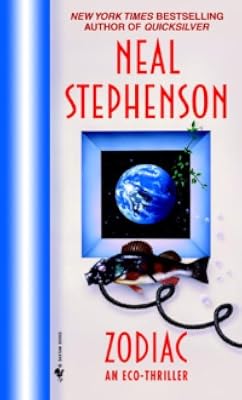
Zodiac
by Neal Stephenson
On This Page
Description
Sangamon Taylor's a New Age Sam Spade who sports a wet suit instead of a trench coat and prefers Jolt from the can to Scotch on the rocks. He knows about chemical sludge the way he knows about evil - all too intimately. And the toxic trail he follows leads to some high and foul places. Before long, Taylor's house is bombed, his every move followed, he's adopted by reservation Indians, moves onto the FBI's most wanted list, makes up with his girlfriend, and plays a starring role in the show more near-assassination of a presidential candidate. Closing the case with the aid of his burnout roomate, his tofu-eating comrades, three major networks, and a range of unconventional weaponry, Sangamon Taylor pulls off the most startling caper in Boston Harbor since the Tea Party. As he navigates this ecological thriller with hardboiled wit and the biggest outboard motor he can get his hands on, Taylor reveals himself as one of the last of the white-hatted good guys in a very toxic world. show lessTags
Recommendations

Member Recommendations
CKmtl Fans of one of these works of Ecological SF may enjoy the other.
11
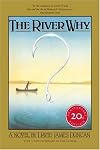
Benbreep Both have environmental themes. Duncan is an even better writer than Stephenson (who is one of my favorite authors). The River Why is not a thriller, but like Stephenson, includes a lot a paragraphs that you want to read over again and appreciate for its craftsmanship. Great to read out loud with a spouse. My favorite novel.
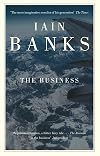
themulhern A mystery unfolds, an acerbic and capable protagonist, technology, money and social observations.

quartzite Reminded me of early Stephenson, and features a Zodiac at one point. Cmplex story of first contact with a light comedic tone covering some serious science and with strong, smart characters.
Member Reviews
Stephenson's second novel (1988) is an enjoyable eco-thriller with a light hard science fiction touch (the genetic engineering of a bacterium) that dates much less in the twenty first century than his fourth and more famous novel 'Snow Crash'.
He has also managed to restrain his absurdist post-graduate humour that was perhaps the only real weakness in his first novel ['The Big U'] without losing any of his amazing verve. The novel moves on at super-thriller pace with him placing science where 'normal' thrillers put the detail of weaponry.
Set with remarkable psychogeographical detail around Boston Harbour (privileging the water over the land), the novel has a fine sense of place but also a useful willingness not to mince words about what show more it is like to swim amongst sewage, to need to defecate and other niceties necessary to the tale.
It is also a sensible novel - although its heroes are non-violent eco-activists, the politics are intelligent and balanced. Stephenson understood better than most in his late twenties the necessity of pragmatic achievement in a world where reputation could be used as a weapon.
Exceptionally sophisticated yet fast-moving and entertaining, it reminds us of a period when eco-activism was a human-centred business of dealing with waste and pollution, of sicknesses that could still be linked psychologically to the evil excesses (such as Agent Orange) of the Vietnam War.
If anything, however, his corporate enemies come across as dim and hapless rather than as demonic or preternaturally bad. They do bad things because they are lazy and in a hurry and bad people jump along for the ride. Corporate man here is just a lazy sod who badly needs shaking up.
Today, instead of exposing actual and specific corporate evils, business and eco-activism have found themselves in a game of mutual appropriation, of abstraction as the planet replaces the human as priority, alongside the negative business of stopping traffic and plastering tomatoes over works of art.
Stephenson's heroes may be exaggerated in their harum-scarum activism but they are heroic and brave and no less believable than the usual affair of the thriller - the testosterone-driven special forces killer in a just cause. The eco-activist is equally just 'doing his job'.
Stephenson cleverly interweaves more typical thriller types (a deep sea diver on the eco-side with a serious pollution related disease, the bit part players working for the corporations) and impressively refuses to de-humanise or simplify anyone except perhaps for the most villainous - Laughlin.
The plotting is good too. The jigsaw fits together well. Of course, there have to be one or two points where you can see the joins in the story but that is necessary in any thriller precisely because it can never be real life. He gets away with it and we don't mind.
Almost flawless as a science-based thriller from the tail end of the Doomwatch era, I hope that it will be rediscovered by a new generation as a minor classic and a rather acute response to the standard thriller ... with much more positive female roles for a start.
There is also a humorous non-patronising native American element in the story with its wry view of 'whitey' as well as similarly wry and slightly satirical uses of the stereotypical Boston-Irish 'fixer' quasi-gangster family, largely decent cops and slacker metalheads.
Most people come up to the mark in the end once things are explained to them. Stephenson's faith in human decency alongside his cynicism about systems comes out as a form of fairly conservative pragmatic anarchism that I found very appealing.
So, instead of mild-mannered enthusiasts inconveniencing the people they need to persuade by doing silly things to get on the news, this book gives us true heroes who use the media and risk their lives to bring the population on side through exposing hard facts that actually affect its health and welfare.
Hard facts, by the way are important to the story, Stephenson educates the reader about the chemistry of chlorine and what it can do the human body when it is sent in the wrong chemical direction. This education is not the point of the story but it certainly adds value.
Oh, and, yes, it is also very funny. Stephenson may have tamed some of the absurdity of his humour but what is left is extremely witty to the point of the odd laugh-out-loud moment without ever breaking the flow of the story. His is the art of the sophisticated wise crack.
Zodiac by the way refers to a type of light but potentially very fast boat used by eco-activists and a lot of the action takes place on and under water. show less
He has also managed to restrain his absurdist post-graduate humour that was perhaps the only real weakness in his first novel ['The Big U'] without losing any of his amazing verve. The novel moves on at super-thriller pace with him placing science where 'normal' thrillers put the detail of weaponry.
Set with remarkable psychogeographical detail around Boston Harbour (privileging the water over the land), the novel has a fine sense of place but also a useful willingness not to mince words about what show more it is like to swim amongst sewage, to need to defecate and other niceties necessary to the tale.
It is also a sensible novel - although its heroes are non-violent eco-activists, the politics are intelligent and balanced. Stephenson understood better than most in his late twenties the necessity of pragmatic achievement in a world where reputation could be used as a weapon.
Exceptionally sophisticated yet fast-moving and entertaining, it reminds us of a period when eco-activism was a human-centred business of dealing with waste and pollution, of sicknesses that could still be linked psychologically to the evil excesses (such as Agent Orange) of the Vietnam War.
If anything, however, his corporate enemies come across as dim and hapless rather than as demonic or preternaturally bad. They do bad things because they are lazy and in a hurry and bad people jump along for the ride. Corporate man here is just a lazy sod who badly needs shaking up.
Today, instead of exposing actual and specific corporate evils, business and eco-activism have found themselves in a game of mutual appropriation, of abstraction as the planet replaces the human as priority, alongside the negative business of stopping traffic and plastering tomatoes over works of art.
Stephenson's heroes may be exaggerated in their harum-scarum activism but they are heroic and brave and no less believable than the usual affair of the thriller - the testosterone-driven special forces killer in a just cause. The eco-activist is equally just 'doing his job'.
Stephenson cleverly interweaves more typical thriller types (a deep sea diver on the eco-side with a serious pollution related disease, the bit part players working for the corporations) and impressively refuses to de-humanise or simplify anyone except perhaps for the most villainous - Laughlin.
The plotting is good too. The jigsaw fits together well. Of course, there have to be one or two points where you can see the joins in the story but that is necessary in any thriller precisely because it can never be real life. He gets away with it and we don't mind.
Almost flawless as a science-based thriller from the tail end of the Doomwatch era, I hope that it will be rediscovered by a new generation as a minor classic and a rather acute response to the standard thriller ... with much more positive female roles for a start.
There is also a humorous non-patronising native American element in the story with its wry view of 'whitey' as well as similarly wry and slightly satirical uses of the stereotypical Boston-Irish 'fixer' quasi-gangster family, largely decent cops and slacker metalheads.
Most people come up to the mark in the end once things are explained to them. Stephenson's faith in human decency alongside his cynicism about systems comes out as a form of fairly conservative pragmatic anarchism that I found very appealing.
So, instead of mild-mannered enthusiasts inconveniencing the people they need to persuade by doing silly things to get on the news, this book gives us true heroes who use the media and risk their lives to bring the population on side through exposing hard facts that actually affect its health and welfare.
Hard facts, by the way are important to the story, Stephenson educates the reader about the chemistry of chlorine and what it can do the human body when it is sent in the wrong chemical direction. This education is not the point of the story but it certainly adds value.
Oh, and, yes, it is also very funny. Stephenson may have tamed some of the absurdity of his humour but what is left is extremely witty to the point of the odd laugh-out-loud moment without ever breaking the flow of the story. His is the art of the sophisticated wise crack.
Zodiac by the way refers to a type of light but potentially very fast boat used by eco-activists and a lot of the action takes place on and under water. show less
Zodiac is described as an eco-thriller, which about sums it up, actually! It certainly is a thriller - I read all 290 or so pages in one (long) night, gripped from the outset. The hero of the story is a chemist working for GEE, a direct action environmental organisation, in its Boston branch. He's out to get the companies dumping toxic waste into the harbour and the rivers and canals that feed into it. He has three company logos on the bows of his inflatable raft with its over-size outboard motor, capable of making it fly. None of those companies is trading anymore. Now he's gunning for his fourth, but the opposition start gunning for him, literally, and some of that opposition are criminal Families not criminal Corporations.
The man on show more a crusade has a big mystery, more enemies than he can figure out reasons for, a neglected girl-friend, a freak-show of friends, a knowledge of chemistry, his wits and a Zodiac boat. This turns out to be plenty to drive this taught, pacy, funny and occassionally unpredictable novel forward but at the end one question is left unaswered: what does our non-violent eco-warrior want more? To protect the aquatic eco-system or bash big corporations? show less
The man on show more a crusade has a big mystery, more enemies than he can figure out reasons for, a neglected girl-friend, a freak-show of friends, a knowledge of chemistry, his wits and a Zodiac boat. This turns out to be plenty to drive this taught, pacy, funny and occassionally unpredictable novel forward but at the end one question is left unaswered: what does our non-violent eco-warrior want more? To protect the aquatic eco-system or bash big corporations? show less
This is different from the other Stephenson books I've read, but is an enjoyable read nonetheless. I particularly liked the way it blends the tropes of the usual noir-type thriller with environmental 'direct-action' (eco-terrorism to some): an eco-crime is being committed - the question is not just by whom, but also how (don't worry if you are not a science-buff - the chemistry lessons are short and well-explained for the layman).
If it has less breadth and a more straightforward premise than Stephenson's later books, Zodiac is more focused, with the plot zipping along at a fair clip (particularly in the second half where it really builds up speed) and holding together well as a story (unlike say The Diamond Age which suffered from some show more strange narrative transitions). Flashes of Stephenson's trademark wit make the story all the more enjoyable to read. As long as one doesn't go in expecting another epic like Cryptonomicon, or the sci-fi spectacle of Snow Crash, one can enjoy it for what it is - a witty, fast-paced eco-thriller.
As an aside, the edition I have published by Arrow Books (2001) is choc full of typos and spelling mistakes which was rather irritating. It really should have been better proof-read. show less
If it has less breadth and a more straightforward premise than Stephenson's later books, Zodiac is more focused, with the plot zipping along at a fair clip (particularly in the second half where it really builds up speed) and holding together well as a story (unlike say The Diamond Age which suffered from some show more strange narrative transitions). Flashes of Stephenson's trademark wit make the story all the more enjoyable to read. As long as one doesn't go in expecting another epic like Cryptonomicon, or the sci-fi spectacle of Snow Crash, one can enjoy it for what it is - a witty, fast-paced eco-thriller.
As an aside, the edition I have published by Arrow Books (2001) is choc full of typos and spelling mistakes which was rather irritating. It really should have been better proof-read. show less
Ok, I'm now a died-in-the-wool (whatever that means) Stephenson enthusiast. According to Goodreads, there're 14 editions of this - so it must be popular. Lardy how I HATE liking popular things! Nonetheless, I like it. Yeah, yeah, Stephenson's sortof a cross between Pynchon & Robert Anton Wilson - I reckon w/ some Rudy Rucker tossed in. There's plenty of murder & mayhem in here to suck in yr average thrill-seeker but there's also enuf precocious exposing of ecoactivists being labelled 'terrrorists' by the omnipresent unscrupulous to earn this a high rating. The protaganist is yet-another classic superhero slob - a role model for public-good-minded psychopaths (like myself). Basically, I cd've hardly rooted for him more. Now it's time to show more get back to LIVING like these characters instead of just getting off on reading about them. show less
Sangamon Taylor is, essentially, a professional asshole. An extreme environmentalist with a passion for wreaking havoc on big corporations that pollute the environment, he is now officially employed to do just that for a non-profit organization in Boston. Sangaman spends his day hunting down toxic waste disposers in the Boston Harbor, and when he finds high concentrations of illegal chemicals in the harbor he finds the source, plugs the pipe first hand, and exposes the crimes of these major corporations to the media - all with little more than an inflatable raft, some scuba gear, and a little bit of ingenuity.
I really loved the book initially, Neal Stephenson commentary on environmentalism is wonderful if not hopelessly pessimistic, and show more the settings and characters are fantastically drawn. I think where it goes wrong is with the half-assed mystery plot that develops awkwardly throughout the book. Stephenson seems to have wanted to create a thrilling mystery in which Sangamon has to discover who is dumping a particularly scary toxic chemical into the harbor, but it just wasn't successful for me. It stalled out regularly and just didn't unfold in a very smooth manner, and all the suspects were so similar that I didn't really find myself caring who it was specifically anyway. Normally you expect the criminal to be the bad guy and for everyone else to be innocent, but when every suspect is a known toxic waste disposer it kind of deflates your interest in which one did it specifically.
I don't necessarily think it's a bad book, but unfortunately I think it got away from the author in the process of writing it. As a result, it fits firmly in the 'just okay' category. show less
I really loved the book initially, Neal Stephenson commentary on environmentalism is wonderful if not hopelessly pessimistic, and show more the settings and characters are fantastically drawn. I think where it goes wrong is with the half-assed mystery plot that develops awkwardly throughout the book. Stephenson seems to have wanted to create a thrilling mystery in which Sangamon has to discover who is dumping a particularly scary toxic chemical into the harbor, but it just wasn't successful for me. It stalled out regularly and just didn't unfold in a very smooth manner, and all the suspects were so similar that I didn't really find myself caring who it was specifically anyway. Normally you expect the criminal to be the bad guy and for everyone else to be innocent, but when every suspect is a known toxic waste disposer it kind of deflates your interest in which one did it specifically.
I don't necessarily think it's a bad book, but unfortunately I think it got away from the author in the process of writing it. As a result, it fits firmly in the 'just okay' category. show less
A decent but not particularly thrilling eco-action narrative as GEE scientist agent, Sangamon Taylor, investigates and takes action against polluters, primarily in the Boston area and often out on Boston Harbor on the Zodiac owned by his organization. For a work set so decidedly in Boston, there is zero feeling of being in any particular city, and this is such a total nerd guy story it even has a woman in peril bit. Admittedly, the guys are in peril too, not quite the same way.
Short, smart, and a page-turner, even though I've read it before. I think I may have read it when I was younger and didn't mind not knowing at least as much as the protagonist does. Now I pay better attention to the chemistry, biology, and geography and it makes a bit more sense. I moved to north-eastern Massachusetts not so long ago, so I've been to many of the locations.
Stephenson has quite a lot to say about society in most of his writing and a lot of it is quite critical. His work tends to bring on a bout of soul-searching. It's also educational; it makes you want to look up PCBs and read "The Origin of Consciousness in the Breakdown of the Bicameral Mind".
He mythologizes smart people excessively. I got a 1500 on my SATs and I've show more known many people who got 1600 and I don't know that any of us is so special.
Is Trisha's boyfriend Hiro Protagonist?
I sometimes think "The Big U" was his best. show less
Stephenson has quite a lot to say about society in most of his writing and a lot of it is quite critical. His work tends to bring on a bout of soul-searching. It's also educational; it makes you want to look up PCBs and read "The Origin of Consciousness in the Breakdown of the Bicameral Mind".
He mythologizes smart people excessively. I got a 1500 on my SATs and I've show more known many people who got 1600 and I don't know that any of us is so special.
Is Trisha's boyfriend Hiro Protagonist?
I sometimes think "The Big U" was his best. show less
Members
- Recently Added By
Lists

Books Read in 2014
2,343 works; 89 members

Books I Read Before The Invention Of The Internet.
144 works; 1 member

Fiction With Familiar Settings
280 works; 93 members
Author Information

80+ Works 118,676 Members
Neal Stephenson, the science fiction author, was born on October 31, 1959 in Maryland. He graduated from Boston University in 1981 with a B.A. in Geography with a minor in physics. His first novel, The Big U, was published in 1984. It received little attention and stayed out of print until Stephenson allowed it to be reprinted in 2001. His second show more novel was Zodiac: The Eco-Thriller was published in 1988, but it was his novel Snow Crash (1992) that brought him popularity. It fused memetics, computer viruses, and other high-tech themes with Sumerian mythology. Neal Stephenson has won several awards: Hugo for Best Novel for The Diamond Age (1996), the Arthur C. Clarke for Best Novel for Quicksilver (2004), and the Prometheus Award for Best Novel for The System of the World (2005). He recently completed the The Baroque Cycle Trilogy, a series of historical novels. It consists of eight books and was originally published in three volumes and Reamde. His latest novel is entitled The Rise and Fall of D. O. D. O. Stephenson also writes under the pseudonym Stephen Bury. (Bowker Author Biography) show less
Some Editions
Series
Belongs to Publisher Series
Gallimard, Folio SF (246)
Common Knowledge
- Original title
- Zodiac: The Eco-Thriller
- Original publication date
- 1988
- People/Characters
- Sangamon Taylor; Boone; Gallagher; Debbie
- Important places
- Boston Harbor, Boston, Massachusetts, USA; Boston, Massachusetts, USA; Roxbury, Massachusetts, USA; Buffalo, New York, USA; Cambridge, Massachusetts, USA; Everett, Massachusetts, USA
- Epigraph
- Down by the river,
Down by the banks of the River Charles
That's where you'll find me
Along with muggers, lovers and thieves
Well I love that dirty water,
Oh Boston, you're my home.
<... (show all)br> -- THE INMATES - Dedication
- TO ELLEN
- First words
- Roscommon came and laid waste to the garden an hour after dawn, about the time I usually get out of bed and he usually passes out on the shoulder of some freeway.
- Quotations
- Normally I never do nitrous before breakfast, but I couldn't refuse Bart a thing in the world, so I took the bag and inhaled as deep as I could.
Sangamon's Principle:
The simpler the molecule, the better the drug. So the best drug is oxygen. Only two atoms. The second-best, nitrous oxide -- a mere three atoms. The third best, ethanol -- nine. Past that, you... (show all)'re talking lots of atoms. Atoms are like people. Get lots of them together, never know what they'll do.
Now that I'd seen the faces of the people who were trying to scare me, I was a lot less scared, and a lot more interested. Maybe they were really making PCP, or maybe they had some other nasty secret. When I got back from B... (show all)uffalo, I'd have to find out, and do these people some damage. In the meantime, I'd have to content myself with charging up tens of thousands of dollars' worth of lingerie on their credit card number.
Most of my colleagues go on backpacking trips when they have to do some thinking. I go to a good hardware store and head for the oiliest, dustiest corners. I strike up conversations with the oldest people who work there, we... (show all) talk about machine vs. carriage bolts and whether to use a compression or a flare fitting. If they're really good, they don't hassle me. They let me wander around and think. Young hardware clerks have a lot of hubris. They think they can help you find anything and they ask a lot of stupid questions in the process. Old hardware clerks have learned the hard way that nothing in a hardware store ever gets bought for its nominal purpose. You buy something that was designed to do one thing, and you use it for another.
I don't like sewing machines. I don't understand how a needle with a thread going through the tip of it can interlock the thread by jamming itself into a little goddamn spool. It's contrary to nature and it irritates me.
"You got any plans for tonight? I asked.
"No more than usual," Bart said. "Amy's in New York."
"There's a chance that, if I get crazy enough, I'll ask you to drive me around all night sewer-diving and possibly being cha... (show all)sed by amateur hit men."
"Whatever"
"I think it's possible to create some terror just by confronting people with their own sins."
"What's your problem, you grow up Catholic or something? Nobody gives a shit about their sins any more."
When I got back from Buffalo I'd have to do these people some damage. In the meantime, I'd have to content myself with charging up tens of thousands of dollars' worth of lingerie on their credit card number. - Last words
- (Click to show. Warning: May contain spoilers.)On my way out of the club, I blew by a nice fifty-foot yacht that was going out for an afternoon cruise. All the well-dressed people grinned, pointed, raised their glasses. I smiled, gave them the finger, and throttled her up.
- Original language
- English
Classifications
Statistics
- Members
- 4,324
- Popularity
- 3,475
- Reviews
- 56
- Rating
- (3.63)
- Languages
- 7 — English, French, German, Italian, Polish, Spanish, Swedish
- Media
- Paper, Audiobook, Ebook
- ISBNs
- 27
- ASINs
- 13