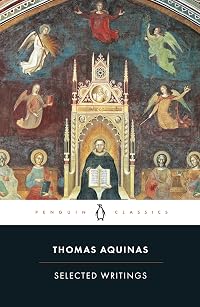
Thomas Aquinas: Selected Writings [edited by Ralph McInerny]
by Thomas Aquinas
On This Page
Description
Brings together sermons, commentary responses to criticism, and substantial extracts from the "Summa Theologiae," arranged chronologically.Tags
Recommendations





Member Reviews
selections are grouped by the period of Aquinas' life in which each was written
selections are grouped by the period of Aquinas' life in which each was written
There are several extremely good collections of Thomas' writings available so the first question one has to address to this 1999 edition with Ralph McInerny as editor is why this one.
Dr. McInerny has found a better way of setting out the thought of Thomas. This is a collection that follows the chronology of Thomas's career and reflects the development of his thought.
A reader may be surprised at this thinking and fear (rightfully) that the early Aquinas may reflect a jejune quality in his writings. Interestingly enough, for example, the commentaries on Aristotle come late in Thomas's career, beginning in 1268, and come to an end, with his writing generally, in 1273.
And a moment's thought indicates that the selections might be skewed show more as to quality is not a problem. As Dr. McInerny explains, Thomas's close study of Aristotle does not begin with the commentaries, it reaches its culmination in them. "From his earliest writings we find him handling the thought of Aristotle with confidence. Misgivings about Averroes and Avicenna are there almost from the beginning. And we find among his earliest writings Thomas's presentation of key philosophical doctrines that are set forth as both Aristotelian and true." So there is no loss of maturity or incisiveness of observation in the earlier writings that deal with Aristotle.
Best of all are the observations and commentaries by Dr. McInerny, a prince of Catholic intellectual life over his 80 years on this earth. One of his parting comments on the Notre Dame controversy the previous year: “Barack Hussein Obama, enabler-in-chief-of abortion, has agreed to speak at the 2009 commencement and to receive an honorary doctorate of law,” he wrote on the Web site of the conservative magazine National Review.
“That abortion and its advocacy violate a primary precept of natural law reinforced by the Catholic Church’s explicit doctrine is a mere bagatelle. Wackos of all kinds will kick up a fuss, of course, but their protest will go unnoticed in South Bend. The pell-mell pursuit of warm and fuzzy Catholicism will continue.”
Dr. McInerny lives in this book. show less
Dr. McInerny has found a better way of setting out the thought of Thomas. This is a collection that follows the chronology of Thomas's career and reflects the development of his thought.
A reader may be surprised at this thinking and fear (rightfully) that the early Aquinas may reflect a jejune quality in his writings. Interestingly enough, for example, the commentaries on Aristotle come late in Thomas's career, beginning in 1268, and come to an end, with his writing generally, in 1273.
And a moment's thought indicates that the selections might be skewed show more as to quality is not a problem. As Dr. McInerny explains, Thomas's close study of Aristotle does not begin with the commentaries, it reaches its culmination in them. "From his earliest writings we find him handling the thought of Aristotle with confidence. Misgivings about Averroes and Avicenna are there almost from the beginning. And we find among his earliest writings Thomas's presentation of key philosophical doctrines that are set forth as both Aristotelian and true." So there is no loss of maturity or incisiveness of observation in the earlier writings that deal with Aristotle.
Best of all are the observations and commentaries by Dr. McInerny, a prince of Catholic intellectual life over his 80 years on this earth. One of his parting comments on the Notre Dame controversy the previous year: “Barack Hussein Obama, enabler-in-chief-of abortion, has agreed to speak at the 2009 commencement and to receive an honorary doctorate of law,” he wrote on the Web site of the conservative magazine National Review.
“That abortion and its advocacy violate a primary precept of natural law reinforced by the Catholic Church’s explicit doctrine is a mere bagatelle. Wackos of all kinds will kick up a fuss, of course, but their protest will go unnoticed in South Bend. The pell-mell pursuit of warm and fuzzy Catholicism will continue.”
Dr. McInerny lives in this book. show less
Ratings
Members
- Recently Added By
Lists

Christianity Books You've Read
179 works; 18 members
GreatBooks Worldview Academy Lists
133 works; 4 members
Author Information

2,187+ Works 27,777 Members
Thomas Aquinas, the most noted philosopher of the Middle Ages, was born near Naples, Italy, to the Count of Aquino and Theodora of Naples. As a young man he determined, in spite of family opposition to enter the new Order of Saint Dominic. He did so in 1244. Thomas Aquinas was a fairly radical Aristotelian. He rejected any form of special show more illumination from God in ordinary intellectual knowledge. He stated that the soul is the form of the body, the body having no form independent of that provided by the soul itself. He held that the intellect was sufficient to abstract the form of a natural object from its sensory representations and thus the intellect was sufficient in itself for natural knowledge without God's special illumination. He rejected the Averroist notion that natural reason might lead individuals correctly to conclusions that would turn out false when one takes revealed doctrine into account. Aquinas wrote more than sixty important works. The Summa Theologica is considered his greatest work. It is the doctrinal foundation for all teachings of the Roman Catholic Church. show less
Some Editions
Awards and Honors
Notable Lists
Common Knowledge
- Canonical title
- Thomas Aquinas: Selected Writings [edited by Ralph McInerny]
Classifications
Statistics
- Members
- 970
- Popularity
- 27,102
- Reviews
- 3
- Rating
- (3.91)
- Languages
- English, German, Latin
- Media
- Paper, Ebook
- ISBNs
- 4
- ASINs
- 4