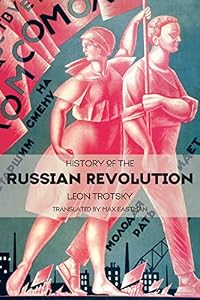
History of the Russian Revolution
by Leon Trotsky
Museo Casa de León Trotsky & CEIP León Trotsky: Obras Escogidas de León Trotsky (Volumen 11i)
On This Page
Description
The Russian Revolution of 1917 was one of the most cataclysmic events in world history, profoundly shaping politics, international relations, social patterns, economics and science in the century that followed. It created long-lasting aftershocks which travelled far beyond its geographical borders. How did it happen? What were the sequence of events that led, following the shocking upheaval of the old Romanov order, to a fierce and violent rivalry between a variety of revolutionary factions show more and the ultimate victory of the Bolsheviks? Throughout the 20th century many accounts were written-and especially in the closing years when Russian archives became more available to external historians. But prime among them remains this work, History of the Russian Revolution, published as early as 1930-for it was a work (virtually unique among historical accounts of major events) written by one of the key protagonists, the Ukrainian-Russian Marxist politician Leon Trotsky (1879-1940). It appeared just a year after he was expelled from Russia (in 1929), having lost a power struggle within the revolutionary government headed by Josef Stalin who had seized control following the death of Vladimir Lenin (1870-1924). Trotsky was forced to flee for his life and in exile immediately set about recording what actually happened (according to his viewpoint). He documented both the February Revolution (the ending of the Tsarist regime) and the October Revolution led by Lenin (and Trotsky's) Bolshevik movement which ultimately resulted (in 1923) in the new Russian state of the Soviet Union. Trotsky's work is divided into three parts: Volume I - The Overthrow of Tzarism, Volume II - The Attempted Counter-Revolution (headed by the socialist Alexander Kerensky), Volume III - The Triumphs of the Soviets. In his vigorous but also personal account of the events leading to Bolshevik victory, Trotsky applied his strong intellectual and analytical abilities, while at the same time allowed his close involvement to present his knowledge of the causes, the results and the personalities in considerable detail. It is a powerful and extraordinary story, all the more engaging because we know how it ended. For Trotsky himself, of course, it was going to end 10 years after publication with his assassination in Mexico (famously with an ice-pick) by an agent of Stalin's NKVD. The importance of History of the Russian Revolution was marked by its English publication in 1932 in the definitive translation by Max Eastman, just two years after its publication in Russian (in Germany). However, it was only in 1997 that it was cleared for publication in Russia itself. Jonathan Booth gives Trotsky's important work its first unabridged audio recording. show lessTags
Recommendations









Member Recommendations
Member Reviews
Tackling this marvellous but massive book is a challenge – but it is also very rewarding.
Marxism is often accused of being “deterministic”, that is, of focusing on historical forces and classes and of ignoring individuals. But this is an unfair criticism. After all, Marx himself said that it is people who make history, “but they do not make it under circumstances chosen by themselves...”
This dialectic of the interaction between objective circumstances and subjective human action is at the core of this book.
So in Chapter One we have Trotsky applying the law of uneven and combined development to Russia’s history; and throughout the book Trotsky shows how class forces underlie political activities and attitudes.
But we also see show more the crucial importance of the actions of individuals. One example of this is the vital role played by Lenin (and by Trotsky himself, of course). Another example is the Cossack, sent to suppress a demonstration, who winked at one of the workers, thus showing that the Cossacks would not violently put down the revolutionary workers.
Trotsky was in exile when he wrote this book. He had gone from being one of the key leaders of the revolution in 1917 to being a fierce critic of Stalin’s bureaucratic tyranny, arguing for a new revolution by Russia’s workers to overthrow Stalin’s dictatorship.
Unfortunately, Trotsky clung to the view that Russia under Stalin was a “degenerated workers’ state”. In fact I find much more convincing the theory that was first fully developed by Tony Cliff: that Stalinist Russia was a bureaucratic state capitalist society, as were the other so-called “communist” regimes that appeared later.
But despite this weakness, Trotsky did keep alive the fundamental Marxist idea that socialism must be based on internationalism and workers’ democracy. (The “dictatorship of the proletariat” was meant to mean the DEMOCRATIC control of society by the working class, not a small group ruling OVER the working class.)
Lenin and Trotsky saw the soviets (democratic workers’ councils) as being the form that working class rule would take, and in this book Trotsky gives us a wonderful description of the relationship between individuals, the Bolshevik Party, the soviets, and the masses. show less
Marxism is often accused of being “deterministic”, that is, of focusing on historical forces and classes and of ignoring individuals. But this is an unfair criticism. After all, Marx himself said that it is people who make history, “but they do not make it under circumstances chosen by themselves...”
This dialectic of the interaction between objective circumstances and subjective human action is at the core of this book.
So in Chapter One we have Trotsky applying the law of uneven and combined development to Russia’s history; and throughout the book Trotsky shows how class forces underlie political activities and attitudes.
But we also see show more the crucial importance of the actions of individuals. One example of this is the vital role played by Lenin (and by Trotsky himself, of course). Another example is the Cossack, sent to suppress a demonstration, who winked at one of the workers, thus showing that the Cossacks would not violently put down the revolutionary workers.
Trotsky was in exile when he wrote this book. He had gone from being one of the key leaders of the revolution in 1917 to being a fierce critic of Stalin’s bureaucratic tyranny, arguing for a new revolution by Russia’s workers to overthrow Stalin’s dictatorship.
Unfortunately, Trotsky clung to the view that Russia under Stalin was a “degenerated workers’ state”. In fact I find much more convincing the theory that was first fully developed by Tony Cliff: that Stalinist Russia was a bureaucratic state capitalist society, as were the other so-called “communist” regimes that appeared later.
But despite this weakness, Trotsky did keep alive the fundamental Marxist idea that socialism must be based on internationalism and workers’ democracy. (The “dictatorship of the proletariat” was meant to mean the DEMOCRATIC control of society by the working class, not a small group ruling OVER the working class.)
Lenin and Trotsky saw the soviets (democratic workers’ councils) as being the form that working class rule would take, and in this book Trotsky gives us a wonderful description of the relationship between individuals, the Bolshevik Party, the soviets, and the masses. show less
Well written and very informative, this is the ultimate account of the Russian revolution by an eyewitness and major player. To be enjoyed with The Red Wheel 1917 by Solgenitsin
I said of 'My Life' that if you only read one book by Trostky then that is the one to read. If you read one other then this is it. But my guess is any one who reads my life with an open mind will be gagging to move onto this masterpiece of historical writing.
Both a fine example of how to write history and how to make it.
First source author. Trotsky was pivotal in the success of the revolution and the beginning of the USSR.
During the first two months of 1917 Russia was still a Romanov monarchy. Eight months later the Bols....
Confirm tag "chinese" added by aw
Members
- Recently Added By
Lists

Recommend the 20 best books you've read in the last five years
2,167 works; 599 members

Top Five Books of 2017
757 works; 231 members

Top Five Books of 2017
5 works; 1 member

All Things Russia
459 works; 11 members

Trinity College Booklist (1951): Class Four, History
120 works; 2 members

Best Books of 1926-1935
403 works; 10 members

Liste Otto
107 works; 1 member
Author Information

783+ Works 7,713 Members
Leon Trotsky was born Lev Davidovich Bronshteyn on November 7, 1879 in Yanovka, Ukraine. As a teenager, he became involved in underground activities and was soon arrested, jailed and exiled to Siberia where he joined the Social Democratic Party. He escaped from exile in Siberia by using the name of a jailer called Trotsky on a false passport. show more During World War I, he lived in Switzerland, France, England, and New York City, where he edited the newspaper Novy Mir (New World). In 1917, after the overthrow of Tsar Nicholas II, he went back to Russia and joined Vladimir Lenin in the first, abortive, July Revolution of the Bolsheviks. A key organizer of the successful October Revolution, he was People's Commissar for Foreign Affairs in the Lenin regime. He was then made war commissar and in this capacity, built up the Red Army which prevailed against the White Russian forces in the civil war. Antagonism developed between him and Joseph Stalin during the Civil War of 1918-1920. When Lenin fell ill and died, Stalin became the new leader and Trotsky was thrown out of the party in 1927. Trotsky fled across Siberia to Norway, France, and finally settled in Mexico in 1936. He began working on the biography of Stalin. He was able to complete 7 of the 12 chapters before an assassin, acting on Stalin's orders, stabbed Trotsky with an ice pick. He died on August 21, 1940. The construction of the remaining five chapters was accomplished by the translator Charles Malamuth, from notes, worksheets, and fragments. (Bowker Author Biography) show less
Some Editions
Series

Belongs to Publisher Series
Common Knowledge
- Canonical title
- History of the Russian Revolution
- Original title
- Istori︠i︡a russkoĭ revol︠i︡u︠t︡sii
- Original publication date
- 1930
- Important events
- Russian Revolution; Bolshevik Revolution (1917); Russian Revolution (1917)
Classifications
- Genres
- History, Nonfiction, General Nonfiction, Politics and Government
- DDC/MDS
- 947.0841 — History & geography History of Europe Russia and neighboring east European countries Russian & Slavic History by Period 1855- 1917-1953 ; Communist period 1917-1924 (Kerensky, Lenin)
- LCC
- DK265 .T773 — History of Europe, Asia, Africa and Oceania Russia. Soviet Union. Former Soviet Republics – Poland History of Russia. Soviet Union. Former Soviet Republics History Revolution, 1917-1921
- BISAC
Statistics
- Members
- 1,068
- Popularity
- 23,837
- Reviews
- 12
- Rating
- (4.19)
- Languages
- 10 — Chinese, Czech, Dutch, English, French, German, Italian, Portuguese, Russian, Spanish
- Media
- Paper, Audiobook, Ebook
- ISBNs
- 42
- ASINs
- 35