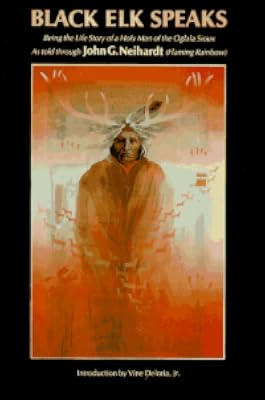
Black Elk Speaks: Being the Life Story of a Holy Man of the Oglala Sioux
by John G. Neihardt, Black Elk
On This Page
Description
"Black Elk Speaks, the story of the Oglala Lakota visionary and healer Nicholas Black Elk (1863-1950) and his people during momentous twilight years of the nineteenth century, offers readers much more than a precious glimpse of a vanished time. Black Elk's searing visions of the unity of humanity and Earth, conveyed by John G. Neihardt, have made this book a classic that crosses multiple genres. Whether appreciated as the poignant tale of a Lakota life, a history of a Native nation, or an show more enduring spiritual testament, Black Elk Speaks is unforgettable"-- show lessTags
Recommendations















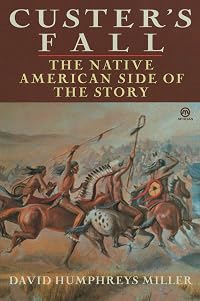


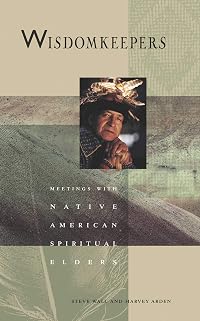
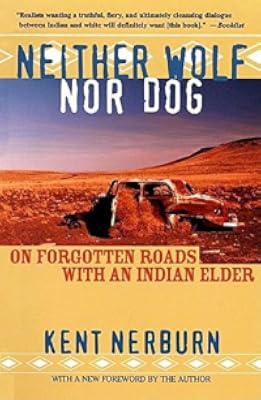

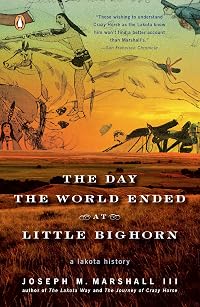

Member Reviews
[b:Black Elk Speaks: Being the Life Story of a Holy Man of the Oglala Sioux|35476|Black Elk Speaks Being the Life Story of a Holy Man of the Oglala Sioux|John G. Neihardt|https://i.gr-assets.com/images/S/compressed.photo.goodreads.com/books/1328819916l/35476._SX50_.jpg|3813941] is a fascinating piece of history. It is the life story of a Native American holy man named Black Elk, as told in 1931 to a Nebraskan poet. Black Elk recounts his youth during the mid-19th century, when battles and massacres drove the Sioux and other tribes into smaller and smaller areas of land. Treaties made with the American government were repeatedly broken by settlers so that land could be exploited for gold or other resources. It is thus a sad story of how show more the Native American way of life was brutally repressed, while also providing insight into religious and social activities before and during this repression. Black Elk explains in detail the visions he had of his people's recovery. It is this aspect that the edition I read focuses on in the blurb and introduction. It did not surprise me to learn that the book was popular in the 1960s, when indigenous spirituality was of particular interest. As a rather prosaic reader, I was most interested in it as history, in particular of how Black Elk and his people interacted with their environment. I hadn't read an account of the mid-19th century told from a Native American perspective before, and it makes a striking contrast to the narrative of economic growth and technological change that dominates histories of this period. A striking and readable autobiographical narrative. show less
I did not know then how much was ending. When I look back now from this high hill of my old age I can still see the butchered women and children heaped and scattered all along the crooked mulch as plain as when I saw them with eyes still young. And I can see that something else died there in the bloody mud and was buried in the blizzard.
My second reading after decades have passed, and I appreciate the plainness and simplicity of Black Elk's voice. I also appreciate the painstaking notes in this edition that indicate where Neihardt introduced his own words and ideas, so that I can see more of the spiritual leader's authentic voice. To hear his stories is to be transported to a series of deeply consequential events. I bought the book at the Little Bighorn National Monument after hearing about the battle from a descendant of one of the Crow guides that marched with Custer.
Interwoven with Black Elk's many spiritual and healing visions
is the pure horror of the white man's attempt to exterminate all the Indian people..
is the pure horror of the white man's attempt to exterminate all the Indian people..
A spiritually powerful book that is as much a testament to Nebraskan John Neihardt's skill as a writer as it is Black Elk's virtuous execution of the oral storytelling tradition. Relating the story of his life, Black Elk takes the reader inside his faith and opens a window to the belief system of his people. On a broader scale, we see the clash of two civilizations in its last stages and it's plain to see the winner wasn't necessarily the better. A sad story, beautifully told and a must read for every American.
I enjoyed this book. I found it kind of difficult when I was reading it to figure out what was actually Black Elk, and what was Neihardt, although the editor had thankfully given little footnotes on the side. While I think this was a powerful book, and very interesting to read, the lack of any true authenticity bothered me quite a lot. I didn't really understand why Neihardt couldn't just tell us what Black Elk said. It was obvious to me that good parts of the book were Black Elk's words filtered through a European-American consciousness in such a way that they would be understandable to European-Americans. And this bugged me, some places more than others.
Still, looking at the time when it was written, I think the interesting thing of show more the book is not what it tells you of Black Elk (of which most words were to me suspect because of Neihardt's 'filter'), but of what it tells you of Neihardt and the mainstream society of the time.
This is not a book to read if you want an accurate, authentic autobiography of Native Americans, but it is an interesting book of Native American/European-American fusion for the time period. show less
Still, looking at the time when it was written, I think the interesting thing of show more the book is not what it tells you of Black Elk (of which most words were to me suspect because of Neihardt's 'filter'), but of what it tells you of Neihardt and the mainstream society of the time.
This is not a book to read if you want an accurate, authentic autobiography of Native Americans, but it is an interesting book of Native American/European-American fusion for the time period. show less
I grew up in the rez and I really wish I could go back and talk to those old timers. But I was a kid and didn't care about such things. I really like this book. I could hear Black Elk talking. It was written how the old timers talked. I had a hard time keeping up with the chapters where he described his visions but I think part of it is that I wanted to get to the next chapter to see what other adventures he was going to have.
I was so angry and sad reading it. I was taught Native history throughout elementary school and Jr. High but it's just different when you read this and other books (Bury My Heart at Wounded Knee-Dee Brown, The Earth is Weeping-Peter Cozzens, and others).
Anyway, really good book with a totally different perspective show more on Native history. show less
I was so angry and sad reading it. I was taught Native history throughout elementary school and Jr. High but it's just different when you read this and other books (Bury My Heart at Wounded Knee-Dee Brown, The Earth is Weeping-Peter Cozzens, and others).
Anyway, really good book with a totally different perspective show more on Native history. show less
Members
- Recently Added By
Published Reviews
ThingScore 75
… Based on interviews given by Lakota holy man Nicolas Black Elk (1863-1950)… a moving portrait of Black Elk emerges. He believed he should use his visions and special powers to help the Lakota return to a good life…. Yet he could find no way to make this dream a reality, and Neihardt emphasizes Black Elk's mournful recognition of this failure. However, since Neihardt intended his book show more as a work of art rather than an anthropological oral history, he felt free to add thoughts of his own and to omit the more optimistic side of Black Elk's views…. show less
added by CourtyardSchool — edited by PVUMCLibrary
Lists

Non-Fiction Worth Reading
1,016 works; 262 members

Literary Works Read in College
316 works; 15 members

1930s
262 works; 5 members

A Rainbow of Books: Colors in the Title
570 works; 24 members

Books About Non-Abrahamic Religions
91 works; 2 members

Lakota (Sioux) Nation
12 works; 1 member

Indigenous Peoples: Nonfiction & Fiction
50 works; 1 member
Author Information

40+ Works 5,224 Members
John G. Neihardt (1881-1973) is the author of several classics, including A Cycle of the West and Eagle Voice Remembers, both available in Bison Books editions. He was named Nebraska's first poet laureate and foremost poet of the nation by the National Poetry Center in 1936.
6+ Works 5,144 Members
All Editions
Some Editions
Awards and Honors
Awards
Series
Belongs to Publisher Series
Work Relationships
Has the adaptation
Is abridged in
Has as a student's study guide
Common Knowledge
- Canonical title*
- Alce nero parla: vita di uno stregone dei Sioux Oglala
- Original title
- Black Elk Speaks As Told To John G Neihardt
- Original publication date
- 1932
- People/Characters
- Black Elk
- Dedication
- What is good in this book
is given back
to the six grandfathers
and
to the great men of my people.
- BLACK ELK - First words
- PREFACE:
It was during August, 1930, that I first met Black Elk.
... John G. Neihardt, 1960
INTRODUCTION:
The twentieth century has produced a world of conflicting visions, intense emotions, and unpredictable events, and the opportunities for grasping the substance of life have faded as the pace of activity... (show all) has increased.
... Vine Deloria, Jr.
My friend, I am going to tell you the story of my life, as you wish; and if it were only the story of my life I think I would not tell it; for what is one man that he should make much of his winters, even when they bend him l... (show all)ike a heavy snow? - Quotations
- What is good in this book is given back to the six grandfathers and to the great men of my people. --Black Elk
We could not eat lies. - Last words
- (Click to show. Warning: May contain spoilers.)There is no center any longer, and the sacred tree is dead.
- Blurbers
- Childs, Marquis; LaFarge, Oliver
- Original language
- English
- Disambiguation notice
- The original edition was titled "as told to" John G. Neihardt. The 1961 edition, at the author's request, reads "as told through" Neihardt.
*Some information comes from Common Knowledge in other languages. Click "Edit" for more information.
Classifications
- Genres
- Biography & Memoir, General Nonfiction, History, Religion & Spirituality, Nonfiction, Anthropology
- DDC/MDS
- 978.004 — History & geography History of North America Western United States Ethnic And National Groups
- LCC
- E99 .O3 .B49 — History of the United States America Indians of North America Indian tribes and cultures
- BISAC
Statistics
- Members
- 4,300
- Popularity
- 3,525
- Reviews
- 56
- Rating
- (3.98)
- Languages
- 12 — Chinese, Dutch, English, Estonian, Finnish, French, German, Hebrew, Italian, Portuguese, Spanish, Swedish
- Media
- Paper, Audiobook, Ebook
- ISBNs
- 56
- UPCs
- 1
- ASINs
- 58
