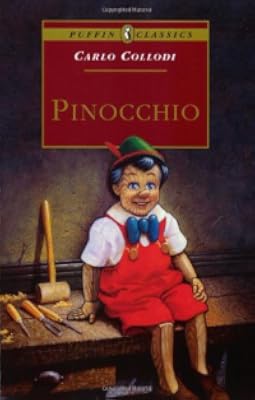
Pinocchio
by Carlo Collodi
There is 1 current discussion about this work.
On This Page
Description
Pinocchio, a wooden puppet full of tricks and mischief, with a talent for getting into and out of trouble, wants more than anything else to become a real boy.Tags
Recommendations

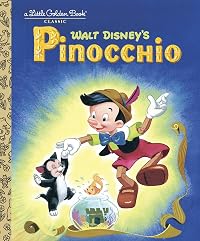
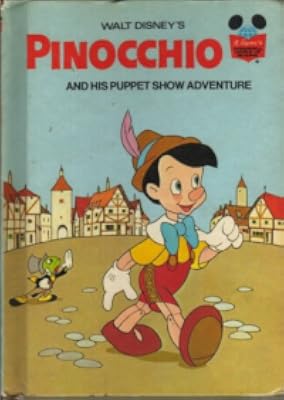










Member Recommendations
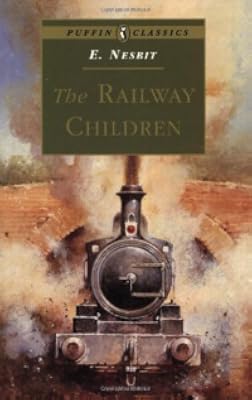
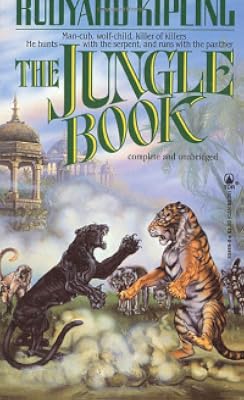
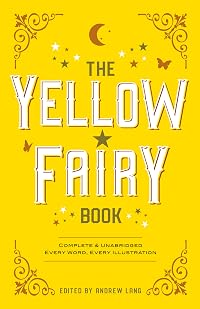
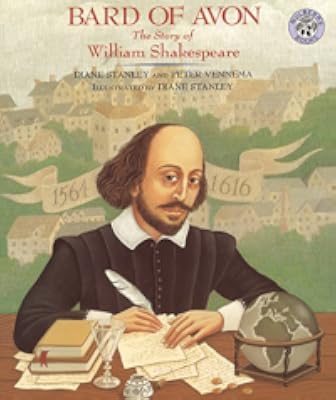
Cecrow Theme and style similarities
Member Reviews
There was mention somewhere of the original Italian story of Pinocchio here on LT, probably in conjunction with discussion of the del Toro movie version, and I realized I had never read it, so I checked this lavish volume out of the library. As a physical object, it's gorgeous. Large format, exquisitely illustrated by Robert Ingpen, pages so thick you never believe you're turning just one at a time, bright red ribbon place marker... If only I could have enjoyed the story. It's not just that it doesn't jive with the Disney version; that on its own is a positive. It's just too choppy, with no internal logic to it except for the over-explicated lesson about what happens to naughty children who don't obey their parents and pay attention to show more their teachers, which even a WOODEN HEADED PUPPET should have taken to heart long about the half-way point. There's very little charm to it that doesn't come from Ingpen's imagination, no real suspense, artificial cliff-hanger chapter breaks. Translation issues? Possibly. I understand it was written in segments, for serial publication. It shows. I don't see it appealing to any of the young'uns, past or present, that I know well. show less
Qué difícil reseñar un libro considerado un clásico, especialmente cuando no te gustó. ¿Cómo confesar que no lo has disfrutado cuando la opinión popular lo coloca entre lo mejor de la literatura infantil?
Pinocho nunca ha sido en realidad un libro que llamara mi atención, de hecho, creo que la adaptación cinemátográfica tampoco fue de mi interés; sin embargo, pensé que como con otras obras a las que tengo muy prejuicidadas, cambiaría mi opinión una vez que me enfrentara a sus páginas, recientemente me ocurrió ese descubrimiento emocionante con Rodari, así que motivos me sobraban para acercarme a Pinocho. Infortunadamente no ocurrió así con este último.
Las aventuras de Pinocho me pareció una de las obras más show more absurdas (quizá porque en su origen se publicó por entregas) que haya leído en mucho tiempo. Sus fines moralizantes rayan en lo ridículo y aburrido. La prosa es sosa (a menos que sea un problema de traducción), algunos pasajes no tienen sentido (un grillo que muere y al siguiente capítulo ya está de nuevo tratando de educar a Pinocho, un hada que muere y tres capítulos adelante ya está de nuevo ayudando a Pinocho, etc.) y, desde luego, no es para nada la historia perturbadora que muchos han mencionado en sus reseñas. Quizá deban acercarse a los cuentos que los Hermanos Grimm recuperaron de la tradición oral para leer historias perturbadoras.
Quizá sea la época en la que fue escrito, pero en lo personal lo aborrecí. show less
Pinocho nunca ha sido en realidad un libro que llamara mi atención, de hecho, creo que la adaptación cinemátográfica tampoco fue de mi interés; sin embargo, pensé que como con otras obras a las que tengo muy prejuicidadas, cambiaría mi opinión una vez que me enfrentara a sus páginas, recientemente me ocurrió ese descubrimiento emocionante con Rodari, así que motivos me sobraban para acercarme a Pinocho. Infortunadamente no ocurrió así con este último.
Las aventuras de Pinocho me pareció una de las obras más show more absurdas (quizá porque en su origen se publicó por entregas) que haya leído en mucho tiempo. Sus fines moralizantes rayan en lo ridículo y aburrido. La prosa es sosa (a menos que sea un problema de traducción), algunos pasajes no tienen sentido (un grillo que muere y al siguiente capítulo ya está de nuevo tratando de educar a Pinocho, un hada que muere y tres capítulos adelante ya está de nuevo ayudando a Pinocho, etc.) y, desde luego, no es para nada la historia perturbadora que muchos han mencionado en sus reseñas. Quizá deban acercarse a los cuentos que los Hermanos Grimm recuperaron de la tradición oral para leer historias perturbadoras.
Quizá sea la época en la que fue escrito, pero en lo personal lo aborrecí. show less
I have to say, my only previous experience with the story of Pinocchio is through the Disney classic cartoon…and boy is this a LOT different than the Disney version! I’m not saying that’s a bad thing…far from it in fact, I was just surprised at how selfish and, well…disobedient this little wooden boy was. In this book, Pinnochio isn’t a naive boy who gets led astray; he’s a selfish, lying, bad-tempered puppet who (for the most part) can’t see past his own immediate wants and needs. He constantly makes bad decisions based on spur of the moment desires without thinking about any long term implications. Naturally, he’s apologetic and supremely sorry when he gets caught or something bad happens to himself or others as a show more result of his actions, but he doesn’t seem to learn very quickly from these lessons and must repeat them many, many times before he finally “gets it.” Similarly, Geppetto isn’t 100% of the time a kindly old man; he too has his moments of anger with Pinocchio’s behavior. Even the Blue Fairy isn’t as kindly and beneficent as Disney made her…she too isn’t above pulling a nasty prank or two to show Pinnochio the error of his ways. I think these personality elements resonate with young readers…I think we can all admit that most children push the limits, do things they know they are not supposed to and generally find disobeying to be more fun than obeying (at least at times)…and in that way, Pinocchio is the embodiment childhood. He does all the things they’ve been told not to and reaps the rewards or pays the price for it! I think that is what makes this a timeless classic that has been loved for generations. I think that there are a lot of dark humor and plot points in this book (the blue fairy’s death, Geppetto’s getting lost as sea, the attempted assassination of Pinocchio, etc.), that it’s effective and riveting (especially for young readers) and enjoyable…it also makes his final transformation into a real boy all the more rewarding when it finally happens. I have to admit I enjoyed reading this far more than ever enjoyed watching the Disney cartoon version. Overall, it’s a rich, dark, and sometimes humorous tale that is illustrated wonderfully in this version by Gus Grimly. I would recommend it for anyone who enjoys reading the non-sanitized versions of Grimm’s Fairy Tales (and other similar stories). It has all the familiar plot elements of the one we grew up watching (in America, at least) but is a much darker story than Disney gave us. I give it 4 stars and I would definitely buy it for my permanent library. show less
I read this book with my family for the first time recently--we'd all seen the classic Disney film many times, of course. The original Italian work is, of course, a bit darker and complex with an Alice in Wonderland feel and vibe to it--far more characters and worlds here in Pinnochio's adventures on the road to becoming a real boy than the movie captures. The overall theme explores the consequences that befall an otherwise innocent animated doll for dishonesty and irresponsible choices made to indulge rather than take on the responsibilities and duties of getting older (or in this case, being a real person). I found this both more interesting and more entertaining than the familiar screen adaptation, and a fun book for an extended read show more with one's kids and family. show less
The Disney Movie, Pinocchio, was my first exposure to the character and the story when I was a child. It terrified me. I acquired this edition in Florence some years back and hadn't read it until now. To put it mildly, it makes the Disney version look like Toy Story. Granted, it is well-written (even in translation) and beautifully illustrated. And I do appreciate its allegorical themes and hero's quest motifs. That being said, Pinocchio kills the cricket (aka Jiminy in my childhood memory) with a hammer; the marioneteer wants to burn him alive; Pinocchio falls asleep by the fire and burns his feet off; the fox and the cat hang him from a tree to die. Bad boys turning into Donkeys is hardly the worst of it.
Seriously, I think it is one show more of the best (still terrifying) examples of episodic literature ever written,
with timeless characters and a strong moral compass. I am sorry I waited so long to read this version, and I plan to seek out others. show less
Seriously, I think it is one show more of the best (still terrifying) examples of episodic literature ever written,
with timeless characters and a strong moral compass. I am sorry I waited so long to read this version, and I plan to seek out others. show less
There's nothing subtle about “The Adventures of Pinocchio” by Carlo Collidi. First published as a book in 1883 — installments were printed in an Italian magazine for children previously — the story tells how a disobedient puppet becomes a boy (after first becoming a donkey). Today more people are familiar with film versions or Golden Book versions than the novel itself — and for good reason. The tale is just too heavy-handed for modern audiences of whatever age.
Time and again, Pinocchio promises to obey instructions, go to school, study hard, etc., then becomes distracted. He yields to temptation. Each time he does, disaster strikes. He is cheated. He is taken prisoner. He is nearly eaten. He is swallowed by a fish. He is, as show more mentioned, turned into a donkey. And of course, when he lies, his nose grows to uncommon lengths.
The book's lessons are made clear and obvious to any reader. The golden rule works best for all. Those who disobey will get in trouble. Liars pay for their sins. Yet one wonders whether Collidi might actually have been teaching just the opposite of the intended lessons. Mischievous little boys might notice:
1. Some kind soul invariably rescues Pinocchio and gives him another chance.
2. Once Pinocchio becomes a good boy, his adventures end. show less
Time and again, Pinocchio promises to obey instructions, go to school, study hard, etc., then becomes distracted. He yields to temptation. Each time he does, disaster strikes. He is cheated. He is taken prisoner. He is nearly eaten. He is swallowed by a fish. He is, as show more mentioned, turned into a donkey. And of course, when he lies, his nose grows to uncommon lengths.
The book's lessons are made clear and obvious to any reader. The golden rule works best for all. Those who disobey will get in trouble. Liars pay for their sins. Yet one wonders whether Collidi might actually have been teaching just the opposite of the intended lessons. Mischievous little boys might notice:
1. Some kind soul invariably rescues Pinocchio and gives him another chance.
2. Once Pinocchio becomes a good boy, his adventures end. show less
Aunque se trata de una de las historias más célebres del mundo, Las aventuras de Pinocho es al mismo tiempo una obra en gran medida desconocida. Las peripecias de un trozo de madera parlante no son aquí un cuento aleccionador ni sentimental, sino un relato profundamente subversivo sobre la infancia perdida, colmado de crueldad, magia y sátira, en el que se entreveran la picaresca, el teatro callejero y los cuentos de hadas de un modo que anticipa el surrealismo e incluso el realismo mágico.
Jack Zipes, eminente estudioso de la narrativa fantástica popular, firma la introducción que abre el presente volumen. La traducción al castellano es de Miquel Izquierdo, que dota a este clásico insoslayable de una actualidad palpitante.
Jack Zipes, eminente estudioso de la narrativa fantástica popular, firma la introducción que abre el presente volumen. La traducción al castellano es de Miquel Izquierdo, que dota a este clásico insoslayable de una actualidad palpitante.
Members
- Recently Added By
Published Reviews
ThingScore 100
What del Toro, who has spoken of a lifelong fascination with Pinocchio, doubtless recognizes, and what Garrone as a cultured Italian would not need to be told, is that the original story is a work of considerable complexity, comparable to “Alice in Wonderland” or “Gulliver’s Travels” and much darker than Disney’s cheery fable about the price of youthful mendacity.... The moral of show more the story, then, is not that children should always tell the truth, but that education is paramount, enabling both liberation from a life of brutal toil, and, more important, self-awareness and a sense of duty to others. The true message of “The Adventures” is that, until you open yourself to knowledge and your fellow human beings, you will remain a puppet forever — other people will continue to pull your strings. And what, in these increasingly authoritarian times, could be more ardently relevant than that? show less
added by danielx
Lists

Favorite Childhood Books
1,651 works; 519 members
1001 Children's Books You Must Read Before You Grow Up
774 works; 101 members

501 Must-Read Books
529 works; 72 members

Childhood Favorites
427 works; 24 members

1,000 Good Books of John Senior
36 works; 6 members

Favourite 19th century fiction
257 works; 62 members
Honey For a Child's Heart
1,152 works; 25 members

Works That Inspired Disney Movies
119 works; 13 members
Ambleside Books
459 works; 18 members

Toy Stories: Living Dolls, Bears and Other Toys
129 works; 7 members

Folio Society
831 works; 53 members

A Child's Book Tour of Italy
88 works; 3 members

Satori Smiles Children's Book List
262 works; 7 members

Out of Copyright
244 works; 14 members

Books Featured on Gilmore Girls
307 works; 21 members

CCE 1000 Good Books List
1,033 works; 12 members

4th Grade Books
312 works; 5 members
LibraryThingers' 1001 Books You Must Read Before You Die
442 works; 30 members

75 Books for Fall Literacy Block - Dr. Reed
67 works; 2 members

Recommended Reading List
219 works; 1 member

2024-2025 Ezra Klein Guest Recommendations
213 works; 6 members
Reading LIst
648 works; 1 member
The Complete Rory Gilmore Reading List
506 works; 5 members

DigitalDreamDoor top 300
300 works; 4 members

Lista dei 100 migliori libri italiani degli ultimi 200 anni
100 works; 1 member
Works Referenced in The League of Extraordinary Gentlemen
122 works; 6 members

Book Titles Mentioned In Newberry Medal And Honor Books
884 works; 3 members

Before Austen Comes Aesop
318 works; 9 members

Books Read in 2022
5,218 works; 111 members
Italian Literature
558 works; 42 members

Bibliografia essenziale
86 works; 2 members

Books Set in Italy
167 works; 19 members
The Joe Rogan Experience Library
254 works; 3 members

Favorite Fairy Tales
269 works; 103 members
Talk Discussions
Current Discussions
New Kickstarter: Pinocchio in Fine Press Forum (August 2025)
Past Discussions
Any thoughts about the Beehive Books Edition of Pinocchio? in Fine Press Forum (March 2023)
Folio Archives 273: Pinocchio by Carlo Collodi 2011 in Folio Society Devotees (June 2022)
Carlo Collodi's Pinocchio, reviewed by jseger9000 in Reviews reviewed (October 2011)
Author Information

316+ Works 12,071 Members
Carlo Collodi was born Carlo Lorenzini in Florence, Italy on November 24, 1826. He joined a seminary as a young man, but Collodi found politics more interesting, as the movement for Italian national unification spread. At the age of 22, he became a journalist to work for the Italian independence struggle. In 1848 he founded the satirical journal show more Il Lampione, which was suppressed in 1849. His next periodical, La Scaramuccia, was more fortunate, and in 1860 he revived Il Lampione again. Collodi also wrote comedies and edited newspapers and reviews. He took the pseudonym Collodi from the name of the town, where his mother was born and where he spent time as a boy. In 1861, when Italy became a united nation, Collodi gave up journalism. After 1870 he settled down as a theatrical censor and magazine editor. He turned to children's fantasy, translating Italian versions of the fairy tales of the French writer Charles Perrault's. Collodi also began to write his own children's stories, including a series about a character named Giannettino. The first chapter of Pinocchio appeared in the Giornale dei bambini in 1881, and became an immediate success. He died in Florence on October 26, 1890. (Bowker Author Biography) show less
All Editions
Some Editions
Awards and Honors
Distinctions
Notable Lists
Series
Belongs to Publisher Series
Le grandi strenne [Mursia] (Mursia)
De Gouden Jeugdcollectie (16 Pinokkio)
Oud goud (nr. 2)
Pony Ausgaben (08)
Pocket Books (18)
Universale [Einaudi] (52)
ATB (64)
Airmont Classics (101)
Corticelli [Mursia] (160)
Everyman's Library (538)
Vintage Scholastic (TX4238)
Reclams Universal-Bibliothek (8336)
Work Relationships
Is contained in
Carlo Collodi Opere: Macchiette; Occhi e nasi; Le avventure di Pinocchio; Storie allegre; Pagine sparse; Gli estremi si toccano. by Carlo Collodi
International Collector's Library Classics 19 volumes: Crime & Punishment; Twenty Thousand Leagues Under the Sea; Mysterious Island; Magic Mountain; Around the World in 80 Days; Count of Monte Cristo; Camille; Quo Vadis; Hunchback of Notre Dame; Nana; Scaramouche; Pinocchio; Fernande; War and Peace; The Egyptian; From the Earth to the Moon; Candide; Treasure of Sierra Madre; Siddhartha/Steppenwolf by Jules Verne
Is retold in
Has the (non-series) sequel
Has the adaptation
Is abridged in
Inspired
Is a concordance to
Common Knowledge
- Canonical title
- Pinocchio
- Original title
- Le avventure di Pinocchio; Le Avventure di Pinocchio
- Alternate titles
- The Adventures of Pinocchio
- Original publication date
- 1881 (1e édition originale italienne sous forme de feuilleton dans le "Giornale per i bambini") (1e édition originale italienne sous forme de feuilleton dans le "Giornale per i bambini"); 1883-02-01 (1e édition italienne en livre) (1e édition italienne en livre)
- People/Characters
- Pinocchio; Geppetto; Mangiafuoco; Blue Fairy; Talking Cricket
- Important places
- Tuscany, Italy; Italy
- Related movies
- Pinocchio (1940 | IMDb); Pinocchio (2002 | IMDb); The Adventures of Pinocchio (1996 | IMDb); Turlis Abenteuer (1967 | IMDb); Le avventure di Pinocchio (1972 | IMDb); Geppetto (2000 | IMDb) (show all 7); Pinocchio (1976 | IMDb)
- Dedication*
- Pour Carlo Collodi et ma fille Alessandra
- First words
- Once upon a time there was...
'A King!' my young readers will instantly exclaim.
No, children, that's where you are wrong. Once upon a time there was a piece of wood.
There once was a piece of wood, lying in the carpenter shop of Master Antonio. Master Antonio decided to make a table leg out of the wood, but to his surprise, when he struck it, the wood cried out. (The Adventures of Pinocch... (show all)io 2003, illustrated by: Greg Hildebrandt)
There was once upon a time...
"A king!" my little readers will instantly exclaim.
[M.A. Murray translation]
Centuries ago there lived –
"A king!" my little readers will say immediately.
No, children, you are mistaken. - Last words
- (Click to show. Warning: May contain spoilers.)"And how happy I am to have become a real boy!"
(Click to show. Warning: May contain spoilers.)Pinocchio joyfully said: How ridiculous I was when I was a puppet! And how glad I am now that I have become a real boy! (The Adventures of Pinocchio 2003, illustrated by: Greg Hildebrandt)
(Click to show. Warning: May contain spoilers.)"And how glad I am that I have become a well-behaved little boy."
[M.A. Murray translation]
(Click to show. Warning: May contain spoilers.)"How ridiculous I was as a Marionette! And how happy I am, now that I have become a real boy!" - Publisher's editor*
- Ediciones Generales Anaya
- Original language
- Italian
*Some information comes from Common Knowledge in other languages. Click "Edit" for more information.
Classifications
- Genres
- Children's Books, Fiction and Literature
- DDC/MDS
- 853.8 — Literature & rhetoric Italian, Romanian & related literatures Italian fiction Later 19th century 1859–1900
- LCC
- PZ8 .C7 .P — Language and Literature Fiction and juvenile belles lettres Fiction and juvenile belles lettres Juvenile belles lettres
- BISAC
Statistics
- Members
- 10,041
- Popularity
- 992
- Reviews
- 156
- Rating
- (3.71)
- Languages
- 40 — Arabic, Bosnian, Catalan, Chinese, Czech, Danish, Dutch, English, Esperanto, Estonian, Finnish, French, German, Irish, Galician, Greek, Hebrew, Hungarian, Italian, Japanese, Korean, Langue d'oc (post-1500), Latin, Multiple languages, Neapolitan Italian, Norwegian (Bokmål), Farsi/Persian, Polish, Romanian, Russian, Serbian, Croatian, Slovenian, Spanish, Swedish, Thai, Turkish, Ukrainian, Welsh, Portuguese (Portugal)
- Media
- Paper, Audiobook, Ebook
- ISBNs
- 1,283
- UPCs
- 10
- ASINs
- 358
