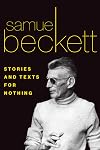
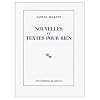
Stories and Texts for Nothing
by Samuel Beckett
On This Page
Description
This volume brings together three of Nobel Prize winner Samuel Beckett's major short stories and thirteen shorter pieces of fiction that he calls "texts for nothing." Here, as in all his work, Beckett relentlessly strips away all but the essential to arrive at a core of truth. His prose reveals the same mastery that marks his work from Waiting for Godot and Endgame to Molloy and Malone Dies. In each of the three stories, old men displaced or expelled from the modest cornerswhere they have show more been living bestir themselves in search of new corners. Told, "You can't stay here," they somehow, doggedly, inevitably, go on. Includes: "The Expelled" "The Calmative" "The End" Texts for Nothing (1-10) show lessTags
Recommendations











Member Reviews
This book made me think about night snorkeling, how you're hesitant at first to slip into the dark unknown but once immersed you can't imagine ever having second-guessed yourself. Wonders are revealed, things that feel unreal but are in fact very much part of this world, should you be willing to acknowledge them. Beckett is stingy with his paragraph breaks, sentences stretch on endlessly, commas are plentiful. It all seems a bit daunting at first look. But once I started reading it all made perfect sense. It was like the cadence of his prose exactly matched that of my thoughts. Reading this book made me not want to read realist fiction anymore. What is the point. Rote description of domestic drama, the kind we've all lived and read show more before. So common, so mundane. Let's cut to the chase, says Beckett. He pulverizes the act of living into fine powder, scatters it into the gutter, and makes absurd jokes in its general direction. There are three short stories and 13 'texts for nothing.' The stories only vaguely follow a plot, the 'texts for nothing' even less so. I was glad because frankly I'm sick of plots.
The short winter's day was drawing to a close. It seems to me sometimes that these are the only days I have ever known, and especially that most charming moment of them all, just before night wipes them out. show less
The short winter's day was drawing to a close. It seems to me sometimes that these are the only days I have ever known, and especially that most charming moment of them all, just before night wipes them out. show less
Three short stories about aged men shouldered aside by society, expecting little, receiving even less, musing as they meander, forward, homeless, hoping to find some other place to rest world-weariness, all told in exceedingly spare and condensed style echoing the stark simplicity of the men's silent lives.
Texts for Nothing? Thirteen condensed and compressed vignettes of thoughts from the verge between life and, well, what? Maybe already past the verge, no, maybe not yet past, maybe still coming, but without a body, well maybe with, but without motion, or maybe only brain, or not, but whence thought, maybe not thought, no, thought, definite thought, but beyond the verge, no, still can't be, no brain, maybe on the verge, but of things show more earlier, things remembered, no, perhaps just voices, no, life remembered, in memory without mind, no, maybe just remembered, and voices, maybe from life, into nothing, or maybe just in nothing. Texts for Nothing.
Extraordinary! show less
Texts for Nothing? Thirteen condensed and compressed vignettes of thoughts from the verge between life and, well, what? Maybe already past the verge, no, maybe not yet past, maybe still coming, but without a body, well maybe with, but without motion, or maybe only brain, or not, but whence thought, maybe not thought, no, thought, definite thought, but beyond the verge, no, still can't be, no brain, maybe on the verge, but of things show more earlier, things remembered, no, perhaps just voices, no, life remembered, in memory without mind, no, maybe just remembered, and voices, maybe from life, into nothing, or maybe just in nothing. Texts for Nothing.
Extraordinary! show less
Typical thematically of most of Beckett's prose fiction--Stories and texts for nothing are made up of 3 short stories and 13 untitled variations on the meaninglessness and absurdities of human endeavor. The short stories are narrated by down and outs almost totally alienated when caught outside their immediate milieus. They are solipsistic autistic characters completely out of touch with any logic not their own. The stories are more conventional however than the texts in that they follow a timeline of event.
The 13 texts are somewhat like shorter versions of his Company--musings of a ghost like being on past life--alienated as well from anything living but commenting on the confusions of human life and endeavor anyway. They have a show more rambling and claustrophobic effect not all that unrelated to Kafka. Some of Becketts later works seem to owe a lot more to Kafka than to Joyce--they also relate well to Thomas Bernhard.
Becketts work cannot be rushed. A reader needs to take his time to be able to enjoy/or even to understand them. They have their own peculiar logic and humor. They're not usually easy reads because they take concentration but given that they can be very rewarding. They are reminiscent in some way to the great Austrian novelist Thomas Bernhard. Anyway Samuel Beckett is one of the best novelists/playwrights of the 20th and without a doubt one of the most unique ones. show less
The 13 texts are somewhat like shorter versions of his Company--musings of a ghost like being on past life--alienated as well from anything living but commenting on the confusions of human life and endeavor anyway. They have a show more rambling and claustrophobic effect not all that unrelated to Kafka. Some of Becketts later works seem to owe a lot more to Kafka than to Joyce--they also relate well to Thomas Bernhard.
Becketts work cannot be rushed. A reader needs to take his time to be able to enjoy/or even to understand them. They have their own peculiar logic and humor. They're not usually easy reads because they take concentration but given that they can be very rewarding. They are reminiscent in some way to the great Austrian novelist Thomas Bernhard. Anyway Samuel Beckett is one of the best novelists/playwrights of the 20th and without a doubt one of the most unique ones. show less
I have no idea why I'm rating the book as I am-- but I couldn't put it down.
Indeholder "Den udstødte", "Sovemidlet", "Enden", "Tekster for intet: I", "Tekster for intet: II", "Tekster for intet: II", "Tekster for intet: IV", "Tekster for intet: V", "Tekster for intet: VI", "Tekster for intet: VII", "Tekster for intet: VIII", "Tekster for intet: IX", "Tekster for intet: X", "Tekster for intet: XI", "Tekster for intet: XII", "Tekster for intet: XIII".
"Den udstødte" handler om ???
"Sovemidlet" handler om ???
"Enden" handler om ???
"Tekster for intet: I" handler om ???
"Tekster for intet: II" handler om ???
"Tekster for intet: II" handler om ???
"Tekster for intet: IV" handler om ???
"Tekster for intet: V" handler om ???
"Tekster for intet: VI" handler om ???
"Tekster for intet: VII" handler om ???
"Tekster for intet: show more VIII" handler om ???
"Tekster for intet: IX" handler om ???
"Tekster for intet: X" handler om ???
"Tekster for intet: XI" handler om ???
"Tekster for intet: XII" handler om ???
"Tekster for intet: XIII" handler om ??? show less
"Den udstødte" handler om ???
"Sovemidlet" handler om ???
"Enden" handler om ???
"Tekster for intet: I" handler om ???
"Tekster for intet: II" handler om ???
"Tekster for intet: II" handler om ???
"Tekster for intet: IV" handler om ???
"Tekster for intet: V" handler om ???
"Tekster for intet: VI" handler om ???
"Tekster for intet: VII" handler om ???
"Tekster for intet: show more VIII" handler om ???
"Tekster for intet: IX" handler om ???
"Tekster for intet: X" handler om ???
"Tekster for intet: XI" handler om ???
"Tekster for intet: XII" handler om ???
"Tekster for intet: XIII" handler om ??? show less
Apr 30, 2013Danish
Ratings
Members
- Recently Added By
Author Information

532+ Works 43,240 Members
Nobel Prize winner (1969) Samuel Beckett was born on April 13, 1906 near Dublin, Ireland into a middle-class Protestant family. As a boy, he studied French and enjoyed cricket, tennis, and boxing. At Trinity College he continued his studies in French and Italian and became interested in theater and film, including American film. After graduation, show more Beckett taught English in Paris and traveled through France and Germany. While in Paris Beckett met Suzanne Deschevaus-Dusmesnil. During World War II when Paris was invaded, they joined the Resistance. They were later forced to flee Paris after being betrayed to the Gestapo, but returned in 1945. Beckett and Deschevaus-Dusmesnil married in 1961. Samuel Beckett's first novel was Dream of Fair to Middling Women. Among his many works are Murphy; Malone Dies; and The Unnameable. His plays include Endgame, Happy Days, Not I, That Time, and Krapp's Last Tape. In 1953, the production of Waiting For Godot in Paris by director and actor Roger Blin earned Beckett international fame. Beckett was awarded the Nobel Prize in Literature in 1969. His style was postmodern minimalist and some of his major themes were imprisonment in one's self, the failure of language, and moral conduct in a godless world. Despite his fame, Samuel Beckett led a secluded life. In his later years he suffered from cataracts and emphysema. His wife Suzanne died on July 17, 1989 and Beckett died on December 22nd of the same year. (Bowker Author Biography) show less
Some Editions
Work Relationships
Is contained in
Common Knowledge
- Canonical title*
- Nouvelles et textes pour rien
- Original title
- Nouvelles et textes pour rien
- Original publication date
- 1955
- First words
- There were not many steps.
- Last words
- (Click to show. Warning: May contain spoilers.)And were there one day to be here, where there are no days, which is no place, born of the impossible voice the unmakable being, and a gleam of light, still all would be silent and empty and dark, as now, as soon now, when all will be ended, all said, it says, it murmurs.
- Blurbers
- Maloff, Saul
- Original language
- French
- Disambiguation notice*
- (L'Expulsé - Le Calmant – La Fin – Textes pour rien)
*Some information comes from Common Knowledge in other languages. Click "Edit" for more information.
Classifications
Statistics
- Members
- 429
- Popularity
- 72,141
- Reviews
- 5
- Rating
- (3.98)
- Languages
- 9 — Czech, Danish, Dutch, English, French, German, Italian, Portuguese, Spanish
- Media
- Paper, Ebook
- ISBNs
- 14
- ASINs
- 10