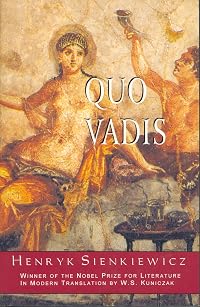
Quo Vadis
by Henryk Sienkiewicz
On This Page
Description
A young Roman soldier falls in love only to discover that his sweetheart belongs to a strange new cult-a group that meets in secret to worship their one and only god. The romance of Marcus Vinicius and Lygia unfolds amid the decadence of ancient Rome, where bloodthirsty crowds flock to gladiatorial contests and a mad emperor sets fire to his own city. With its captivating blend of fictional and real characters, this historical novel contrasts the worldly opulence of the Roman aristocracy show more with the poverty, simplicity, and spiritual power of the early Christians. Quo Vadis ("Where are you going?") was one of the world's first bestsellers and contributed toward the author's 1905 receipt of the Nobel Prize in literature. Originally written in Polish, its tale of the Roman suppression of Christianity echoes the Russian domination of Poland. This edition features Jeremiah Curtin's English translation of Henryk Sienkiewicz's enduring epic. show lessTags
Recommendations





























Member Recommendations


Member Reviews
Although I am not a Christian, or otherwise religious, I have to say that Quo Vadis is one of the most moving and emotional novels I have read. It is also quite different in several important respects from the 1950 film, great all time screen favourite of mine though that is. In the book, Vinicius is terrible before his conversion, his love for Lygia being more of a sadistic desire to control and dominate her, a desire that leads him, for example, to kill outright in a moment of anger a slave who nursed him as a child. I assume for the film they thought that it would not be a success if Robert Taylor as a square-jawed hero was seen doing/saying such things. By the same token, after his conversion, he is far more evangelical than show more portrayed on screen. In general, much of the same events happen on screen and in the book, but in the latter they happen far more intensely – the sufferings of the Christians in the amphitheatre and on the crosses being a particularly moving and disturbing case in point, with quite surprisingly graphic detail for a 19th century novel.
Other minor differences – Aulus (not a Christian in the book) and Pomponia play a lesser role and fade out of the narrative fairly early on. Poppea is a very minor character in the book, Paul of Tarsus a more major one and who seems to meet his martyrdom despite being a Roman citizen.
If one can overlook the fact that many modern scholars do not believe that Nero did actually start the Great Fire of Rome, this is a great historical novel for anyone interested in ancient Rome or early Christianity show less
Other minor differences – Aulus (not a Christian in the book) and Pomponia play a lesser role and fade out of the narrative fairly early on. Poppea is a very minor character in the book, Paul of Tarsus a more major one and who seems to meet his martyrdom despite being a Roman citizen.
If one can overlook the fact that many modern scholars do not believe that Nero did actually start the Great Fire of Rome, this is a great historical novel for anyone interested in ancient Rome or early Christianity show less
Ambientada en la Roma de Nerón, la novela narra el amor entre Marco Vinicio, un joven patricio, y Ligia, una rehén cristiana criada por una familia romana. Para poder unirse a ella, Vinicio deberá renunciar a la corrupción del mundo imperial y abrazar la fe cristiana. A través de esta historia, Henryk Sienkiewicz contrapone la decadencia moral de la aristocracia romana con la pureza y el sacrificio de los primeros cristianos perseguidos.
Publicada por entregas en 1895 en la prensa polaca y editada en libro en 1896, Quo vadis? se convirtió rápidamente en un clásico universal. Más allá del relato histórico, muchos críticos interpretaron la obra como una alegoría de la Polonia oprimida por el Imperio ruso.
Publicada por entregas en 1895 en la prensa polaca y editada en libro en 1896, Quo vadis? se convirtió rápidamente en un clásico universal. Más allá del relato histórico, muchos críticos interpretaron la obra como una alegoría de la Polonia oprimida por el Imperio ruso.
Quo Vadis? is one of my three all-time favorite books. It is set in the time of Nero, when the Christians in Rome began to suffer persecution. The story starts with a young Roman commander, Marcus Vinicius, whose uncle Petronius is a favorite of the emperor. Marcus has met the woman of his dreams, the beautiful Lygia, in the house of a friend and is determined to marry her. What he doesn't know is that Lygia is a member of the new sect, the Christians. When Petronius speaks to Nero and procures Lygia for his nephew, Marcus is overjoyed and prepares his house for Lygia's coming. But she, though attracted to him, is not willing to marry a pagan, and she is rescued from her bridal litter by a group of Christians (including her faithful show more servant, the giant of a man Ursus).
Lygia disappears into the vast city of Rome, and Marcus is devastated. He orders a search for her, and she is eventually located by the Greek Chilomedes. Marcus plans a break-in to capture her, but is injured in the fight. The Christians with whom Lygia is staying take the proud Roman in and care for his wounds, and during this time Marcus and Lygia get to know one another better. Marcus is not yet a Christian, but as he sees the kindness and mercy of the Christians, he begins to wonder about the rumors that say they practice child sacrifice and other horrific things.
When Marcus is healed of his wounds, he leaves the house of the Christians and goes back to his own with a confused heart. On one hand he has the proud Roman heritage of his people; on the other, this humble Christ is confounding all his ideas. When Marcus meets Paul the Apostle, he is finally able to come to faith in Christ, and he and Lygia are engaged.
While all this is happening in Marcus' life, the story also intercuts with Petronius' world in the court of Nero. Nero is a weak and cruel man, and as Petronius' more elegant ethic is replaced by that of his coarse rival, Tigellinus, events move toward Nero's infamous persecutions devised for the Christians in Rome.
Marcus must balance his love for Christ and Lygia with his role as a Roman lord, as Lygia is thrown in prison to await the arena with the other Christians. Although at first he is desperate to save her and himself from death, Marcus comes to realize that their fate is in the hands of God. The last hundred pages of the story are positively riveting as Nero's madness spirals downward and the persecutions begin in earnest. I have a friend who became so engrossed in the story that she actually began praying for the characters! The final few moments that determine the fate of Marcus and Lygia are heartstopping.
I won't spoil the ending for you, but this is an amazing book. It has a beautiful love story, world-shaking faith, and truly inspiring courage — what more can you ask of a novel? Petronius is one of my favorite characters; though he is unabashedly pagan, he behaves nobly and does all he can to save his nephew and Lygia from Nero's cruelties. The Apostles Peter and Paul also make an appearance, and they are well-drawn as well.
Sienkiewicz's narrative is full of action without sacrificing characterization or plot. The culture of the times is very well-written and believable. The language that the characters use is peppered with references to the Romans gods and legends, and is thoroughly enjoyable. And there is even some humor in the tale with the lying, cheating Greek Chilo Chilomedes. Highly, highly recommended.
Translation Note: Curtin's translation is a gem. I do not like the newer translation by W. S. Kuniczak; it's rather stilted in its "updated" language, and fails to render the memorable phrases that Curtin's unfaltering translation gives. show less
Lygia disappears into the vast city of Rome, and Marcus is devastated. He orders a search for her, and she is eventually located by the Greek Chilomedes. Marcus plans a break-in to capture her, but is injured in the fight. The Christians with whom Lygia is staying take the proud Roman in and care for his wounds, and during this time Marcus and Lygia get to know one another better. Marcus is not yet a Christian, but as he sees the kindness and mercy of the Christians, he begins to wonder about the rumors that say they practice child sacrifice and other horrific things.
When Marcus is healed of his wounds, he leaves the house of the Christians and goes back to his own with a confused heart. On one hand he has the proud Roman heritage of his people; on the other, this humble Christ is confounding all his ideas. When Marcus meets Paul the Apostle, he is finally able to come to faith in Christ, and he and Lygia are engaged.
While all this is happening in Marcus' life, the story also intercuts with Petronius' world in the court of Nero. Nero is a weak and cruel man, and as Petronius' more elegant ethic is replaced by that of his coarse rival, Tigellinus, events move toward Nero's infamous persecutions devised for the Christians in Rome.
Marcus must balance his love for Christ and Lygia with his role as a Roman lord, as Lygia is thrown in prison to await the arena with the other Christians. Although at first he is desperate to save her and himself from death, Marcus comes to realize that their fate is in the hands of God. The last hundred pages of the story are positively riveting as Nero's madness spirals downward and the persecutions begin in earnest. I have a friend who became so engrossed in the story that she actually began praying for the characters! The final few moments that determine the fate of Marcus and Lygia are heartstopping.
I won't spoil the ending for you, but this is an amazing book. It has a beautiful love story, world-shaking faith, and truly inspiring courage — what more can you ask of a novel? Petronius is one of my favorite characters; though he is unabashedly pagan, he behaves nobly and does all he can to save his nephew and Lygia from Nero's cruelties. The Apostles Peter and Paul also make an appearance, and they are well-drawn as well.
Sienkiewicz's narrative is full of action without sacrificing characterization or plot. The culture of the times is very well-written and believable. The language that the characters use is peppered with references to the Romans gods and legends, and is thoroughly enjoyable. And there is even some humor in the tale with the lying, cheating Greek Chilo Chilomedes. Highly, highly recommended.
Translation Note: Curtin's translation is a gem. I do not like the newer translation by W. S. Kuniczak; it's rather stilted in its "updated" language, and fails to render the memorable phrases that Curtin's unfaltering translation gives. show less
Quo Vadis is an historical novel centered on Rome in the time of Nero. It is first and foremost a love story between Roman Marcus Vinicius and Christian Lygia, but also provides a vivid depiction of the contrast between Roman corruption and debauchery and emerging Christian teachings.
Typically, I don’t enjoy books about the Roman Empire (or books this heavily steeped in religious philosophy) but this book was an exception. With a few exceptions (i.e. Lygia), historical characters are brought to life in a nuanced and complex way. The descriptions of the time period and excesses of Roman Empire were rich and painted a very vivid picture of important historical moments during the emergence of Christianity. Although I found that the book show more dragged at moments, I really enjoyed the book. It was heartbreaking and uplifting. show less
Typically, I don’t enjoy books about the Roman Empire (or books this heavily steeped in religious philosophy) but this book was an exception. With a few exceptions (i.e. Lygia), historical characters are brought to life in a nuanced and complex way. The descriptions of the time period and excesses of Roman Empire were rich and painted a very vivid picture of important historical moments during the emergence of Christianity. Although I found that the book show more dragged at moments, I really enjoyed the book. It was heartbreaking and uplifting. show less
Quo Vadis may have taken me longer to read than any other book. I don’t blame the quality of the work as it was excellent. Instead, it was the format I selected for this particular reading.
I downloaded this edition from Project Gutenberg and read it on an iPad. The Gutenberg file was poorly translated and contained a number of editorial and spelling errors. These slowed me down a bit. What had the greatest impact, however, was reading on the iPad. There are simply too many distractions, with e-mail coming in and a web browser just a click away, to allow for dedicated concentration.
All that said, I really enjoyed Quo Vadis. I had been wanting to read some Polish literature for a while and this was my first selection. The translator of show more this edition, Jeremiah Curtin, did an excellent job. The story flowed well and the language was still rich and descriptive. The only slightly annoying nuance was their use of “in a twinkle” to mean quickly when it was used in conjunction with some violent act.
The story was fairly complex but can be broken down into a few main components:
The love between Lygia (a Christian) and Vinicius (a Roman tribune)
The resilience of the early Christians
The conversion of Vinicius to Christianity
The brutality and insanity of Nero
Reading this novel, it was sometimes difficult to remember that this was fiction written centuries after the setting of the story. The characters are so well created and the plot finely detailed that it almost seems to be a first-hand account of the action. I suppose this is the mark of a fine author.
The brutality of Nero and the Romans against the early Christians is the subject of many works. Quo Vadis provides a rather bloody and detailed account to what may have happened to some of them during the regular spectacles provided for the benefit of the Roman people. The dignity and grace with which they died became their hallmark and instilled more fear of them within the Romans.
Overall, this may be one of my favorite books of all time. I will, however, likely stick to actual paper and ink in the future as the electronic media doesn’t work well for me. show less
I downloaded this edition from Project Gutenberg and read it on an iPad. The Gutenberg file was poorly translated and contained a number of editorial and spelling errors. These slowed me down a bit. What had the greatest impact, however, was reading on the iPad. There are simply too many distractions, with e-mail coming in and a web browser just a click away, to allow for dedicated concentration.
All that said, I really enjoyed Quo Vadis. I had been wanting to read some Polish literature for a while and this was my first selection. The translator of show more this edition, Jeremiah Curtin, did an excellent job. The story flowed well and the language was still rich and descriptive. The only slightly annoying nuance was their use of “in a twinkle” to mean quickly when it was used in conjunction with some violent act.
The story was fairly complex but can be broken down into a few main components:
The love between Lygia (a Christian) and Vinicius (a Roman tribune)
The resilience of the early Christians
The conversion of Vinicius to Christianity
The brutality and insanity of Nero
Reading this novel, it was sometimes difficult to remember that this was fiction written centuries after the setting of the story. The characters are so well created and the plot finely detailed that it almost seems to be a first-hand account of the action. I suppose this is the mark of a fine author.
The brutality of Nero and the Romans against the early Christians is the subject of many works. Quo Vadis provides a rather bloody and detailed account to what may have happened to some of them during the regular spectacles provided for the benefit of the Roman people. The dignity and grace with which they died became their hallmark and instilled more fear of them within the Romans.
Overall, this may be one of my favorite books of all time. I will, however, likely stick to actual paper and ink in the future as the electronic media doesn’t work well for me. show less
Near the end of Quo Vadis Petronius (Arbiter) writes a letter in reply to his nephew Vicinius who has fled Rome with his bride, Ligia. In the letter Petronius discusses his philosophy and his fate contrasting it with the Christian belief that Vicinius has accepted. He says:
"There are only two philosophers that I care about, Pyrrho and Anacreon. You know what they stand for. The rest, along with the new Greek schools and all the Roman Stoics, you can have for the price of beans. Truth lives somewhere so high that even the gods can't see it from Olympus."(QV, p. 566)
It is interesting to note that Pyrrho is noted for a philosophy of skepticism that claims the impossibility of knowledge. For him our own ignorance or doubt should induce us show more to withdraw into ourselves, avoiding the stress and emotion which belong to the contest of vain imaginings. This theory of the impossibility of knowledge suggests a sort of agnosticism and its ethical implications may be compared with the ideal tranquility of the Stoics and Epicureans (who were more popular among Romans). This certainly contrasts with the Christian spiritual view that emphasizes belief in the supernatural. It is a philosophy that, at least for Petronius, lets him face death unequivocally with a sort of stoicism that provides a potent example in opposition to the Christian view. It also is an example of the breadth of beliefs shown by Sienkiewicz in his portrayal of the culture and character of the Roman world.
This contrast of philosophies underlies the novel and made it more interesting to me than the simple love story that it also presents. In Quo Vadis we are presented with an historical novel of depth that shows us the corruption and depravity of Nero's Rome while it presents the worlds of aesthetics and skepticism represented by Petronius and that of the young Christian sect whose believers include Peter and Paul, of biblical fame, and Ligia, the barbarian princess who becomes the focus of young Vicinius' amour. It is perhaps not a coincidence that the nineteenth century had several writers (Bulwer-Lytton, Kingsley, and Wallace) including Sienkiewicz who reacted to the prevalence of anti-christian views among the romantics (Shelley, et. al.). This is seen in the pronounced admiration for the poor Christians and the sensational nature of the culmination of the story involving the Neronic destruction of many of the Christians in terrifically brutal games. In spite of this Sienkiewicz through vivid detail creates a believable historical setting for his love story; and overcoming his biased portrayal of the Christians and the contrast with the irrationality and evil of Nero, he succeeds in telling a moving and thoughtful portrayal of Rome in the first century A.D. show less
"There are only two philosophers that I care about, Pyrrho and Anacreon. You know what they stand for. The rest, along with the new Greek schools and all the Roman Stoics, you can have for the price of beans. Truth lives somewhere so high that even the gods can't see it from Olympus."(QV, p. 566)
It is interesting to note that Pyrrho is noted for a philosophy of skepticism that claims the impossibility of knowledge. For him our own ignorance or doubt should induce us show more to withdraw into ourselves, avoiding the stress and emotion which belong to the contest of vain imaginings. This theory of the impossibility of knowledge suggests a sort of agnosticism and its ethical implications may be compared with the ideal tranquility of the Stoics and Epicureans (who were more popular among Romans). This certainly contrasts with the Christian spiritual view that emphasizes belief in the supernatural. It is a philosophy that, at least for Petronius, lets him face death unequivocally with a sort of stoicism that provides a potent example in opposition to the Christian view. It also is an example of the breadth of beliefs shown by Sienkiewicz in his portrayal of the culture and character of the Roman world.
This contrast of philosophies underlies the novel and made it more interesting to me than the simple love story that it also presents. In Quo Vadis we are presented with an historical novel of depth that shows us the corruption and depravity of Nero's Rome while it presents the worlds of aesthetics and skepticism represented by Petronius and that of the young Christian sect whose believers include Peter and Paul, of biblical fame, and Ligia, the barbarian princess who becomes the focus of young Vicinius' amour. It is perhaps not a coincidence that the nineteenth century had several writers (Bulwer-Lytton, Kingsley, and Wallace) including Sienkiewicz who reacted to the prevalence of anti-christian views among the romantics (Shelley, et. al.). This is seen in the pronounced admiration for the poor Christians and the sensational nature of the culmination of the story involving the Neronic destruction of many of the Christians in terrifically brutal games. In spite of this Sienkiewicz through vivid detail creates a believable historical setting for his love story; and overcoming his biased portrayal of the Christians and the contrast with the irrationality and evil of Nero, he succeeds in telling a moving and thoughtful portrayal of Rome in the first century A.D. show less
This historical fiction epic by Noble Prize winner [a:Henryk Sienkiewicz|25619|Henryk Sienkiewicz|http://d.gr-assets.com/authors/1209072961p2/25619.jpg] was much more graphically violent than I had anticipated. But for that, and a certain stiltedness to this translation, I would give this novel 5 stars.
If you have seen the classic movie adaptation with Robert Taylor and Deborah Kerr, be warned that there are some significant differences between the book and the film. In particular, Vinicius is much more despicable at the beginning - to the point where you wonder why Lygia would ever fall in love with him!
If you have seen the classic movie adaptation with Robert Taylor and Deborah Kerr, be warned that there are some significant differences between the book and the film. In particular, Vinicius is much more despicable at the beginning - to the point where you wonder why Lygia would ever fall in love with him!
Members
- Recently Added By
Lists

1001 Books You Must Read Before You Die
1,448 works; 1,134 members

Best historical fiction set in the ancient world
126 works; 40 members

Best of World Literature
435 works; 52 members

Favorite Long Books
330 works; 42 members

Best Historical Fiction
620 works; 261 members

Historical Fiction
889 works; 90 members

Books Set in Italy
167 works; 19 members

Favourite 19th century fiction
257 works; 60 members
Best Roman Empire Books
49 works; 17 members

Nobel Price Winners
222 works; 20 members

Western World's Greatest Books - Project Gutenberg
295 works; 15 members

1,001 BYMRBYD Concensus
723 works; 27 members

once upon a time ~ ancient world
46 works; 7 members

Lamont's Hundred Best Novels (1947)
100 works; 4 members

1890s
49 works; 6 members

CCE 1000 Good Books List
1,033 works; 12 members

Books Read in 2022
5,226 works; 115 members

Books Set in Rome
98 works; 2 members

KayStJ's to-read list
1,616 works; 11 members

Sonlight Books
1,487 works; 25 members

Publisher's Weekly Bestsellers Part I - 1895-1939
399 works; 8 members

High School Books
3 works; 1 member

𓐩hought Daughter ♱♰✟✞✝︎☨†˚₊‧꒰ა ♱ ໒꒱ ‧
38 works; 1 member

.
396 works; 1 member
Author Information

332+ Works 7,152 Members
Far more celebrated than any of his positivist contemporaries, Henryk Sienkiewicz began as a journalist and achieved considerable renown with his account of a two-year journey to the United States. Between 1882 and 1888 he wrote three historical novels dealing with political and military events in seventeenth-century Poland: With Fire and Sword, show more The Deluge (1886), and Fire in the Steppe (1888, also translated as Pan Michael). Although superficial in its analysis of historical events, the trilogy gained enormous popularity both in Poland and in other Slavic countries thanks to Sienkiewicz's masterful use of epic techniques and of the seventeenth-century colloquial idiom. Even more popular, if artistically far weaker, was his Quo Vadis? (1896), a novel about Rome in the age of Nero (Sienkiewicz's fame in the West is chiefly based on this work). Another historical novel, The Teutonic Knights (1900), deals with the fifteenth-century struggle between Poland-Lithuania and the Teutonic Order. Henryk Sienkiewicz was awarded The Nobel prize in Literature for 1905 "because of his outstanding merits as an epic writer". (Bowker Author Biography) show less
Some Editions
Awards and Honors
Awards
Distinctions
Notable Lists
Greatest Books algorithm (1182)
Bulgarian Big Read (42)
Hungarian Big Read (30)
Series
Belongs to Publisher Series
[Untitled Series] (Adelphi library)
Nobelpreisträger Coron-Verlag (weiß) (1905 (Polen))
Grandes Novelas de Aventuras (XXXIII)
Corticelli [Mursia] (70)
Airmont Classics (188)
A tot vent (359)
Everyman's Library (970)
Work Relationships
Is contained in
International Collector's Library Classics 19 volumes: Crime & Punishment; Twenty Thousand Leagues Under the Sea; Mysterious Island; Magic Mountain; Around the World in 80 Days; Count of Monte Cristo; Camille; Quo Vadis; Hunchback of Notre Dame; Nana; Scaramouche; Pinocchio; Fernande; War and Peace; The Egyptian; From the Earth to the Moon; Candide; Treasure of Sierra Madre; Siddhartha/Steppenwolf by Jules Verne
Has the adaptation
Common Knowledge
- Canonical title
- Quo Vadis
- Original title
- Quo Vadis ? Powieść z czasów Nerona
- Alternate titles*
- Quo vadis? : een verhaal uit de tijd van Nero
- Original publication date
- 1896
- People/Characters
- Lygia; Marcus Vinicius; Gaius Petronius Arbiter; Nero Claudius Caesar Augustus Germanicus
- Important places
- Ancient Rome
- Important events
- Reign of Nero (54-10-13 | 68-06-09)
- Related movies
- Quo Vadis? (1912 | IMDb); Quo Vadis (1951 | IMDb); Quo Vadis? (1985 | IMDb); Quo Vadis? (1925 | IMDb); Quo Vadis (2001 | IMDb)
- First words
- Petronius woke only about midday, and as usual greatly wearied.
- Last words
- (Click to show. Warning: May contain spoilers.)Near the ancient Porta Capena stands to this day a little chapel with the inscription, somewhat worn: Quo Vadis, Domine ?
- Blurbers
- James Michener
- Original language
- Polish
- Canonical DDC/MDS
- 891.8536
- Canonical LCC
- PG7158.S4
- Disambiguation notice*
- Date de première publication
- 1895-1896 (1e édition originale polonaise en série)
- 1896 (1e édition originale polonaise compilée en livre)
- 1897 (1e traduction et édition très abrégée américai... (show all)ne, Hurst, New York)
- 1900 (1e traduction et édition très partielle française traduite par Mme F. Kallenbach, La Quinzaine", juillet 19 00
- 1900 (Nouvelle traduction par B. Kozakiewicz et J. L. de Janaszet et édition française, Editions de la Revue blanche, Paris)
- ...
- 2010-06-18 (Nouvelle traduction de Ely Halpérine-Kaminski avec une préface de Claude Aziza, Les Belles lettres)
*Some information comes from Common Knowledge in other languages. Click "Edit" for more information.
Classifications
- Genres
- Fiction and Literature, General Fiction, Historical Fiction, Christian Fiction
- DDC/MDS
- 891.8536 — Literature & rhetoric Literatures of other languages East Indo-European and Celtic literatures West and South Slavic languages (Bulgarian, Slovene, Polish, Czech, Slovak, Serbo-Croatian, and Macedonian) Polish Polish fiction 1795–1919
- LCC
- PG7158 .S4 — Language and Literature Slavic languages and literatures. Baltic languages. Albanian language Slavic. Baltic. Albanian Slavic Polish
- BISAC
Statistics
- Members
- 3,996
- Popularity
- 3,923
- Reviews
- 73
- Rating
- (3.96)
- Languages
- 28 — Bengali, Catalan, Chinese, Czech, Danish, Dutch, English, Esperanto, Estonian, Finnish, French, German, Hungarian, Indonesian, Italian, Korean, Lithuanian, Norwegian (Bokmål), Polish, Romanian, Russian, Serbian, Slovak, Slovenian, Spanish, Swedish, Turkish, Portuguese (Portugal)
- Media
- Paper, Audiobook, Ebook
- ISBNs
- 372
- UPCs
- 3
- ASINs
- 165