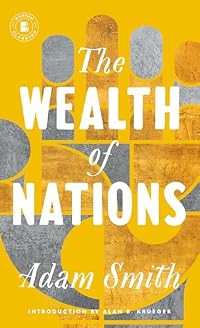
An Inquiry into the Nature and Causes of the Wealth of Nations
by Adam Smith 
On This Page
Description
The foundation for all modern economic thought and political economy, The Wealth of Nations is the magnum opus of Scottish economist Adam Smith, who introduces the world to the very idea of economics and capitalism in the modern sense of the words. Smith details his argument in five books: Book I. Of the Causes of Improvement in the Productive Power of LabourBook II. Of the Nature, Accumulation, and Employment of Stock IntroductionBook III. Of the Different Progress of Opulence in Different show more NationsBook IV. Of Systems of Political EconomyBook V. Of the Revenue of the Sovereign or CommonwealthTaken together, these books form a giant leap forward in the field of economics. A product of the "Age of Enlightenment," The Wealth of Nations is a must for all who wish to gain a better understanding of the principles upon which all modern capitalistic economies have been founded and the process of wealth creation that is engendered by those principles. show lessTags
Recommendations













Member Reviews
According to the introduction Adam Smith was the “first modern economist” and “widely credited with laying the theoretical and philosophical foundation for the modern free market system” and “commercial society." He famously wrote that "It is not from the benevolence of the butcher, the brewer, or the baker that we expect our dinner, but from their regard to their own interest." And that by pursuing their own interest in competition with others, entrepreneurs are “led by an invisible hand” by economic forces to create a variety of goods and services that benefit the public. But even Karl Marx used ideas of Smith in arguing for communism--particularly his key idea of the labor theory of value can be traced to Smith--as was show more Marx's idea of the “alienation” of the worker. As the introduction put it, Smith was concerned about the “deformation of humans due to tedious and repetitive work.” He was also concerned about how business interests would use their potential monopoly power--particularly in how they might use politics against the consumer:
The proposal of any new law or regulation of commerce which comes from this [business] order, ought always to be listened to with great precaution, and ought never be adopted till after having been long and carefully examined, not only with the most scrupulous, but with the most suspicious attention.
What struck me from the first about the book was how flowing and lucid it was to read. I’m not saying there aren’t difficult, dry passages--there are. But if you take the time, it is understandable without reading some Adam Smith for Dummies, and believe me, having read several books of philosophy and economics I appreciated that. And actually I found a lot of the reading quite lively. Like Darwin (and unlike Marx), Smith isn’t just erudite and well-read, but speaks of his personal observations, and in that regard his portrait of a pin-making factory and how it illustrates the efficiencies of the division of labor was very memorable. For Smith such specialization and the gains in productivity are key to the wealth of nations. And I found it interesting Smith stresses geography, not race, as the ultimate reason for differences of wealth between nations--particularly its role in access to markets as there ports and navigable rivers are crucial. An explanation not just enlightened for his time, but anticipating much-lauded recent arguments by Landes in The Wealth and Poverty of Nations and Diamond in Guns, Germs and Steel. Smith’s explanation of the formation and role of money still is among the most lucid and still rings true.
All this is to say that Smith is quite readable and enormously influential, and thus well-worth the read. If anything might put a reader off, it’s the sheer length, since complete unabridged editions run to around 600 pages. And as I admit above, I’m not saying some of it isn’t a slog--just that it’s worth it if you want to educate yourself about the basis of modern economics; this is definitely where to start. At the very least, see if you can read an excerpt containing his description of a Pin Factory. It's clear, interesting, short, and influenced both free market and socialist thinkers. show less
The proposal of any new law or regulation of commerce which comes from this [business] order, ought always to be listened to with great precaution, and ought never be adopted till after having been long and carefully examined, not only with the most scrupulous, but with the most suspicious attention.
What struck me from the first about the book was how flowing and lucid it was to read. I’m not saying there aren’t difficult, dry passages--there are. But if you take the time, it is understandable without reading some Adam Smith for Dummies, and believe me, having read several books of philosophy and economics I appreciated that. And actually I found a lot of the reading quite lively. Like Darwin (and unlike Marx), Smith isn’t just erudite and well-read, but speaks of his personal observations, and in that regard his portrait of a pin-making factory and how it illustrates the efficiencies of the division of labor was very memorable. For Smith such specialization and the gains in productivity are key to the wealth of nations. And I found it interesting Smith stresses geography, not race, as the ultimate reason for differences of wealth between nations--particularly its role in access to markets as there ports and navigable rivers are crucial. An explanation not just enlightened for his time, but anticipating much-lauded recent arguments by Landes in The Wealth and Poverty of Nations and Diamond in Guns, Germs and Steel. Smith’s explanation of the formation and role of money still is among the most lucid and still rings true.
All this is to say that Smith is quite readable and enormously influential, and thus well-worth the read. If anything might put a reader off, it’s the sheer length, since complete unabridged editions run to around 600 pages. And as I admit above, I’m not saying some of it isn’t a slog--just that it’s worth it if you want to educate yourself about the basis of modern economics; this is definitely where to start. At the very least, see if you can read an excerpt containing his description of a Pin Factory. It's clear, interesting, short, and influenced both free market and socialist thinkers. show less
Тази книга е ГОЛЯМА не защото ще получите кой-знае колко много икономически познания от Адам Смит. Така или иначе, ако разбирате от икономика, нищо ново няма да видите в нея, а ако не разбирате - едва ли ще се хванете да четете над 1000 странична книга от 18 век.
"Богатството на народите" е важна книга заради простия език и елементарните примери, с които борави, за да покаже икономическите отношения и принципите, show more които те следват, като нещо съвсем делнично, нормално, житейско.
За болшинството хора, даже за много от завършилите икономика, самата икономика и икономическите отношения са нещо изключително сложно, пълно с графики, формули и други али-бали и те по никакъв начин не могат да свържат цялата тая какафония с това, което става в реалния живот и държавната политика. И именно заради това неразбиране на даже елементарни неща, се раждат идейни малформации като социализъм, антиблобализъм и др. опити да се "поправи икономиката".
Защото болшинството хора като чуят "пазарна икономика" не разбират, че тя не е нещо сложно, някаква измислица, "създадена за да се потискат бедните" или нещо такова - а просто нормалният начин на съществуване и функциониране на човешкото общество, в което всеки отделен човек има максималната свобода да избира какво да купи и какво да произвежда, на кого да даде парите си и как да ги харчи. Че не е наложена "от горе", та да бъде поправяна с политики, а идва от долу, от обикновения начин на отношение на хората едни към други, от изборът, който всеки човек прави всеки ден за това какъв хляб да си купи, примерно.
Точно това постига Адам Смит и затова книгата му е гениална за мен. Не защото е поставил основите на икономическата наука (макар безспорно да го е направил). Книгата му е ценна тук и сега, защото той отлично описва малките хора, с техните делнични, малки желания и стремежи, които заедно, но всеки за себе си, изграждат развиващия се свободен свят.
"It is not from the benevolence of the butcher, the brewer, or the baker that we expect our dinner, but from their regard to their own interest. We address ourselves, not to their humanity but to their self-love, and never talk to them of our own necessities but of their advantages." show less
"Богатството на народите" е важна книга заради простия език и елементарните примери, с които борави, за да покаже икономическите отношения и принципите, show more които те следват, като нещо съвсем делнично, нормално, житейско.
За болшинството хора, даже за много от завършилите икономика, самата икономика и икономическите отношения са нещо изключително сложно, пълно с графики, формули и други али-бали и те по никакъв начин не могат да свържат цялата тая какафония с това, което става в реалния живот и държавната политика. И именно заради това неразбиране на даже елементарни неща, се раждат идейни малформации като социализъм, антиблобализъм и др. опити да се "поправи икономиката".
Защото болшинството хора като чуят "пазарна икономика" не разбират, че тя не е нещо сложно, някаква измислица, "създадена за да се потискат бедните" или нещо такова - а просто нормалният начин на съществуване и функциониране на човешкото общество, в което всеки отделен човек има максималната свобода да избира какво да купи и какво да произвежда, на кого да даде парите си и как да ги харчи. Че не е наложена "от горе", та да бъде поправяна с политики, а идва от долу, от обикновения начин на отношение на хората едни към други, от изборът, който всеки човек прави всеки ден за това какъв хляб да си купи, примерно.
Точно това постига Адам Смит и затова книгата му е гениална за мен. Не защото е поставил основите на икономическата наука (макар безспорно да го е направил). Книгата му е ценна тук и сега, защото той отлично описва малките хора, с техните делнични, малки желания и стремежи, които заедно, но всеки за себе си, изграждат развиващия се свободен свят.
"It is not from the benevolence of the butcher, the brewer, or the baker that we expect our dinner, but from their regard to their own interest. We address ourselves, not to their humanity but to their self-love, and never talk to them of our own necessities but of their advantages." show less
There are two non-religious books that have impacted the world in the last two and a half centuries, both dealing with economics that would result in dueling worldviews. The Wealth of Nations by Adam Smith was published the same year as the signing of the Declaration of Independence by the nation that would be his “champion” in the 20th century.
The predominate economic thought of the 18th century was mercantilism that sought to maximize exports and minimize imports to accumulate resources, i.e. money. Yet Smith viewed this theory and the French theory that focused solely on land value as inadequate for the growing Industrial Revolution that is just commencing, and this his magnum opus was a paradigm shift for economics. However, for show more many of certain of today’s defenders and proponents of Smith, they claim fly in the face of the author’s actual words including the very lauded phrase “invisible hand”. But even as Smith’s defenders twist his words, some of his detractors overlook many of his passages that support their critiques of him or what is thought he says by those who use his words out of context. Though this is primarily a philosophical treatise on economics that doesn’t stop Smith from revealing his antislavery views as well as his belief that competition in religion would lead to a more tolerate government—this later point would influence James Madison and the separation of church and state. While these two non-economic points were interwoven within the text as a way to emphasize Smith’s economic arguments, Smith’s use of economic data—or overabundant use—was detrimental to the book especially in his digressions and in the last chapter of Book V when covering Public Debt when he went over the history of England/Great Britain’s debt he could have literally halved the section and had a stronger argument to end his treatise. Smith’s very readable treatise comes in at over 1200 pages in this edition and there are many chapters that like the chapter on Public Debt could have been shortened and been just as, if not more, powerful in argument.
The Wealth of Nations is Adam Smith’s magnum opus that resulted in him becoming the “Father of Capitalism” and has been one of the most important economic books of all time, along with Karl Marx’s Das Kapital, and the world has been debating his work ever since. show less
The predominate economic thought of the 18th century was mercantilism that sought to maximize exports and minimize imports to accumulate resources, i.e. money. Yet Smith viewed this theory and the French theory that focused solely on land value as inadequate for the growing Industrial Revolution that is just commencing, and this his magnum opus was a paradigm shift for economics. However, for show more many of certain of today’s defenders and proponents of Smith, they claim fly in the face of the author’s actual words including the very lauded phrase “invisible hand”. But even as Smith’s defenders twist his words, some of his detractors overlook many of his passages that support their critiques of him or what is thought he says by those who use his words out of context. Though this is primarily a philosophical treatise on economics that doesn’t stop Smith from revealing his antislavery views as well as his belief that competition in religion would lead to a more tolerate government—this later point would influence James Madison and the separation of church and state. While these two non-economic points were interwoven within the text as a way to emphasize Smith’s economic arguments, Smith’s use of economic data—or overabundant use—was detrimental to the book especially in his digressions and in the last chapter of Book V when covering Public Debt when he went over the history of England/Great Britain’s debt he could have literally halved the section and had a stronger argument to end his treatise. Smith’s very readable treatise comes in at over 1200 pages in this edition and there are many chapters that like the chapter on Public Debt could have been shortened and been just as, if not more, powerful in argument.
The Wealth of Nations is Adam Smith’s magnum opus that resulted in him becoming the “Father of Capitalism” and has been one of the most important economic books of all time, along with Karl Marx’s Das Kapital, and the world has been debating his work ever since. show less
Overall, this was an informative read; not for its economic insightfulness but for how its supporters use Smith's theories. There are some basic economic truths and a lot of tedious detail but what is really telling are the outdated ideas and the sweeping generalizations which have carried over to our contemporary economic discussions.
This may not be the work Smith wanted to be known for, but it remains his most famous, and most significant, work.
Smith goes into exacting detail in exploring all things economics, inquiring into everything from labor and capital to considering the long-term changes in tax policy and cost of wheat in England and Scotland.
He makes the case for free trade, a turn away from a mercantilist economic framework, and encouraged the basic principles of capitalism which have endured to this day, very much because Smith's work became popular and was the catalyst for changing British economic policy. His concept of mutual self-interest as an effective driver but also check on capitalism sounds good in the abstract, and was an improvement over show more existing economic theory.
But as with the Theory of Moral Sentiments, so with the Inquiry into the Wealth of Nations: Smith's using his reason and experience well, and it worked well at the time, but why should this be the Economics Bible? Would that be what Smith himself would even want? As a testament to the profound economic changes of the late 18th century, and a major driver of what has made our modern world what it is, the book is a priceless witness. But hopefully we've learned a few things in our experiences with capitalism, and the discipline can move forward. show less
Smith goes into exacting detail in exploring all things economics, inquiring into everything from labor and capital to considering the long-term changes in tax policy and cost of wheat in England and Scotland.
He makes the case for free trade, a turn away from a mercantilist economic framework, and encouraged the basic principles of capitalism which have endured to this day, very much because Smith's work became popular and was the catalyst for changing British economic policy. His concept of mutual self-interest as an effective driver but also check on capitalism sounds good in the abstract, and was an improvement over show more existing economic theory.
But as with the Theory of Moral Sentiments, so with the Inquiry into the Wealth of Nations: Smith's using his reason and experience well, and it worked well at the time, but why should this be the Economics Bible? Would that be what Smith himself would even want? As a testament to the profound economic changes of the late 18th century, and a major driver of what has made our modern world what it is, the book is a priceless witness. But hopefully we've learned a few things in our experiences with capitalism, and the discipline can move forward. show less
What more is there to say about a book that's been around 233 years? That's considered to be the founding text of modern economics? Written by a man who has organizations and lectures named after him, whose name is synonymous with free markets?
Well, the following is a list of things not generally talked about - in my casual exposure to economics - in regards to this work.
Smith, not surprisingly for a man of the Enlightenment, was a blank slate guy. The philosopher, we're told, differs from the porter "not so much from nature, as from habit, custom, and education". Smith's professional progeny, with less justification and an autistic-like inability to model human nature, has largely kept the notion of people as malleable economic units show more whose value can simply be altered by some inputs of education.
This is a book on the wealth of nations, not an argument for how trade is going to pacify the world and render borders obsolete as is the gospel sometimes preached - for at least a hundred years - by advocates of globalization. While Smith acknowledges that wealthy countries make great trading partners, he also notes their wealth makes them "dangerous in war and politics". (He also makes a not entirely unconvincing argument for standing armies being necessary. Part of it rests on the general efficacy of the specialization of labor.)
He also makes some, on the face of it, surprising digressions into what sort of established church should be supported and if public education is worthwhile - all under the section on how the government should be spending its money. He's not big on established churches but thinks they are inevitable unless a country has no tradition of them - like the American colonies who were just rebelling in the "recent disturbances" at the time of the book's publication. (Though, of course, individual colonies did have established churches.) He's a supporter of everyone being educated to a certain minimum degree. Indeed, he seems to argue for a sort of licensure system in which people, before entering economic life, have to prove a minimum standard of education. But he is skeptical of public financing and administration being able to do this. And, given the state of American public education in all its aspects, his skepticism sometimes seems still relevant and appropriate.
While Smith is rightly considered a strong advocate of free trade - a large section of the book is a demolition of the then fashionable mercantile system with its attendant emphasis on gold and silver as something more than just merely convenient mediums of exchange, he does note some objections. In an age where the US Pentagon admits some of its supply chains disappear somewhere overseas, Smith's admonition that free trade should not hamper national defense seems forgotten. "Defence" notes Smith, "... is of much more importance than opulence." Smith also is not in favor of free trade for items that are taxed by the importing country. Tariffs, he argues, should equal the tax load on the native manufacturer. He also supports retaliatory tariffs, a gradual elimination of tariffs, and notes that free trade should not proceed if those it unemploys can not easily find other employment. Historically, using the argument of the re-employment of thousands of soldiers and seamen after demobilization, he doesn't see this as usually being a problem though.
Smith states four maxims of good tax policy: each citizen paying in proportion to the property the state protects and enables the accumulation of , convenience of payments, certainty of amount and time of payment, convenience of payment, and economy of collection. He seems, at one point, to argue for hidden taxes on luxury consumer goods - the goods that social custom does not dictate are essential to the lives of even the lowest class.
What isn't in the book is any sort of mention of monetary policy - governments attempting to manipulate economies by manipulating money supplies. And one also wonders what Smith would have thought of the notion of a service economy. To Smith, productive labor was only that which increased the tangible, material property of a society. No significant mention is made of the idea of intellectual property yet he notes that "philosophers or men of speculation" have invented machines that have increased production of goods.
Is Smith readable? Largely, yes. The marginal annotations of the Cannan edition are very good and help easily follow Smith's arguments and find relevant sections. There is a reason there are many famous quotes from this book. Smith is usually a lucid - and occasionally wry - author. Even though he digresses into some less - at least to me - interesting topics like the history of the Bank of Amsterdam or the specifics of Britain's deficit financing in the early 18th century, his economic history is often interesting. I don't know how kind modern scholarship has been to his economic theories on European social development post-Roman Empire and the reasons for the Reformation, but they were interesting and not implausible. He also has an section on the pragmatic reasons why slavery was not conducive to the economic development of societies.
Smith's work is largely known for being an extended apologia for the benefits of enlightened self-interest. George Stigler, in a preface that ably sums up Smith's main points, convincingly argues - though the debt is not explicit in the text - that it isn't exactly self-interest, and not socialism's and communism's essential and necessary altruism, that motivates economic efficiency. It's the private vices that become public benefits. It's a notion developed in Smith's The Theory Of Moral Sentiments and may stem from Mandeville's The Fable of the Bees: Or Private Vices, Publick Benefits. show less
Well, the following is a list of things not generally talked about - in my casual exposure to economics - in regards to this work.
Smith, not surprisingly for a man of the Enlightenment, was a blank slate guy. The philosopher, we're told, differs from the porter "not so much from nature, as from habit, custom, and education". Smith's professional progeny, with less justification and an autistic-like inability to model human nature, has largely kept the notion of people as malleable economic units show more whose value can simply be altered by some inputs of education.
This is a book on the wealth of nations, not an argument for how trade is going to pacify the world and render borders obsolete as is the gospel sometimes preached - for at least a hundred years - by advocates of globalization. While Smith acknowledges that wealthy countries make great trading partners, he also notes their wealth makes them "dangerous in war and politics". (He also makes a not entirely unconvincing argument for standing armies being necessary. Part of it rests on the general efficacy of the specialization of labor.)
He also makes some, on the face of it, surprising digressions into what sort of established church should be supported and if public education is worthwhile - all under the section on how the government should be spending its money. He's not big on established churches but thinks they are inevitable unless a country has no tradition of them - like the American colonies who were just rebelling in the "recent disturbances" at the time of the book's publication. (Though, of course, individual colonies did have established churches.) He's a supporter of everyone being educated to a certain minimum degree. Indeed, he seems to argue for a sort of licensure system in which people, before entering economic life, have to prove a minimum standard of education. But he is skeptical of public financing and administration being able to do this. And, given the state of American public education in all its aspects, his skepticism sometimes seems still relevant and appropriate.
While Smith is rightly considered a strong advocate of free trade - a large section of the book is a demolition of the then fashionable mercantile system with its attendant emphasis on gold and silver as something more than just merely convenient mediums of exchange, he does note some objections. In an age where the US Pentagon admits some of its supply chains disappear somewhere overseas, Smith's admonition that free trade should not hamper national defense seems forgotten. "Defence" notes Smith, "... is of much more importance than opulence." Smith also is not in favor of free trade for items that are taxed by the importing country. Tariffs, he argues, should equal the tax load on the native manufacturer. He also supports retaliatory tariffs, a gradual elimination of tariffs, and notes that free trade should not proceed if those it unemploys can not easily find other employment. Historically, using the argument of the re-employment of thousands of soldiers and seamen after demobilization, he doesn't see this as usually being a problem though.
Smith states four maxims of good tax policy: each citizen paying in proportion to the property the state protects and enables the accumulation of , convenience of payments, certainty of amount and time of payment, convenience of payment, and economy of collection. He seems, at one point, to argue for hidden taxes on luxury consumer goods - the goods that social custom does not dictate are essential to the lives of even the lowest class.
What isn't in the book is any sort of mention of monetary policy - governments attempting to manipulate economies by manipulating money supplies. And one also wonders what Smith would have thought of the notion of a service economy. To Smith, productive labor was only that which increased the tangible, material property of a society. No significant mention is made of the idea of intellectual property yet he notes that "philosophers or men of speculation" have invented machines that have increased production of goods.
Is Smith readable? Largely, yes. The marginal annotations of the Cannan edition are very good and help easily follow Smith's arguments and find relevant sections. There is a reason there are many famous quotes from this book. Smith is usually a lucid - and occasionally wry - author. Even though he digresses into some less - at least to me - interesting topics like the history of the Bank of Amsterdam or the specifics of Britain's deficit financing in the early 18th century, his economic history is often interesting. I don't know how kind modern scholarship has been to his economic theories on European social development post-Roman Empire and the reasons for the Reformation, but they were interesting and not implausible. He also has an section on the pragmatic reasons why slavery was not conducive to the economic development of societies.
Smith's work is largely known for being an extended apologia for the benefits of enlightened self-interest. George Stigler, in a preface that ably sums up Smith's main points, convincingly argues - though the debt is not explicit in the text - that it isn't exactly self-interest, and not socialism's and communism's essential and necessary altruism, that motivates economic efficiency. It's the private vices that become public benefits. It's a notion developed in Smith's The Theory Of Moral Sentiments and may stem from Mandeville's The Fable of the Bees: Or Private Vices, Publick Benefits. show less
A great book, but not for everyone. Amazing insights which are still as valid today as 1775 when the book was written.
Very detailed, great analysis and I really learned a lot from this book. Hard to read in sections, as it is written in very verbose, antiquated English.
I would recommend it if you are interested in Economics and want to gain a perspective from first principles.
Very detailed, great analysis and I really learned a lot from this book. Hard to read in sections, as it is written in very verbose, antiquated English.
I would recommend it if you are interested in Economics and want to gain a perspective from first principles.
Members
- Recently Added By
Lists

Books that changed the world
67 works; 63 members

100 Books to Read in a Lifetime (That Are Older Than 200 Years)
415 works; 175 members

Economics for the layperson
33 works; 8 members

Libertarian Books
102 works; 18 members

Economics
60 works; 5 members

The Road to Freedom (Will Durant's 100 Best Books for an Education)
100 works; 8 members

Books recommended by Barack Obama
295 works; 28 members

Economics
12 works; 1 member

Obama Reads
181 works; 3 members

Política - Clásicos
164 works; 2 members

Books Read in 2024
4,623 works; 126 members

Philosophy, Politics and Economics
61 works; 1 member

BitLife
212 works; 3 members

Works cited in The New Science of the Enchanted Universe by Marshall Sahlin
141 works; 1 member

Books Read in 2010
631 works; 11 members

el
1,139 works; 1 member
My List
302 works; 1 member

Robert B. Downs's Books that Changed the World
16 works; 1 member

Book wishlist
78 works; 1 member

The Art of Manliness' 100+ Books Every Man Should Read
108 works; 2 members

Books Referenced by Izetbegovic's Islam Between East and West
233 works; 2 members

Greatest Books, allegedly
484 works; 9 members

Books Read in College
80 works; 5 members

How to Read a Book's Recommended Reading List
309 works; 10 members
A Reading List
100 works; 3 members

essential pol.phil
17 works; 1 member
Trinity College Booklist (1951): Class Two, Social and Psychological Scienc
60 works; 3 members

Blue Pyramid 1,276 Best Books of All Time
1,248 works; 32 members

Great Books Favorites
71 works; 6 members

Non-Fiction Worth Reading
1,015 works; 259 members

100
15 works; 1 member
Author Information

85+ Works 12,967 Members
Adam Smith (1723-1790) was a key figure in the Scottish Enlightenment. Born in Scotland and educated at Glasgow and Oxford universities, he was a professor of logic and later chair of moral philosophy at Glasgow University. Smith wrote two major classics, The Theory of Moral Sentiments (1759) and The Wealth of Nations (1776), earning him a show more reputation as "the Father of Economics." show less
Adam Smith has a Legacy Library. Legacy libraries are the personal libraries of famous readers, entered by LibraryThing members from the Legacy Libraries group.
Some Editions
Awards and Honors
Notable Lists
Series
Belongs to Publisher Series
Work Relationships
Is contained in
Contains
Is abridged in
Has as a commentary on the text
Common Knowledge
- Canonical title
- The Wealth of Nations; An Inquiry into the Nature and Causes of the Wealth of Nations
- Original title
- An Inquiry into the Nature and Causes of the Wealth of Nations
- Alternate titles
- The Wealth of Nations
- Original publication date
- 1776-03-09
- First words
- The annual labour of every nation is the fund which originally supplies it with all the necessaries and conveniences of life which it annually consumes, and which consist always either in the immediate produce of that labour,... (show all) or in what is purchased with that produce from other nations.
- Quotations
- It is not from the benevolence of the butcher, the brewer, or the baker, that we expect our dinner, but from their regard to their own interest. We address ourselves, not to their humanity but to their self-love, and never ta... (show all)lk to them of our own necessities but of their advantages.
The real price of everything, what everything really costs to the man who wants to acquire it, is the toil and trouble of acquiring it.
Labor...is the only universal, as well as the only accurate measure of value, or the only standard by which we can compare the values of different commodities at all times and at all places.
The property which every man has is his own labor, as it is the original foundation of all other property, so it is the most sacred and inviolable.
The interest of the dealers...in any particular branch of trade or manufactures is always in some respects different from, and even opposite to, that of the public.
To give the monopoly of the home-market to the produce of domestic industry...is in some measure to direct private people in what manner they ought to employ their capitals, and must, in almost all cases, be either a useless ... (show all)or a hurtful regulation.
To prohibit a great people...from making all that they can of every part of their own produce, or from employing their stock and industry in the way that they judge most advantageous to themselves, is a manifest violation of ... (show all)the most sacred rights of mankind.
A tax which tended to drive away stock from any particular country, would so far tend to dry up every source of revenue, both to the sovereign and to the society. Not only the profits of stock, but the rent of land and the wa... (show all)ges of labor, would necessarily be more or less diminished by its removal.
…by directing that industry in such a manner as its produce may be of the greatest value, he intends only his own gain, and he is in this, as in many other cases, led by an invisible hand to promote an end which was no part... (show all) of his intention. Nor is it always the worse for the society that it was no part of it. By pursuing his own interest he frequently promotes that of the society more effectually than when he really intends to promote it. - Last words
- (Click to show. Warning: May contain spoilers.)If any of the provinces of the British empire cannot be made to contribute towards the support of the whole empire, it is surely time that Great Britain should free herself from the expense of defending those provinces in time of war, and of supporting any part of their civil or military establishments in time of peace, and endeavour to accommodate her future views and designs to the real mediocrity of her circumstances.
- Original language
- English
- Disambiguation notice
- Complete work. Do not combine with abridged versions or partial editions (e.g. editions that only have books 1–3 instead of all 5).
Abridged version for Modern Library College Editions; abridged by Teichgraeber. Do not combine with complete version.
Classifications
Statistics
- Members
- 7,169
- Popularity
- 1,618
- Reviews
- 55
- Rating
- (3.93)
- Languages
- 22 — Catalan, Czech, Danish, Dutch, English, Finnish, French, German, Galician, Greek, Hebrew, Hungarian, Italian, Japanese, Romanian, Russian, Croatian, Spanish, Swedish, Turkish, Portuguese (Portugal), Chinese, simplified
- Media
- Paper, Audiobook, Ebook
- ISBNs
- 349
- UPCs
- 1
- ASINs
- 223