
The Voyage of the Beagle
by Charles Darwin 
On This Page
Description
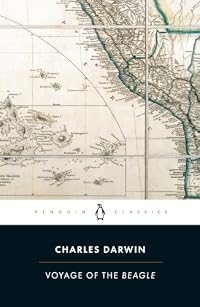
Voyage of the Beagle chronicles Charles Darwin's five years as a naturalist on board the H.M.S. Beagle. The notes and observations that he recorded in his diary included Chile, Argentina and Galapagos Islands and encompasses the ecology, geology and anthropology of the places he visits. A fascinating travel memoir the ideas that were later to evolve into Darwin's theory of natural selection find their naissance in Voyage of the Beagle..
Tags
Recommendations

























Member Recommendations
John_Vaughan The two stories interlink particulary around the facinating character of Captain Fitzroy.

amerynth Great account of living on Tierra del Fuego, with more extensive account of Jemmy Button, York Minster and Fuegia Basket.
Fitzroy: The Remarkable Story of Darwin's Captain and the Invention of the Weather Forecast by John Gribbin
John_Vaughan As an ideal companion read.

Member Reviews
Summary: When people mention Charles Darwin and the HMS Beagle, the only place most people think of (if they think of anything at all) is the Galápagos Islands. However, the Beagle circumnavigated the world in its five year voyage, and the young Charles Darwin saw it all. The Voyage of the Beagle is his account of the journey, edited together from his journal entries at the time. He describes the geology, the animals, the vegetation, and the people of the lands he visits, and speculates about the nature of some of his observations.
Review: I read this book in a very, very piecemeal fashion (over five years it took!) but I really enjoyed it. Darwin is so often depicted as a grumpy old man with the giant beard that I think people tend to show more forget that his trip on the Beagle was actually when he was quite young, basically a twenty-something who didn't want to go to med school and didn't really know what he wanted to do with his life (I try to emphasize this point to my students as often as I can, since many of them are probably twenty-somethings not sure what they want to do with their lives). So his journals are full of careful observation and beautifully rendered descriptions and thoughtful conclusions, but there's also a fair bit of hitting birds with his rock hammer and jumping on the back giant tortoises and hitting them with sticks until they move and knocking birds off of their perches with the muzzle of his gun. (And also occasionally bemoaning his seasickness.)
It was also totally fascinating reading this book in the light of knowing about Darwin's future work. It's hard not to spot the germs of his future ideas on evolution by natural selection in some of the passages. This book is just peppered with little bits about the length of time that physical features must have taken, and how similar but different animals in different locations are, and the relationship between changing geology and changing vegetation, and island biogeography. For example: "Seeing this gradation and diversity of structure in one small, intimately related group of birds, one might really fancy that from an original paucity of birds in this archipelago, one species had been taken and modified for different ends." There's half of an introductory lecture on the history of evolutionary thought right there. And who doesn't hear echoes (or future echoes, I guess. Pre-echoes?) of the last line of On the Origin of Species in the line "Where on the face of the earth can we find a spot on which close investigation will not discover signs of that endless cycle of change, to which this earth has been, is, and will be subjected?"
This book obviously tickled me as a biologist, but it was also easy to read, and well-written, if full of the Victorian standard run-on sentences, but also some wonderfully evocative passages. Some parts are a little dry - he expounds at great length on some seemingly small and obscure topics, like the formation of coral atolls - but as a whole, it's a really interesting blend of science and adventuring and nature writing, and really a just plain fascinating book to read. 4 out of 5 stars.
Recommendation: Biologists and those interested in the history of science are the main audience, obviously, but I think anyone who likes travel books, naval adventures, or the age of exploration should find some bits here to interest them as well. If you can find an illustrated edition, I think that would be extremely helpful; if not, keep Wikipedia and a map of the Beagle's journey handy. show less
Review: I read this book in a very, very piecemeal fashion (over five years it took!) but I really enjoyed it. Darwin is so often depicted as a grumpy old man with the giant beard that I think people tend to show more forget that his trip on the Beagle was actually when he was quite young, basically a twenty-something who didn't want to go to med school and didn't really know what he wanted to do with his life (I try to emphasize this point to my students as often as I can, since many of them are probably twenty-somethings not sure what they want to do with their lives). So his journals are full of careful observation and beautifully rendered descriptions and thoughtful conclusions, but there's also a fair bit of hitting birds with his rock hammer and jumping on the back giant tortoises and hitting them with sticks until they move and knocking birds off of their perches with the muzzle of his gun. (And also occasionally bemoaning his seasickness.)
It was also totally fascinating reading this book in the light of knowing about Darwin's future work. It's hard not to spot the germs of his future ideas on evolution by natural selection in some of the passages. This book is just peppered with little bits about the length of time that physical features must have taken, and how similar but different animals in different locations are, and the relationship between changing geology and changing vegetation, and island biogeography. For example: "Seeing this gradation and diversity of structure in one small, intimately related group of birds, one might really fancy that from an original paucity of birds in this archipelago, one species had been taken and modified for different ends." There's half of an introductory lecture on the history of evolutionary thought right there. And who doesn't hear echoes (or future echoes, I guess. Pre-echoes?) of the last line of On the Origin of Species in the line "Where on the face of the earth can we find a spot on which close investigation will not discover signs of that endless cycle of change, to which this earth has been, is, and will be subjected?"
This book obviously tickled me as a biologist, but it was also easy to read, and well-written, if full of the Victorian standard run-on sentences, but also some wonderfully evocative passages. Some parts are a little dry - he expounds at great length on some seemingly small and obscure topics, like the formation of coral atolls - but as a whole, it's a really interesting blend of science and adventuring and nature writing, and really a just plain fascinating book to read. 4 out of 5 stars.
Recommendation: Biologists and those interested in the history of science are the main audience, obviously, but I think anyone who likes travel books, naval adventures, or the age of exploration should find some bits here to interest them as well. If you can find an illustrated edition, I think that would be extremely helpful; if not, keep Wikipedia and a map of the Beagle's journey handy. show less
Probably a bit dry for many readers, but I enjoyed the journal and it is much more readable than the 'Origin of Species'. Darwin corrected his first edition and merged some chapters in this, the second edition. This narrative was easiest to assimilate in small doses whilst skimming through some of the long treatises. In the second edition, the subtitle was transposed (originally, 'the Geology and Natural History...'), perhaps by John Murray (publisher). The steel engraved illustrations are gorgeous. I've never chanced across the first edition.
This record from the 1830s describes the second HMS Beagle survey expedition. Captain Robert Fitzroy thought that a follow-up survey would benefit from having a naturalist onboard, and the recently graduated Darwin's keen enthusiam won him the role. While this voyage is perhaps best known for its stopover in the Galapagos, that was merely one location visited on a round-the-world-trip. Nearly half of Darwin's journal is devoted to Argentina where the captain's primary map-making mission was served. Much of the rest is spent on Chile, one chapter in the Galapagos, and the remainder of the voyage is summarized in four final chapters.
In my younger days I sailed the Great Lakes with my father, lodging fond memories of island stopovers and show more casual exploration. I took up this journal expecting something of a similar degree but Darwin's interest in flora and fauna far, far exeeds mine. It's very slow-paced through dwelling on the details, and an interest in biology would have helped me since the vast majority of his attention is on the life he encounters both large and small. He also has a lot to say about geological formations and the peoples encountered, which I found more engaging. Very quickly there were too many details for me to follow or remember, but several things stood out and the cumulative effect is impressive. Darwin's attentiveness and observational skills are beyond the pale, and were frankly almost beyond my toleration, but for another reader I can believe this is a gold mine of science and its history that is not to be missed. show less
In my younger days I sailed the Great Lakes with my father, lodging fond memories of island stopovers and show more casual exploration. I took up this journal expecting something of a similar degree but Darwin's interest in flora and fauna far, far exeeds mine. It's very slow-paced through dwelling on the details, and an interest in biology would have helped me since the vast majority of his attention is on the life he encounters both large and small. He also has a lot to say about geological formations and the peoples encountered, which I found more engaging. Very quickly there were too many details for me to follow or remember, but several things stood out and the cumulative effect is impressive. Darwin's attentiveness and observational skills are beyond the pale, and were frankly almost beyond my toleration, but for another reader I can believe this is a gold mine of science and its history that is not to be missed. show less
Very accessible and gripping diary. Darwin's kind and open character and seemingly infinite curiosity come across SO well. Some painful and relevant insights into early c19 attitudes to 'aboriginal' peoples and the destruction of societies and ecosystems.
The work of science is often shown as a form of vision, innate to the workings of science, and exploring the various ways in which that kind of vision manifests within the work of the scientist. Though vision is often invoked as a metaphor for the operation of science by scientists and non-scientists alike, it can be an odd one. John Berger opens his famous Ways of Seeing with the statement: “Seeing comes before words. The child looks and recognizes before it can speak” (7). The metaphor of sight suggests something instantaneous and intrinsic, but much of the writing on scientific sight stresses the need for training, for time, and for judgment.
Charles Darwin returns to the concept of scientific sight several times in The Voyage of show more the Beagle, most interestingly when contemplating how one looks at a lagoon island: “We feel surprise when travelers tell us of the vast dimensions of the Pyramids and other great ruins, but how utterly insignificant are the greatest of these, when compared to these mountains of stone accumulated by the agency of various minute and tender animals! This is a wonder which does not at first strike the eye of the body, but, after reflection, the eye of reason” (464). For Darwin, scientific sight is a direct contrast to visual sight—it requires reflection to see with it, as well as training. It does not come before words, but rather requires considerable knowledge in order to utilize.
There is not much of a resemblance between visual sight and scientific sight in this instance, except in one regard—its all-pervasiveness. Berger’s formulation that “Seeing comes before words” suggests that it is impossible to not see, that it suffuses every part of the human experience. In The Structure of Scientific Revolutions, Thomas Kuhn employs the metaphor of sight for similar reasons, using it to explain his concept of the scientific paradigm: an orientation towards the world so innate that one is almost literally unable to see it differently. Scientific sight, as used by Darwin and others, suggests that the worldview of the scientist is so ingrained that once acquired, it cannot be gotten rid of. show less
Charles Darwin returns to the concept of scientific sight several times in The Voyage of show more the Beagle, most interestingly when contemplating how one looks at a lagoon island: “We feel surprise when travelers tell us of the vast dimensions of the Pyramids and other great ruins, but how utterly insignificant are the greatest of these, when compared to these mountains of stone accumulated by the agency of various minute and tender animals! This is a wonder which does not at first strike the eye of the body, but, after reflection, the eye of reason” (464). For Darwin, scientific sight is a direct contrast to visual sight—it requires reflection to see with it, as well as training. It does not come before words, but rather requires considerable knowledge in order to utilize.
There is not much of a resemblance between visual sight and scientific sight in this instance, except in one regard—its all-pervasiveness. Berger’s formulation that “Seeing comes before words” suggests that it is impossible to not see, that it suffuses every part of the human experience. In The Structure of Scientific Revolutions, Thomas Kuhn employs the metaphor of sight for similar reasons, using it to explain his concept of the scientific paradigm: an orientation towards the world so innate that one is almost literally unable to see it differently. Scientific sight, as used by Darwin and others, suggests that the worldview of the scientist is so ingrained that once acquired, it cannot be gotten rid of. show less
Charles Darwin wrote this diary/journal while on board the HMS Beagle as the naturalist of the ship. It's an interesting account of his journey around the world. Most of his descriptions of the inhabitants aren't very flattering, except when it came to Tahiti. Everywhere else in these places people inhabited hovels and had bad manners and all sorts of really terrible things to say. He knows a lot about plants and animals, and recites the genus and family names of pretty much everything he finds.
I can accept his superiority complex since he comes from a time where that sort of thing was acceptable, but I can't accept his overuse of commas. I don't know why, but he puts commas almost everywhere, and I can't find any rhyme or reason for show more this. It is terribly annoying to read it like that, though I suppose I can just say "unnecessary comma" in a Strongbad Voice whenever it comes up...
In any case, this journal is a fascinating study of nature and man. You can tell that at the end of the book he just wants to go home, though this was a pivotal point in Darwin's life. show less
I can accept his superiority complex since he comes from a time where that sort of thing was acceptable, but I can't accept his overuse of commas. I don't know why, but he puts commas almost everywhere, and I can't find any rhyme or reason for show more this. It is terribly annoying to read it like that, though I suppose I can just say "unnecessary comma" in a Strongbad Voice whenever it comes up...
In any case, this journal is a fascinating study of nature and man. You can tell that at the end of the book he just wants to go home, though this was a pivotal point in Darwin's life. show less
This book has long been considered a classic in the history of science. Darwin says in his preface that here he somewhat condensed and corrected some parts and added to others to "render the volume more fitted for popular reading" and has dedicated this volume to Charles Lyell, the author of Principles of Geology.
The Beagle set sail from Davenport on Dec. 27, 1831 and Darwin disembarked at Falmouth on Oct, 2, 1836 after a voyage of nearly five years. While much of the time was taken up in sailing from one place to another, in nearly every port of call he left the Beagle to stay ashore while the ship did its coastal surveying and mapping (the principal purpose of this expedition). There he observed the flora and fauna as well as the show more geological formations both near the shore, and, when time permitted, the interior, collecting numerous specimens and discovering many new species and varieties of plants and animals. On occasion he traveled overland and met the ship at another settlement farther along the coast. The journal also contains many observations of the inhabitants at each locale with Darwin being most impressed by the generous hospitality with which he was met almost everywhere.
I generally enjoyed the book although it was heavy going in places because of the extensive use of biological terms which I am largely unfamiliar with. The sections on geology were a bit easier and the descriptions of the people he met were very interesting. However, one must remember that Darwin was a product of English society of the early 1800's and shared many of the attitudes of that society. Those interested in the history of science, particularly the biological sciences, should find it of interest. show less
The Beagle set sail from Davenport on Dec. 27, 1831 and Darwin disembarked at Falmouth on Oct, 2, 1836 after a voyage of nearly five years. While much of the time was taken up in sailing from one place to another, in nearly every port of call he left the Beagle to stay ashore while the ship did its coastal surveying and mapping (the principal purpose of this expedition). There he observed the flora and fauna as well as the show more geological formations both near the shore, and, when time permitted, the interior, collecting numerous specimens and discovering many new species and varieties of plants and animals. On occasion he traveled overland and met the ship at another settlement farther along the coast. The journal also contains many observations of the inhabitants at each locale with Darwin being most impressed by the generous hospitality with which he was met almost everywhere.
I generally enjoyed the book although it was heavy going in places because of the extensive use of biological terms which I am largely unfamiliar with. The sections on geology were a bit easier and the descriptions of the people he met were very interesting. However, one must remember that Darwin was a product of English society of the early 1800's and shared many of the attitudes of that society. Those interested in the history of science, particularly the biological sciences, should find it of interest. show less
Members
- Recently Added By
Lists

Recommended Nature Writing
346 works; 180 members

501 Must-Read Books
508 works; 71 members

Global Reads: Books Set South and Central America
40 works; 7 members

25 Greatest Science Books of All Time
33 works; 6 members

Best Travel Writing - Non-Fiction
110 works; 6 members

Books Read in 2016
4,666 works; 197 members

Mustich's 1000 Books to Read Before You Die: A Life Changing List
1,001 works; 18 members

Books Read in 2022
5,164 works; 113 members

A Reading List
100 works; 3 members

1964 College Preparatory Reading List
202 works; 8 members

Best 19th and 20th Century Travel
22 works; 4 members

Animals in the Title
498 works; 11 members
Folio Society
831 works; 53 members
Trinity College Booklist (1951): Class One, Natural Science
98 works; 2 members

Blue Pyramid 1,276 Best Books of All Time
1,248 works; 32 members

I Can't Finish This Book
189 works; 22 members

Books I Own But Haven't Read
144 works; 2 members

New Lifetime Reading Plan by Fadiman and Major
225 works; 5 members
Talk Discussions
Past Discussions
Best editions of the Voyage? in Evolve! (October 2012)
Author Information

342+ Works 32,491 Members
Charles Robert Darwin, born in 1809, was an English naturalist who founded the theory of Darwinism, the belief in evolution as determined by natural selection. Although Darwin studied medicine at Edinburgh University, and then studied at Cambridge University to become a minister, he had been interested in natural history all his life. His show more grandfather, Erasmus Darwin, was a noted English poet, physician, and botanist who was interested in evolutionary development. Darwin's works have had an incalculable effect on all aspects of the modern thought. Darwin's most famous and influential work, On the Origin of Species, provoked immediate controversy. Darwin's other books include Zoology of the Voyage of the Beagle, The Variation of Animals and Plants Under Domestication, The Descent of Man, and Selection in Relation to Sex. Charles Darwin died in 1882. (Bowker Author Biography) show less
Charles Darwin has a Legacy Library. Legacy libraries are the personal libraries of famous readers, entered by LibraryThing members from the Legacy Libraries group.
Some Editions
Awards and Honors
Awards
Notable Lists
Series
Belongs to Publisher Series
Work Relationships
Is contained in
The Darwin Compendium: Voyage of the Beagle, The Origin of Species / Descent of Man and Selection in Relation to Sex / Expression of the Emotions in Humans and Animals / Autobiography by Charles Darwin
Contains
Is abridged in
Inspired
Common Knowledge
- Canonical title*
- De reis van de Beagle
- Original title
- Journal and Remarks, 1832-1836
- Alternate titles
- Journal of researches into the geology and natural history of the various countries visited by H.M.S. Beagle; A naturalist's voyage; The Voyage of the Beagle
- Original publication date
- 1839; 1845 (2nd ed.) (2nd ed.); 1860 (3rd ed.) (3rd ed.)
- People/Characters
- Charles Darwin; Robert Fitzroy
- Important places
- Galápagos Islands, Ecuador; Argentina; Australia; Bahía Blanca, Argentina; Buenos Aires, Argentina; Cape Verde (show all 22); Ecuador; Falkland Islands; Latin America; Lima, Peru; Maldonado, Uruguay; Montevideo, Uruguay; New South Wales, Australia; New Zealand; Patagonia, South America; Peru; Rio de Janeiro, Rio de Janeiro, Brazil; South America; Sydney, New South Wales, Australia; Tahiti; Tierra del Fuego; Uruguay
- Important events
- Voyage of the HMS Beagle
- First words
- [1st edn., 1839:]
Jan. 16th, 1832.—The neighbourhood of Porto Praya, viewed from the sea, wears a desolate aspect. The volcanic fire of past ages, and the scorching heat of a tropical sun, have in most places rendered th... (show all)e soil sterile and unfit for vegetation.
[2nd end., 1845:]
After having been twice driven back by heavy southwestern gales, Her Majesty's ship Beagle, a ten-gun brig, under the command of Captain Fitz Roy, R. N., sailed from Devonport on the 27th of December, 1831. - Last words
- (Click to show. Warning: May contain spoilers.)Travelling ought also to teach him distrust; but at the same time he will discover, how many truly kind-hearted people there are, with whom he never before had, or ever again will have any further communication, who yet are ready to offer him the most disinterested assistance.
- Original language
- English
- Disambiguation notice
- Although The Voyage of the Beagle is the most common title in English, there are others; the work was published by Darwin in 1839 as Journal and Remarks, and is also known as Darwin's Journal of Researches... (show all)>.
Please do not combine with the abridged edition from Penguin Classics.
*Some information comes from Common Knowledge in other languages. Click "Edit" for more information.
Classifications
Statistics
- Members
- 3,467
- Popularity
- 4,768
- Reviews
- 30
- Rating
- (4.08)
- Languages
- 16 — Catalan, Chinese, Dutch, English, Finnish, French, German, Greek, Hungarian, Italian, Polish, Portuguese, Russian, Spanish, Swedish, Turkish
- Media
- Paper, Audiobook, Ebook
- ISBNs
- 231
- UPCs
- 1
- ASINs
- 168