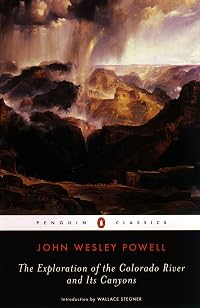
The Exploration of the Colorado River and Its Canyons
by John Wesley Powell
On This Page
Description
Full text of Powell's 1,000-mile expedition down the fabled Colorado in 1869. Superb account of terrain, geology, vegetation, Indians, famine, mutiny, treacherous rapids, mighty canyons, during exploration of last unknown part of continental U.S. 240 illustrations.Tags
Recommendations














Member Reviews
Classic read about the first major expedition of the Colorado river area. Great descriptions of the landscape and the adventures of the crew. Also interesting to read about the interaction of Powell and his team with local Indian tribes and description of their different cultures
Though plain spoken in describing the portages in such canyons the immensity of the landscape and the task undertaken by Powell and his men permeated the read. Truly an awesome undertaken. And his descriptions of side canyons and Indians that inhabited these areas in the early 1870s were very interesting and unsentimental. A very enlightening though sometimes tedious read.
Quite an interesting book, seeing that its more of a collection of writings that were originally written for a magazine. The first 100 pages focused on geography and seems more like nature writing. This part was a little slow and seemed that it was designed to inform casual readers on the east coast, who may not be as familiar with the western territories. It was 1870 after all.
The second and more quickly paced section of the book is the diary of J.W. Powell, but there are some points where it can be somewhat confusing because one of the other party members is also named Powell. The diary covers the first trip down the Green River and then the Colorado River through Glen Canyon and Grand Canyon. The third section of the book is really show more more of an ethnography than exploration and seems to be written in 1890, a good deal after the actual journey. In hindsight, Powell's outlook on the natives he encounters would seem archaic compared to modern anthropology, but given the time and circumstances, it was quite surprising to read his relatively modern views on the matter.
Overall, a nice edition to any exploration literature collection. It covers a lot of subjects and might not be for everyone, especially if your looking to read a book about a rafting trip and not a book about native story telling. show less
The second and more quickly paced section of the book is the diary of J.W. Powell, but there are some points where it can be somewhat confusing because one of the other party members is also named Powell. The diary covers the first trip down the Green River and then the Colorado River through Glen Canyon and Grand Canyon. The third section of the book is really show more more of an ethnography than exploration and seems to be written in 1890, a good deal after the actual journey. In hindsight, Powell's outlook on the natives he encounters would seem archaic compared to modern anthropology, but given the time and circumstances, it was quite surprising to read his relatively modern views on the matter.
Overall, a nice edition to any exploration literature collection. It covers a lot of subjects and might not be for everyone, especially if your looking to read a book about a rafting trip and not a book about native story telling. show less
John Wesley Powell's account of the first descent of the Colorado River and Grand Canyon by boat is generally considered canonical American exploration literature. To give some sense of its perceived importance, National Geographic in its list of 100 all time best adventure books ranks the Lewis and Clark journals as number 2, and Powell's book at number 4. The Grand Canyon itself ranks as one of the worlds greatest natural features, on par with the poles, Mount Everest and the Amazon - Powell's account likewise is lifted by the sheer magnificence of its discovery, the books literary qualities and story of sheer survival enhance it further.
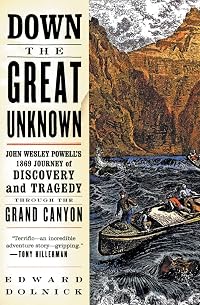
The 1869 trip was largely funded with private money, and was supposed to have been a scientific show more journey of exploration. Because Powell lost in the rapids most of the science equipment, maps and records, he ended up writing most of the book years later in the first person for a wider non-scientific audience, based from his personal journal, memory and with some embellishments. Powell could be literary in his descriptions: "We think of the mountains as forming clouds about their brows, but the clouds have formed the mountains." Unfortunately the book is inconsistent and large sections contain geographic descriptions that can easily be skipped over since they were meant to be scientific, but are really more amateur science. Many of his analogies today seem dated, such as mountains with "gables" and "panels", imagery more meaningful to Victorian architecture, but this creates period atmosphere. As is usual in older exploration books, it needs a modern re-telling to fully understand and absorb the events from multiple perspectives, but reading the original account is the most authentic experience we have, short of running the river in person, which many still do with a copy of Powell's book on hand. I look forward to watching the 1999 PBS documentary done in a "Ken Burns" style with original photos, as well as the most recent and longest reconstruction Edward Dolnick's Down the Great Unknown (2001).
--Review by Stephen Balbach, via CoolReading (c) 2008 cc-by-nd show less
The 1869 trip was largely funded with private money, and was supposed to have been a scientific show more journey of exploration. Because Powell lost in the rapids most of the science equipment, maps and records, he ended up writing most of the book years later in the first person for a wider non-scientific audience, based from his personal journal, memory and with some embellishments. Powell could be literary in his descriptions: "We think of the mountains as forming clouds about their brows, but the clouds have formed the mountains." Unfortunately the book is inconsistent and large sections contain geographic descriptions that can easily be skipped over since they were meant to be scientific, but are really more amateur science. Many of his analogies today seem dated, such as mountains with "gables" and "panels", imagery more meaningful to Victorian architecture, but this creates period atmosphere. As is usual in older exploration books, it needs a modern re-telling to fully understand and absorb the events from multiple perspectives, but reading the original account is the most authentic experience we have, short of running the river in person, which many still do with a copy of Powell's book on hand. I look forward to watching the 1999 PBS documentary done in a "Ken Burns" style with original photos, as well as the most recent and longest reconstruction Edward Dolnick's Down the Great Unknown (2001).
--Review by Stephen Balbach, via CoolReading (c) 2008 cc-by-nd show less
This write-up by Powell of his trip down the rivers of the southwest is very good. The book is written in first person like a log of the juorney, complete with dates at the start of new paragraphs for each day.
Powel writes very clearly and the excitement of exploration of a new unknown area comes through. Also coming through in his writing style are the apprehension of the dangers in following an uncharted river into areas they would not be able to escape from the water became impassible. Powell was awed by the majesty of the landscape and he does well in passing this on to the reader . There are many black and white photos and drawings throughout the book, almost every other page. The drawings seem very accurate to me, having been in show more the region. Tip-offs to the accuracy is the portrayal of iron stainings coming down some smoth sandstone surfaces in a way I have often seen them.
This book gives the reader a feel for both the majesty of the landscape through which the Colorado and green Rivers pass and also the excitement of exploring an unknown area with its associated unknown dangers.
Powell describes many active Indian villiages and abandoned zIndian dwellings, camps and towns, replete with abuntant arrowheads and petroglyphs. The photos actually go further at illustrating the Indian architecture and culture than the text does. What I like about the inclusion of the Indian culture is that at the time Powell witnessed the Indians living and working in their native environment, not having to describe just abandoned ruinsand infer from that.
This book gives a good feel for what exploration of the west was like back when there was no form of communication with the known world until the expedition reached its end. It gives a good framework of what the untamed river and its canyons were like before dams and widespread agriculture affected streamflow and turbidity. it gives an accurate picture of the Indian's daily lifestyle and cautious attitude towards non-Indians.
In summary, Powells book is a very good window into how the expedition went, how early expeditions went in general back then, the majesty of the southwest, particularly around the canyons, and the daily lives of the Indian before they became familiar with white-man culture. show less
Powel writes very clearly and the excitement of exploration of a new unknown area comes through. Also coming through in his writing style are the apprehension of the dangers in following an uncharted river into areas they would not be able to escape from the water became impassible. Powell was awed by the majesty of the landscape and he does well in passing this on to the reader . There are many black and white photos and drawings throughout the book, almost every other page. The drawings seem very accurate to me, having been in show more the region. Tip-offs to the accuracy is the portrayal of iron stainings coming down some smoth sandstone surfaces in a way I have often seen them.
This book gives the reader a feel for both the majesty of the landscape through which the Colorado and green Rivers pass and also the excitement of exploring an unknown area with its associated unknown dangers.
Powell describes many active Indian villiages and abandoned zIndian dwellings, camps and towns, replete with abuntant arrowheads and petroglyphs. The photos actually go further at illustrating the Indian architecture and culture than the text does. What I like about the inclusion of the Indian culture is that at the time Powell witnessed the Indians living and working in their native environment, not having to describe just abandoned ruinsand infer from that.
This book gives a good feel for what exploration of the west was like back when there was no form of communication with the known world until the expedition reached its end. It gives a good framework of what the untamed river and its canyons were like before dams and widespread agriculture affected streamflow and turbidity. it gives an accurate picture of the Indian's daily lifestyle and cautious attitude towards non-Indians.
In summary, Powells book is a very good window into how the expedition went, how early expeditions went in general back then, the majesty of the southwest, particularly around the canyons, and the daily lives of the Indian before they became familiar with white-man culture. show less
This is like an adventure novel and a travel journal, boring at times, interesting and readable others.
Ratings
Members
- Recently Added By
Author Information

127+ Works 1,759 Members
Powell was born in western New York. His family later moved to Ohio and then to Wisconsin, where he began his adult life as a teacher. For about nine years, he taught and took time to study at colleges in Ohio and Illinois. When the Civil War began, he enlisted and quickly rose to the rank of major, laying out roads and designing bridges. Powell show more was wounded at the Battle of Shiloh and lost his right arm. Because of these events, for the remainder of his life he was referred to as Major Powell or One-arm Powell. After the war, he organized several expeditions down the Colorado River, which heretofore had not come under scientific study. It was during these trips and others that he formulated the concept of base level and antecedent streams. Although his ideas and observations are noteworthy, Powell was not a prolific writer, and his writings were not scholarly in style. Powell became the president of the U.S. Geological Survey, a position from which he lobbied congressmen and senators for funding for topographic mapping and technical reports. He was a strong proponent of developing the American West on a sound and realistic foundation. Powell died in Maine during the summer of 1902. (Bowker Author Biography) show less
Some Editions
Awards and Honors
Series
Belongs to Publisher Series
Work Relationships
Is abridged in
Common Knowledge
- Canonical title
- The Exploration of the Colorado River and Its Canyons
- Original publication date
- 1875
- People/Characters
- J.W. Powell; J.C. Sumner; William H. Dunn; W. H. Powell; G.Y. Bradley; O.G. Howland (show all 10); Seneca Howland; Frank Goodman; W.R. "Billy" Hawkins; Andrew Hall
- Important places
- Grand Canyon National Park, Arizona, USA; Arizona, USA; Colorado River, USA
- Related movies
- Ten Who Dared (1960 | IMDb)
- First words
- On my return from the first exploration of the canyons of the Colorado, I found that our journey had been the theme of much newspaper writing. A story of disaster had been circulated, with many particulars of hardship and tra... (show all)gedy, so that it was currently believed throughout the United States that all the members of the party were lost save one.
- Original language
- English
Classifications
- Genres
- Nonfiction, Science & Nature, Travel, General Nonfiction, Biography & Memoir
- DDC/MDS
- 979.13 — History & geography History of North America Great Basin and Pacific Slope region of United States Arizona Northern Arizona
- LCC
- F788 .P886 — Local History of the United States, Canada and Latin America United States local history New Southwest. Colorado River, Canyon, and Valley
- BISAC
Statistics
- Members
- 798
- Popularity
- 34,901
- Reviews
- 6
- Rating
- (3.97)
- Languages
- English
- Media
- Paper, Audiobook, Ebook
- ISBNs
- 21
- UPCs
- 2
- ASINs
- 18