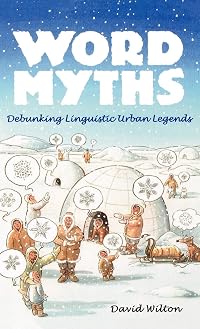
Word Myths: Debunking Linguistic Urban Legends
by David Wilton 
On This Page
Description
"Word Myths takes on linguistic urban legends, not just debunking them, but also examining why they are told and what they tell us about ourselves. The book examines the patterns and comes to conclusions about such things as why we attach morbid tales to children's rhymes, why newspapers keep promulgating false origins for terms like the Windy City, or why so many words have false nautical origins."--Jacket.Tags
Recommendations
















Member Reviews
David Wilton takes on the sacred cows of word or phrase origins (such as "Ring Around the Rosie" and "The Windy City") and provides their actual provenance and/or etymology. Naturally, there are some words and phrases that can't be traced to their origins: for these, Wilton shows us how the myth cannot be true. His breezy, light touch is just the right style for this sort of work. He's humorous without being petty, and informative without being pedantic. A fun read.
This book discusses urban myths about English word etymologies. While entertaining, I found , even for the urban legends I would have never believed, the legend so much more interesting than the actual etymology that I was worried I wouldn't remember the actual origin of the word. I guess that's what makes them spread so well even though untrue.
This book aims to examine urban myths surrounding word origins, phrases, and commonly held misperceptions about words. Included: how many words for snow to Eskimos really have, "OK," and whether or not picnics are racist. Wilton does an excellent job of presenting the stories and why the stories started, and then ripping the stories to shreds. He also includes his research methods, which is a nice addition. Unlike most books like this, the words and phrases are organized based on a theme, not in alphabetical order.
Entertaining read for armchair linguists.
Entertaining read for armchair linguists.
Urban legends for the entymologist. In some ways its kind of depressing to learn that those cute little stories you always heard were false but you get to learn new ones.
I kept this book for a while, hoping to be able to read it before sending it on.
I did not have the time for it yet and I will not be able to read it anytime soon. So, to fulfill the last part of my 1001-RABCK for Vasha, this book is going on to the next reader.
I did not have the time for it yet and I will not be able to read it anytime soon. So, to fulfill the last part of my 1001-RABCK for Vasha, this book is going on to the next reader.
Ratings
Members
- Recently Added By
Author Information

5 Works 385 Members
David Wilton is the creator and editor of Wordorigins.org, since 1997 a leading Internet site for word and phrase origins. In May 1999 Yahoo Internet Life awarded the site 4 stars, calling it one of the best reference sites on the web. An amateur logophile, Mr. Wilton earned his undergraduate degree in Government and Law from Lafayette College and show more his master's degree in National Security Policy Studies from George Washington University. Over the years, Mr. Wilton has had an eclectic career, serving as a journalist, Army officer, defense contractor, chemical and biological arms control negotiator, and software marketing executive show less
David Wilton is a LibraryThing Author, an author who lists their personal library on LibraryThing.
Some Editions
Common Knowledge
- Canonical title
- Word Myths: Debunking Linguistic Urban Legends
- Alternate titles
- WORD MYTHS
- Original publication date
- 2004-10
- Blurbers
- Lighter, J. E.
Classifications
Statistics
- Members
- 387
- Popularity
- 80,794
- Reviews
- 5
- Rating
- (3.60)
- Languages
- English
- Media
- Paper, Ebook
- ISBNs
- 6
- UPCs
- 1
- ASINs
- 1