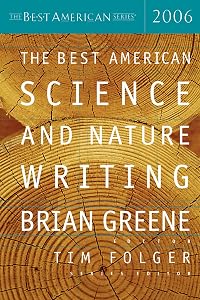
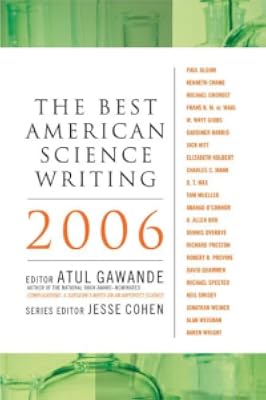
The Best American Science and Nature Writing 2006
by Brian Greene (Editor), Tim Folger (Series Editor)
The Best American Science and Nature Writing (2006), Best American (2006)
On This Page
Description
In his introduction to The Best American Science and Nature Writing 2006, Brian Greene writes that "science needs to be recognized for what it is: the ultimate in adventure stories." The twenty-five pieces in this year's collection take you on just such an adventure. Natalie Angier probes the origins of language, Paul Raffaele describes a remote Amazonian tribe untouched by the modern world, and Frans B. M. de Waal explains what a new breed of economists is learning from monkeys. Drake show more Bennett profiles the creator of Ecstasy and more than two hundred other psychedelic compounds -- a man hailed by some as one of the twentieth century's most important scientists. Some of the selections reflect the news of the past year. Daniel C. Dennett questions the debate over intelligent design -- is evolution just a theory? --while Chris Mooney reports on how this debate almost tore one small town apart. John Hockenberry examines how blogs are transforming the twenty-first-century battlefield, Larry Cahill probes the new science uncovering male and female brain differences, Daniel Roth explains why the programmer who made it easy to pirate movies over the Internet is now being courted by Hollywood, and Charles C. Mann looks at the dark side of increased human life expectancy. Reaching out beyond our own planet, Juan Maldacena questions whether we actually live in a three-dimensional world and whether gravity truly exists. Dennis Overbye surveys the continuing scientific mystery of time travel, and Robert Kunzig describes new x-ray images of the heavens, including black holes, exploding stars, colliding galaxies, and other wonders the eye can't see. show lessTags
Recommendations



Member Reviews
This is one of the best editions of this line since 2003. This has pieces on how strongly our brains react to swearing, on the man who has invented dozens of psychedelic drugs, on the development of X-ray telescopes, on how little we understand the delicate balances of bacteria in our bodies, on BitTorrent, and on the discovery of "ghost forests" and the geological faults that will probably destroy Seattle. There are difficult pieces on "The Illusion of Gravity" (are three dimensions just a hologram?) and "The Mysteries of Mass."
This opening line -- "Anna Nicole Smith's role as a harbinger of the future is not widely acknowledged" -- begins a fascinating exploration of the social and economic impact of the extension of human life spans; show more the first person to live to 150 probably has already been born.
I was particularly intrigued by Chorost's story of the scientific advances that are gradually letting this deaf man hear music again, and the profile of Arthur Aufderheide, paleopathologist, who autopsies mummies. show less
This opening line -- "Anna Nicole Smith's role as a harbinger of the future is not widely acknowledged" -- begins a fascinating exploration of the social and economic impact of the extension of human life spans; show more the first person to live to 150 probably has already been born.
I was particularly intrigued by Chorost's story of the scientific advances that are gradually letting this deaf man hear music again, and the profile of Arthur Aufderheide, paleopathologist, who autopsies mummies. show less
As usual with this series, I learned a lot in the 2006 edition.
In "Dr. Ecstasy" I learned about Alexander Shulgin who, in a Frankensteinian laboratory in his home in CA, has single-handily invented over 200 psychedelic compounds, including ecstasy. In "My Bionic Quest for Bolero" a deaf man describes his quest to restore his hearing with cutting edge "bionic" ear implants (this article became a book: Rebuilt: My Journey Back to the Hearing World). In "Show Me the Science", the ever fascinating Daniel C. Dennett shakes his head at the anti-science movements and their techniques, notably the "intelligent design" crowd, but just as easily applicable to global warming deniers, Holocaust deniers and anyone with a political agenda that is at show more odds with science. In "Buried Answers" I learned about the business of autopsy and how important they are and how rarely they are performed these days.
"Conservation Refugees" is probably the most important article of the book. Mark Dowie introduces the concept and term "conservation refugee" and it since become more commonly used with this article a sort of genesis. Conservation refugees are (usually) native people who have been oppressed or expelled from their traditional lands after those lands have been put into conservation, usually by one of the big NGO's such as the World Wildlife Fund or Conservation International. The result is the growing recognition that "wild" lands can not be left barren of people, that humans play an integral part of nature.
"The Mummy Doctor" is a great human interest story of the worlds leading expert on the dissection of mummies. The graphic descriptions of organs like cardboard and smells are priceless. In "Out of Time" I went on a journey into the Amazon and lived with a small band of dangerous head-hunters with little contact with the outside world. In "Buried Suns" I learned about the underground nuclear testing in Nevada.
These are my favorites, there are more, most of which can be read online at The Online Index to The Best American Science and Nature Writing Series.
--Review by Stephen Balbach, via CoolReading (c) 2008 cc-by-nd show less
In "Dr. Ecstasy" I learned about Alexander Shulgin who, in a Frankensteinian laboratory in his home in CA, has single-handily invented over 200 psychedelic compounds, including ecstasy. In "My Bionic Quest for Bolero" a deaf man describes his quest to restore his hearing with cutting edge "bionic" ear implants (this article became a book: Rebuilt: My Journey Back to the Hearing World). In "Show Me the Science", the ever fascinating Daniel C. Dennett shakes his head at the anti-science movements and their techniques, notably the "intelligent design" crowd, but just as easily applicable to global warming deniers, Holocaust deniers and anyone with a political agenda that is at show more odds with science. In "Buried Answers" I learned about the business of autopsy and how important they are and how rarely they are performed these days.
"Conservation Refugees" is probably the most important article of the book. Mark Dowie introduces the concept and term "conservation refugee" and it since become more commonly used with this article a sort of genesis. Conservation refugees are (usually) native people who have been oppressed or expelled from their traditional lands after those lands have been put into conservation, usually by one of the big NGO's such as the World Wildlife Fund or Conservation International. The result is the growing recognition that "wild" lands can not be left barren of people, that humans play an integral part of nature.
"The Mummy Doctor" is a great human interest story of the worlds leading expert on the dissection of mummies. The graphic descriptions of organs like cardboard and smells are priceless. In "Out of Time" I went on a journey into the Amazon and lived with a small band of dangerous head-hunters with little contact with the outside world. In "Buried Suns" I learned about the underground nuclear testing in Nevada.
These are my favorites, there are more, most of which can be read online at The Online Index to The Best American Science and Nature Writing Series.
--Review by Stephen Balbach, via CoolReading (c) 2008 cc-by-nd show less
Ratings
Members
- Recently Added By
Author Information

Brian Greene was born on February 9, 1963 in New York City. After attending Stuyvesant High School, where he was a classmate of fellow physicist Lisa Randall. Brian Greene entered Harvard in 1980 to major in physics. He graduated with a bachelor's degree, and went on to earn his doctorate from Oxford University as a Rhodes Scholar, graduating in show more 1987. Greene joined the physics faculty of Cornell University in 1990, and was appointed to a full professorship in 1995. The following year, he joined the staff of Columbia University as a full professor; this remains his current position. At Columbia, Greene is co-director of the University's Institute for Strings, Cosmology, and Astroparticle Physics (ISCAP), and is leading a research program applying superstring theory to cosmological questions. He has become known to a wider audience through his books for the general public, The Elegant Universe, Icarus at the Edge of Time, The Fabric of the Cosmos, The Hidden Reality, and a related PBS television special. (Bowker Author Biography) show less

Series


Common Knowledge
- Canonical title
- The Best American Science and Nature Writing 2006
- Original publication date
- 2006-10
Classifications
- Genres
- Science & Nature, Nonfiction
- DDC/MDS
- 808.80356 — Literature & rhetoric Literature, rhetoric & criticism Rhetoric and collections of literary texts from more than two literatures Literature Collections > By Theme Humanity General anthologies about science and medicine
- LCC
- Q1 .B47 — Science Science (General) General
- BISAC
Statistics
- Members
- 271
- Popularity
- 119,258
- Reviews
- 2
- Rating
- (3.93)
- Languages
- English
- Media
- Paper
- ISBNs
- 2
- UPCs
- 2
- ASINs
- 1