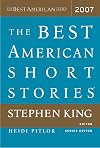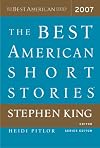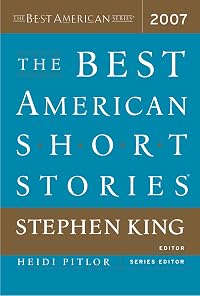
The Best American Short Stories 2007
by Stephen King (Editor), Heidi Pitlor (Series Editor)
The Best American Short Stories (2007), Best American (2007)
On This Page
Description
Presents a collection of stories selected from magazines in the United States and Canada.Tags
Recommendations








Member Reviews
I absolutely loved this collection of stories. Except for Karen Russell's story St. Lucy's Home For Girls Raised by Wolves (which I had to apply a Mini Pearl Rule too and jump ship at page 3 - just terrible - but I don't really "get" her stories, or the alien-esque people that inhabit them, despite some interesting writing/talent - but others love her, and the media/writing community clearly does - so don't mind me), these stories were all outstanding. Each one made me either think, laugh, wonder or just have moment of pause about life, in some capacity or another. Some are a little dark, some are quite funny, some are a mixture of those things. Also, having never before read a "best of" type short story collection, I truly enjoyed the show more process, how [Stephen King] picked the stories (with co-editor Heider Pitlor), the life and struggle of "the short story," where they first were published and mostly, the bios of the authors (all of whom describe their impetus for the story selected). So I learned about some new writers I never, ever would have known about otherwise. Some of the standouts, even among such a wonderful collection, I thought, were: "My Brother Eli" by Jospeh Epstein, "Balto" by T.C. Boyle, "Wake" by Beverly Jensen and "Findings & Impressions" by Kim Stellar. Highly recommended for any short fiction lover, or anyone wanting to explore new literary territory. show less
I have to admit I was more than a little surprised to see Stephen King as the guest editor of this edition of the august Best American Short Stories series. Both the short story form and the high artistic ambitions of the stories typically included seem to be at odds with the sort of mega-popularity of Stephen King's genre-bound novels. I'm happy to report that I was pleasantly surprised by the very high quality of the stories chosen. This I think is one of the best editions of the series to appear in recent years.
All of the stories in this collection were commendable in some way, and most of them were very dark in tone -- reflecting Mr. King's tastes no doubt. Every reader will have their own personal favorites. Here are the ones that show more stand out for me as particularly excellent:
"Toga Party," John Barth -- this story just perfectly captures the feeling of declining empire in contemporary American culture.
"Balto", T.C. Boyle -- one of the most unique and engaging treatments of the problem of courage and personal integrity I've read.
"Riding the Doghouse", Randy DeVita -- one of the creepiest stories I've ever read.
"Wait", Roy Kesey -- terrific evocation of the surreal nature of the modern world
"Findings & Impressions," Stellar Kim -- absolutely wrenching exploration of grief and the fear of illness, but so beautifully and sensitively done that you cannot turn away.
"Dimension," Alice Munro -- another great story from Munro -- this one almost impossible healing and redemption from the worst kind of violence and violation. astonishing.
"The Bris," Eileen Pollack -- absorbing and entertaining exploration of honesty, deceit and filial obligation. Closest thing to light in this collection.
"Do Something," Kate Walbert -- this story deals with the sense of helplessness and futility in contemporary culture and politics. As with Barth's "Toga Party," a surprising willingness by King to choose stories w/ overt if complex and subtle political themes. show less
All of the stories in this collection were commendable in some way, and most of them were very dark in tone -- reflecting Mr. King's tastes no doubt. Every reader will have their own personal favorites. Here are the ones that show more stand out for me as particularly excellent:
"Toga Party," John Barth -- this story just perfectly captures the feeling of declining empire in contemporary American culture.
"Balto", T.C. Boyle -- one of the most unique and engaging treatments of the problem of courage and personal integrity I've read.
"Riding the Doghouse", Randy DeVita -- one of the creepiest stories I've ever read.
"Wait", Roy Kesey -- terrific evocation of the surreal nature of the modern world
"Findings & Impressions," Stellar Kim -- absolutely wrenching exploration of grief and the fear of illness, but so beautifully and sensitively done that you cannot turn away.
"Dimension," Alice Munro -- another great story from Munro -- this one almost impossible healing and redemption from the worst kind of violence and violation. astonishing.
"The Bris," Eileen Pollack -- absorbing and entertaining exploration of honesty, deceit and filial obligation. Closest thing to light in this collection.
"Do Something," Kate Walbert -- this story deals with the sense of helplessness and futility in contemporary culture and politics. As with Barth's "Toga Party," a surprising willingness by King to choose stories w/ overt if complex and subtle political themes. show less
Stephen King is not the kind of guy who will do anything half-assed, and his selections for this year's BASS collection are no exceptions. Unlike most editors, he didn't just go through the pile the series editor forwarded him--he bought and read nearly every short-story periodical that exists, and read far and wide from them. As a result, the anthology he put together includes an impressive variety of stories, from the French revolution to futuristic military plague-carriers to a road trip through a snowstorm toward a funeral. What the stories have in common, though, is the heart--each story has a voice and a point, an emotional impact that's been lacking in much of my other recent reading.
Each story is also marked by King's aversion show more to brevity, but there were only one or two I felt were running long. This is an improvement over some recent years' BASS collections. show less
Each story is also marked by King's aversion show more to brevity, but there were only one or two I felt were running long. This is an improvement over some recent years' BASS collections. show less
I read this large collection of stories over several months and as a result some of the stories have faded from memory. At the start I was under-impressed with the collection and found elements of the stories tedious and not conducive to an easy reading, some were so dense. I encourage fellow readers to skim those that don't interest. I mention this so that others who read the collection not give up. Take your time. Taking breaks let me get through it and enjoy the high points.
There lies in this collection one of the most powerful and affecting short stories I have ever read. There are other very good and excellent ones but nothing quite like 'Sans Farine' by Jim Sheperd. The story originally appeared in Harper's magazine. It is set show more primarily at the time of the French revolution and in particular during the reign of terror and it touched me (and it educated me) in a way that few stories do. Jim Shepard is now on my short list of authors to read more.
Another story I really liked, and very timely, coincidentally, is set during the flu pandemic of 1918. It is a little odd and emotionally touching with a bit of horror. It is called 'L. DeBard and Aliette, A love story' by Lauren Groff. It appeared in The Atlantic and you can read it online here: https://www.theatlantic.com/magazine/archive/2006/08/l-debard-and-aliette/305035.... .
I was also moved by Mary Gordon's 'Eleanor's Music' - it was such a sad story.
In sum, there are some boring, skippable stories and a couple stories have some horrific bits, but there are enough good stories in this collection to be worth the read.
Included stories from wikipedia:
Author Story Where story previously appeared
Louis Auchincloss "Pa's Darling" Yale Review
John Barth "Toga Party" Fiction
Ann Beattie "Solid Wood" Boulevard
T. C. Boyle "Balto" Paris Review
Randy DeVita "Riding the Doghouse" West Branch
Joseph Epstein "My Brother Eli" Hudson Review
William Gay "Where Will You Go When Your Skin Cannot Contain You" Tin House
Mary Gordon "Eleanor's Music" Ploughshares
Lauren Groff "L. DeBard and Aliette: A Love Story" The Atlantic Monthly
Beverly Jensen "Wake" New England Review
Roy Kesey "Wait" Kenyon Review
Stellar Kim "Findings & Impressions" Iowa Review
Aryn Kyle "Allegiance" Ploughshares
Bruce McAllister "The Boy in Zaquitos" Fantasy and Science Fiction
Alice Munro "Dimension" The New Yorker
Eileen Pollack "The Bris" Subtropics
Karen Russell "St. Lucy's Home for Girls Raised by Wolves" Granta
Richard Russo "Horseman" The Atlantic Monthly
Jim Shepard "Sans Farine" Harper's Magazine
Kate Walbert "Do Something" Ploughshares show less
There lies in this collection one of the most powerful and affecting short stories I have ever read. There are other very good and excellent ones but nothing quite like 'Sans Farine' by Jim Sheperd. The story originally appeared in Harper's magazine. It is set show more primarily at the time of the French revolution and in particular during the reign of terror and it touched me (and it educated me) in a way that few stories do. Jim Shepard is now on my short list of authors to read more.
Another story I really liked, and very timely, coincidentally, is set during the flu pandemic of 1918. It is a little odd and emotionally touching with a bit of horror. It is called 'L. DeBard and Aliette, A love story' by Lauren Groff. It appeared in The Atlantic and you can read it online here: https://www.theatlantic.com/magazine/archive/2006/08/l-debard-and-aliette/305035.... .
I was also moved by Mary Gordon's 'Eleanor's Music' - it was such a sad story.
In sum, there are some boring, skippable stories and a couple stories have some horrific bits, but there are enough good stories in this collection to be worth the read.
Included stories from wikipedia:
Author Story Where story previously appeared
Louis Auchincloss "Pa's Darling" Yale Review
John Barth "Toga Party" Fiction
Ann Beattie "Solid Wood" Boulevard
T. C. Boyle "Balto" Paris Review
Randy DeVita "Riding the Doghouse" West Branch
Joseph Epstein "My Brother Eli" Hudson Review
William Gay "Where Will You Go When Your Skin Cannot Contain You" Tin House
Mary Gordon "Eleanor's Music" Ploughshares
Lauren Groff "L. DeBard and Aliette: A Love Story" The Atlantic Monthly
Beverly Jensen "Wake" New England Review
Roy Kesey "Wait" Kenyon Review
Stellar Kim "Findings & Impressions" Iowa Review
Aryn Kyle "Allegiance" Ploughshares
Bruce McAllister "The Boy in Zaquitos" Fantasy and Science Fiction
Alice Munro "Dimension" The New Yorker
Eileen Pollack "The Bris" Subtropics
Karen Russell "St. Lucy's Home for Girls Raised by Wolves" Granta
Richard Russo "Horseman" The Atlantic Monthly
Jim Shepard "Sans Farine" Harper's Magazine
Kate Walbert "Do Something" Ploughshares show less
This is a yearly anthology that attempts to collect the best short stories written by American authors and published that year. After reading this, I wrote an essay about why the short story form just doesn’t appeal to me as a reader:
I have never been a big fan of the short story. I like to immerse myself in a world, really get to know and love the characters of a story, and read a complete narrative–beginning, middle and end. For me, this can only happen satisfactorily in novel form. In fact, I prefer longer novels, and I am not daunted by books weighing in at 500 pages or more.
I wanted the collection Best American Short Stories 2007 to add to my Stephen King collection (King was the guest editor). But since it represents the best show more of contemporary short story writing, I thought I’d challenge myself and see if I could find something to like about the short story in reading it.
A short story is only really long enough to do one of two things well: explore a single character or detail a single incident. In doing so, a good story will reveal a truth about the human condition. Both types of stories are presented in this collection. I prefer the incident stories, which seem to be more about something than the character-driven ones.
But even though I recognized that the writing overall was very good and all the stories were engaging, I still failed to connect with many of them on any more than an appreciative level. At the end of the story, I usually found myself asking, “So what?” These stories seem so fraught with meaning, so important, and yet so little happens. The meaning is subtle and hidden, requiring a more patient or insightful reader than me to dig it out.
I realize this is not necessarily the fault of the writer, but I am not going to blame the reader either. The short story is just not a form of literary conversation that engages me. My husband, an avid reader of short stories, would disagree with me, but isn’t it wonderful that there are all sorts of books and stories available to us, and both of us can find something to satisfy?
I will note the exception that proves the rule. One story out of the entire selection of the year’s best spoke to me very strongly. It’s also the story with the best title: “Where Will You Go When Your Skin Cannot Contain You?” by William Gay. I responded to it because it made vivid an emotional state I have never personally felt but that I could understand and experience just by experiencing this story. I also liked it because it is one of the darkest stories in the book. Runners-up were “Balto” by T.C. Boyle and “Allegiance” by Aryn Kyle.
But overall, reading this collection only served to convince me that the short story is just not for me. And that’s okay. show less
I have never been a big fan of the short story. I like to immerse myself in a world, really get to know and love the characters of a story, and read a complete narrative–beginning, middle and end. For me, this can only happen satisfactorily in novel form. In fact, I prefer longer novels, and I am not daunted by books weighing in at 500 pages or more.
I wanted the collection Best American Short Stories 2007 to add to my Stephen King collection (King was the guest editor). But since it represents the best show more of contemporary short story writing, I thought I’d challenge myself and see if I could find something to like about the short story in reading it.
A short story is only really long enough to do one of two things well: explore a single character or detail a single incident. In doing so, a good story will reveal a truth about the human condition. Both types of stories are presented in this collection. I prefer the incident stories, which seem to be more about something than the character-driven ones.
But even though I recognized that the writing overall was very good and all the stories were engaging, I still failed to connect with many of them on any more than an appreciative level. At the end of the story, I usually found myself asking, “So what?” These stories seem so fraught with meaning, so important, and yet so little happens. The meaning is subtle and hidden, requiring a more patient or insightful reader than me to dig it out.
I realize this is not necessarily the fault of the writer, but I am not going to blame the reader either. The short story is just not a form of literary conversation that engages me. My husband, an avid reader of short stories, would disagree with me, but isn’t it wonderful that there are all sorts of books and stories available to us, and both of us can find something to satisfy?
I will note the exception that proves the rule. One story out of the entire selection of the year’s best spoke to me very strongly. It’s also the story with the best title: “Where Will You Go When Your Skin Cannot Contain You?” by William Gay. I responded to it because it made vivid an emotional state I have never personally felt but that I could understand and experience just by experiencing this story. I also liked it because it is one of the darkest stories in the book. Runners-up were “Balto” by T.C. Boyle and “Allegiance” by Aryn Kyle.
But overall, reading this collection only served to convince me that the short story is just not for me. And that’s okay. show less
In “Best American Short Stories” Stephen Kings laments in his introduction about the lowly stature short stories have in our society. Like poetry, they just don’t seem to capture the American public’s attention. Is this a sign of our multimedia, electronic, high-speed driven world? You’d think given the supposed shortened attention span that our youth are often accused of having that they’d readily embrace the short story as one of their own.
The first five or six were tight and descriptive which I like, but as I read more stories, what I’ve noticed about this collection is that the style of writing seems to be similar with very rich, dense text. It doesn’t really sound like different writer’s, more like they could have show more all been written by the same person, almost. I’m not seeing much variety in voice and don’t know if that is because of editor favoritism or if this is what is expected from this short story collection.
The information is so compact, dense and rich, that it’s like eating a whole pan of brownies in one sitting. I can do it, it just doesn’t feel too good afterward. My mind feels too full. Take them slow.
A few stories were so compact that I had a hard time following them. The particulars were a bit lost in the overly descriptive world in which they took place. Further in I found a few that were much lighter in tone with a decidedly feminine touch. It really left me wondering about the choices in the book and whether Stephen King, guest editor, picked them or series editor Heidi Pitlor. show less
The first five or six were tight and descriptive which I like, but as I read more stories, what I’ve noticed about this collection is that the style of writing seems to be similar with very rich, dense text. It doesn’t really sound like different writer’s, more like they could have show more all been written by the same person, almost. I’m not seeing much variety in voice and don’t know if that is because of editor favoritism or if this is what is expected from this short story collection.
The information is so compact, dense and rich, that it’s like eating a whole pan of brownies in one sitting. I can do it, it just doesn’t feel too good afterward. My mind feels too full. Take them slow.
A few stories were so compact that I had a hard time following them. The particulars were a bit lost in the overly descriptive world in which they took place. Further in I found a few that were much lighter in tone with a decidedly feminine touch. It really left me wondering about the choices in the book and whether Stephen King, guest editor, picked them or series editor Heidi Pitlor. show less
I try to pick up the latest copy of this book every year. It's a great way to sort through the masses of short stories that are published each year and find the very best. It's always interesting to see how each guest editor puts his or her own take on the short story. I always read the guest editor's introduction for this reason, although my partner tends to skip it and get right to the stories.
King's intro was among the best I've read in the series, although his selection of stories was a bit too dark for me. Granted, I didn't read the hundreds of stories that he did, so I can't really criticize his selection. But the recurring theme of death was not a welcome one.
I won't go into the stories I could have done without, but some of the show more stories about death were excellent. I loved Barth's "Toga Party" for its unexpected ending, Jensen's "Wake," for its insights into an extended family dealing with the death of a loved (and not-so-loved) one, and Pollack's "Bris," for the way it examined how a son can (barely) begin to try to repay his debt to his father by attempting to carry out an unusual last wish.
Russell's "St. Lucy's Home for Girls Raised by Wolves" was my favorite story. This bit of fantasy is a fun read while its accumulated insights into teaching, parenting, growing up, and family relationships stun you in the last line. show less
King's intro was among the best I've read in the series, although his selection of stories was a bit too dark for me. Granted, I didn't read the hundreds of stories that he did, so I can't really criticize his selection. But the recurring theme of death was not a welcome one.
I won't go into the stories I could have done without, but some of the show more stories about death were excellent. I loved Barth's "Toga Party" for its unexpected ending, Jensen's "Wake," for its insights into an extended family dealing with the death of a loved (and not-so-loved) one, and Pollack's "Bris," for the way it examined how a son can (barely) begin to try to repay his debt to his father by attempting to carry out an unusual last wish.
Russell's "St. Lucy's Home for Girls Raised by Wolves" was my favorite story. This bit of fantasy is a fun read while its accumulated insights into teaching, parenting, growing up, and family relationships stun you in the last line. show less
Members
- Recently Added By
Lists

Books Read in 2008
335 works; 8 members
Author Information

Stephen King was born in Portland, Maine, on September 21, 1947. After graduating with a Bachelor's degree in English from the University of Maine at Orono in 1970, he became a teacher. His spare time was spent writing short stories and novels. King's first novel would never have been published if not for his wife. She removed the first few show more chapters from the garbage after King had thrown them away in frustration. Three months later, he received a $2,500 advance from Doubleday Publishing for the book that went on to sell a modest 13,000 hardcover copies. That book, Carrie, was about a girl with telekinetic powers who is tormented by bullies at school. She uses her power, in turn, to torment and eventually destroy her mean-spirited classmates. When United Artists released the film version in 1976, it was a critical and commercial success. The paperback version of the book, released after the movie, went on to sell more than two-and-a-half million copies. Many of King's other horror novels have been adapted into movies, including The Shining, Firestarter, Pet Semetary, Cujo, Misery, The Stand, and The Tommyknockers. Under the pseudonym Richard Bachman, King has written the books The Running Man, The Regulators, Thinner, The Long Walk, Roadwork, Rage, and It. He is number 2 on the Hollywood Reporter's '25 Most Powerful Authors' 2016 list. King is one of the world's most successful writers, with more than 100 million copies of his works in print. Many of his books have been translated into foreign languages, and he writes new books at a rate of about one per year. In 2003, he received the National Book Foundation Medal for Distinguished Contribution to American Letters. In 2012 his title, The Wind Through the Keyhole made The New York Times Best Seller List. King's title's Mr. Mercedes and Revival made The New York Times Best Seller List in 2014. He won the Edgar Allan Poe Award in 2015 for Best Novel with Mr. Mercedes. King's title Finders Keepers made the New York Times bestseller list in 2015. Sleeping Beauties is his latest 2017 New York Times bestseller. (Bowker Author Biography) Stephen King is the author of more than thirty books, all of them worldwide bestsellers. Among his most recent are "Hearts in Atlantis", "The Girl Who Loved Tom Gordon", "Bag of Bones", & "The Green Mile". "On Writing" is his first book of nonfiction since "Danse Macabre", published in 1981. He served as a judge for Prize Stories: The Best of 1999, The O. Henry Awards. He lives in Bangor, Maine with his wife, novelist Tabitha King. King's book, The Bazaar of Bad Dreams: Stories, made the 2015 New York Times bestseller list. (Publisher Provided) show less

Heidi Pitlor is a former senior editor at Houghton Mifflin and, as of 2007, will be the annual series editor for The Best American Short Stories.
All Editions
Series


Work Relationships
Contains
Common Knowledge
- Canonical title
- The Best American Short Stories 2007
- Original publication date
- 2007
- First words
- Pa's death, in the cold winter of 1960, at the age of eighty-seven, was a crucial event in the lives of his two daughters, but particularly for myself, the supposedly most loved, the adored Kate, the eldest.
- Last words
- (Click to show. Warning: May contain spoilers.)"Goodbye," Margaret calls to them, though none can hear for the crack crack crack; the hunters particularly ravenous at dawn.
Classifications
Statistics
- Members
- 893
- Popularity
- 30,207
- Reviews
- 15
- Rating
- (3.79)
- Languages
- English
- Media
- Paper
- ISBNs
- 3
- UPCs
- 2
- ASINs
- 5